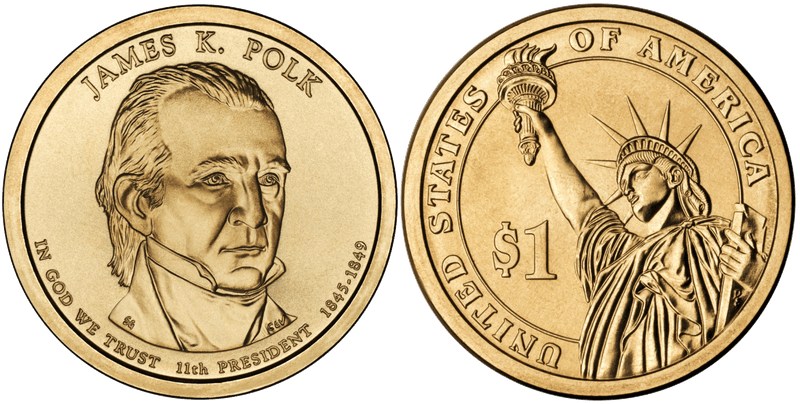
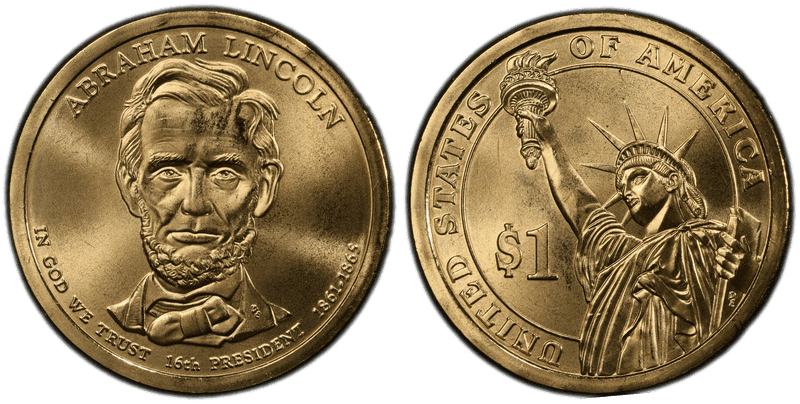
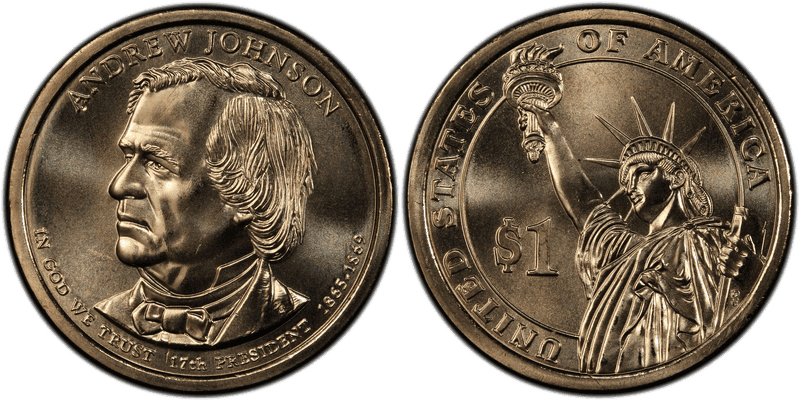
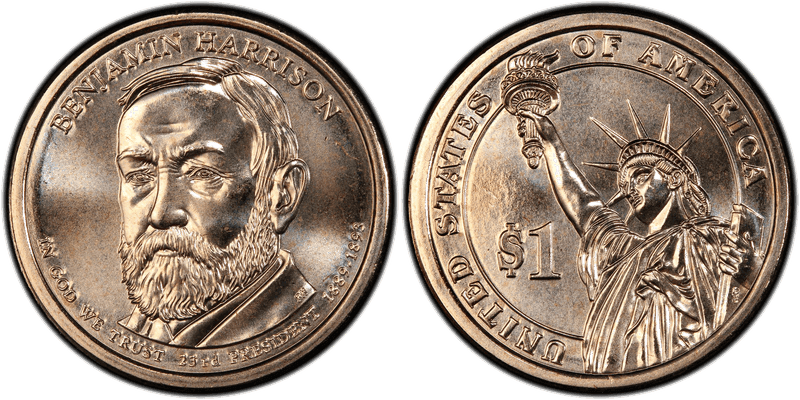
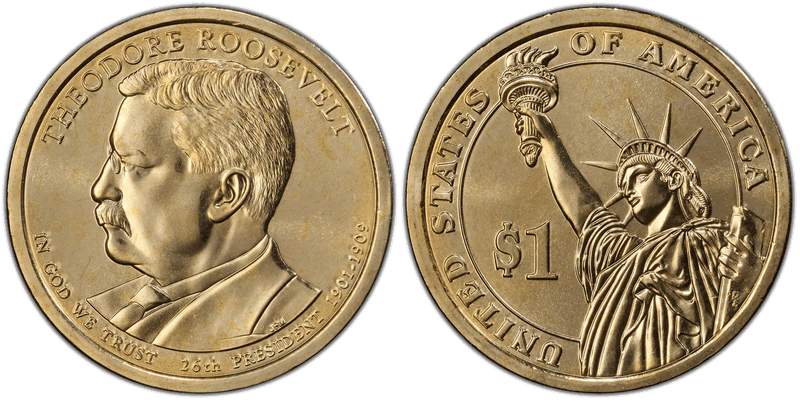
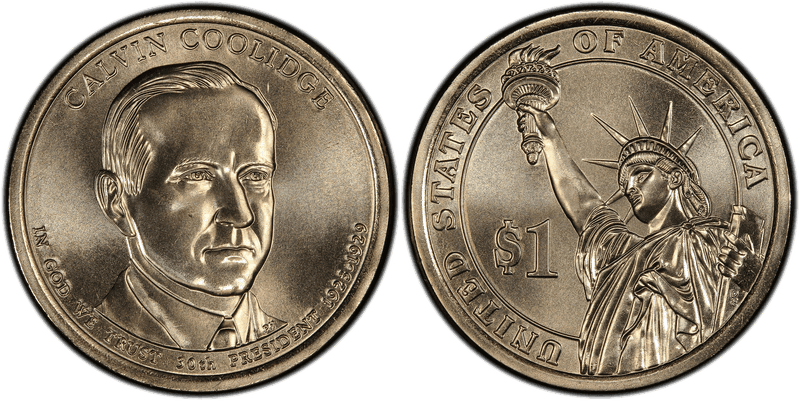
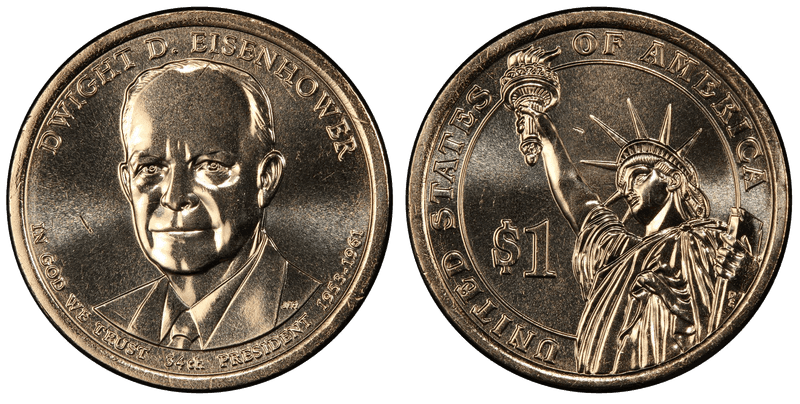
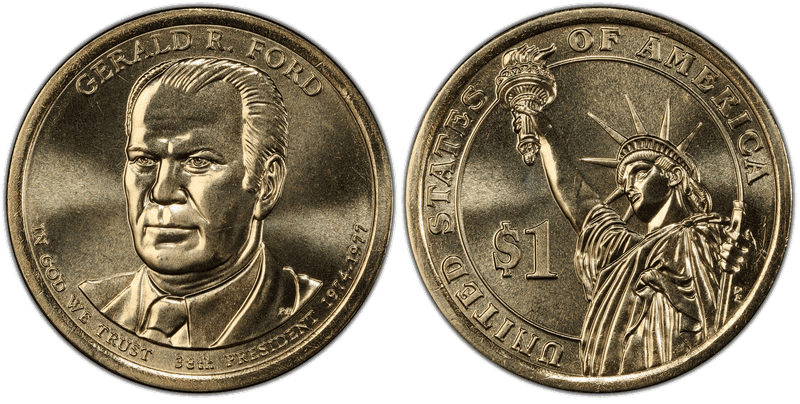
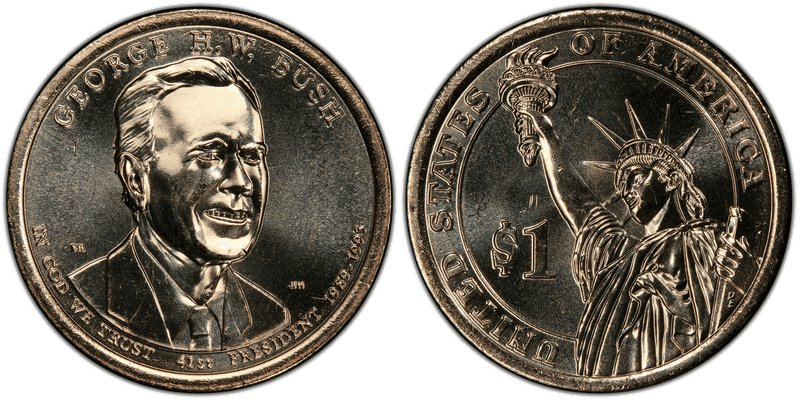
Presidential Dollars 2007 to Date

Coin Series
Presidential Dollars 2007 to Date series coin

About This Series

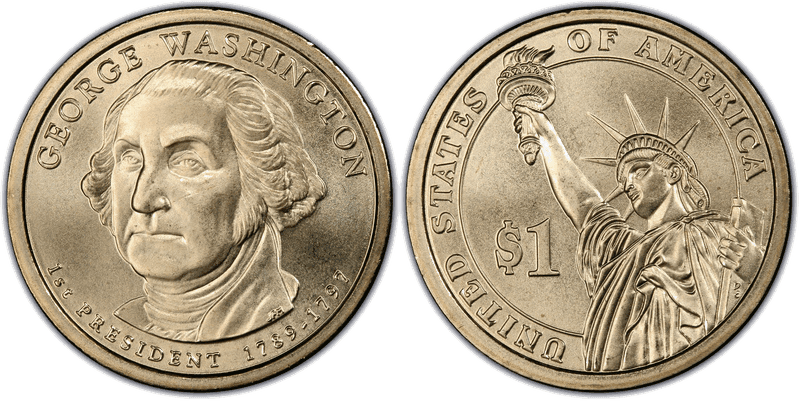
Honoring each U.S. president in chronological order, the Presidential Dollar program introduced edge lettering carrying the date, mint mark and E PLURIBUS UNUM (with IN GOD WE TRUST on 2007-2008 coins) — an innovation that proved sometimes problematic. Four designs were released annually beginning in 2007, with the obverse featuring each president's portrait and the reverse depicting the Statue of Liberty. Early releases generated intense interest when manufacturing errors produced missing, doubled, or inverted edge lettering. Washington dollars without edge lettering, the so-called "Godless" dollars, drew wide press attention after the Mint confirmed in March 2007 that some had left Philadelphia unlettered. Production for circulation ended in 2011 when existing dollar coin inventories proved sufficient; subsequent issues were made only for collectors. When the Treasury halted circulation production in December 2011, the Federal Reserve was holding nearly 1.4 billion unused dollar coins. The original schedule, which honored only presidents deceased for at least two years, ended with Ronald Reagan in 2016; a 2020 coin for George H. W. Bush required separate legislation and was sold only to collectors. The obverse portraits came from a number of Mint engravers and outside artists, some of whom designed more than one.

From NumisDex News

Series Information

Designer
Various (obverse) / Don Everhart (reverse)
Composition
88.5% Copper, 6% Zinc, 3.5% Manganese and 2% Nickel
Weight
8.1g
Diameter
26.5mm

Browse by Base(11 bases)

Showing all 11 listings

About the Program

Congress created the series with the Presidential $1 Coin Act of 2005, Public Law 109-145, signed on December 22, 2005. It was a second try at a dollar coin people would use, after the Sacagawea dollar failed to circulate, and it borrowed the idea that had made the state quarters popular: a new design every few months. Four presidents were honored each year, in the order they served, starting with George Washington on February 15, 2007 and moving to the next president about every three months.

The law set the rules for the whole run. A president had to be dead for at least two years before appearing on a coin, and no living president could appear. Each period of service got one coin, so Grover Cleveland, with two terms that did not follow each other, got two. The Sacagawea design had to keep coming too, at no less than a third of all dollars struck. The First Spouse gold coins honored each president's spouse on the same schedule.

The coins did not catch on. On December 13, 2011 the Treasury suspended minting them for circulation; according to Wikipedia, about 1.4 billion unused dollar coins were in storage by then. The Mint kept striking each new design for collectors, so from Chester Arthur in 2012 the coins were sold in rolls, bags and sets. Ronald Reagan closed the series in 2016, because every later president was still living. The law allowed the program to restart only by a new Act of Congress, and Public Law 116-112, approved January 27, 2020, did that for one coin: George H.W. Bush, released on December 4, 2020.

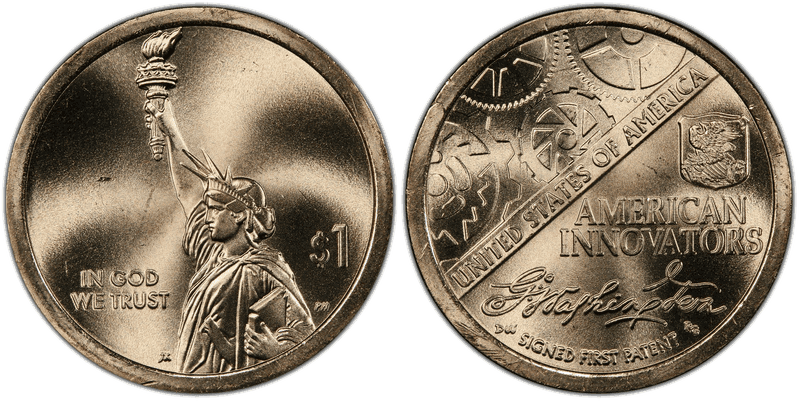
From 2018 the American Innovation dollars took over the golden dollar with a Statue of Liberty obverse of their own. The 2026 Donald Trump dollar is not part of this series; it was issued under the 2020 law behind the Semiquincentennial designs.
The Designs

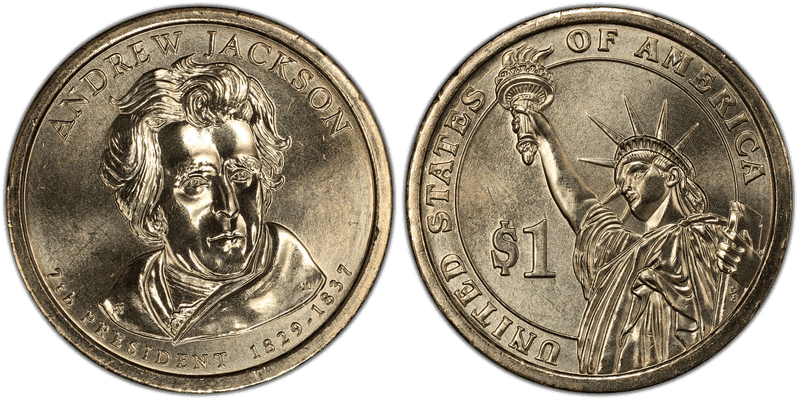
Every coin shares one reverse: the Statue of Liberty by Don Everhart, with "$1" and UNITED STATES OF AMERICA. The obverses came from Mint engravers and outside artists. Where two names are given below, the first created the design and the second sculpted it.

2007

George Washington and Thomas Jefferson by Joseph Menna; John Adams by Joel Iskowitz and Charles Vickers; James Madison by Joel Iskowitz and Don Everhart.

2008

James Monroe by Joseph Menna; John Quincy Adams by Don Everhart; Andrew Jackson by Joel Iskowitz and Jim Licaretz; Martin Van Buren by Joel Iskowitz and Phebe Hemphill.

2009

William Henry Harrison by Joseph Menna; John Tyler by Phebe Hemphill; James K. Polk by Susan Gamble and Charles Vickers; Zachary Taylor by Don Everhart.

2010

Millard Fillmore by Don Everhart; Franklin Pierce by Susan Gamble and Charles Vickers; James Buchanan by Phebe Hemphill; Abraham Lincoln by Don Everhart.

2011

Andrew Johnson, Ulysses S. Grant and Rutherford B. Hayes by Don Everhart; James Garfield by Phebe Hemphill. These were the last Presidential dollars struck for circulation.

2012

Chester Arthur and both Grover Cleveland coins, first term and second term, by Don Everhart; Benjamin Harrison by Phebe Hemphill.

2013

William McKinley by Phebe Hemphill; Theodore Roosevelt by Joseph Menna; William Howard Taft by Barbara Fox and Michael Gaudioso; Woodrow Wilson by Don Everhart.

2014

Warren Harding by Michael Gaudioso; Calvin Coolidge and Herbert Hoover by Phebe Hemphill; Franklin D. Roosevelt by Joseph Menna.

2015

Harry S. Truman and John F. Kennedy by Don Everhart; Dwight D. Eisenhower by Joseph Menna; Lyndon B. Johnson by Michael Gaudioso.

2016

Richard Nixon by Don Everhart; Gerald Ford by Phebe Hemphill; Ronald Reagan by Richard Masters and Joseph Menna. Only three coins were issued, since Jimmy Carter, next in line, was still alive.

2020

George H.W. Bush, designed by Elana Hagler of the Artistic Infusion Program and sculpted by Joseph Menna.

Mintages

Presidential Dollars 2007 to Date mintages by design and finish, taken from each coin's page in our catalog. Each figure opens that coin's page, which lists its varieties and errors. A dash means no figure was recorded. Where one issue was struck in more than one type, each type is listed.

DesignPDP SatinD SatinProofReverse Proof
2007 George Washington
2007 James Madison
2007 John Adams
2007 Thomas Jefferson
2008 Andrew Jackson
2008 James Monroe
2008 John Quincy Adams
2008 Martin Van Buren
2009 James K. Polk
2009 John Tyler
2009 William Henry Harrison
2009 Zachary Taylor
2010 Abraham Lincoln
2010 Franklin Pierce
2010 James Buchanan
2010 Millard Fillmore
2011 Andrew Johnson
2011 James Garfield
2011 Rutherford B. Hayes
2011 Ulysses S. Grant
2012 Benjamin Harrison
2012 Chester A. Arthur
2012 Grover Cleveland 22nd
2012 Grover Cleveland 24th
2013 Theodore Roosevelt
2013 William Howard Taft
2013 William McKinley
2013 Woodrow Wilson
2014 Calvin Coolidge
2014 Franklin D. Roosevelt
2014 Herbert Hoover
2014 Warren G. Harding
2015 Dwight D. Eisenhower
2015 Harry S. Truman
2015 John F. Kennedy
2015 Lyndon B. Johnson
2016 Gerald R. Ford
2016 Richard M. Nixon
2016 Ronald Reagan
2020 George H.W. Bush

How to Tell Them Apart

Obverse. The president's portrait, name, number in order of service and years in office. From 2009 IN GOD WE TRUST is on the obverse too. The years on the face are the president's term; the year the coin was made appears only on the edge.

Edge. The edge is stamped with the date, the mint mark, E PLURIBUS UNUM and 13 stars. On 2007 and 2008 coins IN GOD WE TRUST is on the edge as well; a 2007 law moved it to the face, and Wikipedia gives 2009 as the first year without it on the edge. These were the first U.S. circulating coins with edge lettering since the Saint-Gaudens double eagle.

Position A and Position B. The lettering is added after the coin is struck, so it can land either way up. PCGS calls a coin Position A when the lettering reads upside down with the portrait facing up, and Position B when it reads normally. Both are normal coins, and PCGS does not expect either to be rare.

Mint mark. Look on the edge: P for Philadelphia and D for Denver on coins struck for circulation and, from 2012, for collector rolls and bags; S for San Francisco proofs.

Satin finish. The Mint's uncirculated sets of 2007 through 2010 held P and D coins with a soft, satin surface. NGC gives 895,628 of each 2007 design, 745,464 for 2008, 784,614 for 2009 and 583,897 for 2010.

Proofs and reverse proofs. Each design from 2007 to 2016 was struck as an S proof for the Presidential dollar proof sets. Reverse proofs, which swap the usual finish so the fields are frosted and the design is mirror-like (search), were made only for special sets: 2015 Philadelphia coins of Truman, Eisenhower, Kennedy and Lyndon Johnson, a 2016-S Reagan and a 2020-S Bush.

Mintages. They fell sharply once circulation production stopped. Wikipedia gives 176,680,000 Philadelphia and 163,680,000 Denver Washington dollars in 2007, against 6,020,000 and 4,060,000 Chester Arthur dollars in 2012. For the 2020 Bush dollar Wikipedia gives 1,242,275 Philadelphia and 1,502,425 Denver coins; USA Coin Book gives 1,264,226 and 1,515,875.

Errors and Varieties

Missing edge lettering. Coins that missed the lettering step have a plain edge with no date, mint mark or motto. On March 7, 2007 the Mint said an unknown number of Washington dollars had left Philadelphia this way and that it had told the Treasury's Inspector General. PCGS president Ron Guth estimated that at least 50,000 reached circulation. Because the missing motto included IN GOD WE TRUST, the press called them "Godless" dollars. NGC records plain-edge coins for most presidents from 2007 to 2011, including some satin-finish ones. Some fakes have had the lettering filed away.

Doubled edge lettering. A coin fed through the edge machine twice gets two sets of lettering, either overlapped, running the same way, or inverted, running opposite ways. The 2007 John Adams dollar is the classic example: see our overlapped and inverted pages. Wikipedia says most come from Philadelphia, and NGC lists both kinds from both mints.

Doubled dies. The Wexler files list doubled die reverses on many presidents, almost all at one spot: where the second ray clockwise from Liberty's head meets her right arm. 2007-P Washington WDDR-001 is typical. Two of the Washington dies were found on satin-finish coins. On the obverse side, Wexler describes 2012-P Benjamin Harrison WDDO-001 as strong extra thickness around the rim.

Other oddities. Wexler's 2007-P WUFO-001 has a third crown ray long enough to touch Liberty's arm. Wikipedia also reports a 2007 blank planchet, with no portrait or statue, that received edge lettering anyway.

In Our Catalog

90 errors and varieties are listed for this series. Browse them by type:

Recently added

Composition and Silver Content

  • Metal: manganese brass outer layers of 77% copper, 12% zinc, 7% manganese and 4% nickel over a pure copper core; 88.5% copper, 6% zinc, 3.5% manganese and 2% nickel overall. There is no gold or silver.
  • Weight: 8.1 grams (NGC gives 8.07 g)
  • Diameter: 26.49 mm (NGC gives 26.5 mm)
  • Edge: lettered, with the date, mint mark and E PLURIBUS UNUM

The golden alloy came from the Sacagawea dollar. According to Wikipedia it was chosen for its color and because coin machines read it the same way as the Susan B. Anthony dollar. Satin, proof and reverse proof coins are struck in the same metal.

FAQ

What is a Godless Presidential dollar?

A 2007 George Washington dollar that skipped the edge-lettering step, so its edge is plain. On those coins the edge carried the date, mint mark, E PLURIBUS UNUM and IN GOD WE TRUST, so a coin without lettering has no motto, date or mint mark at all, and collectors nicknamed it the Godless dollar. On March 7, 2007 the Mint said an unknown number had left the Philadelphia Mint without edge lettering. PCGS president Ron Guth told the Associated Press he believed at least 50,000 reached circulation. Plain-edge coins are also known for other presidents, and some fakes have had their lettering filed off. See our Washington missing edge lettering page.

What do Position A and Position B mean on a Presidential dollar?

They describe which way the edge lettering runs. PCGS calls a coin Position A when the lettering reads upside down with the president's portrait facing up, and Position B when it reads normally. The Mint adds the lettering in a separate step after the coin is struck, so the orientation is random. PCGS treats both as normal products of minting, not errors, and does not expect either to be rare.

Why did Presidential dollars stop circulating?

The public never took to them. On December 13, 2011 the Treasury suspended minting Presidential dollars for circulation, with about 1.4 billion unused dollar coins already in storage, according to Wikipedia. The Mint kept striking each new design in circulation quality for collectors, so the coins from Chester Arthur in 2012 onward were sold in rolls, bags and sets rather than paid out by banks.

What are reverse proof Presidential dollars?

Proofs with the usual finish swapped, so the fields are frosted and the design is mirror-like (search). They were made only for special sets. The 2015 Coin and Chronicles sets held Philadelphia reverse proofs of Truman, Eisenhower, Kennedy and Lyndon Johnson; Reagan in 2016 and George H.W. Bush in 2020 were struck at San Francisco. The Presidential Dollar Guide gives mintages from 11,251 (Bush) to 49,051 (Kennedy); USA Coin Book's figures differ slightly.

Are there doubled edge lettering Presidential dollars?

Yes. When a coin goes through the edge-lettering machine twice, it gets two sets of lettering. Collectors call it overlapped when both run the same way and inverted when one runs upside down to the other. The 2007 John Adams dollar is the best-known example; NGC lists overlapped and inverted coins from both Philadelphia and Denver. See our Adams overlapped and Adams inverted pages.

Will there be Presidential dollars for Jimmy Carter or Donald Trump?

Not under the original program. The 2005 law ended the series once every eligible president had been honored and said it could restart only by an Act of Congress, which is how the 2020 George H.W. Bush dollar came about. A bill to resume the program for Carter was introduced in the Senate in February 2025 (Wikipedia). The 2026 Trump dollar is a different coin, issued under the 2020 law behind the Semiquincentennial designs rather than the Presidential $1 program.

↑ Back to the coins: every year, mint, variety and error

Explore Other Denominations

Collector Essentials

Tools and references for building and protecting your coin collection.

As an Amazon Associate, NumisDex earns from qualifying purchases.