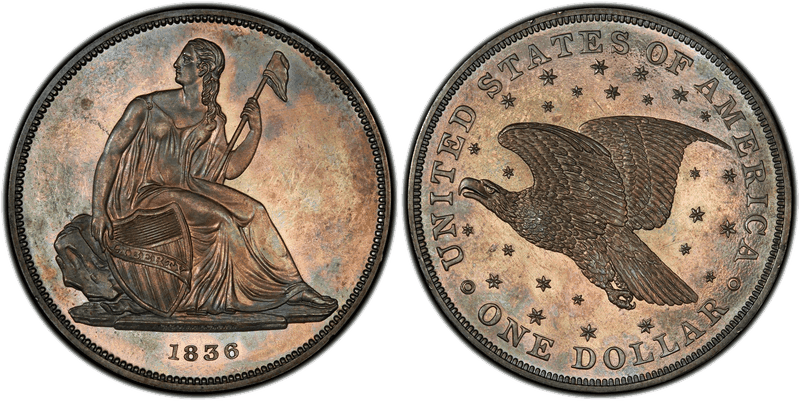
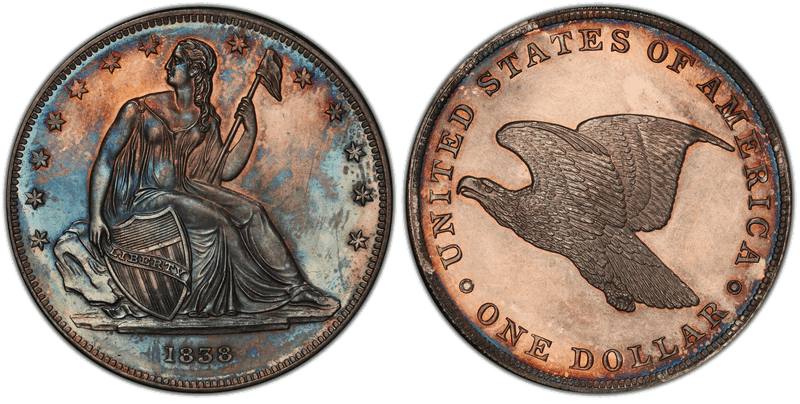
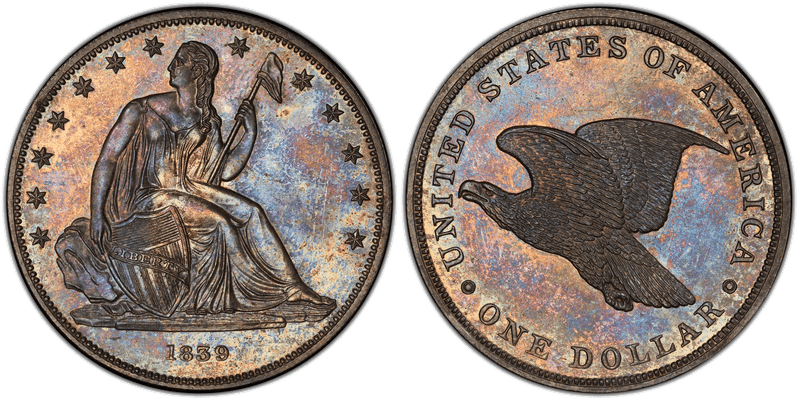
The United States had not struck a silver dollar for circulation in more than thirty years. Most early dollars had gone to Asia as bullion, and the last ones, dated 1803, were struck in 1804 before Secretary of State James Madison stopped the denomination in 1806. President Andrew Jackson lifted that order in 1831, and when Robert M. Patterson became Director of the Mint in 1835 he set out to restart the dollar with a new design.
Patterson asked two Philadelphia artists for ideas. Thomas Sully drew Liberty seated on a rock, holding a pole topped by a liberty cap, and Titian Peale drew an eagle in flight. Christian Gobrecht, hired as engraver after Chief Engraver William Kneass suffered a stroke, turned both into dies. Patterson had wanted the eagle rising among 24 stars, one per state; by the time the coin was struck there were 26, with the 13 larger ones standing for the original states.
The Mint struck its first dollars for circulation in December 1836, with Gobrecht's signature, C. GOBRECHT F., in small letters on the base of the rock. The traditional account, in Wikipedia after Adams and Woodin, is that the signature first stood in the open field below Liberty and was moved after complaints. John Dannreuther's die study of 2015 found that the die with the name in the field was made later, for collectors, so the order may have been the reverse. Q. David Bowers records 1,000 of these delivered on December 31, 1836, at the old weight of 416 grains, 600 of which went to the Bank of the United States and out into circulation. A law of January 18, 1837 set a new standard of 412.5 grains at 90% silver, and Bowers lists a further 600 struck from the same dies on March 31, 1837.
For 1838 the design moved the stars to the obverse, 13 around Liberty, left the reverse field bare and dropped Gobrecht's name. Bowers counts every 1838 dollar as a pattern or a later restrike. On December 31, 1839 the Mint delivered 300 dollars dated 1839, and most went into circulation. Full production returned in 1840 with the Seated Liberty dollar, which kept Liberty but replaced the flying eagle with a heraldic one. Longacre later reused the flying eagle on the Flying Eagle cent.
The dies survived, and collectors wanted the coins. Mint Director James Ross Snowden had Gobrecht dollars restruck around 1859 and 1860, trading some for Washington medals for the Mint's collection, and Mint workers struck more for their own profit. Bowers dates other restrikes to 1867-1869. Restrikes were made in silver and copper, some with the wrong reverse or edge, and Judd gives each combination its own number.
R.W. Julian has since argued that the March 1837 coins were never issued, and that the 1839 coins may have been melted too. Others point to the 300 recorded in the Mint's 1840 report. The question is open.