Classic Gold Commemoratives (1903-1926)

Coin Series
Classic Gold Commemoratives (1903-1926) series coin

About This Series

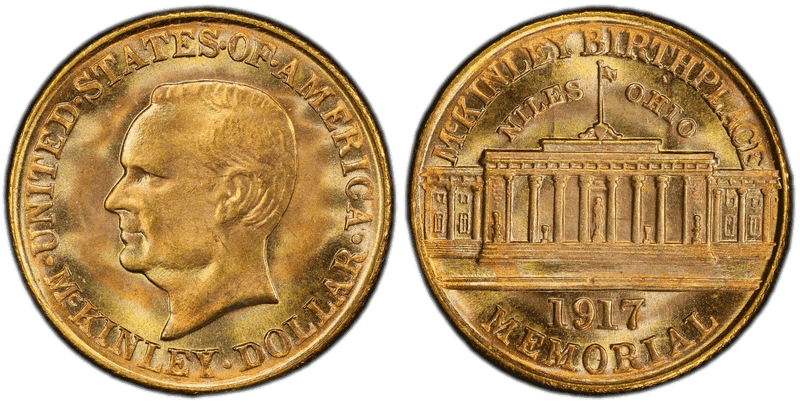
Spanning the early 20th century, classic gold commemoratives were produced in $1, $2.50, and $50 denominations for expositions and historical anniversaries. The series opened with the 1903 Louisiana Purchase gold dollars in Jefferson and McKinley varieties — the first gold commemoratives in American history. Later issues included the 1904-1905 Lewis and Clark dollars, the 1915 Panama-Pacific gold dollar, quarter eagle and round and octagonal $50 pieces (83.59 grams in .900 fine gold), the 1916-1917 McKinley and 1922 Grant dollars, and the 1926 Sesquicentennial quarter eagle. One-dollar commemoratives measured 15 mm at 1.672 grams, while quarter eagles were 18 mm at 4.18 grams, all in .900 fine gold. Many coins were returned unsold and melted, so the figures given are net distributions.

From NumisDex News

Series Information

Production Years
1903-1926
Composition
90% Gold, 10% Copper

Browse by Base(9 bases)

Showing all 9 listings

About the Program

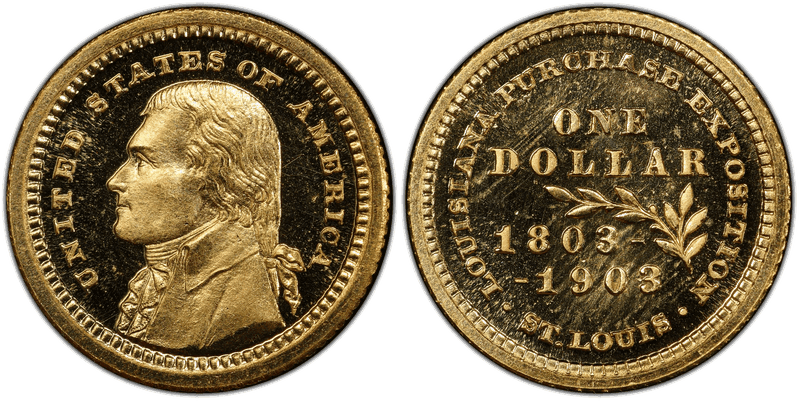
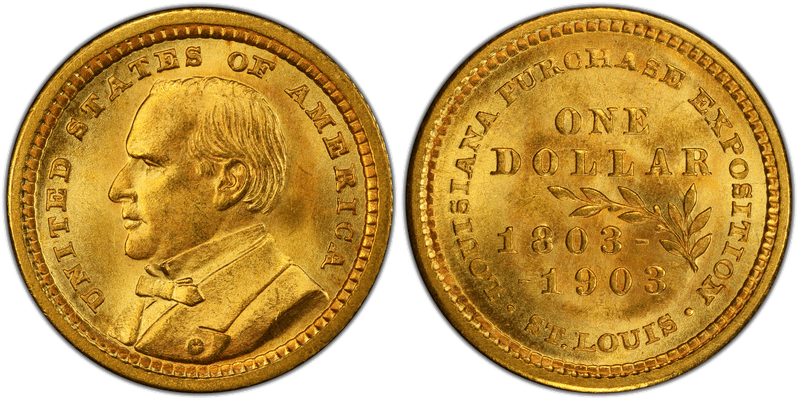
The United States struck its first gold commemoratives for a world's fair. Congress tied a $5,000,000 grant for the Louisiana Purchase Exposition, held at St. Louis in 1904, to an issue of 250,000 gold dollars, signed on June 28, 1902. The law did not say what the coins should show, and the promoter Farran Zerbe pressed the Mint to make two designs so that buyers would want both. The coins came out dated 1903, one with Thomas Jefferson, who made the Purchase, and one with the late President McKinley.

Every issue that followed worked the same way. Congress named a sponsor, the sponsor paid the Mint face value for its coins and resold them at a higher price to raise money: for the Portland Lewis and Clark fair in 1904 and 1905, the San Francisco Panama-Pacific Exposition in 1915, a memorial at McKinley's Ohio birthplace in 1916 and 1917, the Grant centennial in 1922 and the Philadelphia Sesquicentennial Exposition in 1926. Zerbe handled sales of the Louisiana Purchase, Lewis and Clark and Panama-Pacific coins.

Sales fell short for nearly every issue. Unsold coins went back to the Mint for melting: about 215,000 of the 250,258 Louisiana Purchase dollars, 40,003 of the Lewis and Clark dollars, 10,023 McKinley dollars and 154,207 Sesquicentennial quarter eagles. The Grant dollars, limited by the Senate to 10,000, were the only issue to sell out.

The 1926 quarter eagle was the last of the series. Gold left circulation in 1933, and no gold commemorative was struck again until the 1984 Olympic eagle, covered on the modern ten-dollar gold page. The silver coins of the same years are on the classic silver commemoratives page.
The Designs

Each design page lists the coins struck for that issue.

  • Louisiana Purchase Exposition, 1903 (Jefferson, McKinley): two gold dollars by Chief Engraver Charles E. Barber sharing one reverse: the value and a commemorative legend, with the anniversary dates under an olive branch. Barber took Jefferson's head from John Reich's Indian Peace Medal and McKinley's from his own medal of the president.
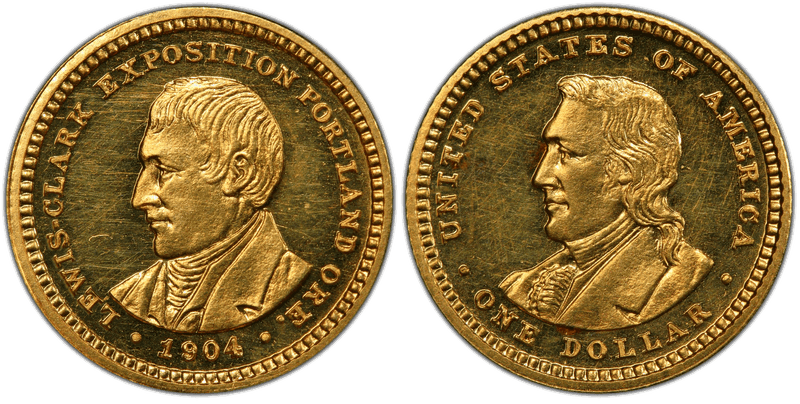
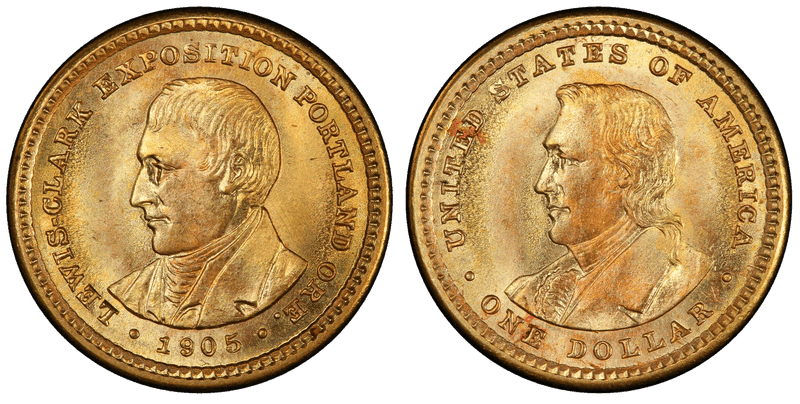
  • Lewis and Clark Exposition, 1904 and 1905 (1904, 1905): Barber put Meriwether Lewis on one side and William Clark on the other, so the coin has a portrait on each face. It was the first gold commemorative dated in more than one year.
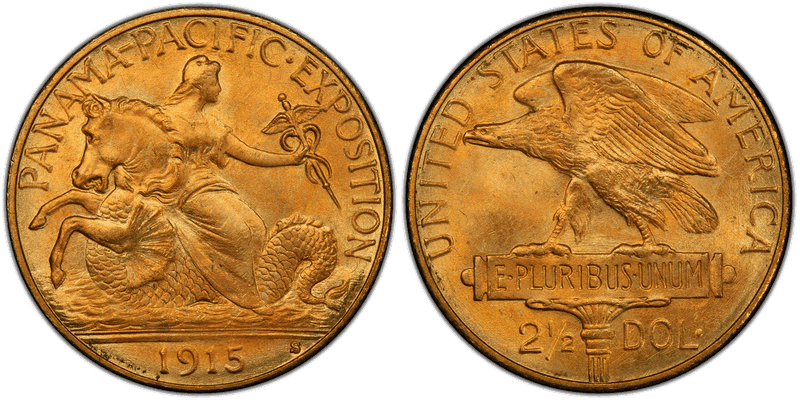
  • Panama-Pacific International Exposition, 1915 (all four gold coins): the law called for a half dollar, a gold dollar, a quarter eagle and two $50 pieces, all struck at San Francisco. Charles Keck's gold dollar shows the capped head of a canal worker, with two dolphins on the reverse for the two oceans. Barber's quarter eagle shows Columbia riding a sea horse with a caduceus, and an eagle on a standard on the reverse. Robert Aitken's $50 shows Minerva in a crested helmet and, on the reverse, an owl on a pine branch; the octagonal coin adds a border of dolphins.
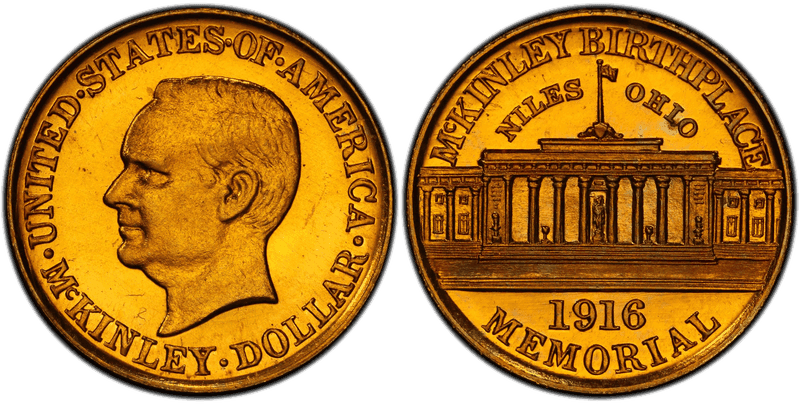
  • McKinley Memorial, 1916 and 1917 (1916, 1917): Barber's bare-necked bust of McKinley and George T. Morgan's view of the birthplace memorial at Niles, Ohio. With these coins McKinley became the first person shown on two different U.S. coin issues.
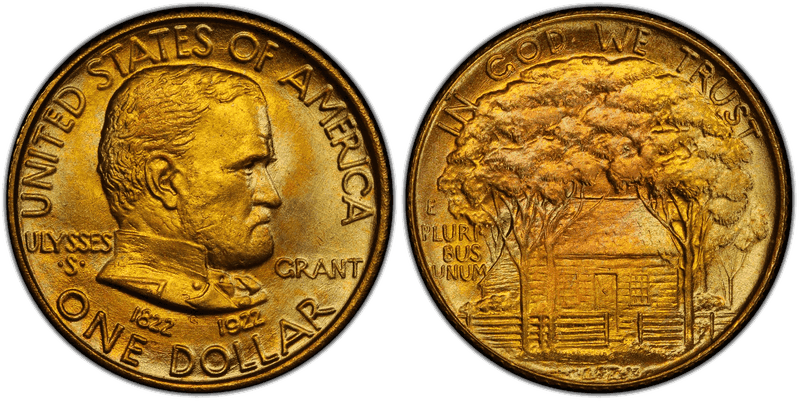
  • Grant Memorial, 1922 (1922): Laura Gardin Fraser's portrait of Grant and the house at Point Pleasant, Ohio where he was born, the same design as the Grant half dollar. Half the coins carry a star.
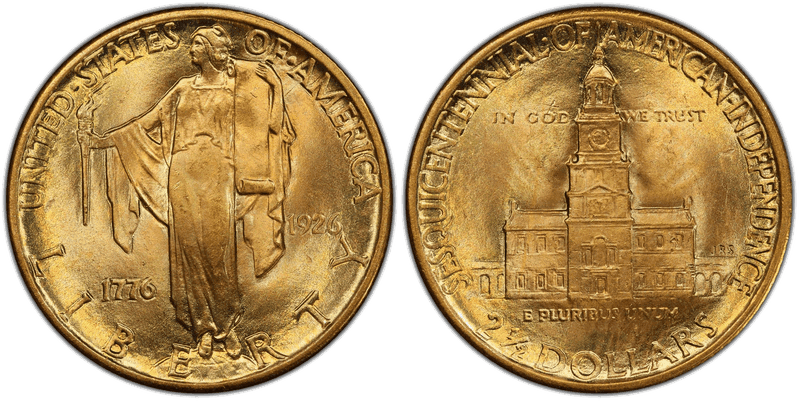
  • Sesquicentennial of American Independence, 1926 (1926): John R. Sinnock's quarter eagle, with Liberty standing on part of a globe holding a torch and a scroll for the Declaration of Independence, and Independence Hall in front of a rising sun.

Mintages

Classic Gold Commemoratives (1903-1926) mintages by design and finish, taken from each coin's page in our catalog. Each figure opens that coin's page, which lists its varieties and errors. A dash means no figure was recorded. Where one issue was struck in more than one type, each type is listed.

How to Tell Them Apart

Denomination and size. The gold dollars are 15 mm across, the quarter eagles 18 mm, and the $50 pieces far larger: Wikipedia gives 43 mm for the round coin and 44.9 mm across the octagonal one, and NGC 44 mm and 44.7 mm point to point.

Mint marks. Only the Panama-Pacific coins were struck away from Philadelphia, and each carries an S. Dies were first sent to San Francisco without the letter, on the reasoning that the whole issue was struck there; the new Mint director had them remade with it. On the gold dollar the S sits under the D and O of DOLLAR, on the quarter eagle right of the date, and on the $50 above the O of FRANCISCO. Every other issue is from Philadelphia and has no mint mark.

Dates. The Louisiana Purchase dollars are dated 1903, though the first 75,080 were struck in December 1902. The Lewis and Clark and McKinley dollars come in two dates each.

Errors and Varieties

  • Jefferson and McKinley, 1903: two designs of one issue. About 35,000 were sold in all; the Mint kept no record of how the melted coins divided between the two, so the usual figure of 17,500 each is half the total, not a count.
  • Grant with star and no star, 1922: 5,016 and 5,000 struck, all sold. The star was added at the commission's request to sell more coins and has no meaning in the design.
  • Round and octagonal $50, 1915: one design in two shapes. More of the octagonal coins sold, so more of the round ones were melted.
  • Proofs: the first hundred of each Jefferson and McKinley dollar were struck as proofs and presented mounted on certificates. NGC lists proofs of the 1904 Lewis and Clark and 1916 McKinley dollars, and also of the 1917 McKinley dollar and the 1926 quarter eagle, without figures.

In Our Catalog

No errors or varieties are listed for Classic Gold Commemoratives (1903-1926) yet. Submit one

Composition and Gold Content

  • Composition: 90% gold, 10% copper (all issues)
  • Gold dollar: 1.672 grams, 15 mm, 0.0484 troy ounce of gold
  • Quarter eagle: 4.18 grams, 18 mm, 0.1209 troy ounce of gold
  • Panama-Pacific $50: 83.59 grams, about 2.42 troy ounces of gold (NGC)
  • Edge: reeded

FAQ

What were the first U.S. commemorative gold coins?

The two 1903 Louisiana Purchase Exposition gold dollars, one with Thomas Jefferson and one with William McKinley. Congress authorized them on June 28, 1902, and the Philadelphia Mint struck them in December 1902 and January 1903, all dated 1903. Earlier commemoratives, starting with the 1892 Columbian half dollar, were silver. See the Jefferson and McKinley pages.

How many Panama-Pacific $50 gold coins were made?

The San Francisco Mint struck 1,500 of each shape in 1915, plus a few for the Assay Commission. Sales were poor and the unsold coins were melted, leaving 645 octagonal and 483 round pieces in the hands of the public, the figures Wikipedia's table gives and NGC repeats; sources differ slightly on the exact counts. See the 1915 Panama-Pacific page.

How much gold is in a commemorative gold dollar?

Every classic commemorative gold coin is 90% gold and 10% copper. A gold dollar weighs 1.672 grams and holds 0.0484 troy ounce of gold. The quarter eagles weigh 4.18 grams and hold 0.1209 ounce, and each Panama-Pacific $50 weighs 83.59 grams and holds about 2.42 ounces, as NGC gives them.

What is the difference between the 1922 Grant gold dollar with and without the star?

Only a small incuse star above the word GRANT. The Grant Commission asked the Mint to put the star on half of the 10,000 gold dollars Congress allowed, so collectors would need two coins. The Mint struck 5,016 with the star and 5,000 without, and the commission sold all of them. See the with star and no star pages.

Why were there no gold commemoratives between 1926 and 1984?

After the 1926 Sesquicentennial quarter eagle, the Mint made no gold commemorative until the 1984 Los Angeles Olympic eagle. In between, gold left circulation in 1933, when Executive Order 6102 made gold circulation illegal, and the silver commemorative program ended in 1954 after President Eisenhower vetoed the issues proposed that year. The modern ten-dollar gold page covers the coins that came after.

Were proofs made of the classic gold commemoratives?

A few. The first 100 coins of each 1903 Louisiana Purchase design were struck as proofs and given to officials and insiders, mounted on cards with certificates. NGC also lists proofs of the 1904 Lewis and Clark dollar, the 1916 and 1917 McKinley dollars and the 1926 Sesquicentennial quarter eagle, but no mintage is recorded for them. For the Grant dollars, the Mint turned down a request for proofs.

↑ Back to the coins: every year, mint, variety and error

Explore Other Denominations

Collector Essentials

Tools and references for building and protecting your coin collection.

As an Amazon Associate, NumisDex earns from qualifying purchases.