Draped Bust Dollars 1795-1804

Coin Series
Draped Bust Dollars 1795-1804 series coin

About This Series

Spanning the formative decade of the United States Mint, the Draped Bust dollar encompasses two reverse types: the Small Eagle (1795-1798) and the Heraldic Eagle (1798-1804) projecting national authority through Great Seal imagery. Struck in .8924 fine silver at 26.96 grams and 39-40 mm, the obverse Liberty portrait was reportedly inspired by Philadelphia socialite Ann Willing Bingham. Production occurred exclusively at Philadelphia, with annual mintages from 7,776 (1797) to 423,515 (1799). No 1804-dated dollar was struck in 1804. The eight Class I originals were made around 1834 for diplomatic presentation sets, two of which reached the Sultan of Muscat and the King of Siam, while the Class II and Class III pieces are later unauthorized Mint restrikes. A previously unrecorded example from the James A. Stack Sr. collection, sold in December 2025, raised the known total to 16. Silver dollar production was suspended from 1804 to 1836 because coins were being exported for bullion value.

From NumisDex News

Series Information

Production Years
1795-1804
Composition
89.2% Silver, 10.8% Copper

Browse by Base(10 bases)

Showing all 10 listings

History

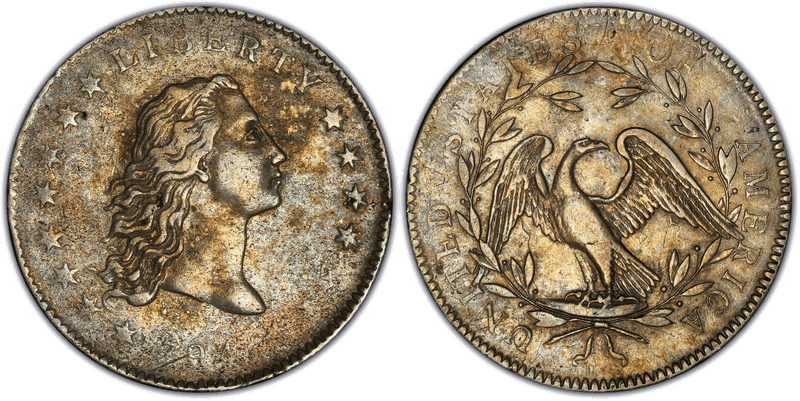
The Draped Bust design replaced the Flowing Hair on the silver dollar in the autumn of 1795. Its designer is unknown. In the 1850s Mint Director James Ross Snowden heard from Gilbert Stuart's descendants that the painter had drawn it, and Ann Willing Bingham has been suggested as the model, but NGC notes that no document from 1795 links Stuart to the coin. What is recorded is that John Eckstein was paid for plaster models in September 1795, from which the Mint's engravers, Robert Scot among them, cut the hubs. The new director, Elias Boudinot, also restored the legal .8924 alloy on October 28, 1795, ending the Mint's use of an unauthorized .900 standard.

The Mint reported 203,033 dollars for 1795 without separating the two designs; the usual figure for the Draped Bust coins is 42,738, while Q. David Bowers estimated 110,000. Silver deposits then fell. Output dropped to 79,920 in 1796 and 7,776 in 1797, when Thomas Jefferson himself deposited Spanish dollars and the Mint closed from August to November for yellow fever. NGC cautions that these calendar-year figures do not match the dates on the coins: dies were used until they failed, and many dollars of 1796 and 1797 likely carried earlier dates.

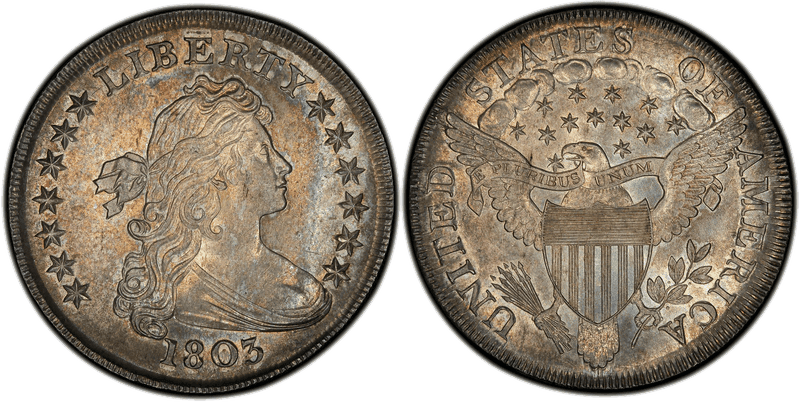
Early in 1798 the small eagle on the reverse gave way to a heraldic eagle modeled on the Great Seal. An agreement with the Bank of the United States brought in foreign silver, and the Mint reported 327,536 dollars for 1798 and 423,515 for 1799, many of them shipped abroad, to China among other places, for their bullion. By 1801 the silver in a dollar was worth about $1.03 at market, and Boudinot steered depositors toward smaller coins. Output fell to 54,454 in 1801 and 41,650 in 1802. The last regular dollars, dated 1803, were struck in March 1804, and Secretary of State James Madison formally suspended dollar coinage in 1806.

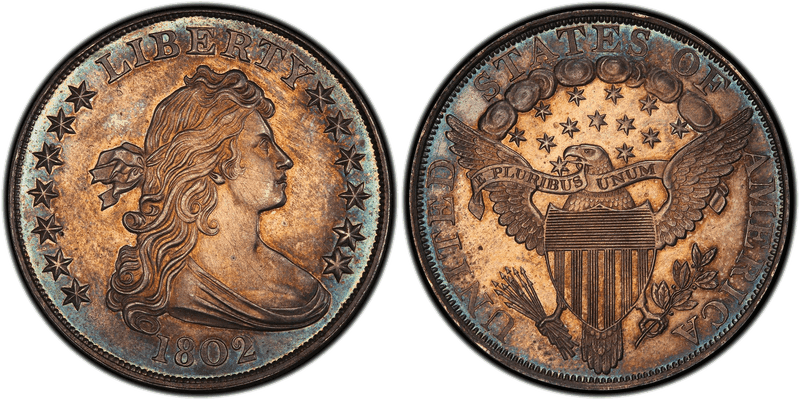
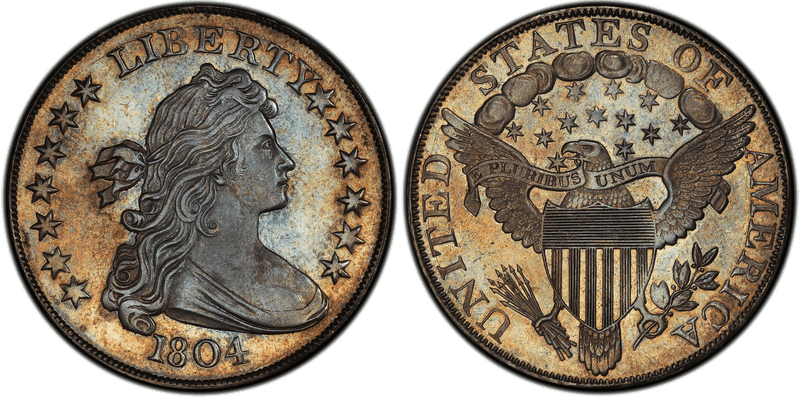
The 1804 dollar belongs to a later era. In 1834 the State Department ordered sets of every coin in use as gifts for rulers in Asia on Edmund Roberts' trade mission. Mint officials believed the last dollars had been dated 1804 and struck the new ones with that date, in November 1834. Roberts presented sets to the Sultan of Muscat in 1835 and, the next year, to King Rama III of Siam. Collectors learned of the coin in 1842, and in 1858 Mint employees struck more 1804 dollars from a different reverse die for sale to collectors. In the 1870s the Mint also struck proof dollars dated 1801, 1802 and 1803, novodels with no original proofs behind them.
How to Identify It

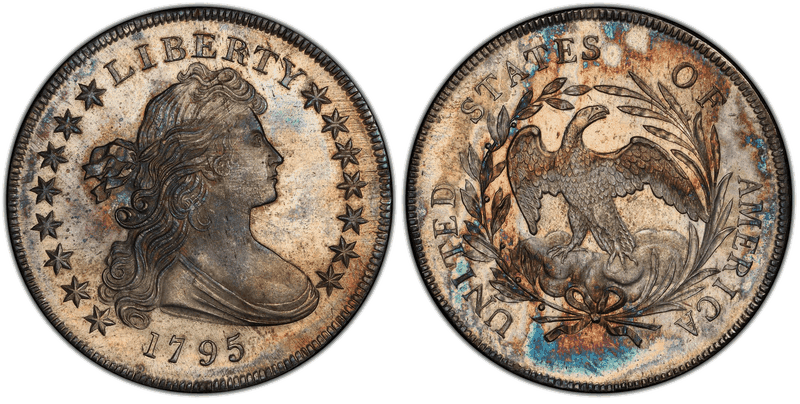
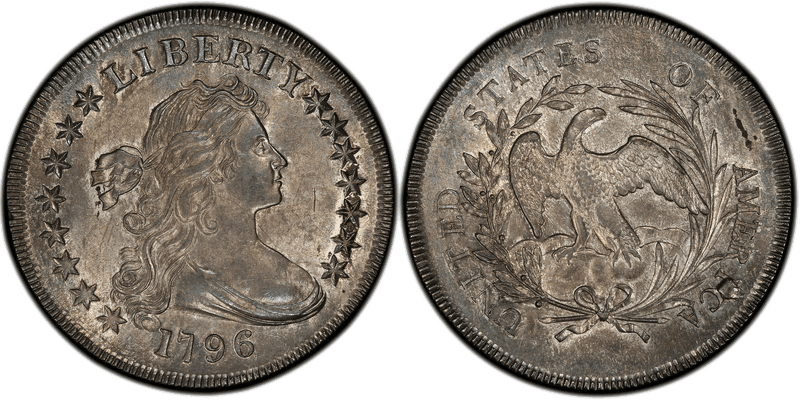
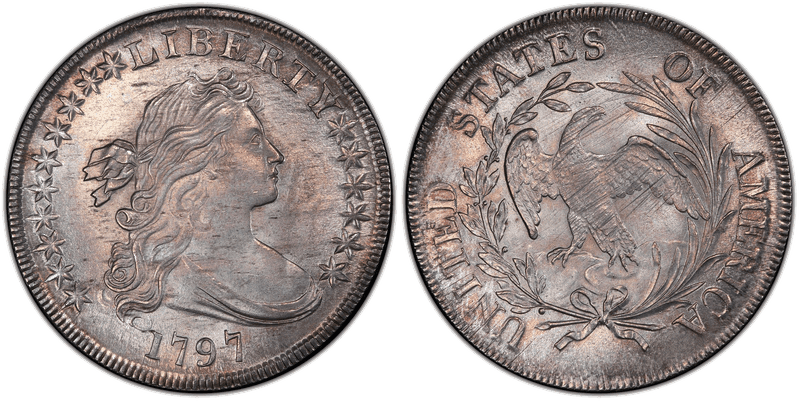
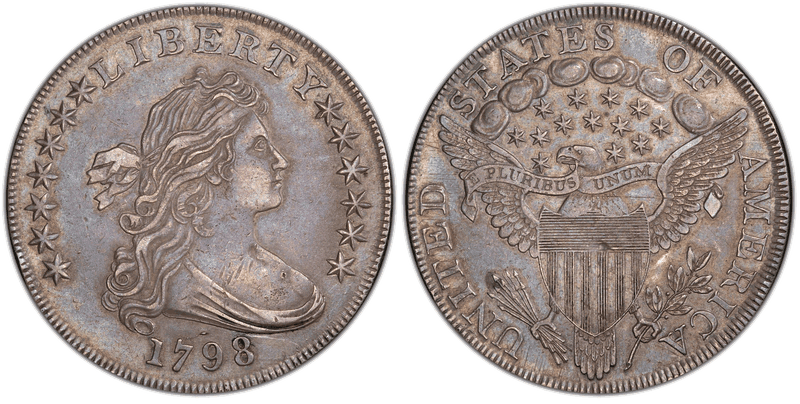
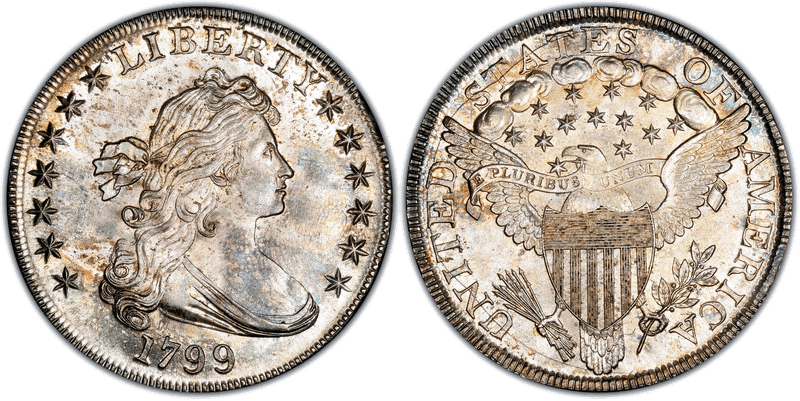
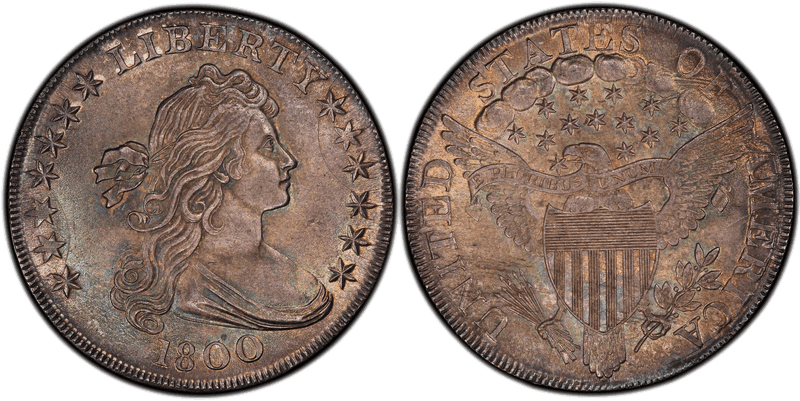
Obverse. Liberty faces right with her hair loose behind and tied with a ribbon, a drape across her bust. LIBERTY is above and the date below. The star count changes: fifteen on the 1795 and 1796 dies, sixteen in 1797, fifteen or thirteen on the Small Eagle dollars of 1798, and thirteen, seven left and six right, on the Heraldic Eagle dollars, except one 1799 obverse with eight left and five right.

Reverse, 1795-1798 (Small Eagle). A small eagle standing on a cloud inside an open wreath, with UNITED STATES OF AMERICA around it.

Reverse, 1798-1804 (Heraldic Eagle). A heraldic eagle, shield on breast, grips arrows and an olive branch, with the motto E PLURIBUS UNUM on a scroll in its beak and stars and clouds above it. No denomination appears on either face.

Edge. Lettered HUNDRED CENTS ONE DOLLAR OR UNIT, except the Class II 1804 dollar, which has a plain edge.

Mint mark. None. Every coin was struck at Philadelphia.

Die marriages. Each pairing of dies has a Bowers-Borckardt number (BB-51 and up for the Draped Bust dollars) and an older Bolender number.

Key Dates and Varieties

  • 1795 Off-Center and Centered bust: two die marriages. On BB-51 the portrait sits to the left; on BB-52 it is centered, as on later dates. The BB-51 reverse was used again in 1796, 1797 and 1798.
  • 1796: Small Date, Small Letters, Small Date, Large Letters and Large Date, Small Letters, from four 15-star obverses in six marriages.
  • 1797: 16 stars arranged ten left and six right, or nine and seven with Large Letters or Small Letters on the reverse. The Mint reported 7,776 dollars for the year.
  • 1798 Small Eagle: a 15-star and a 13-star obverse; Bowers estimated about 35,000 Small Eagle dollars dated 1798.
  • 1798 Heraldic Eagle: the Large Eagle dollars come in 31 marriages, divided by the shape of the 9 into Knob 9 and Pointed 9 groups, with shield and arrow varieties such as Knob 9, 4 Lines, Pointed 9, 5 Vertical Lines, 10 Arrows and the Wide Date.
  • 1799/8: one overdated obverse used with three reverses, BB-141 to BB-143, including one reverse cut with 15 stars instead of 13, the extra stars partly hidden by enlarged clouds. The 13-star reverse is the other overdate style; the 8x5 Stars obverse is the only one with eight stars on the left.
  • 1800 AMERICAI: a small die break after AMERICA that looks like a letter I, on one reverse paired with two obverses. Other 1800 varieties include the Dotted Date and Wide Date, Low 8.
  • 1802/1: five overdate marriages, each with its own obverse.
  • 1803 Small 3 and Large 3: NGC suggests Plain 3 and Serif 3 would describe them better, since the sizes are close.
  • Proof novodels dated 1801, 1802 and 1803: struck in the 1870s from a new obverse die. No record of their numbers was kept.
  • 1804 dollars: the Class I originals of 1834-1835, the unique plain-edge Class II and the Class III restrikes with edges lettered after striking. The King of Siam set surfaced in 1962, and a seventh Class III, from the James A. Stack Sr. collection, was found in 2025.

In Our Catalog

1 error or variety is listed for this series. Browse them by type:

Recently added

    Mintages

    Draped Bust Dollars 1795-1804 mintages by year and mint, taken from each coin's page in our catalog. Each figure opens that coin's page, which lists its varieties and errors. A dash means no figure was recorded. Where one issue was struck in more than one type, each type is listed.

    YearPProof
    1795
    1796
    1797
    1798
    1799
    1800
    1801
    1802
    1803
    1804

    Composition and Silver Content

    • Weight: 26.96 grams (416 grains)
    • Composition: .8924 silver (about 89 percent), the rest copper, from October 28, 1795; NGC lists .892
    • Silver content: 0.7731 troy ounce
    • Diameter: about 39-40 mm
    • Edge: lettered HUNDRED CENTS ONE DOLLAR OR UNIT (plain on the Class II 1804)
    • Designer: Robert Scot, from a design traditionally credited to Gilbert Stuart

    FAQ

    Were any 1804 dollars struck in 1804?

    No. The dollars the Mint delivered in 1804 came from dies dated 1803. The first 1804-dated dollars were struck in November 1834 for presentation sets of United States coins carried on Edmund Roberts' diplomatic mission to Asia; officials chose the date 1804 believing it was the last year dollars had been coined.

    What are Class I, Class II and Class III 1804 dollars?

    Class I are the coins of 1834-1835 made for the diplomatic sets, with a lettered edge and their own reverse die. Class II and Class III were struck about 1858 for collectors with a different reverse die. The single Class II has a plain edge and was overstruck on a Swiss shooting thaler dated 1857; the Class III coins had their edges lettered after striking. Sixteen are known in all, eight Class I, one Class II and seven Class III.

    What is the King of Siam set?

    One of the presentation sets from Edmund Roberts' mission, given to King Rama III of Siam on April 6, 1836. It contains an 1804 dollar and an 1804 eagle with coins dated 1834 from half cent to half eagle. It came to light in 1962, the first proof that 1804 dollars were part of the diplomatic sets.

    Are the proof dollars dated 1801, 1802 and 1803 original?

    No. NGC calls them novodels, coins of a date for which no proof originals exist. They were struck at the Philadelphia Mint in the 1870s from a new obverse die, the 1802 and 1803 pieces on planchets made for trade dollars, and sold to collectors.

    What is the difference between the Small Eagle and Heraldic Eagle dollars?

    The reverse. Dollars of 1795 to early 1798 show a small eagle standing on a cloud inside an open wreath. From 1798 the reverse shows a heraldic eagle modeled on the Great Seal, shield on breast, arrows and an olive branch in its claws, and stars and clouds above.

    How much silver is in a Draped Bust dollar?

    The coin weighs 26.96 grams at .8924 fine, holding 0.7731 troy ounce of silver, according to NGC. The Mint returned to this legal standard on October 28, 1795; the earlier Flowing Hair dollars had been struck at .900.

    ↑ Back to the coins: every year, mint, variety and error

    Explore Other Denominations

    Collector Essentials

    Tools and references for building and protecting your coin collection.

    As an Amazon Associate, NumisDex earns from qualifying purchases.