American Innovation Dollars 2018 to Date

Coin Series
American Innovation Dollars 2018 to Date series coin

About This Series

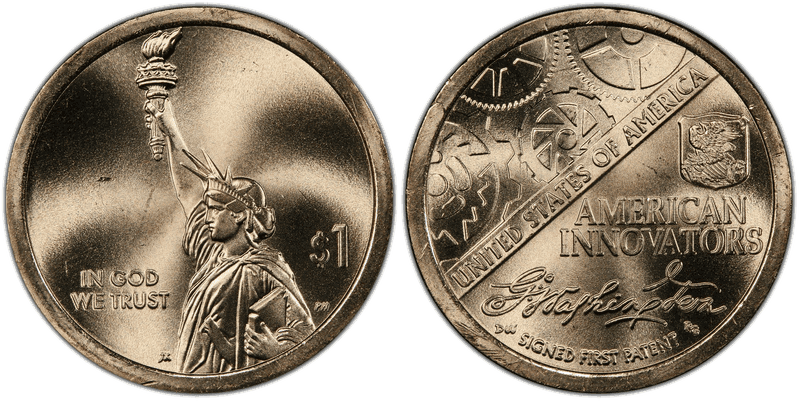
Celebrating the spirit of ingenuity that has defined the American experience, the American Innovation Dollar program honors innovations and innovators from each state, the District of Columbia, and U.S. territories. Authorized by the American Innovation $1 Coin Act of 2018, four designs are released annually highlighting transformative achievements. The states come in the order they ratified the Constitution or joined the Union, followed by the District of Columbia and the five territories. The common obverse features Justin Kunz's dramatic Statue of Liberty portrait maintaining visual continuity throughout. The introductory 2018 coin, whose reverse reproduces George Washington's signature from the first U.S. patent of 1790 with stylized gears, launched the series before state-specific designs began in 2019. Like the Presidential Dollar program, Innovation Dollars are produced primarily for collectors rather than circulation, as existing dollar coin inventory made further production unnecessary. Struck in manganese brass clad over copper with golden color and distinctive edge lettering containing date, mintmark, and E PLURIBUS UNUM, the program provides a rolling celebration of American achievement across science, technology, agriculture, and the arts.

From NumisDex News

Series Information

Designer
Justin Kunz (obverse) / various (reverse)
Composition
88.5% Copper, 6% Zinc, 3.5% Manganese and 2% Nickel
Weight
8.1g
Diameter
26.49mm

Browse by Base(9 bases)

Showing all 9 listings

About the Program

The American Innovation $1 Coin Act, Public Law 115-197, was approved on July 20, 2018. It called for a golden dollar honoring an innovation, an innovator or a group of innovators from every state, the District of Columbia and the five territories, four designs a year over 14 years starting in 2019. The states come in the order they ratified the Constitution or joined the Union, followed by the District of Columbia, Puerto Rico, Guam, American Samoa, the U.S. Virgin Islands and the Northern Mariana Islands, so the last coins are due in 2032.

The Treasury Secretary picks each state's subject after consulting its governor, and the Commission of Fine Arts and the Citizens Coinage Advisory Committee review the designs. The law also allowed an introductory coin in 2018, released on December 14, 2018, with George Washington's signature from the first U.S. patent.

None of these coins were made for circulation. Dollar coins have not been paid out since 2011, and the Mint sells American Innovation dollars only as collector products: rolls and bags of Philadelphia and Denver coins, and San Francisco proofs and reverse proofs in sets. The Native American dollar continues alongside, as the law requires. The program followed the Presidential dollars, and like them it uses the Statue of Liberty and an edge-lettered golden coin.

The Designs

Every coin shares an obverse: the Statue of Liberty in profile with IN GOD WE TRUST and "$1", designed by Justin Kunz of the Artistic Infusion Program and sculpted by Phebe Hemphill. Each reverse names its state or territory. Where two names are given below, the first created the reverse and the second sculpted it.

2018

The introductory coin: Washington's signature on the first patent, granted in 1790 for a way of making potash (search), with stylized gears and an eagle on a shield, by Donna Weaver and Renata Gordon.

2019

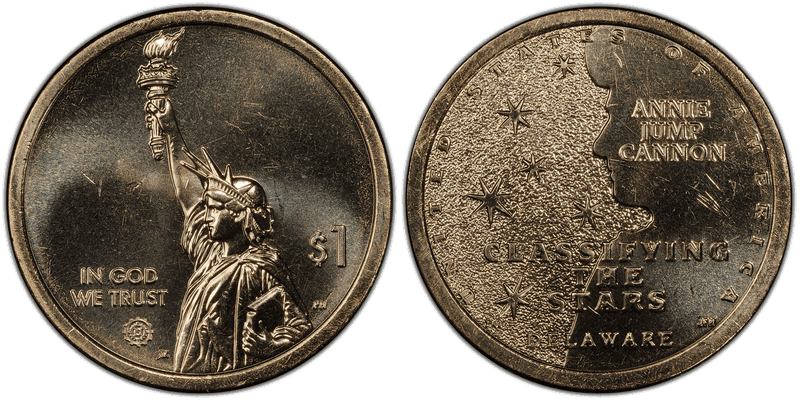
Delaware (astronomer Annie Jump Cannon against a starry sky, by Donna Weaver and Joseph Menna), Pennsylvania (the poliovirus at three magnifications for the 1953 polio vaccine, by Richard Masters and Joseph Menna), New Jersey (an Edison light bulb, by Paul C. Balan and Phebe Hemphill) and Georgia (a hand planting seeds in the Trustees' Garden, by Emily Damstra and Michael Gaudioso).

2020

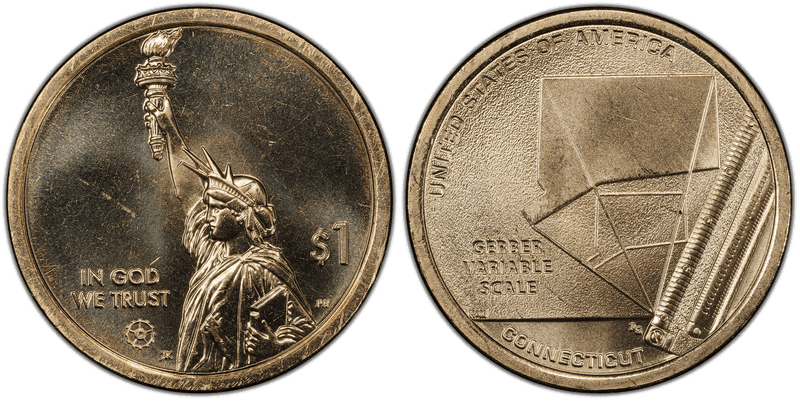
Connecticut (the Gerber Variable Scale, by Richard Masters and Renata Gordon), Massachusetts (an early telephone dial, by Emily Damstra and Eric David Custer), Maryland (the Hubble Space Telescope, by Joseph Menna) and South Carolina (educator Septima Clark walking with students, by Justin Kunz and Phebe Hemphill).

2021

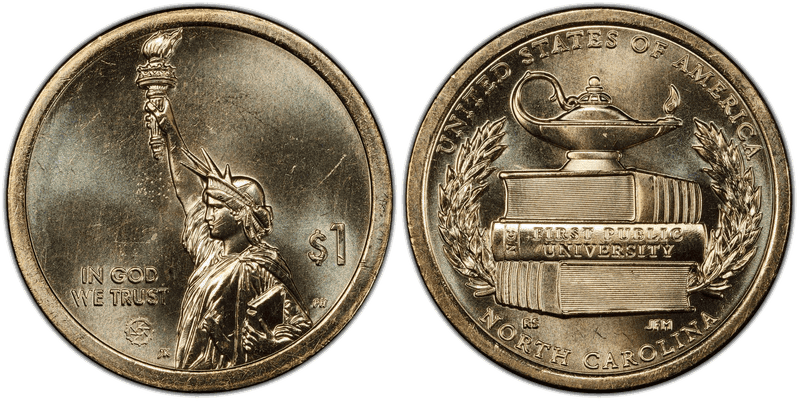
New Hampshire (Ralph Baer's first home video game, by Christina Hess and Eric David Custer), Virginia (a cutaway of the Chesapeake Bay Bridge-Tunnel, by Matt Swaim and John P. McGraw), New York (a packet boat on the Erie Canal, by Ronald D. Sanders and Phebe Hemphill) and North Carolina (the first public university, by Ronald D. Sanders and Joseph Menna).

2022

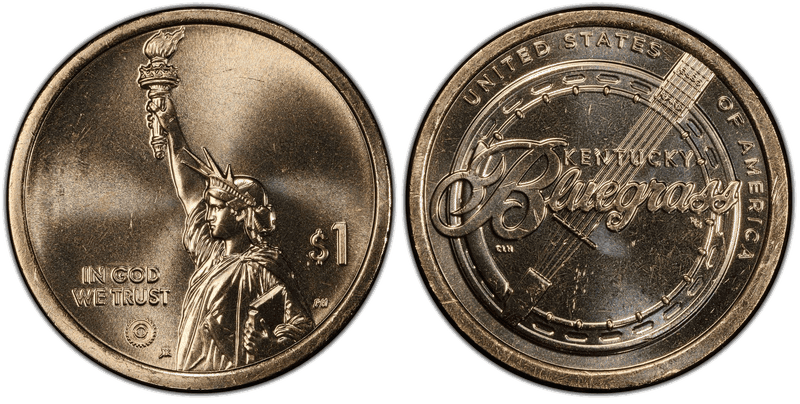
Rhode Island (the yacht Reliance, by Dennis Friel and Phebe Hemphill), Vermont (a snowboarder, by Justin Kunz and Craig Campbell), Kentucky (a banjo for bluegrass music, by Christina Hess and Renata Gordon) and Tennessee (the Tennessee Valley Authority, by Matt Swaim and Joseph Menna).

2023

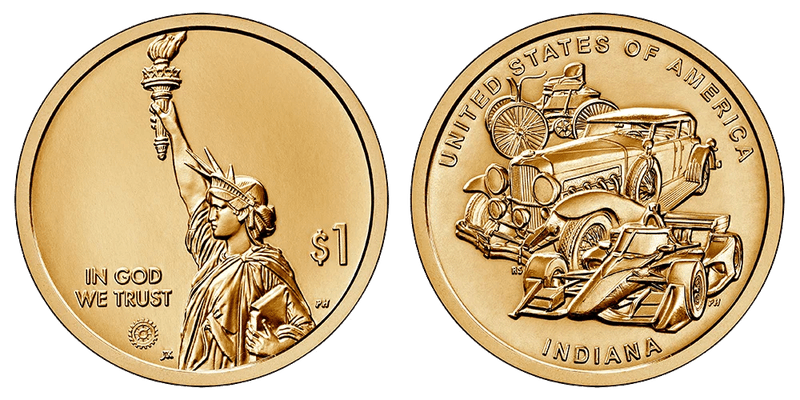
Ohio (clasped hands and a broken chain for the Underground Railroad, by Beth Zaiken and Stephen Layne), Louisiana (a Higgins boat with its ramp down, by Dennis Friel and John P. McGraw), Indiana (three generations of cars, by Ron Sanders and Phebe Hemphill) and Mississippi (the first human lung transplant, by Katelyn Arquette and Craig A. Campbell).

2024

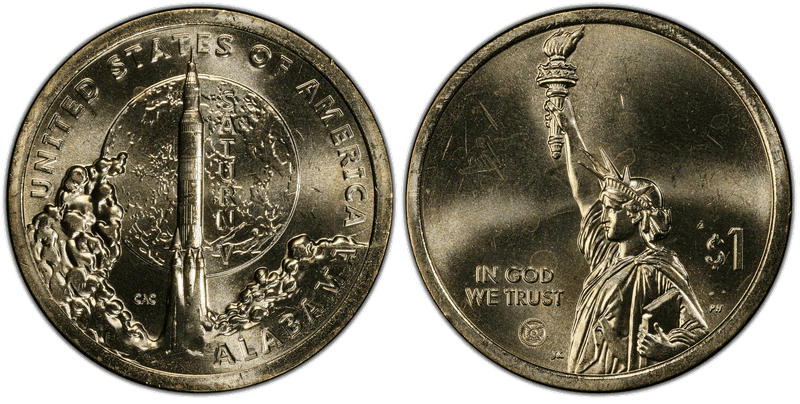
Illinois (the steel plow, credited by the Mint to Beth Zaiken and Renata Gordon), Alabama (a Saturn V liftoff, by Craig A. Campbell), Maine (Dr. Bernard Lown and his direct current defibrillator, by Phebe Hemphill) and Missouri (George Washington Carver in his laboratory, by Eric David Custer).

2025

Arkansas (naval engineer Raye Montague and an Oliver Hazard Perry-class frigate, by Elana Hagler and Eric David Custer), Michigan (a 1930s assembly line, by Ron Sanders and John P. McGraw), Florida (a Space Shuttle launch, by Ron Sanders and Eric David Custer) and Texas (a spacewalk at the International Space Station, honoring Mission Control, by Ron Sanders and John P. McGraw).

2026

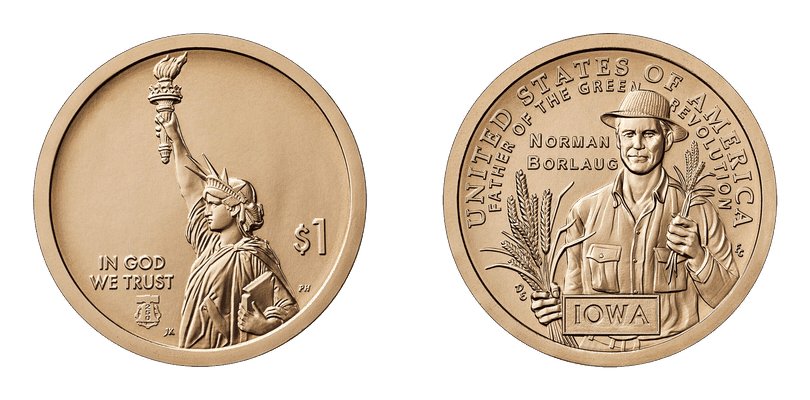
Iowa (Norman Borlaug with a sheaf of wheat, by Don Everhart and Eric David Custer), Wisconsin (the Cray-1 supercomputer from above, by Paul Romano and John P. McGraw), California (Steve Jobs before oak-covered hills, by Elana Hagler and Phebe Hemphill) and Minnesota (a 1940s truck with a mobile refrigeration unit, by Beth Zaiken and Joseph V. Noorigian).

Mintages

American Innovation Dollars 2018 to Date mintages by design and finish, taken from each coin's page in our catalog. Each figure opens that coin's page, which lists its varieties and errors. A dash means no figure was recorded. Where one issue was struck in more than one type, each type is listed.

How to Tell Them Apart

Reverse. The subject and the state or territory name identify the design; there is no date on either face.

Privy mark. From 2019 a small gear sits on the obverse below IN GOD WE TRUST, and its shape changes slightly each year, so it dates the obverse. The 2018 coin has no privy mark. In 2026 the gear takes in a Liberty Bell with the number 250 for the Semiquincentennial.

Edge. The edge is stamped with the year, the mint mark and E PLURIBUS UNUM. Because the lettering can run either way up, PCGS labels coins Position A or Position B, as it does Presidential dollars (search).

Mint and finish. P and D coins are uncirculated, sold in 25-coin rolls and 100-coin bags. S coins are proofs, with mirror fields and frosted designs, or reverse proofs, with the finish swapped (search); both come from San Francisco in the Mint's proof and reverse proof sets.

Mintages. For 2021 through 2025, Wikipedia and USA Coin Book give between about 380,000 and 590,000 coins of each design at each of Philadelphia and Denver. For 2018 through 2020 they disagree: Wikipedia gives 2,143,925 Philadelphia introductory coins and USA Coin Book 862,475.

Errors and Varieties

Edge lettering is the place to look first. It is added in a separate step after striking, and on the Presidential dollars that step produced coins with no lettering at all and coins lettered twice. NGC also lists Native American dollars of 2009 and 2010 with missing edge lettering. A coin without lettering has no date or mint mark, since both live on the edge.

Position A and Position B coins are not errors: the lettering simply ran one way or the other, and both are normal products of minting.

In Our Catalog

No errors or varieties are listed for American Innovation Dollars 2018 to Date yet. Submit one

Composition and Silver Content

  • Metal: manganese brass, 88.5% copper, 6% zinc, 3.5% manganese and 2% nickel overall, with golden outer layers over a copper core. There is no gold or silver.
  • Weight: 8.1 grams
  • Diameter: 26.49 mm
  • Edge: lettered, with the year, mint mark and E PLURIBUS UNUM

The same alloy and size are used for the Sacagawea and Native American dollars and were used for the Presidential dollars. Proofs and reverse proofs are struck in the same metal.

FAQ

Are American Innovation dollars in circulation?

No. The Mint makes them only for collectors, as it has for all dollar coins since 2011. Philadelphia and Denver coins are sold in 25-coin rolls and 100-coin bags, and San Francisco strikes the proofs and reverse proofs for sets. Banks do not pay them out, so they reach collectors through the Mint's rolls, bags and sets.

What is the 2018 American Innovation dollar?

The introductory coin, released on December 14, 2018, before the state designs began. Its reverse shows George Washington's signature from the first U.S. patent, issued in 1790 (search), with stylized gears for industry and an eagle in a shield. Donna Weaver designed it and Renata Gordon sculpted it. It was struck as P and D uncirculated coins, an S proof and an S reverse proof.

What order are the American Innovation dollars released in?

The order the law sets: the states as they ratified the Constitution or joined the Union, four a year from 2019, then the District of Columbia, Puerto Rico, Guam, American Samoa, the U.S. Virgin Islands and the Northern Mariana Islands. Delaware, Pennsylvania, New Jersey and Georgia came first in 2019; 2026 brought Iowa, Wisconsin, California and Minnesota.

What is the gear on the front of an American Innovation dollar?

A privy mark. Since 2019 the Statue of Liberty obverse has carried a small stylized gear below IN GOD WE TRUST, standing for industry and innovation, and its design changes a little each year, so it tells one year's obverse from another. The 2018 coin has none. In 2026 the gear includes a Liberty Bell with the number 250 for the nation's Semiquincentennial.

Do American Innovation dollars have Position A and Position B?

Yes. As on the Presidential and Native American dollars, the date, mint mark and E PLURIBUS UNUM are lettered on the edge, and the lettering can run either way up. PCGS uses the same terms it adopted for Presidential dollars in 2007, Position A for lettering upside down with the obverse facing up and Position B for lettering that reads normally (search). Neither is an error.

When will the American Innovation dollar program end?

The law covers a 14-year period starting in 2019, with four designs a year until every state, the District of Columbia and the five territories has had a coin. At that pace the last coins, for the territories, are due in 2032.

↑ Back to the coins: every year, mint, variety and error

Explore Other Denominations

Collector Essentials

Tools and references for building and protecting your coin collection.

As an Amazon Associate, NumisDex earns from qualifying purchases.