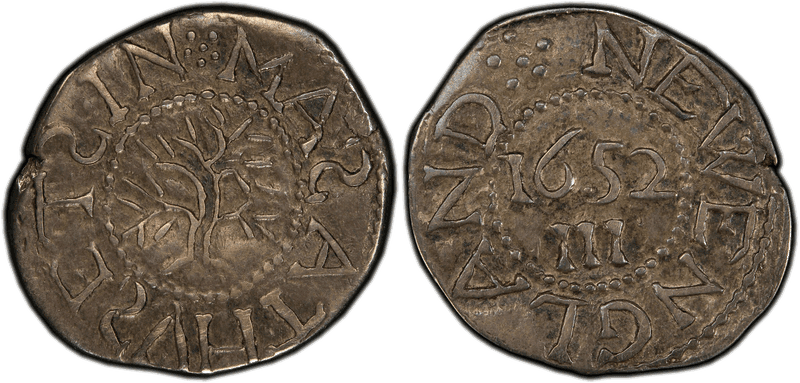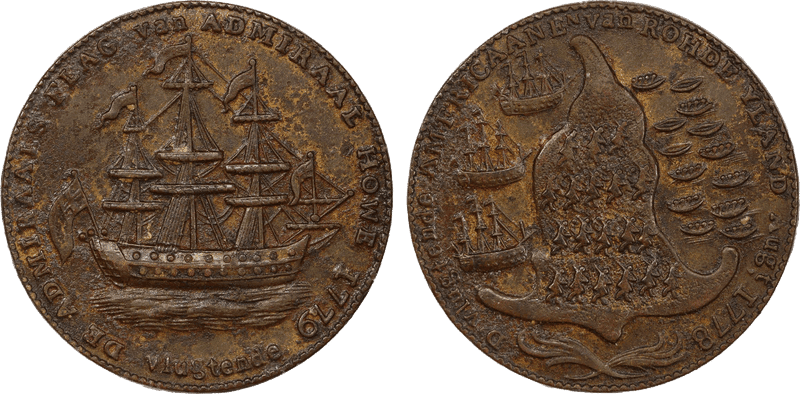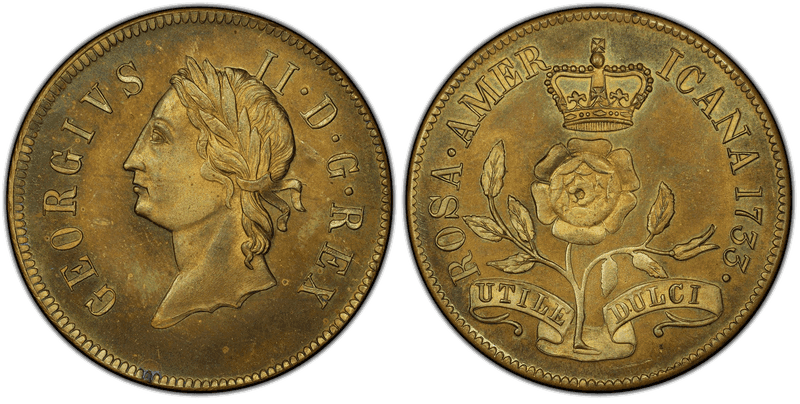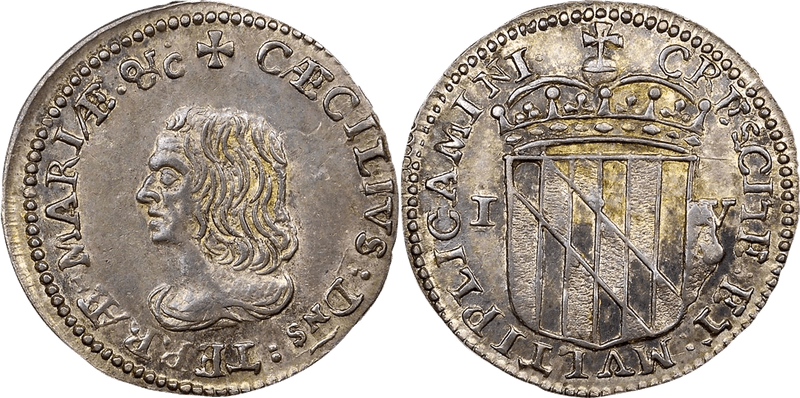
Post-1776 States Coinage (1776-1788)

Coin Series
Post-1776 States Coinage (1776-1788) series coin

About This Series

This series holds the copper coins struck under the authority of the states in the 1780s, before the Constitution gave Congress sole power to coin money. Connecticut licensed a company of coiners in 1785, Vermont, then an independent republic, licensed Reuben Harmon Jr. the same year, New Jersey licensed Walter Mould, Albion Cox and Thomas Goadsby in 1786, and Massachusetts built a mint of its own that struck cents and half cents in 1787 and 1788. New York never authorized a coinage, but the coppers bearing its arms and mottoes and the gold pieces of the New York goldsmith Ephraim Brasher are kept here as well. Most of these coins were made from hand-cut dies, and collectors attribute them by the die pairs listed by Miller (Connecticut), Maris (New Jersey), Ryder (Massachusetts) and Ryder, Richardson and Bressett (Vermont).

Browse by Base(6 bases)

Showing all 6 listings

History

When the Revolution ended, the new states had paper money of falling value and very little small change. Light imitation halfpence, many of them made in Birmingham, passed alongside a few genuine British coppers. The Articles of Confederation let Congress regulate coin but did not keep the states from coining, and between 1785 and 1788 four of them took the matter into their own hands.

Vermont, then an independent republic outside the Union, moved first. In June 1785 its legislature gave Reuben Harmon Jr. of Rupert the sole right to coin copper for two years, at first in pieces of a third of an ounce, a weight it lowered in October 1785. Harmon's first coins show the sun rising over wooded hills with a plow below, and an eye in a glory ringed by thirteen stars with STELLA QUARTA DECIMA, the fourteenth star. In October 1786 the grant was extended for eight years from July 1787 with a new design of a head and a seated woman, and in 1787 Harmon's partners joined the owners of Machin's Mills near Newburgh, New York.

Connecticut acted in October 1785. Samuel Bishop, Joseph Hopkins, James Hillhouse and John Goodrich won leave to coin up to 10,000 pounds in coppers of six pennyweight, the weight of a British halfpenny, paying the state one coin in twenty. They formed the Company for Coining Coppers at New Haven, with Abel Buell among the partners, and James Jarvis bought into it during 1786 and 1787. A committee that reported in 1789 found that the owners had coined until about June 1787 and that inspectors had passed 28,944 pounds of coppers.

New Jersey licensed Walter Mould, Albion Cox and Thomas Goadsby on June 1, 1786 to strike 10,000 pounds in coppers at fifteen to the shilling. The partners soon fell out, and a supplement of November 1786 let Mould work on his own at Morristown while Goadsby and Cox struck elsewhere. CoinWeek, writing for PCGS, puts the output at about four million pieces, many made outside the terms of the contract, before the coppers were demonetized in 1790.

Massachusetts chose a state mint instead of a contractor. An act of October 17, 1786 ordered cents and half cents on the federal standard, and Joshua Wetherle ran the mint from 1787. The accounts Crosby prints show that the coinage cost more than the value of the coins delivered, and the mint struck only pieces dated 1787 and 1788.

New York heard petitions from John Bailey, Ephraim Brasher and Thomas Machin early in 1787 but authorized no coinage; its act of April 20, 1787 only fixed which coppers might pass. The coppers with New York themes in this series were private ventures, and so were Brasher's gold doubloons. The Constitution, drafted later in 1787, gave the power to coin money to Congress alone, which ended the state coinages.
How to Identify It

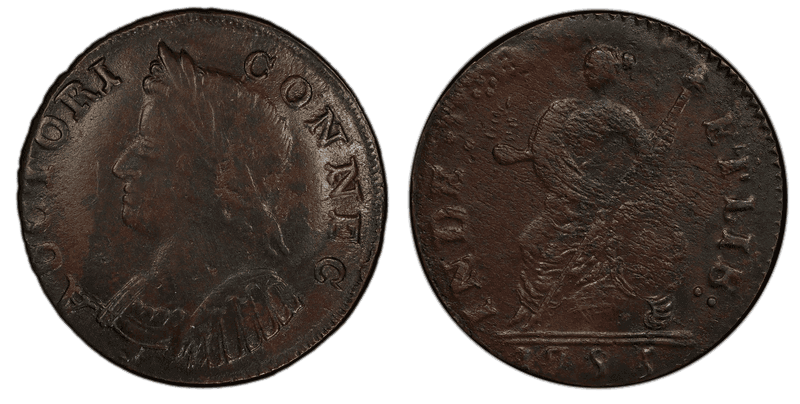
Connecticut coppers read AUCTORI CONNEC around a laureate head and INDE ET LIB around a seated Liberty with an olive branch. The busts are mailed (armored) or draped and face left or right; Crosby found that all 1785 dies have mailed busts, most facing right, while the draped bust left became the usual style of 1787 and 1788. Named heads such as the African Head, Muttonhead and Laughing Head come from single dies.

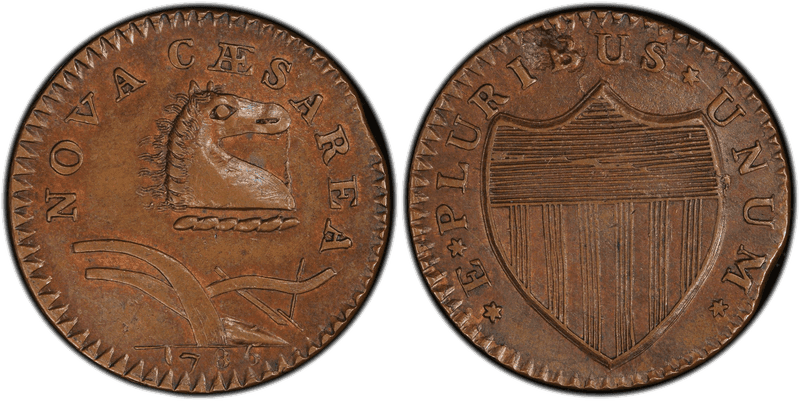
New Jersey coppers show a horse's head above a plow with NOVA CAESAREA, and a shield with E PLURIBUS UNUM, the motto later used on federal coins. Varieties are told apart by the plow (with or without a coulter, a straight or curved beam), the horse's head and the shape of the shield.

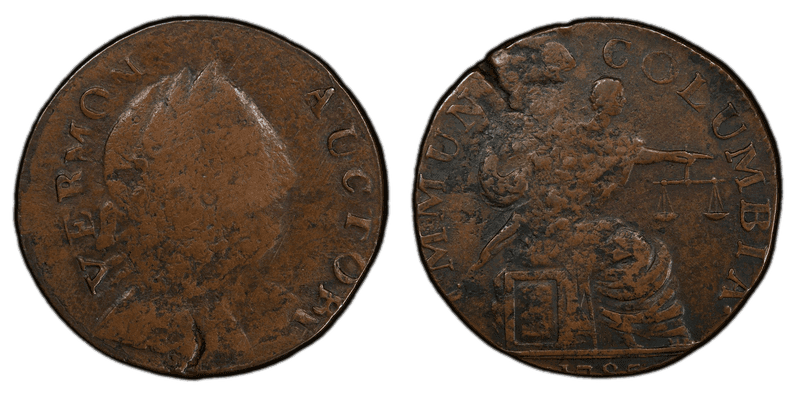
Vermont has two types. The landscape type of 1785 and 1786 reads VERMONTS, VERMONTIS or VERMONTENSIUM RES PUBLICA around the sun, hills and plow. The head type of 1786 to 1788 reads AUCTORI VERMON or VERMON AUCTORI with INDE ET LIB, and looks much like the Connecticut coppers and the British halfpenny.

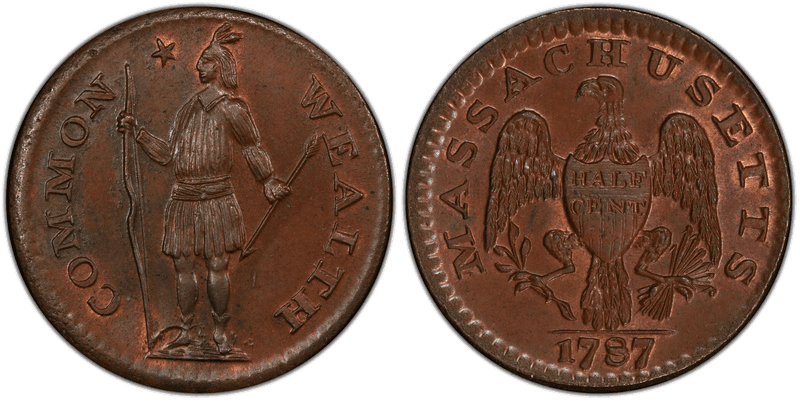
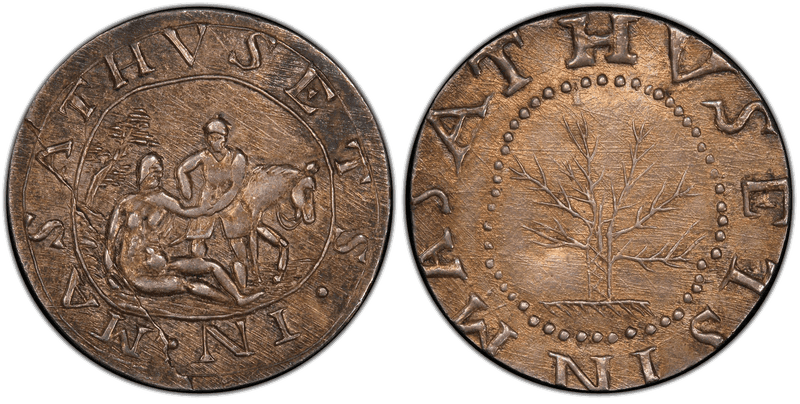
Massachusetts cents and half cents carry an Indian with a bow and arrow and COMMONWEALTH, and an eagle with a shield marked CENT or HALF CENT and MASSACHUSETTS. Crosby noticed that the reverse dies of 1787 have a broad, open S, while seven cent dies and both half cent dies of 1788 have a narrow S like a figure 8, which he linked to a second engraver, Jacob Perkins.

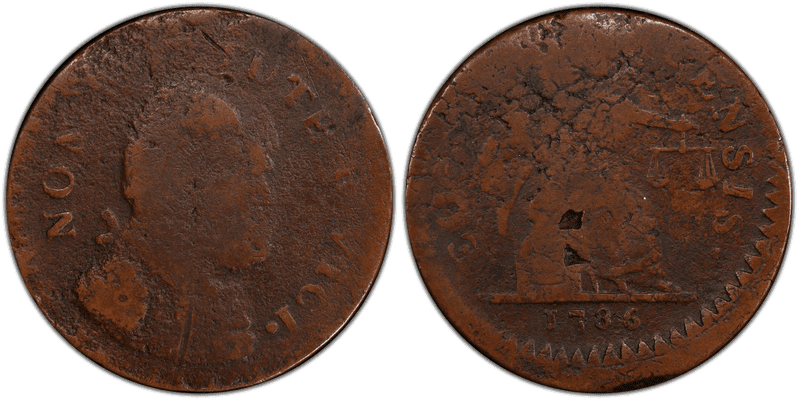
New York pieces carry the state arms with EXCELSIOR, an eagle, a bust of Governor George Clinton, an Indian with LIBER NATUS LIBERTATEM DEFENDO, or a military bust with NON VI VIRTUTE VICI and NEO-EBORACENSIS.

Attribution. Each die was cut by hand, so every die differs a little from every other. Collectors use Miller's numbers for Connecticut, Maris's for New Jersey, Ryder's for Massachusetts and the RR and Bressett numbers for Vermont; a number such as Miller 40-N names the obverse and the reverse. Most pages here are types, and several die pairs can fall under one page.

Key Types and Varieties

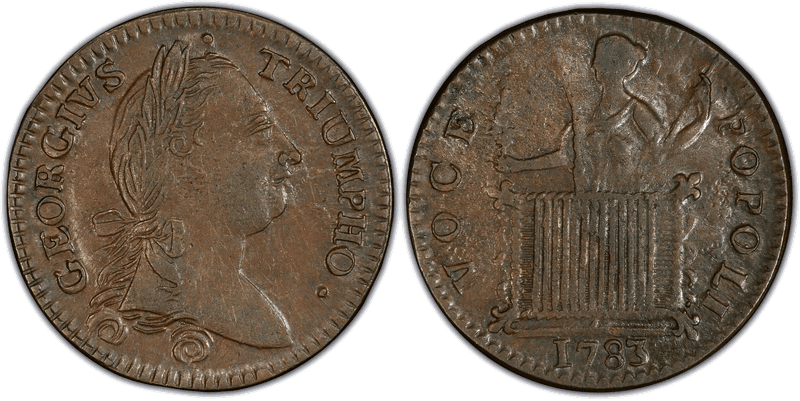
Connecticut. The 1785 issue has the mailed bust right, the mailed bust left, known to Crosby from only two dies, and the African Head. The Hercules Head of 1786 is a deeply cut, scowling head whose die was used again in 1787. The 1787 coins include the Muttonhead, the largest head of the series, the Horned Bust, whose "horn" is a break in the die, the Laughing Head and the CONNECT obverse. The misspelled legends include AUCIORI, AUCTOBI, AUCTOPI (three obverse dies, Miller 40, 41 and 42), CONNFC and, on reverses, ETLIR, FNDE and the 1788 INDL ET LIB. The 1787 and 1788 pieces with a GEORGIVS III obverse pair a British-style head with a Connecticut reverse.

New Jersey. The 1786 coins include the no-coulter dies and the dies with the date below the plow beam, the Bridle, named for a line from the horse's nose to its breast on Maris obverse 18, the Protruding Tongue and the PLUKIBUS error. Among the 1787 coins are the Camel Head (Maris 56-n, 57-n and 58-n), the Serpent Head (Maris 54-k), which many specialists take for a contemporary counterfeit, the Goiter, the PLURIBS reverse, the pattern shield of Maris 6-C, the overdate with an 8 under the first 7, and the unique WM above the plow, first shown in 1994, whose initials stand for Walter Mould. The head left coins of 1788 reverse the horse and plow, and the running fox reverses carry a small running animal that Maris called a horse courant.

Vermont. The landscape coins are the VERMONTS and VERMONTIS pieces of 1785 and the VERMONTENSIUM pieces of 1786. The first head die of 1786 is the Baby Head. Some Vermont dies were paired with dies of other coppers: a BRITANNIA reverse in 1787, an IMMUNE COLUMBIA reverse dated 1785 and a GEORGIVS III REX obverse in 1788. The backward C of 1788 has a C cut the wrong way in AUCTORI.

Massachusetts. The 1787 half cent, the 1787 cent, the 1788 half cent and the 1788 cent without a period after the legend are on separate pages; the 1787 cents usually have the arrows in the eagle's left talon.

New York. The coppers include the NON VI VIRTUTE VICI pieces of 1786, the EXCELSIOR pieces with the state arms and an eagle, the George Clinton copper, on which the G was first punched as a C, and the Indian with George III, which Crosby thought unique.

Brasher. The 1787 doubloon with the hallmark on the wing, the unique breast punch, the half doubloon in the Smithsonian, the Lima-style doubloon and foreign gold coins stamped with his hallmark make up the group, with a copper copy of the 1860s.

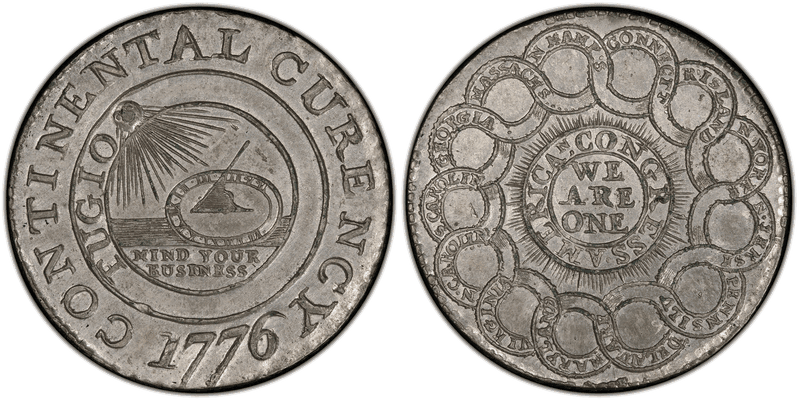
Related pieces sit in other trees: the 1776 New Hampshire and Massachusetts pattern coppers, the Nova Eborac coppers and the Machin's Mills halfpence are in private and regional issues, and the Fugio cents and the Confederatio, Immune Columbia and Nova Constellatio pieces in proposed national issues.

Composition

The state coppers are copper, struck by hand-turned screw presses on planchets cut from rolled or cast strip. The laws set weights: six pennyweight (144 grains) in Connecticut, six pennyweight six grains (150 grains) in New Jersey, a third of an ounce troy (160 grains) and then not less than 111 grains in Vermont, and the federal standard for the Massachusetts cents and half cents. Actual weights vary widely. Crosby weighed Connecticut coppers from about 104 to 184 grains, Vermont heads mostly above the 111-grain standard, Massachusetts cents from 146 to 165 grains and half cents from 75 to 83 grains, and many state coppers were struck over other coins. Brasher's doubloons are gold of about 22 carats; Crosby gives 408 grains for the doubloon he described, with a plain edge. No mint records give the number of coins struck for any piece in this series, so the pages carry no mintage figures.

In Our Catalog

1 error or variety is listed for this series. Browse them by type:

Recently added

    FAQ

    Why did the states coin their own money in the 1780s?

    The Articles of Confederation did not give Congress the sole right to coin, and small change was in short supply while light, imported imitation halfpence circulated widely. Connecticut and Vermont licensed private coiners in 1785, New Jersey followed in 1786, and Massachusetts built a mint of its own under an act of October 1786. The Constitution of 1787 then gave the power to coin to Congress alone.

    Did New York have a state coinage?

    No. The New York assembly received petitions to coin copper from John Bailey, Ephraim Brasher and Thomas Machin in 1787 but never authorized a coinage. Its act of April 20, 1787 only set the weight of coppers allowed to pass. The EXCELSIOR, NON VI VIRTUTE VICI and George Clinton coppers were made privately, and Crosby thought some of them were patterns offered to the state.

    What do numbers like Miller 6.1-M or Maris 54-k mean?

    They name a pair of dies. Henry C. Miller's 1920 book numbers Connecticut obverses and letters their reverses, so Miller 6.1-M is the Laughing Head obverse with reverse M. Edward Maris did the same for New Jersey in 1881 (Maris 54-k is the Serpent Head), Hillyer Ryder for Massachusetts, and the RR (Ryder-Richardson) and Bressett numbers for Vermont. Many coins on these pages are type pages that cover several die pairs.

    Why do so many Connecticut coppers have misspelled legends?

    Every die was cut by hand with letter punches, and the die cutters made errors. Crosby lists obverses reading AUCIORI, AUCTOBI, AUCTOPI and CONNFC in place of AUCTORI CONNEC, and reverses such as INDL ET LIB. Each spelling came from a particular die, so the errors are also an easy way to attribute a coin.

    What is a Brasher doubloon?

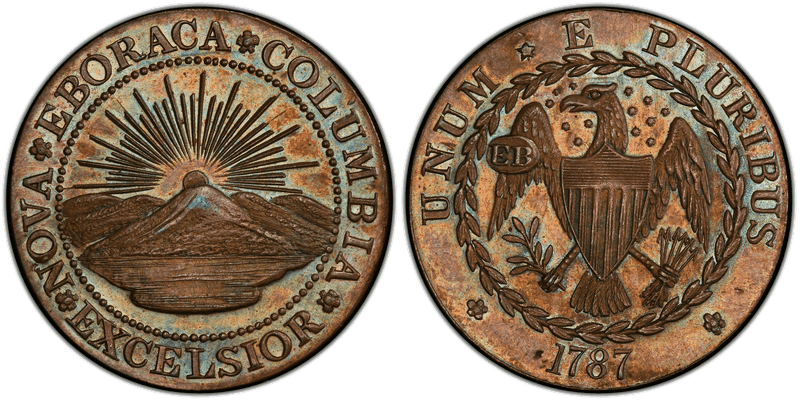
    A gold coin made in 1787 by Ephraim Brasher, a New York goldsmith, with the sun rising over mountains, NOVA EBORACA COLUMBIA EXCELSIOR and his name on one side and an eagle with E PLURIBUS UNUM on the other. His EB hallmark is punched into the eagle, on the wing on most examples and on the breast on one. He also made a gold half doubloon and doubloons in the style of the Lima mint.

    ↑ Back to the coins: every year, mint, variety and error

    Explore Other Denominations

    Collector Essentials

    Tools and references for building and protecting your coin collection.

    As an Amazon Associate, NumisDex earns from qualifying purchases.