Massachusetts Silver Coins (1652-1662)

Coin Series
Massachusetts Silver Coins (1652-1662) series coin

About This Series

The first coins struck in British North America, Massachusetts silver was produced at the Hull Mint in Boston from 1652 under authorization from the Massachusetts General Court — implicitly defying the English Crown's coinage prerogative. John Hull and Robert Sanderson ran the mint, and the shilling was set at 72 grains of sterling-fineness silver, lighter than the English shilling. Four designs follow one another: the NE pieces of 1652, the Willow Tree coins to about 1660, the Oak Tree coins to about 1667 and the Pine Tree coins until the mint closed in 1682. The shillings, sixpences and threepences are all dated 1652, the year they were authorized, and the twopence is dated 1662. The die varieties are numbered by Noe and, more recently, by Salmon.

Series Information

Production Years
1652-1682

Browse by Base(4 bases)

Showing all 4 listings

History

Massachusetts had no coin of its own until 1652. Trade ran on barter and on whatever foreign silver came in, much of it light or counterfeit Spanish money from the West Indies. In May 1652 the General Court set up a mint in Boston and on May 27 named the silversmith John Hull its master, with Robert Sanderson as his partner. No one asked England for leave: Charles I had been executed in 1649, and there was no king to grant one. Anyone could bring Spanish coin, plate or bullion to be melted and returned as Boston money, less the mint's fee.

The law fixed the shilling at three pennyweight, 72 grains, of silver of sterling fineness, about 22 percent lighter than the English shilling. The difference was deliberate: the lighter coins were meant to stay in the colony rather than be exported. Sixpences and threepences were struck to the same standard, and a twopence was added in 1662.

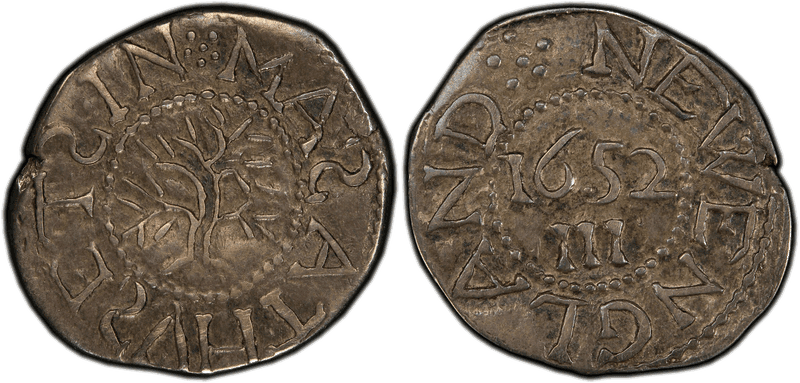
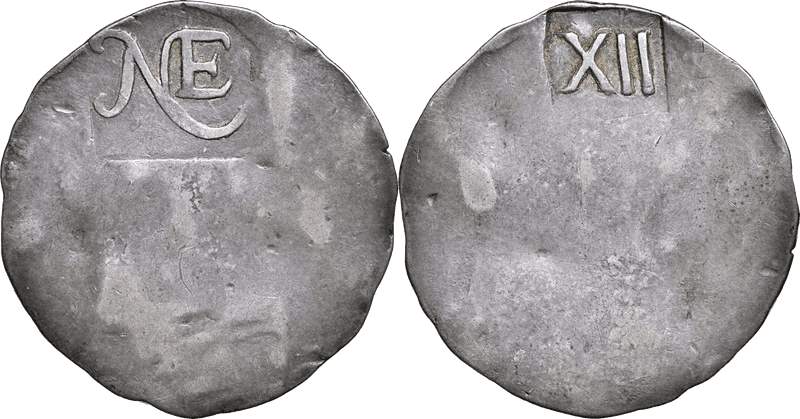
The first coins, struck from June 1652, were simply punched with NE on one side and XII, VI or III on the other. On October 19, 1652 the court ordered a new design with a tree in a ring of beads, MASATHVSETS IN on one side and NEW ENGLAND with the date on the other, so that clipping would show. The tree changed over the years: a willow-like tree until about 1660, an oak until about 1667 and a pine until the mint closed. After the Restoration the mint drew complaints. The king's commissioners demanded its abolition in 1665, and the court answered with a gift of masts for the navy. Hull's contracts were renewed in 1667 and 1675, and the mint finally stopped in 1682. Two years later the colony's charter was annulled, and the mint was among the charges against it.

How to Identify It

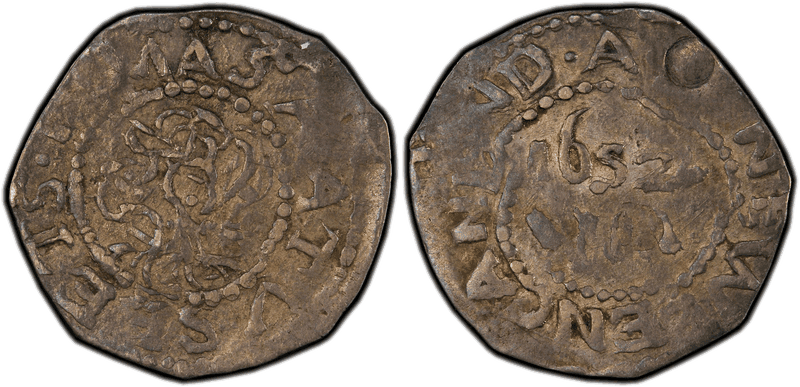
Design and date. All the tree coins show the tree inside a ring of beads with MASATHVSETS IN, and the value in Roman numerals (XII, VI, III, II) at the center of the other side with NEW ENGLAND and the date. The shillings, sixpences and threepences are dated 1652 whatever the year of striking; only the twopence is dated 1662. NE pieces have no legend and no tree, just two small punched marks on a plain planchet.

Which tree. Willow Tree coins have a crude, tangled tree, crude enough that some early collectors took them for counterfeits; the Willow Tree shilling, sixpence and threepence have their own pages. Oak Tree coins have a rounded, branching tree, and Pine Tree coins a tall, pointed one, often with pellets at the base of the trunk.

Planchet and press. Oak Tree shillings and the early Pine Tree shillings were struck with a rocker press on broad, thin planchets, and many are slightly bent. The small planchet Pine Tree shilling is thicker and narrower, struck with a screw press. Compare the large planchet shilling.

Die varieties. Noe's numbers and Salmon's obverse-reverse letters identify the dies. The features named on the varieties are easy to check: where the word IN falls in the obverse legend, whether the trunk has pellets, a reversed letter N, a missing H, or the joined NE in NEW.

Copies. Many copies exist, from the Wyatt and Good Samaritan pieces of about 1850 to modern fakes. They are listed in the colonial restrikes and fantasies tree, with Noe's imitation pages.

Key Types and Varieties

NE coinage (1652). The NE shilling, sixpence and threepence were struck only between June 11 and October 19, 1652, according to Noe. Three NE punches and several XII punches were used on the shillings.

Oak Tree shillings. IN at Left is Noe-1 (Salmon 1-A), which Salmon takes for the first shilling struck on the rocker press. The same obverse with other reverses makes the ANDO pieces, Noe-2 and Noe-3, whose legend ends ANDO or AN DO instead of AN DOM. Most later obverses put IN at the bottom (IN at Bottom). The Ghost, Noe-10, has a tree cut in very shallow relief, and the Spiny Tree, Noe-14, is described as the last Oak Tree shilling before the pine design.

Oak Tree sixpence, threepence and twopence. The sixpences (IN on Reverse, Noe-16, and IN on Obverse) and threepences (IN on Obverse, Noe-23, and No IN) differ chiefly in the word IN. The 1662 twopence comes from a single pair of dies; Salmon divides it into small 2 and large 2 by the recut final digit of the date.

Pine Tree shillings. Among the large planchet dies, Noe-1 has pellets at the trunk, others have no pellets, Noe-4 and Noe-5 have a reversed N, Noe-8 joins the N and E of NEW in a monogram, and Noe-11 drops the H of MASATHVSETS.

Pine Tree sixpence and threepence. Only two sixpence die pairs are listed: Noe-33 with pellets and Noe-32 without. The threepence obverse of Noe-34 and Noe-35 has pellets, and Noe-36 and Noe-37 lack them.

Composition and Silver Content

Every piece in this series is silver, recoined from Spanish money and plate and brought to sterling fineness, .925. The legal weights were 72 grains (4.67 grams) for the shilling, 36 grains (2.33 grams) for the sixpence and 18 grains (1.17 grams) for the threepence. A later assay at the United States Mint, reported by Mossman, found the Pine Tree money .926 fine and averaging 65 to 67 grains, which reflects wear and clipping as well as the mint's tolerance. Planchets were cut by hand and are rarely round, so the diameter of any one coin says little; the small planchet shillings are narrower and thicker than all the earlier shillings. No mintage records survive for any of these coins.

In Our Catalog

No errors or varieties are listed for Massachusetts Silver Coins (1652-1662) yet. Submit one

FAQ

Why are almost all Massachusetts silver coins dated 1652?

The shillings, sixpences and threepences all carry the year of the law that set up the mint, 1652, even though they were struck until 1682. An older explanation held that the frozen date hid how long the mint kept working without royal leave. Philip Mossman prefers a simpler reading, that each die carried the year its value was authorized, which is why the twopence, a value added in 1662, is dated 1662.

What is the difference between the NE, Willow Tree, Oak Tree and Pine Tree coins?

They are four designs made one after another at the same mint. The NE pieces of 1652 carry only the punched letters NE and the value in Roman numerals. On October 19, 1652 the General Court ordered a tree in a ring of beads on one side and NEW ENGLAND with the date on the other, so that clipped coins would show it. The tree was cut as a willow until about 1660, as an oak until about 1667 and as a pine until the mint closed in 1682.

How much silver is in a Massachusetts shilling?

The law set the shilling at 72 grains, about 4.67 grams, of silver of sterling fineness (.925). That was roughly 22 percent lighter than the English shilling of about 93 grains, a gap meant to keep the coins from being shipped out of the colony. The sixpence and threepence were struck at the same standard, 36 and 18 grains.

What do Noe and Salmon numbers mean?

They name the die pairs. Sydney Noe's monographs of 1943 to 1952 gave each pair one number within a series, such as Noe-1 for the first Oak Tree shilling, and added decimals for later finds. Christopher Salmon's 2010 system names the obverse die with a number and the reverse with a letter, such as 1-A, with extra letters or numerals for re-engraved dies, and numbers each value separately. Both are given on our pages where a source ties them to the variety.

What is the difference between a large planchet and a small planchet Pine Tree shilling?

The earlier Pine Tree shillings, from about 1667 to 1675, were struck on broad, thin planchets with a rocker press, whose curved dies often left the coin slightly bent. From about 1675 the shillings were struck on smaller, thicker planchets with a screw press. Salmon finds the large planchet coins closer in style to the Oak Tree shillings.

↑ Back to the coins: every year, mint, variety and error

Explore Other Denominations

Collector Essentials

Tools and references for building and protecting your coin collection.

As an Amazon Associate, NumisDex earns from qualifying purchases.