Pre-1776 Private and Regional Issues (1616-1766)

Coin Series
Pre-1776 Private and Regional Issues (1616-1766) series coin

About This Series

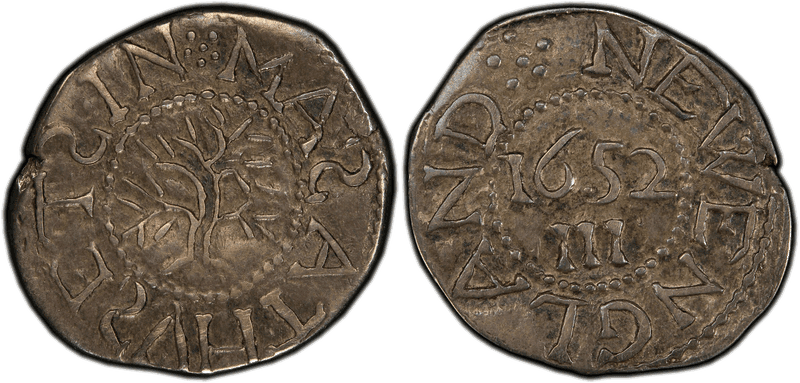
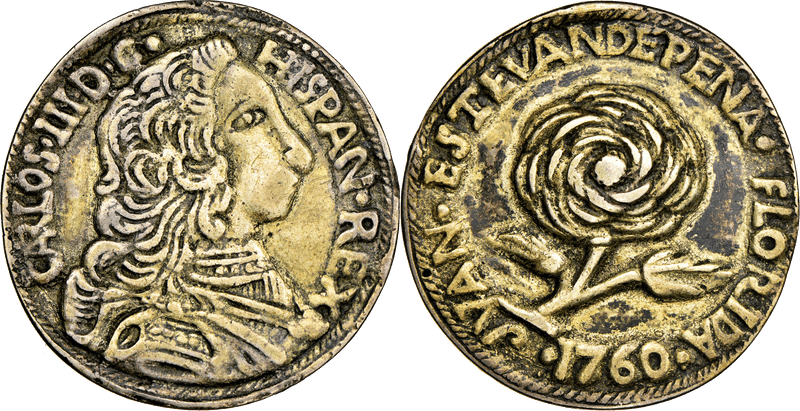
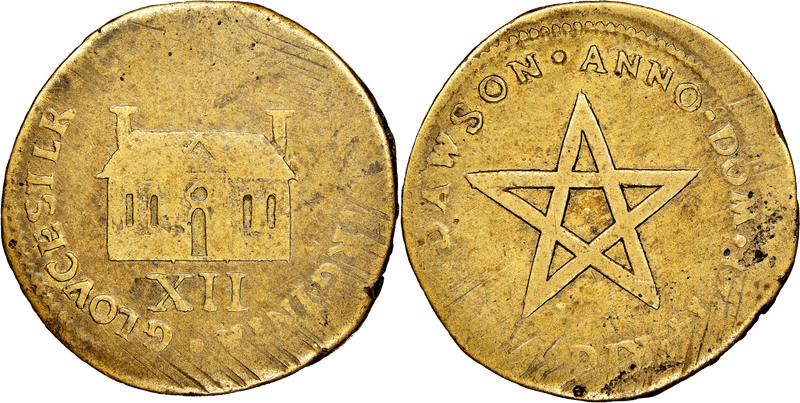
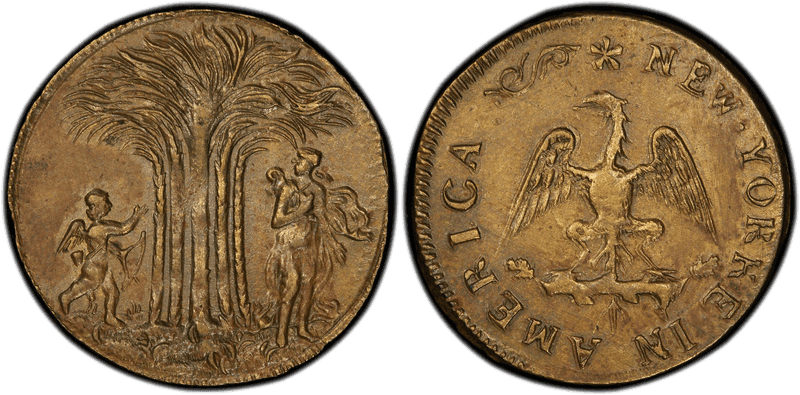
Encompassing 150 years of monetary improvisation in colonial America, this category gathers coins and tokens produced by private individuals, colonial authorities, and regional enterprises before the Declaration of Independence. It runs from the Sommer Islands Hogge money authorized in 1615 through the American Plantations tin tokens of 1688, the Elephant tokens, the New Yorke token, the Gloucester token of 1714, William Wood's Rosa Americana and Hibernia coppers of 1722-1724, the Higley coppers of 1737-1739, the Voce Populi coppers and the Florida proclamation piece of 1760 and the Pitt tokens of 1766. Many of them were made in England or Ireland and reached America only in small numbers.

Browse by Base(11 bases)

Showing all 11 listings

History

This series gathers the coins and tokens that served, or were meant to serve, the English colonies in America without being a colony's own coinage. Some were made in England under a royal grant, some by private people in the colonies, and some in Ireland for Irish use and only later counted as American.

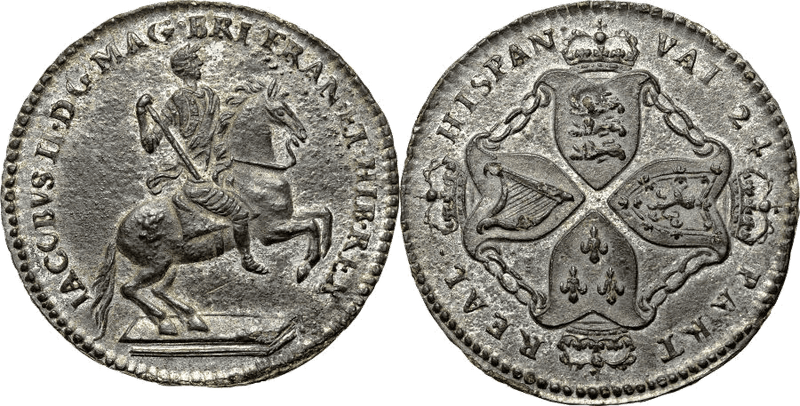
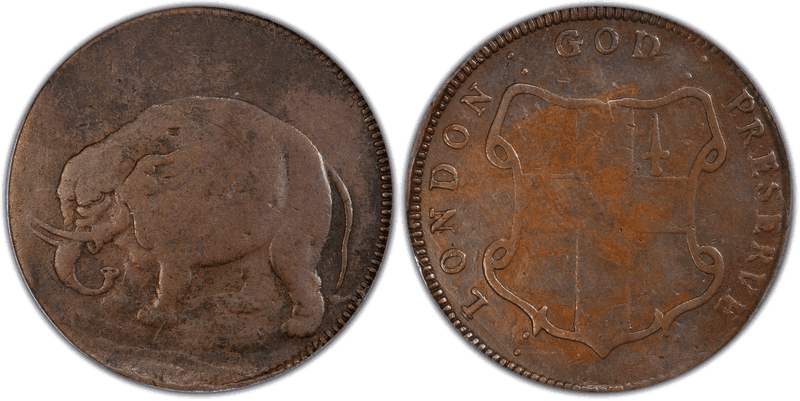
The earliest pieces. The Somers Islands, now Bermuda, received the first coinage made for an English colony: James I authorized it on June 29, 1615, in shillings, sixpences, threepences and twopences of silver-washed brass. The coins stood for amounts of tobacco, the islands' money, and had been given up by 1624. In 1688 Richard Holt petitioned for a tin coinage for the American plantations, and the 1/24 real tokens with James II on horseback were made, though no patent has been found. The undated NEW YORKE IN AMERICA token belongs to the same century; John Kleeberg tied it to Francis Lovelace, governor of New York from 1668 to 1673. The English Elephant tokens, with an elephant on the obverse, are placed about 1694; most read GOD PRESERVE LONDON, and other versions name Carolina or New England.

William Wood's coppers. In 1722 the ironmaster William Wood bought the patent to coin halfpence and farthings for Ireland and received a second patent, on July 12, to coin 300 tons for the American colonies. The American coins, the Rosa Americana twopence, penny and halfpenny, were struck in Bath metal at 120 halfpence to the pound, half the weight of his Irish coins, and the colonists refused them. The Irish Hibernia coinage met fierce opposition in Ireland, led by Jonathan Swift's Drapier's Letters, and was recalled; Wood was given a pension and died in 1730.

Colonial makers. In Gloucester County, Virginia, someone, perhaps a Dawson, made a brass token dated 1714 that is known in two examples. In Connecticut, Samuel Higley, who owned a copper mine near Granby, began striking threepence coppers in 1737 with his brother John, and John carried on after Samuel was lost at sea that year.

Later pieces. The Voce Populi coppers of 1760 were made in Dublin during a shortage of small change. The same year Spanish Florida issued a proclamation piece for the new king, Charles III. In 1766 tokens honoring William Pitt marked the repeal of the Stamp Act, for which Pitt had argued in Parliament.

How to Identify It

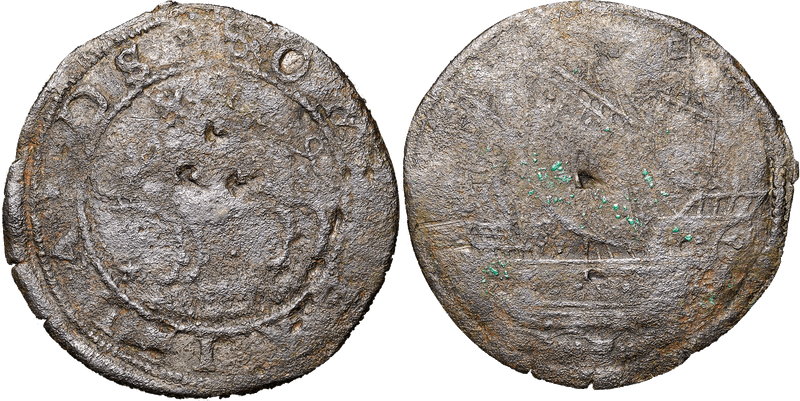
Sommer Islands. A hog with SOMMER ISLANDS on the obverse and the value in Roman numerals; the shillings and sixpences show a ship, while the threepence and twopence have a single ring of beads and no legend. Most survivors are corroded, since the silver wash on brass did poorly in salt air.

American Plantations tokens. Tin, with James II on horseback and the royal arms on crowned shields, valued at 1/24 of a real. Originals are listed apart from the restrikes of about 1828.

Elephant tokens. The elephant is the same on all of them; the reverse tells them apart. The London shield has a sword in its upper left quarter, or in the upper right on the Sword in 2nd Quadrant die; LON DON leaves out GOD PRESERVE; the Carolina and New England pieces have the legend in lines across the field with the date 1694.

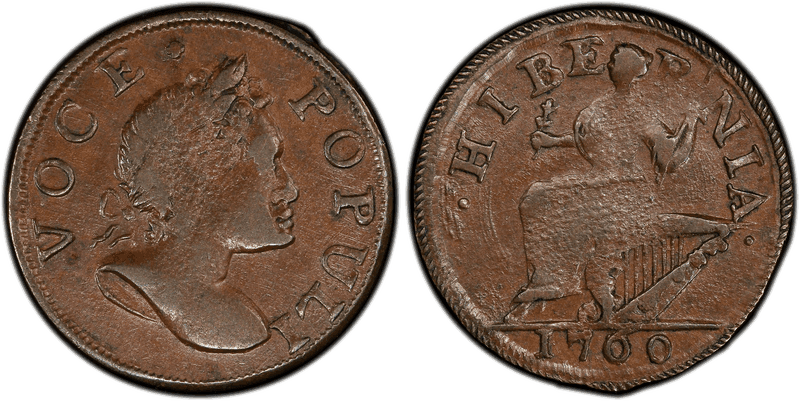
Rosa Americana and Hibernia. Both show George I. The Rosa Americana reverse has a Tudor rose, crowned on the twopence, with ROSA AMERICANA UTILE DULCI; the Hibernia reverse has the seated figure of Hibernia with a harp and the date. Rosa Americana pieces are in Bath metal, a brass alloy, and the Hibernia pieces in copper.

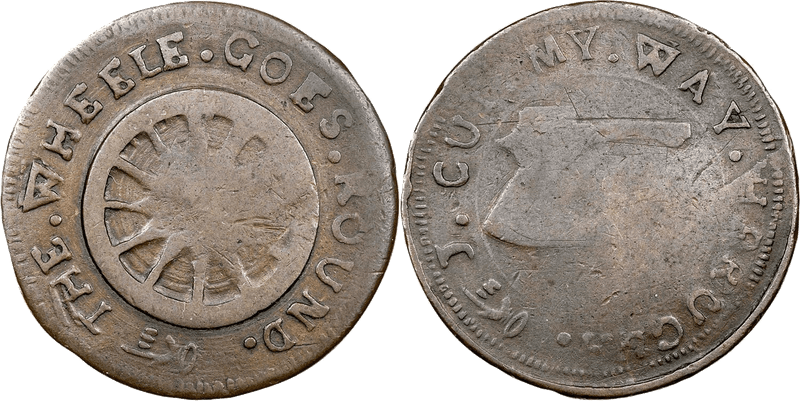
Higley coppers. A deer on the obverse; three crowned hammers or a broad axe on the reverse. The legends name the variety, and the dates are 1737 and 1739, with the undated broad-axe pieces placed with 1737.

Voce Populi. A laureate bust with VOCE POPULI and a seated Hibernia with the date 1760. Look for a letter P before the face or below the bust, and for die errors such as VOOE or the date 1700.

Key Types and Varieties

Sommer Islands. The Large Sails and Small Sails shillings differ in how close the foresail comes to the border, and the sixpences in the size of the portholes (Small Portholes). PCGS separates the twopences by the size of the star.

Plantation tokens. The original 1688 token comes in several die varieties, including the HB, the sideways 4 and the arms transposed reverse, where the Irish and Scottish shields trade places.

Elephant tokens. Hodder's numbers sort them: 2-B on thick and thin planchets, with one piece in brass; 1-A, the Diagonals; 2-D, LON DON; 1-E, the Carolina die spelled PROPRIETERS, and 2-F, the same die corrected to PROPRIETORS; and 2-G, New England.

New Yorke and Gloucester. The brass and white metal New Yorke tokens; the Gloucester shilling, whose legend is only partly readable.

Rosa Americana. The 1722 halfpenny legends (D.G. REX, DEI GRATIA, VTILEDVLC); the 1722 pennies (UTILE, VTILEDVLC, GEORGIVS); the 1722 twopence with and without a period after REX and the undated twopence with ribbon; the 1723 halfpence with a crowned and an uncrowned rose. The 1724 twopence is a pattern, and the 1733 twopence with George II was made after Wood's death. The Robinson copies of the 1733 piece date from about 1861.

Wood's Hibernia. The 1722 halfpence have the harp at the left or at the right, with a DEII error die and a rocks variety. For 1723 there are the 1723/2 overdate, the star before date die, and farthings reading D:G:REX or DEI GRATIA, with silver strikings. The 1724 halfpenny with the date below Hibernia is listed by NGC as a pattern.

Higley coppers. Freidus recorded 15 die marriages: the CONNECTICVT reverse with THE VALVE OF THREE PENCE; VALVE ME and VALUE ME AS YOU PLEASE with I AM GOOD COPPER; the undated broad axe and the 1739 broad axe; and the wheel die, of which his census found one example.

Voce Populi. Halfpence without a P, with the P before the face (Nelson-12) or below the bust, the VOOE die (Nelson-3) and the 1700 date; and farthings in large and small letters.

Florida and Pitt. The Florida proclamation piece is known struck and cast. The Pitt tokens come as a farthing and a halfpenny, some silvered and some in tin.

Composition

The metals vary with the maker. The Sommer Islands pieces are brass with a thin silver wash; the Plantation tokens are tin; the Elephant tokens are copper, with one brass piece; the New Yorke token is brass or a white metal. Wood's Rosa Americana coins are Bath metal, which Mossman gives as 75 percent brass, 20 percent tutenag and 5 percent silver, struck at 120 halfpence to the pound, while his Hibernia coins are copper at 60 halfpence to the pound, with some strikings in silver. The Gloucester token is brass, the Higley and Voce Populi pieces are copper, and the Pitt tokens are copper, sometimes silvered or struck in tin. The Florida proclamation pieces are silver: Stack's Bowers gives 31.1 mm and 13.56 grams for the struck example and 31.4 mm and 8.22 grams for a cast one. Weights and sizes vary from piece to piece, and none of these issues has a recorded mintage.

In Our Catalog

2 errors and varieties are listed for this series. Browse them by type:

Recently added

    FAQ

    What is Hogge money?

    The coinage of the Somers Islands, now Bermuda, which James I authorized on June 29, 1615 - the first coinage made for an English colony in America. It came in shillings, sixpences, threepences and twopences of brass washed with silver, with a hog on the obverse; the two larger values show a ship on the reverse. The pieces stood for amounts of tobacco, the islands' money, and were given up by 1624.

    Were the Rosa Americana coins used in America?

    Only a little. William Wood's patent of July 12, 1722 allowed him to coin 300 tons for the colonies, but the coins were light, 120 halfpence to the pound, and colonists would not take them at face value. Massachusetts even issued small parchment notes in 1722 partly to keep them out. Some did circulate, since examples have been found in excavations at Colonial Williamsburg, but Mossman notes that the cool reception is why so many survive in fine condition.

    Why are Irish coppers like Wood's Hibernia and the Voce Populi pieces in an American series?

    Mainly by tradition. Wood's Hibernia halfpence and farthings were made for Ireland and recalled after protests there, and the Voce Populi pieces were unofficial Dublin coppers of 1760. Both have long been collected with American colonial coins, and the Hibernia pieces were reported in American circulation by the 1860s, but Mossman finds no record of their shipment and suggests they may have arrived later, as other foreign coppers did.

    What do the Higley legends mean?

    Samuel Higley's first coppers of 1737 read THE VALVE OF THREE PENCE, with a V for the U. A copper of about the weight of a halfpenny would not pass for threepence, and the later dies read VALUE ME AS YOU PLEASE (one die spells it VALVE), leaving the value to the user. The reverses add CONNECTICVT, I AM GOOD COPPER or J CUT MY WAY THROUGH, and one obverse shows a wheel with THE WHEELE GOES ROUND.

    Who issued the NEW YORKE IN AMERICA token?

    Nobody signed it, but John Kleeberg's 1991 study argued that it was struck under Francis Lovelace, governor of New York from 1668 to 1673. He read the eagle on a ragged staff as the crest of the Lovelace arms and the other side as a rebus on the name. The token is known in brass and in a white metal that the grading services call pewter.

    Are the 1828 Plantation tokens and the Robinson copies originals?

    No. The American Plantations tokens were restruck from original dies about 1828, and the 1733 Rosa Americana twopence was copied about 1861 for Alfred S. Robinson of Hartford from new dies by Joseph H. Merriam. Both are listed on their own pages so they are not confused with the originals.

    ↑ Back to the coins: every year, mint, variety and error

    Explore Other Denominations

    Collector Essentials

    Tools and references for building and protecting your coin collection.

    As an Amazon Associate, NumisDex earns from qualifying purchases.