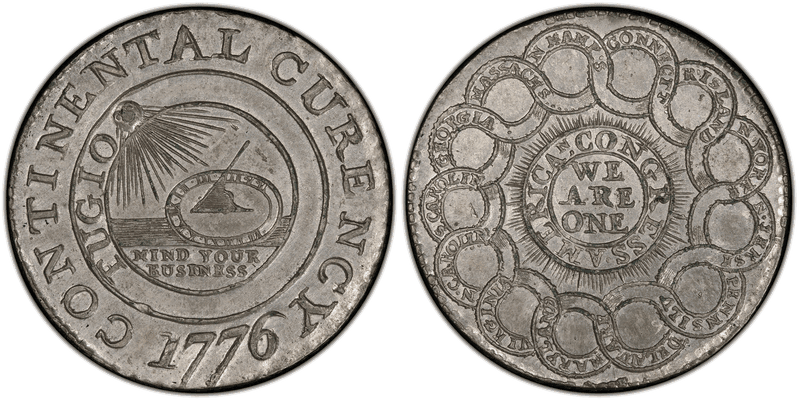
The Continental Currency pieces of 1776. In 1776 the Continental Congress was paying for the war with paper money and had almost no silver. Eric Newman found that Congress stopped printing $1 notes in the issue of July 22, 1776 and did not print them again until 1779, and he argued that a dollar coin was meant to take their place. The pieces dated 1776 copy the designs of the fractional notes of February 17, 1776: a sundial under the sun with FUGIO and MIND YOUR BUSINESS, and thirteen linked rings bearing the names of the states. Most were struck in pewter, a few in brass and silver. No act authorizing them has been found, and an article in The Numismatist in 2018 argued that they were souvenir tokens made in Britain Newman had concluded that they were made in America about July 1776.
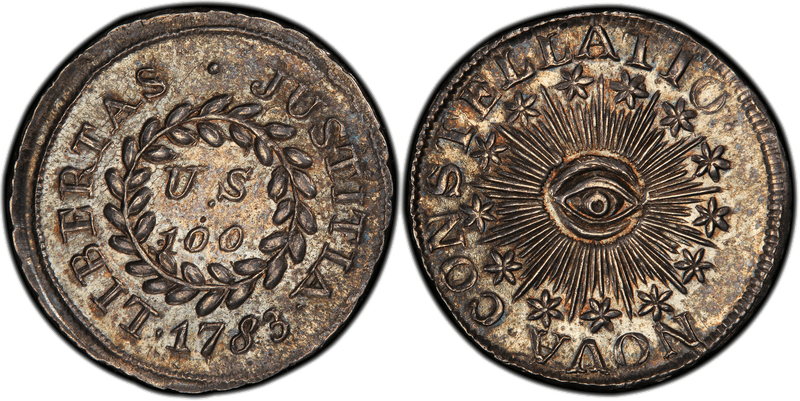
The Nova Constellatio patterns of 1783. Robert Morris became Superintendent of Finance in 1781. In January 1782 he sent Congress a plan, worked out by his assistant Gouverneur Morris, for a mint and a decimal coinage built on a unit equal to a quarter grain of silver. Benjamin Dudley, an English craftsman, prepared the mint, and in early 1783 John Jacob Eckfeldt and Abraham Dubois made dies in Philadelphia. On April 2, 1783 Dudley brought Morris the first silver piece, and on April 22 several pieces as patterns, which Morris laid before Congress. Congress took no action, and in August Morris told Dudley the mint would not go ahead. The patterns passed to Charles Thomson, Secretary of Congress, and to Thomas Jefferson, who wrote his own proposal for a decimal coinage based on the dollar.
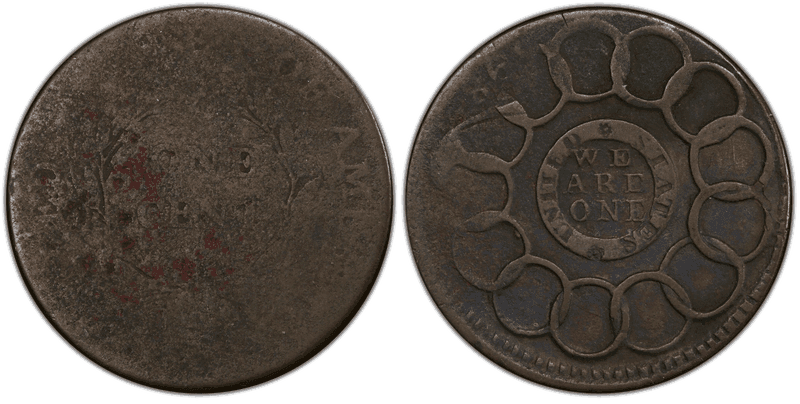
The Fugio cents of 1787. On April 21, 1787 Congress authorized the Board of Treasury to contract with James Jarvis for copper coin of the federal standard, and on July 6 it fixed the design: thirteen linked circles around UNITED STATES and WE ARE ONE, and a sundial under the sun with FUGIO, 1787 and MIND YOUR BUSINESS. Jarvis had bought into the Connecticut coining company, and Newman places the striking at New Haven; Charles Bushnell, quoted by Crosby, named Abel Buell as the die maker. In 1788 the Bank of New York put a keg of Fugio cents in its vault, and when the hoard was examined in 1948, 1,641 coins remained.
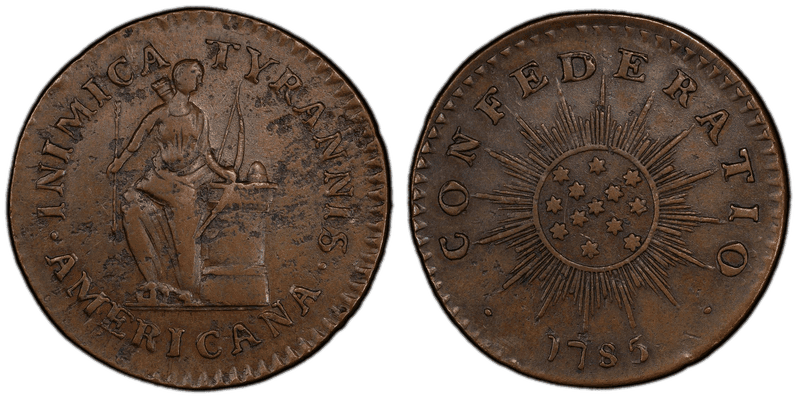
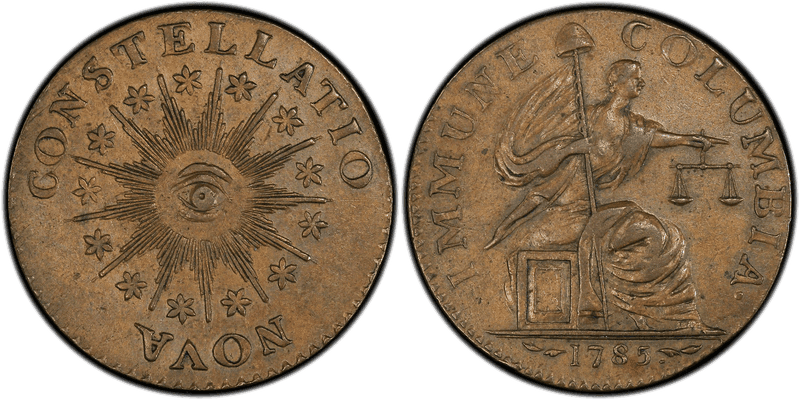
Immune Columbia and Confederatio. In the same years a group of coppers with national themes appeared whose purpose is not recorded. The 1785 IMMUNE COLUMBIA pieces pair the eye-and-stars die of the Nova Constellatio coppers with Liberty seated, holding scales; the CONFEDERATIO pieces of 1785 and 1786 show thirteen stars in a glory. Crosby believed Thomas Wyon of Birmingham cut most of these dies and thought some were offered as patterns for state or national coppers.