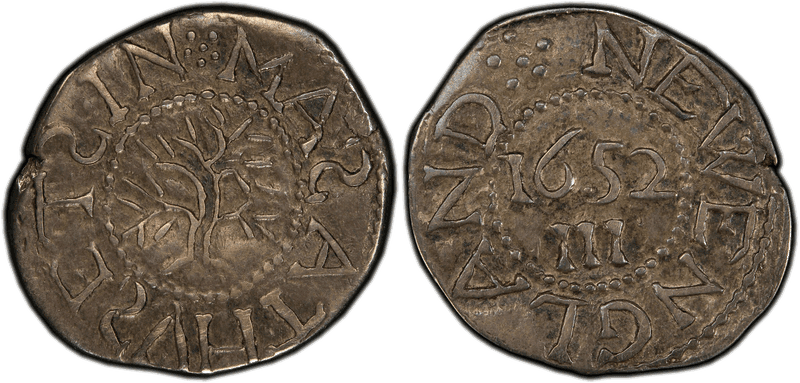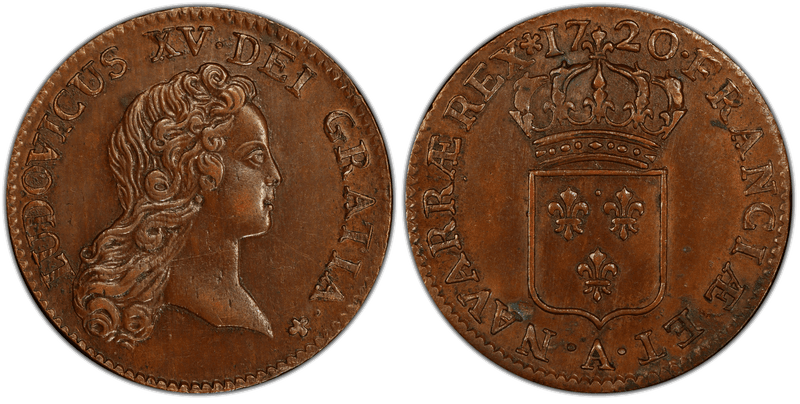
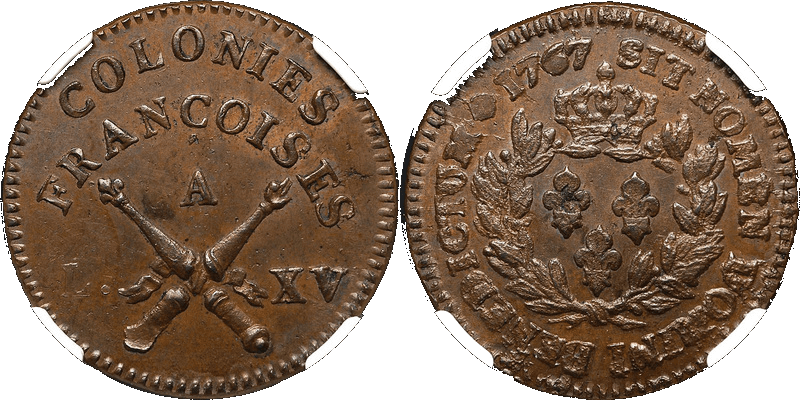


The coins in this series all came from the royal mints of France. Only a handful of issues were ordered with New France, Louisiana or the French islands in mind; the rest were coins of the kingdom that also crossed the Atlantic.
The first was the silver coinage of 1670. A decree of February 19, 1670, obtained by Colbert, set up a special coinage for the lands of the French West India Company: pieces of 15 and 5 sols in silver and copper doubles. The silver coins were struck at Paris that summer and are known as the Gloriam Regni pieces after their Latin legend. Writers gave them to Canada for more than three hundred years, but François Jambu's study of the French archives shows they were made for the West Indies, with some reaching Canada.
Later issues tried copper. An edict of December 1716 ordered copper pieces of 6 and 12 deniers for the colonies at Perpignan, and a royal edict of March 9, 1717 made them legal in Canada, but the copper sent to the mint was poor and the work stopped after trials. A second attempt followed after the John Law years, when Law's Compagnie des Indes held the right to coin money in France: an edict of June 1721 ordered a copper coinage for the colonies alone, and Rouen and La Rochelle struck nine-denier pieces dated 1721 and 1722 on Swedish planchets, inscribed COLONIES FRANÇOISES. Canada took few of them; Louisiana accepted them for a time. The last colonial issue was a copper sou approved in late 1766 and dated 1767, meant for the Lesser Antilles, which refused it. Guadeloupe later counterstamped its stock RF and used it during the Revolution.
Between these issues the colonies used the ordinary coins of the kingdom. The billon mousquetaires of 30 and 15 deniers (1709-1713) are long collected with colonial coins, though most stayed in France. The billon sou marqué of 24 deniers, created by an edict of October 1738, and its half were shipped to Canada in the 1740s and 1750s, and in 1763 the worn pieces were called in, counterstamped and sent to the islands.