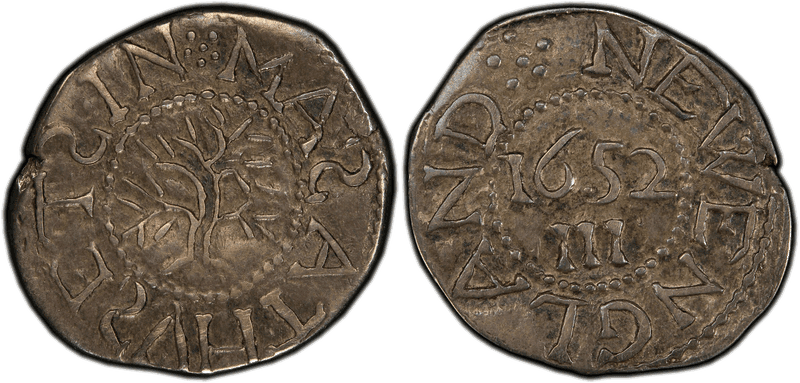
Before 1776 only a few colonies, or their proprietors, had coins made for them, and each case had its own story. This series holds three of them; the Massachusetts silver of 1652-1682 has its own series.
Maryland. Cecil Calvert, the second Lord Baltimore, took his 1632 charter, which did not mention coinage, as allowing him one and had shillings, sixpences and fourpences (groats) made in England for his colony some time before October 1659. The coins carry his bust and his crowned arms. They were of sterling silver but about a quarter lighter than English coins of the same value. On October 4, 1659, after a complaint by an officer of the Tower Mint, the Privy Council ordered Calvert's arrest as a false coiner, and he was heard the next day; no penalty is recorded. In April 1662 a Maryland law told each householder to exchange tobacco for the new money, which suggests an issue of about £2,500. A few copper pennies (denarii) are known and are thought to be patterns.
New Jersey. The St. Patrick coppers are older than their American story. Their maker is unknown: writers have placed them in the 1640s under Charles I or the Irish Confederates, while Michael Hodder dated them to about 1672-1675, and the Dublin arms on the larger piece point to Ireland. In 1681 the Quaker merchant Mark Newby left Dublin for West New Jersey with a quantity of the larger pieces, and in May 1682 the West Jersey Assembly made them current as halfpence. Newby died the next year, and his estate redeemed £30 of the coppers.
Virginia. Virginia asked for copper coin many times from the 1640s on. A royal warrant of May 20, 1773 finally allowed up to twenty-five tons of halfpence at the Tower Mint, 60 to the pound, and Eric Newman called them the only fully authorized coinage made for any of the colonies that became the United States. About five tons, some 672,000 coins, arrived in February 1774. The colony's treasurer held them back until a royal proclamation of November 16, 1774, and they were put out in 1775. A few proof pieces of 1773 and silver pieces dated 1774 come from the same work.