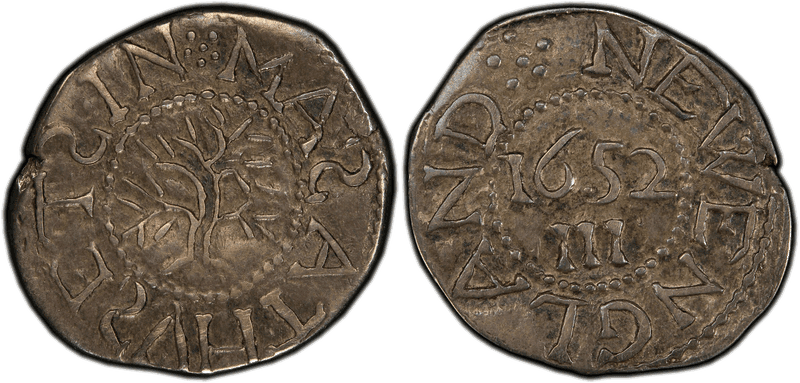
The years between independence and the opening of a working federal coinage left the states short of small change, and private makers filled part of the gap. In Annapolis the goldsmith John Chalmers struck silver shillings, sixpences and threepences dated 1783. A German traveller of the time, quoted by Crosby, wrote that the goldsmith coined on his own account and took in the cut fragments of Spanish dollars that had made ordinary trade awkward. In Baltimore a small silver threepence reading BALTIMORE TOWN JULY 4 90 bears the name of Standish Barry. See the Chalmers group and the Baltimore threepence.
Much of the copper in this group came from English makers who saw a market across the Atlantic. Crosby quotes Bushnell's notes that the Nova Constellatio coppers dated 1783 and 1785 were struck in Birmingham from dies cut by Wyon for a New York gentleman thought to be Gouverneur Morris, and that the Bar copper with its USA monogram was made there in 1785. The Nova Eborac coppers of 1787 carry New York's arms but, as Crosby points out, the state never authorized them. Closer to home, Thomas Machin, who had laid the chain across the Hudson at West Point for the Continental Army, opened a works near Newburgh, New York, in 1787 with coining as its main business; the imitation British halfpence filed under Machin's Mills are attributed to it and to related makers.
From 1789 merchants began to issue their own coppers. William and John Mott, watch and clock dealers of Water Street in New York, put out a token dated 1789 that Crosby calls the first American tradesman's token, made in England. Talbot, Allum & Lee, New York merchants in the India trade, followed with cents dated 1794 and 1795 from Birmingham dies. In 1790 the trustees of the First Presbyterian Church of Albany voted to have a thousand coppers stamped for the congregation (search).
The 1790s also brought tokens that used American themes without any American issuer. The Kentucky token with its pyramid of fifteen stars, the Auctori Plebis token and the Franklin Press token appear among English token plates of 1796. The tokens of 1796 payable by P. P. P. Myddelton, struck by Boulton and Watt, advertise a British settlement in Kentucky. The Theatre at New York penny was struck in London as a proof for collectors (search). The Castorland jeton was struck at the Paris Mint in 1796 for French settlers in northern New York.
The group closes with pieces from the edges of the country. The North West Company issued fur-trade tokens dated 1820, its last year before it merged with the Hudson's Bay Company (search). In Spanish Texas, copper half reales called jolas were made at San Antonio de Béxar in 1817 and 1818 (search). The 1776 Massachusetts and New Hampshire patterns and the North American token dated 1781 but struck later in Dublin are also filed here.