Colonial Restrikes and Fantasies

Coin Series
Colonial Restrikes and Fantasies series coin

About This Series

The 19th-century passion for collecting early American coins spawned a parallel industry of restrikes and fantasy pieces. This series holds copies, imitations and fantasies of colonial coins: Thomas Wyatt's copies of Massachusetts silver of about 1856 and later strikings from his dies, imitations listed by Sydney P. Noe in his Massachusetts silver studies, the "1650" Pine Tree shillings sold in the 1850s, Montroville W. Dickeson's Sommer Islands shilling copies and their mules, and a fantasy by John Adams Bolen. None is a colonial coin; each page names the genuine coin it imitates where the catalog has one.

Browse by Base(9 bases)

Showing all 9 listings

History

This series gathers copies, imitations and fantasies of colonial coins made for collectors in the nineteenth century, each on its own page beside a link, in its text, to the genuine coin it imitates.

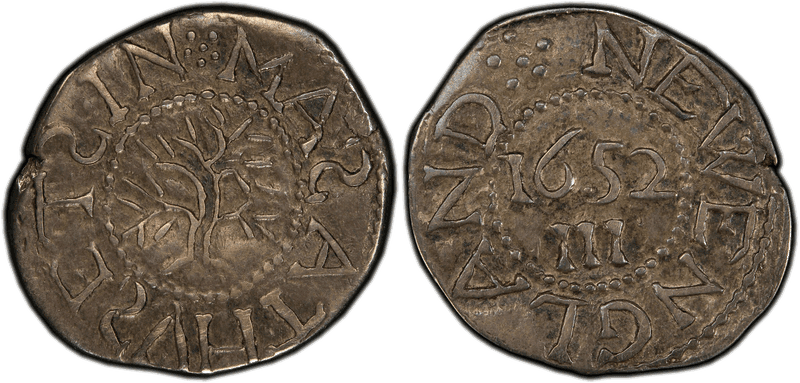
The largest group comes from Thomas Wyatt, a New York numismatist who had dies cut for copies of Massachusetts silver coins about 1856. When a run of newly "discovered" Massachusetts coins appeared that year, a Boston newspaper traced them to New York, and the Boston collector Jeremiah Colburn named a New Yorker with the initials T.W. Wyatt's first strikings were in silver, sold in sets that included an NE shilling and sixpence, Oak Tree shilling and twopence, Pine Tree sixpence, threepence and penny, and a Good Samaritan shilling. Edwin Bishop of New York later acquired the dies and struck copper pieces, and the Good Samaritan and Oak Tree mule is credited to him.

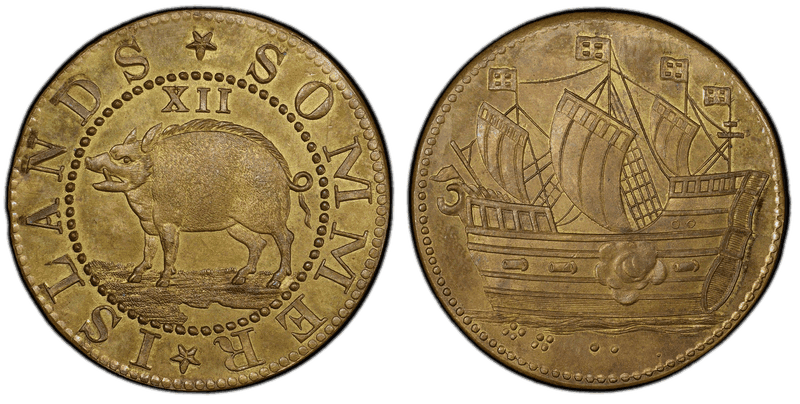
Other groups come from the same decade. Pine Tree shillings dated "1650" were offered to collectors in 1854, when a young man from Boscawen, New Hampshire showed several to Dr. Ammi Brown of Salem; the Stack's Bowers catalogue describes them as struck copies of about 1850. In Philadelphia, Montroville W. Dickeson struck copies of the Sommer Islands (Bermuda) shilling in the 1850s and paired the dies with others to make mules. In 1869 John Adams Bolen of Springfield, Massachusetts cut dies for a copy of the 1694 Carolina elephant token, and the series holds a Bolen fantasy with an elephant design.

How to Identify It

Maker and catalogue numbers. Sydney P. Noe's studies of the Massachusetts silver coinage list many of these pieces next to the genuine dies, with letters or numbers of their own (Noe-2, Noe-L, Noe-M, Noe-Y and so on), and Noe's plates mark the Wyatt pieces as counterfeits. Kenney's numbers and the Whitman (W-) numbers that PCGS uses also identify them, and the Dickeson copies and mules carry both in their titles, as in W-15480 Kenney-1.

Metal. Genuine Massachusetts coins are silver, so the copper strikings, such as the copper Oak Tree shilling Noe-2, are told apart by their metal alone. The silver Wyatt pieces, such as the silver Oak Tree shilling Noe-2, need comparison of the dies. The genuine Sommer Islands coins are a brassy copper with a thin silver wash; Dickeson's copies come in copper, brass, nickel and white metal.

Design and date. Some pieces give themselves away at once. Massachusetts struck no penny, so the Pine Tree penny is a denomination Wyatt added to his sets. No Massachusetts coin is dated 1650, since the mint was set up in 1652. Dickeson's Sommer Islands copy has stars in its legend where the originals have stops, and a puff of smoke beside the ship.

Key Types and Varieties

Composition

The metal is part of each piece's identity here, and each page names it where the PCGS listing does: silver, copper or bronze for the Massachusetts copies, imitations and fantasies; copper, brass, nickel, copper-nickel and white metal for the Dickeson copies and mules. Several pages, including the Noe imitations without a metal in their listing, leave the field empty rather than guess. None of these pieces has a recorded mintage.

In Our Catalog

No errors or varieties are listed for Colonial Restrikes and Fantasies yet. Submit one

FAQ

What is the difference between a copy, an imitation and a fantasy?

As the pages here use the words, a copy reproduces a known genuine coin from new dies, an imitation is a copy of uncertain origin that the references list beside the genuine dies, and a fantasy is a design or date that no genuine coin ever carried, such as a Pine Tree shilling dated 1650 or a Good Samaritan design muled with an Oak Tree die. A mule pairs two dies that were never meant to go together.

Who was Wyatt, and when were the Wyatt copies made?

Thomas Wyatt was a New York numismatist who had dies cut for copies of Massachusetts silver coins about 1856. In 1856 a Boston newspaper traced a run of newly "discovered" coins to New York, and the Boston collector Jeremiah Colburn named a New Yorker with the initials T.W. The first pieces were silver, sold in sets; copper strikings came later, after Edwin Bishop of New York acquired the dies. Older descriptions that place him in London are mistaken.

Was there ever a genuine Good Samaritan shilling?

No. The piece that the copies follow was made by altering a genuine Pine Tree shilling, and it is in the British Museum. The Red Book once listed it as a colonial coin, but Eric P. Newman's study The Secret of the Good Samaritan Shilling showed it to be a fabrication.

How can a Dickeson Sommer Islands copy be told from an original?

Dickeson's copies of the 1850s follow the Bermuda shilling closely but not exactly. Their legend uses stars where the originals have stops, the ship shows a puff of smoke from a firing cannon, and the copies are struck in copper, brass, nickel or white metal, while the originals are a brassy copper with a thin silver wash.

↑ Back to the coins: every year, mint, variety and error

Explore Other Denominations

Collector Essentials

Tools and references for building and protecting your coin collection.

As an Amazon Associate, NumisDex earns from qualifying purchases.