St. Gaudens Double Eagles 1907-1933

Coin Series
St. Gaudens Double Eagles 1907-1933 series coin

About This Series

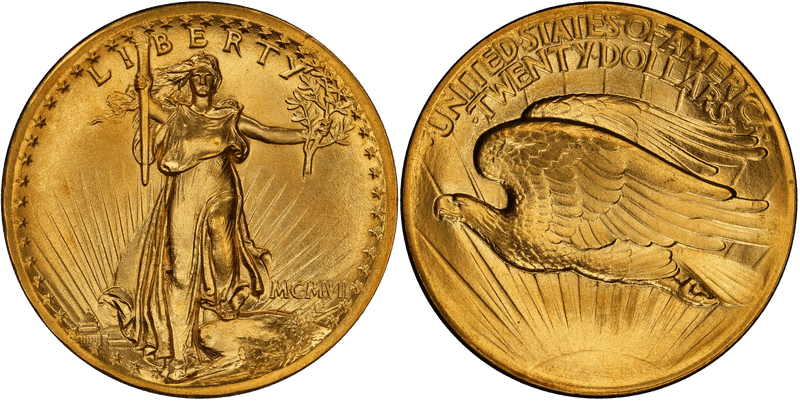
The Saint-Gaudens Double Eagle emerged from President Theodore Roosevelt's friendship with sculptor Augustus Saint-Gaudens and their shared conviction that American coinage should rival ancient Greek artistry. Roosevelt set the redesign in motion with a December 1904 letter to Treasury Secretary Leslie Shaw, and Saint-Gaudens died in August 1907, before his double eagle reached regular production. The obverse depicts a full-length Liberty striding forward with torch and olive branch against a radiant sunrise, while the reverse features a majestic eagle in flight. The original 1907 ultra high relief proved impractical for mass production, leading to a flattened version for regular coinage. The ultra high relief patterns took as many as nine blows of the press per coin and the MCMVII high relief about three; roughly 12,367 high relief coins were struck before the relief was lowered. Only one 1933 double eagle may legally be owned privately. The Mint struck 445,500 of them, but the gold recall that spring meant none left the Mint as money; two went to the Smithsonian in 1934 and nearly all the rest were melted. The series includes the MCMVII Roman-numeral High Relief and the 1927-D. The 1907 and early 1908 coins omit IN GOD WE TRUST; an Act of May 18, 1908 required the motto, creating the 1908 No Motto and With Motto varieties. Struck in .900 fine gold at 33.436 grams, each coin contains nearly one ounce of pure gold. Saint-Gaudens' vision transformed American coinage from mere money into enduring art.

From NumisDex News

Series Information

Production Years
1907-1933
Designer
Augustus Saint-Gaudens
Composition
90% Gold, 10% Copper
Weight
33.44g
Diameter
34mm

Browse by Base(24 bases)

Showing all 24 listings

History

On December 27, 1904, President Theodore Roosevelt wrote to Treasury Secretary Leslie Shaw that he found the nation's coins ugly and asked whether a sculptor like Augustus Saint-Gaudens could be hired to improve them. No American coin had ever been designed by anyone outside the Mint. Saint-Gaudens took the work despite years of friction with the Mint and with Chief Engraver Charles E. Barber, and Roosevelt, who admired the high-relief gold coins of ancient Greece, suggested that the new designs be in high relief too. Shaw objected to dating the coin in Roman numerals, and Roosevelt overruled him.

Saint-Gaudens was ill with cancer, and his assistant Henry Hering carried much of the work. The first dies, cut from his models early in 1907, gave about two dozen pieces that each needed as many as nine blows on the Mint's medal press, the coins now called the Ultra High Relief. A second, lower set still needed about three blows. Saint-Gaudens died on August 3, 1907. On November 18 an impatient Roosevelt ordered the Mint to strike from the second dies anyway, and more than 12,000 of these MCMVII High Relief coins went out in 1907 and 1908. Meanwhile Barber flattened the design so a coin could be struck with a single blow and changed the date to ordinary numerals, and 361,667 of his 1907 coins were released at the end of December.

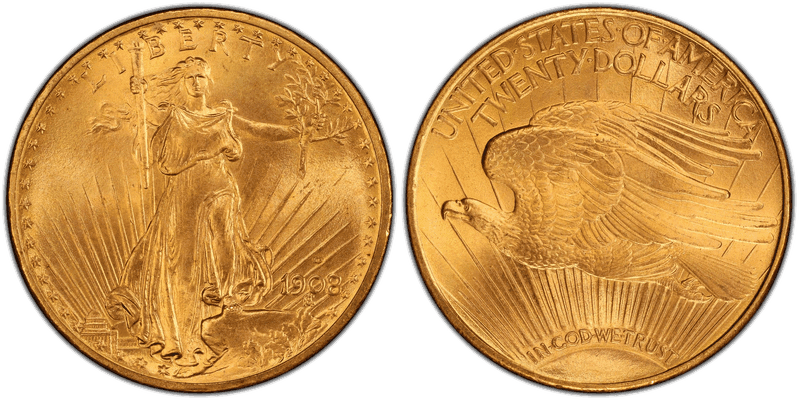
Roosevelt had asked that IN GOD WE TRUST be left off, and the omission caused an outcry. Congress restored the motto by an act of May 18, 1908 (search), so 1908 coins exist both without and with it. In 1912 two stars were added to the obverse for New Mexico and Arizona. Striking stopped after 1916, when wartime gold prices rose, and resumed in 1920, by which time the double eagle was mostly a coin for international settlements and for bank reserves rather than for spending.

That is why so many late dates are now hard to find. Double eagles that stayed in American vaults were melted after Franklin Roosevelt's 1933 gold recall, while those shipped to European and South American banks survived and have been coming home for decades. The Mint struck 445,500 double eagles dated 1933, but none were ever issued, and nearly all were melted.

How to Identify It

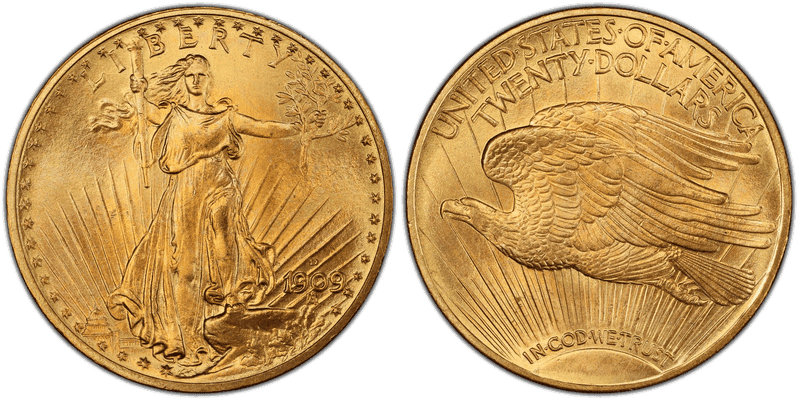
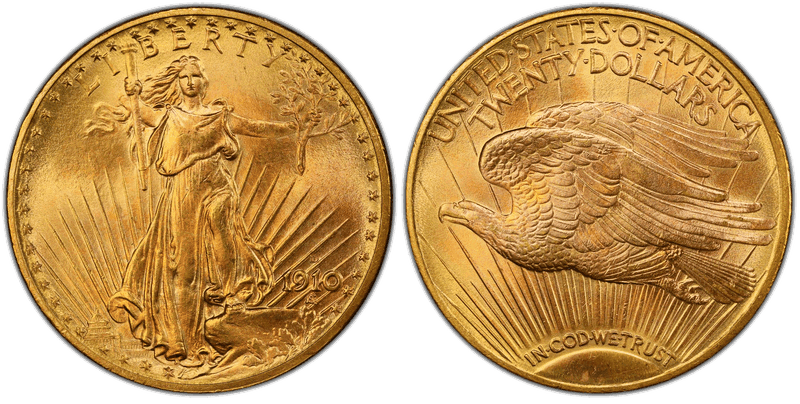
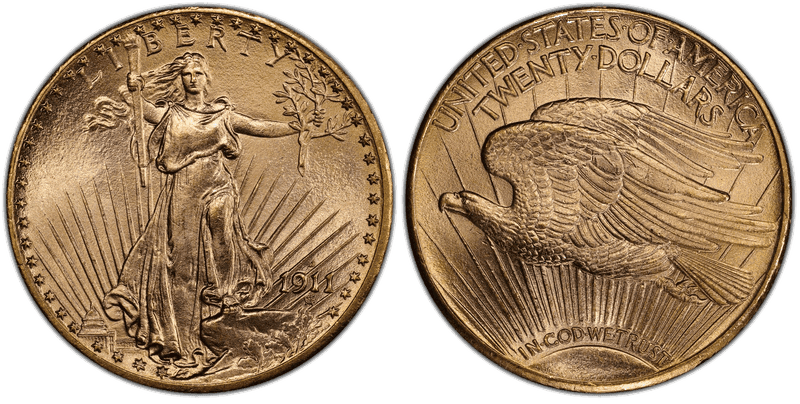
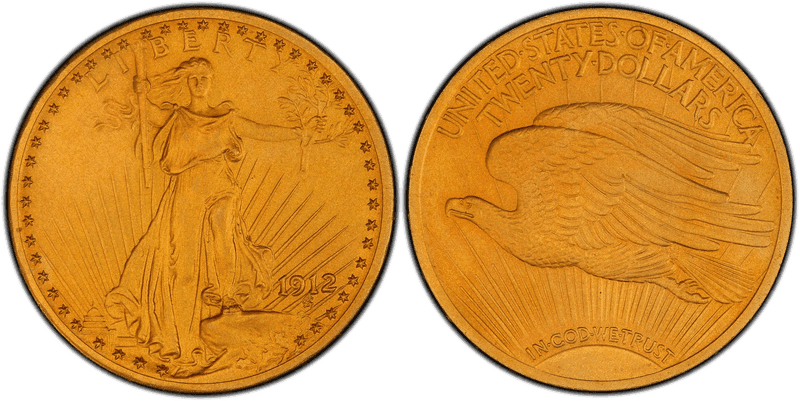
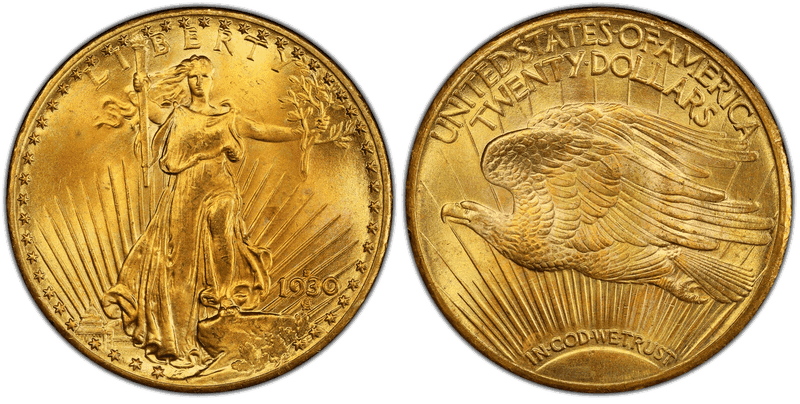
Obverse. Liberty strides forward across a rocky ledge, holding a torch in her right hand and an olive branch in her left, with the sun's rays and the Capitol behind her. A ring of stars surrounds the design: 46 through 1911 and 48 from 1912.

Reverse. An eagle in flight, seen from the side and slightly below, above a rising sun and its rays. From mid-1908 the motto IN GOD WE TRUST is added above the sun (search).

Edge. Lettered E PLURIBUS UNUM. That motto went on the edge because Saint-Gaudens did not want a third line of lettering on the reverse.

Mint mark. On the obverse, just above the date. D is Denver and S is San Francisco; Philadelphia coins have no letter.

Telling the 1907 versions apart.

VersionDateReliefHow many
Ultra High Relief (pattern)MCMVIIdeepest; up to nine blows of the pressabout two dozen made
High ReliefMCMVIIhigh; about three blowsmore than 12,000
Regular (Barber's)1907low; one blow361,667

Things that cause confusion.

  • No Motto and Motto 1908. Philadelphia and Denver struck both kinds in 1908. San Francisco's 1908 coins all carry the motto.
  • Wire Rim and Flat Rim. Garrett describes the two High Relief kinds as the same apart from a thin raised edge of metal at the rim on the Wire Rim coins, probably a by-product of the Mint's struggle to strike so deep a design.
  • Proof finishes. Saint-Gaudens proofs do not have mirrored fields. Those of 1908 and 1911 to 1915 have a grainy matte (sandblast) finish, and those of 1909 and 1910 a brighter satin (Roman) finish.
  • Later issues of the design. The American Gold Eagle bullion coins since 1986 use Saint-Gaudens's obverse, and the Mint issued gold pieces with the Ultra High Relief design in 2009 and 2026. They are not double eagles of this series.

Key Dates and Varieties

  • 1907 Ultra High Relief: struck early in 1907 as patterns. Wikipedia says about 24 were made and about 20 are known, and Jeff Garrett (NGC) counts 14 or 15. The first piece has a plain edge, because its die cracked before edge lettering was added, and two have the edge lettering inverted. Three are in the Smithsonian.
  • 1907 High Relief (MCMVII): the second dies, with the Roman-numeral date and no motto. Wikipedia puts the number struck at more than 12,000 and USA Coin Book at 12,367. Coins come with a Wire Rim or a Flat Rim, and a group with satiny, die-polished surfaces has been graded as proof or specimen since about the late 1960s, though no mintage was recorded for them.
  • 1907: 361,667 of Barber's low-relief version, released in the last days of 1907.
  • 1908 No Motto and Motto. Philadelphia struck 4,271,551 without the motto and 156,258 with it; Denver struck 663,750 without and 349,500 with. The 1908-S, all with the motto, had 22,000 struck. A hoard of 19,900 1908 No Motto coins, the Wells Fargo Hoard, came to light in the 1990s.
  • 1909/8: an overdate made when a 1908 die was given a 1909 date from the hub. Edgar Adams published it in The Numismatist in 1910, and perhaps half of the 161,282 Philadelphia coins of 1909 show it. The 1909-D had 52,500 struck.
  • 1911-D D/D: a repunched mint mark, the D punched twice with the second slightly east, listed by Wexler as WRPM-001.
  • 1913-S: 34,000 struck.
  • 1920-S (558,000) and 1921 (528,500): nearly all were melted in the 1930s, and Garrett knows of none from the overseas hoards. Two 1921 coins with a Roman finish have turned up, one traced to Mint Director Raymond T. Baker.
  • 1924: 4,323,500 struck. Collectors long believed few had survived, until large numbers came back from European bank vaults.
  • 1925-S (3,776,500), 1926-D (481,000) and 1927-S (3,107,000): large mintages, but few were released or exported, and most were melted. Wikipedia counts fewer than a thousand 1925-S coins and Garrett about 200 of the 1927-S.
  • 1927-D: 180,000 struck. None has turned up in the European or South American hoards, the Smithsonian holds three, and Garrett warns that counterfeits with an added D exist.
  • The last dates. The 1929 (1,779,750), 1930-S (74,000), 1931 (2,938,250), 1931-D (106,500) and 1932 (1,101,750) were almost all melted. Wikipedia estimates fewer than 2,000 1929 coins survive, and Garrett fewer than 100 each of the 1930-S, 1931 and 1932.
  • 1933: 445,500 struck from March to May 1933 and never issued. Two went to the Smithsonian. Others left the Mint unofficially, through the Philadelphia jeweler Israel Switt, and from 1944 the Secret Service seized nine, which were destroyed. One had already gone abroad to King Farouk of Egypt with an export license. The coin seized in New York in 1996, which its seller said came from Farouk's collection, was formally monetized under a 2001 settlement and is the only one that may be privately owned. In September 2004 Switt's daughter, Joan Langbord, turned over ten more, which the Mint announced in August 2005; the courts ruled in the government's favor, and the case ended in 2017.

Proofs. Philadelphia struck proofs for collectors from 1907 to 1915, such as 101 1908 Motto proofs with a matte finish and 67 1909 and 167 1910 with a satin finish. A single 1910 coin with a different, brighter finish surfaced as a new find and was given its own PCGS number.

In Our Catalog

3 errors and varieties are listed for this series. Browse them by type:

Recently added

Mintages

St. Gaudens Double Eagles 1907-1933 mintages by year and mint, taken from each coin's page in our catalog. Each figure opens that coin's page, which lists its varieties and errors. A dash means no figure was recorded. Where one issue was struck in more than one type, each type is listed.

Composition and Gold Content

  • Composition: 90% gold, 10% copper
  • Weight: 516 grains (33.436 grams)
  • Gold content: 0.9675 troy ounce
  • Diameter: 34 mm
  • Edge: lettered E PLURIBUS UNUM
  • Designer: Augustus Saint-Gaudens; relief lowered by Charles E. Barber in 1907, who also added the motto in 1908

FAQ

Where is the mint mark on a Saint-Gaudens double eagle?

On the obverse, just above the date. You will find D (Denver) or S (San Francisco). Philadelphia coins have no mint mark.

How much gold is in a Saint-Gaudens double eagle?

Each coin weighs about 33.44 grams (516 grains) and is 90% gold and 10% copper, so it holds 0.9675 troy ounce of pure gold, the same as the Liberty Head double eagle it replaced.

What is the difference between the Ultra High Relief, the High Relief and the regular 1907 double eagle?

All three carry Saint-Gaudens's design. The Ultra High Relief pieces of early 1907 are patterns that needed up to nine blows of a medal press each, and only about two dozen were made. The High Relief coins, dated MCMVII in Roman numerals, took about three blows and were released at the end of 1907 and in 1908. Charles Barber then lowered the relief so a coin could be struck with one blow, and that version, dated 1907 in ordinary numerals, was struck by the hundreds of thousands.

What is the difference between No Motto and Motto double eagles?

Roosevelt wanted IN GOD WE TRUST left off, so the 1907 coins and the first 1908 coins from Philadelphia and Denver have no motto. Congress ordered it restored by an act of May 18, 1908, and from then on the motto appears on the reverse.

Is it legal to own a 1933 double eagle?

Only one. The Mint struck 445,500 of them but never issued any, and nearly all were melted. The government treats every other 1933 double eagle as stolen property. The single exception is the coin seized in New York in 1996, which the Treasury formally monetized in a 2001 settlement before it was sold the next year.

Why are double eagles from the late 1920s and early 1930s so hard to find when the Mint struck millions?

Most of them never left government and bank vaults. After the gold recall of 1933, the Treasury melted them by the millions, so dates such as the 1929, 1931 and 1932 survive mainly in small numbers saved by collectors or sent abroad. Coins shipped to European banks before then escaped the melting and many have since come home.

↑ Back to the coins: every year, mint, variety and error

Explore Other Denominations

Collector Essentials

Tools and references for building and protecting your coin collection.

As an Amazon Associate, NumisDex earns from qualifying purchases.