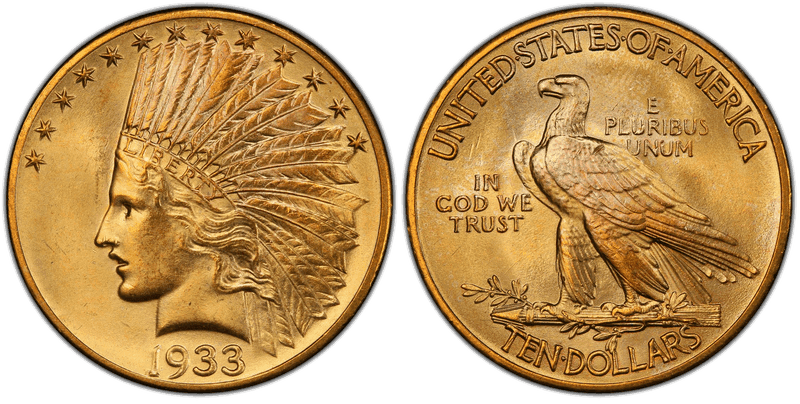
Indian Head Eagles 1907-1933

Coin Series
Indian Head Eagles 1907-1933 series coin

About This Series

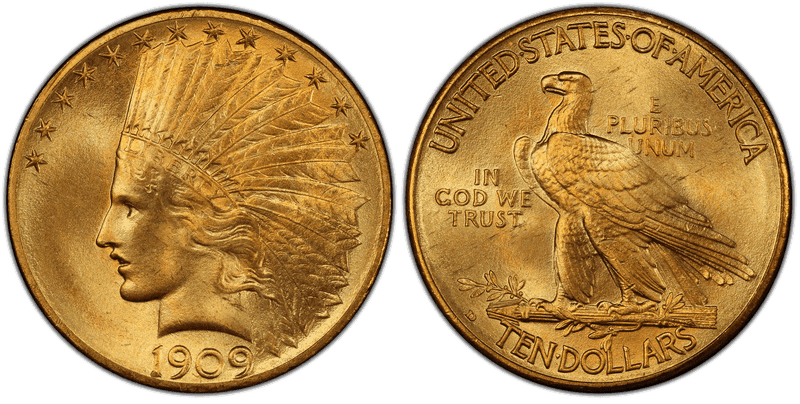
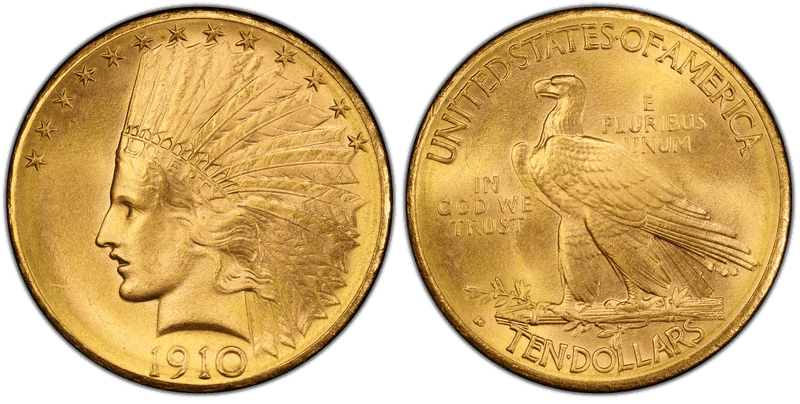
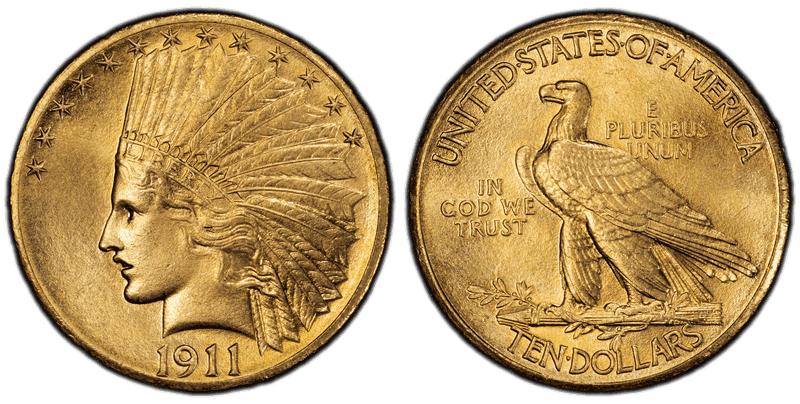
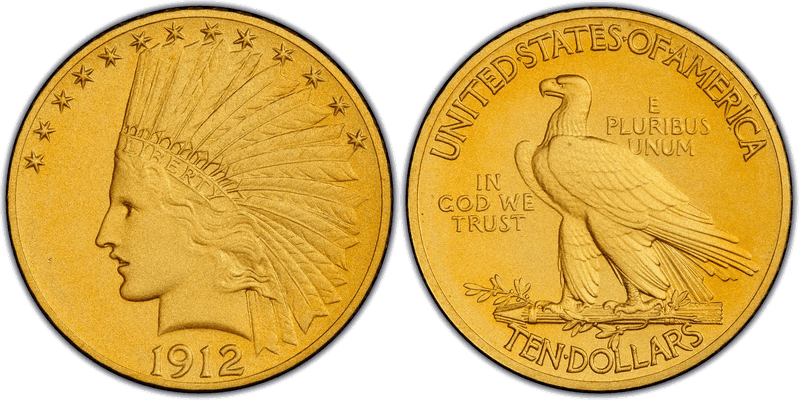
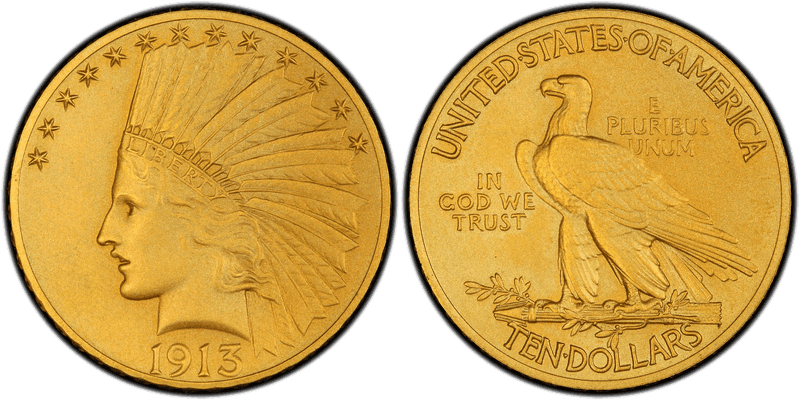
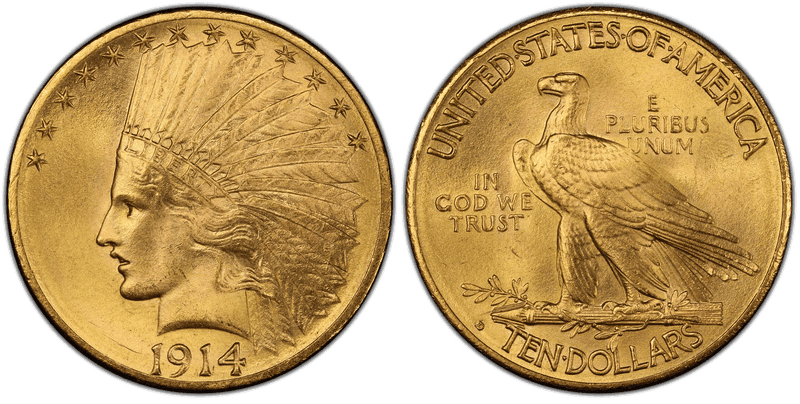
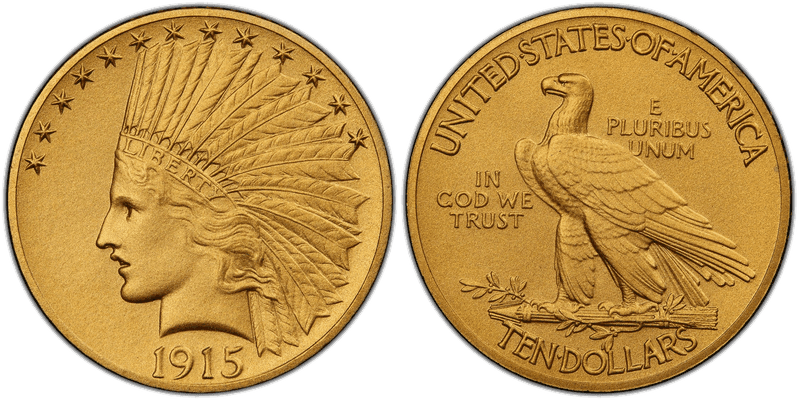
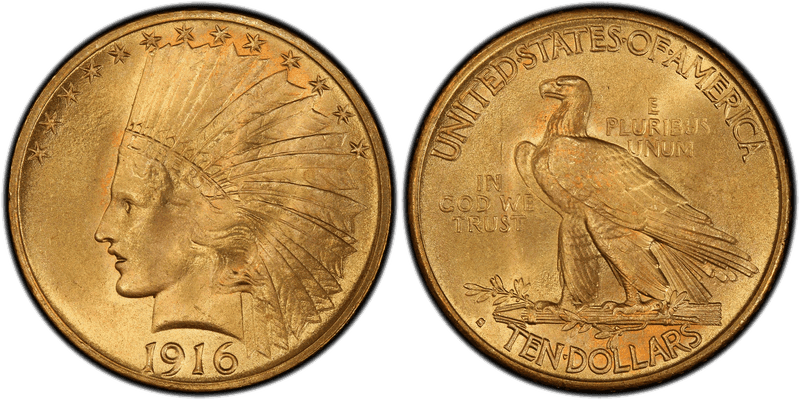
The final work of Augustus Saint-Gaudens, the Indian Head eagle was part of President Theodore Roosevelt's crusade to elevate American coinage artistry. The obverse depicts Liberty wearing a feathered war bonnet, a choice that drew both admiration and criticism. Liberty's head was adapted from a study Saint-Gaudens made for the Victory of his Sherman Monument, and the standing eagle closely follows his 1905 inaugural medal for Roosevelt. The original 1907 issues omitted IN GOD WE TRUST by Roosevelt's direction, as he considered the motto irreverent on coins; Congress mandated restoration in 1908, creating Without Motto and With Motto subtypes. Struck in .900 fine gold at 16.718 grams and 27 mm, the coin is in conventional raised relief; the incuse designs of the same era are Bela Lyon Pratt's quarter and half eagles. Production occurred at Philadelphia, Denver, and San Francisco. Of the 312,500 eagles dated 1933, nearly all were melted after the gold recall; about forty survive, and unlike the 1933 double eagle it is legal to own. Gold coinage for circulation ended in 1933, making this the last circulating $10 gold coin in U.S. history.

From NumisDex News

Series Information

Production Years
1907-1933
Designer
Augustus Saint-Gaudens
Composition
90% Gold, 10% Copper
Weight
16.72g
Diameter
27mm

Browse by Base(15 bases)

Showing all 15 listings

History

Theodore Roosevelt thought American coins lacked artistic merit, and in 1904 the Mint engaged the sculptor Augustus Saint-Gaudens to give new designs to the four gold coins and the cent. Roosevelt asked for a feathered Indian headdress on Saint-Gaudens's head of Liberty, which had been modeled for the cent, and in May 1907 the Mint settled that the eagle would carry that head with a standing eagle on the reverse. The head came from a model Saint-Gaudens had made, and not used, for the figure of Victory on his Sherman Monument in New York. The eagle had first been planned for the double eagle and closely resembles the reverse of the medal he made for Roosevelt's 1905 inauguration.

Saint-Gaudens was dying of cancer and passed away on August 3, 1907, before any coins were issued. Roosevelt ordered the eagle into production within weeks. The Mint, unable to strike the high-relief design in one blow on a coining press, made about 500 pieces on its medal press from the sculptor's original dies; these have a sharp edge with no true rim and are called Wire Rim coins. Barber then added a rounded rim to stop metal squeezing out at the edge, and some 32,000 Rolled Rim coins followed. On November 9, 1907 the new Mint Director, Frank Leach, had all but about fifty of them melted, because dies from lower-relief models finished by Saint-Gaudens's assistant Henry Hering were now in production. Those final coins, which lack the small periods of the earlier two, entered circulation around November 4, 1907.

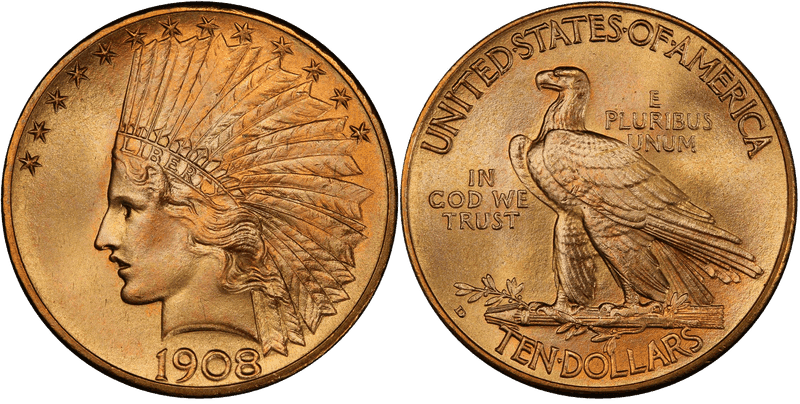
The design left off IN GOD WE TRUST. Roosevelt considered the motto irreverent on money, and no law required it, but the omission caused a public outcry. Congress ordered the motto restored in May 1908, and Barber fitted it into the reverse field beside the eagle's breast, on the left. Philadelphia and Denver struck eagles both with and without the motto that year.

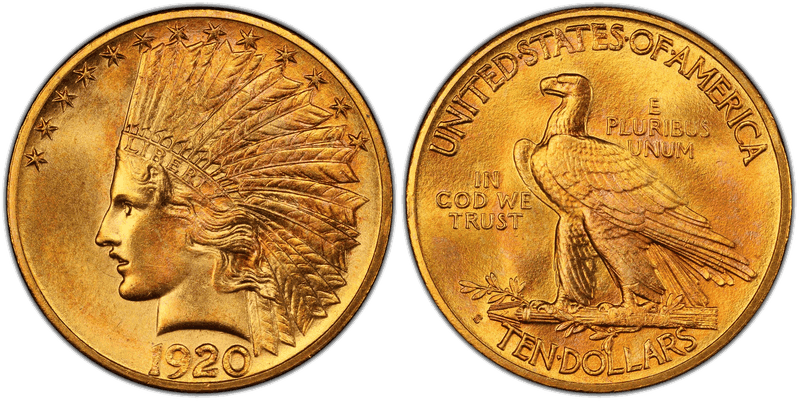
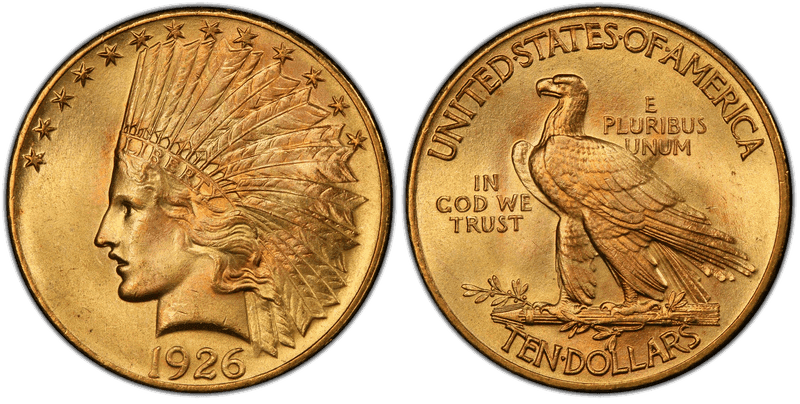
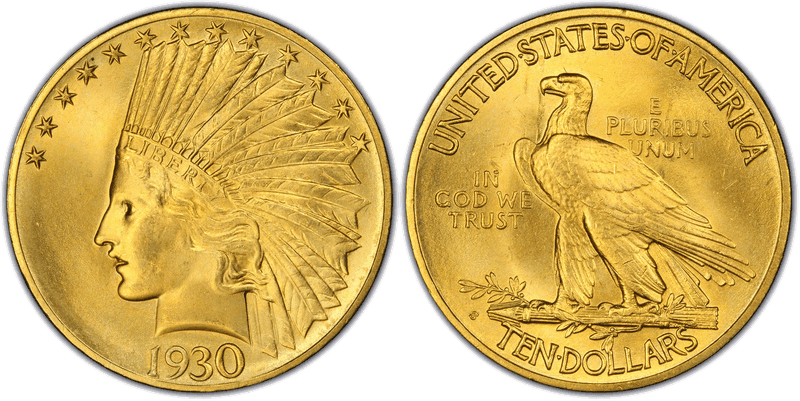
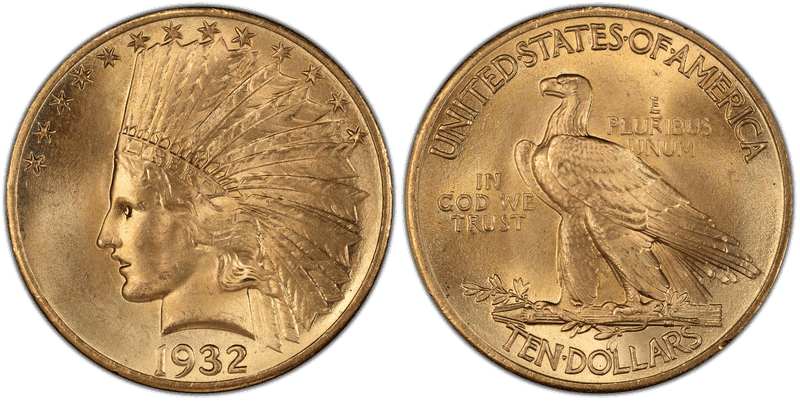
Eagles were struck every year through 1916. During World War I gold coins traded above face value and there was little need for new ones, so coinage stopped, and later issues came only in 1920 (San Francisco), 1926 (Philadelphia), 1930 (San Francisco), 1932 and 1933 (Philadelphia). In March 1933 Franklin Roosevelt halted the paying out of gold coins, and Executive Order 6102 of April 5 required them to be handed in, with exceptions for small amounts and for coins of special value to collectors. The Treasury melted millions of gold coins in the following years, including most of the 1920-S, 1930-S and 1933 eagles. Many of the gold coins known today, eagles among them, had been shipped to Europe before 1933 and came back later.
How to Identify It

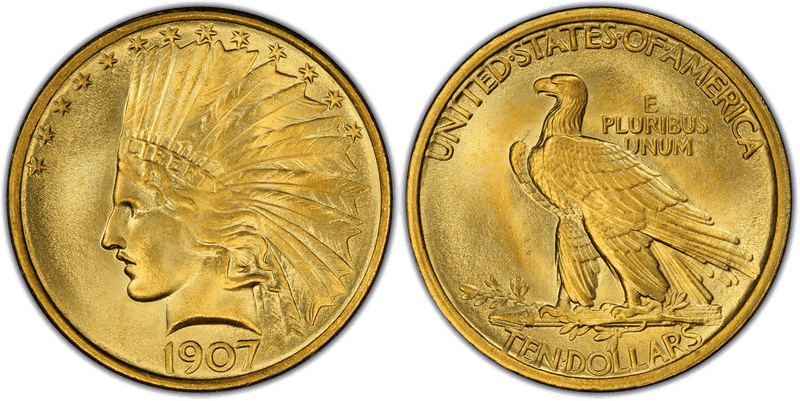
Obverse. Liberty faces left wearing a feathered Indian war bonnet with LIBERTY on its band. Thirteen stars arc across the top, and the date is below. Despite the headdress, the figure is Saint-Gaudens's Liberty, not a portrait of a Native American; the Native American man appears on Pratt's $2.50 and $5 coins.

Reverse. A standing eagle faces left, its feet on a sheaf of arrows that an olive branch twines through. The legend across the top reads UNITED STATES OF AMERICA, the value TEN DOLLARS is at the bottom, and E PLURIBUS UNUM sits at upper right. From mid-1908 the motto IN GOD WE TRUST occupies the left field, in front of the eagle's breast.

Edge. Raised stars instead of reeding: 46 from 1907 to 1911, 48 from 1912.

Mint mark. On the reverse. On motto coins, left of the arrows under the eagle; on the 1908-D No Motto, above the olive leaves near the eagle's feet. D is Denver, S is San Francisco; Philadelphia coins have none.

Telling the 1907 and 1908 types apart.

TypeRimPeriods on reverseMottoMint
1907 Wire RimSharp, no true rimYesNoPhiladelphia
1907 Rolled RimRoundedYesNoPhiladelphia
1907-1908 No MottoNormalNoNoPhiladelphia, Denver (1908)
1908-1933 MottoNormalNoYesPhiladelphia, Denver, San Francisco

Things that cause confusion.

  • Liberty or Indian. The $10 head is Liberty in a headdress; the $2.50 and $5 coins of 1908-1929 show a Native American man and have their whole design sunk into the coin. The $10 is in raised relief.
  • 1908 with or without the motto. Check the field left of the eagle. Both kinds exist for 1908 Philadelphia and 1908-D; every 1908-S has the motto.
  • Wire Rim or Rolled Rim. Both have periods. The Wire Rim's field meets the edge at a sharp angle; the Rolled Rim has a rounded border.

Key Dates and Varieties

  • 1907 Wire Rim: about 500 struck on the medal press, most given to officials. CoinWeek notes that figures of 500 to 550 have been cited.
  • 1907 Rolled Rim: of some 32,000 struck, Roger Burdette's account has about fifty saved from the melt; Jeff Garrett at NGC gives 42.
  • 1907 Rolled Rim proof: a satin-finish proof of the Rolled Rim design. Wikipedia, after Garrett and Guth, calls it unique; Jeff Garrett's NGC note describes two nearly identical specimen strikes, one from the estate of Mint Director Leach.
  • 1907: 239,406 of the regular No Periods coins.
  • 1908 No Motto (33,500) and 1908-D No Motto (210,000), with the 1908 Motto (341,370) and 1908-D Motto (836,500): the year of the motto change.
  • 1911-D: 30,100 struck at Denver.
  • 1920-S: 126,500 struck. Few were exported and most were melted after 1933, according to Garrett and Guth.
  • 1930-S: 96,000 struck. NGC says eagles were hardly needed after the large 1926 coinage, few of these entered circulation, and most were melted.
  • 1933: 312,500 struck, nearly all melted before release. Mike Fuljenz counts about forty survivors.
  • Proofs: Philadelphia made proofs from 1907 to 1915. NGC records 116 for 1908 (catalogued here in matte and satin finishes), 204 for 1910 and 50 for 1914. Most have a dark matte finish; NGC and Wikipedia describe a brighter "Roman gold" finish on some 1908-1910 coins.

In Our Catalog

No errors or varieties are listed for Indian Head Eagles 1907-1933 yet. Submit one

Mintages

Indian Head Eagles 1907-1933 mintages by year and mint, taken from each coin's page in our catalog. Each figure opens that coin's page, which lists its varieties and errors. A dash means no figure was recorded. Where one issue was struck in more than one type, each type is listed.

Composition and Gold Content

  • Composition: 90% gold, 10% copper
  • Weight: 16.718 grams
  • Gold content: about 0.4838 troy ounce
  • Diameter: 27 mm (Wikipedia gives 26.92 mm)
  • Edge: 46 raised stars (1907-1911), 48 (1912-1933)
  • Designer: Augustus Saint-Gaudens

The weight and fineness are those of the Liberty Head eagle it replaced. Only the design and the starred edge were new.

FAQ

Where is the mint mark on an Indian Head $10 gold eagle?

On the reverse. On coins with the motto, it sits just left of the arrows the eagle stands on. On the 1908-D without the motto, it is above the olive leaves near the eagle's feet. You will find D (Denver) or S (San Francisco); Philadelphia coins have no mint mark, and every 1907 eagle is from Philadelphia.

How much gold is in an Indian Head $10 gold piece?

Each coin weighs about 16.72 grams and is 90% gold and 10% copper, so it holds about 0.4838 troy ounce of pure gold.

What is the difference between the 1907 Wire Rim, Rolled Rim and No Periods eagles?

The Wire Rim and Rolled Rim coins have small periods before and after the reverse legends. About 500 Wire Rim coins were struck on a medal press from Saint-Gaudens's original dies, with a sharp edge and no true rim. The Rolled Rim coins have a rounded rim Barber added; nearly all were melted in November 1907. The No Periods coins, struck from the lower-relief final dies, are the regular 1907 issue (239,406).

Why do some Indian Head eagles not have IN GOD WE TRUST?

Theodore Roosevelt thought putting God's name on money was irreverent, and no law then required the motto, so Saint-Gaudens left it off. After public protest, Congress passed a law in May 1908 ordering it restored. Eagles of 1907 and the early 1908 and 1908-D coins have no motto; later 1908 coins and all after carry IN GOD WE TRUST in the left field, in front of the eagle.

Is it legal to own a 1933 Indian Head eagle?

Yes. Unlike the 1933 double eagle, the 1933 eagle's legal status has never been challenged, according to Jeff Garrett at NGC. Of 312,500 struck, a handful were paid out before gold coin payments stopped in 1933, and about forty are known today, by Mike Fuljenz's count.

How many stars are on the edge of an Indian Head eagle?

The edge has raised stars instead of reeding, one for each state. Coins from 1907 to 1911 have 46 stars; from 1912, after New Mexico and Arizona joined the Union, they have 48.

↑ Back to the coins: every year, mint, variety and error

Explore Other Denominations

Collector Essentials

Tools and references for building and protecting your coin collection.

As an Amazon Associate, NumisDex earns from qualifying purchases.