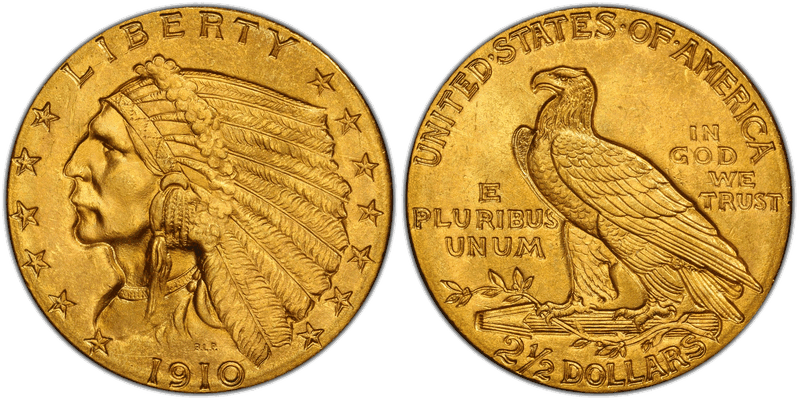
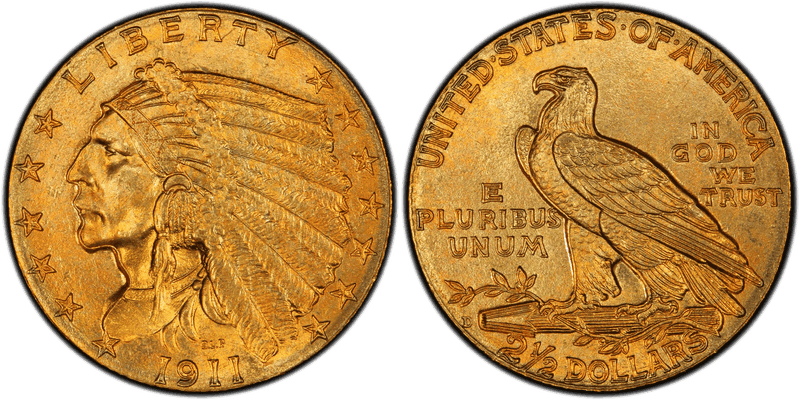
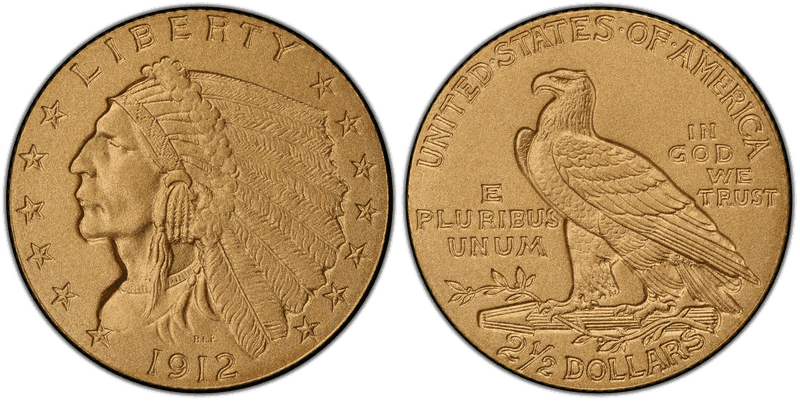
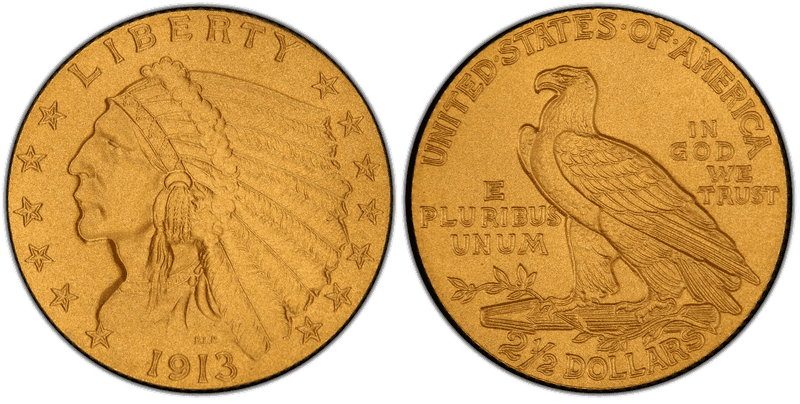
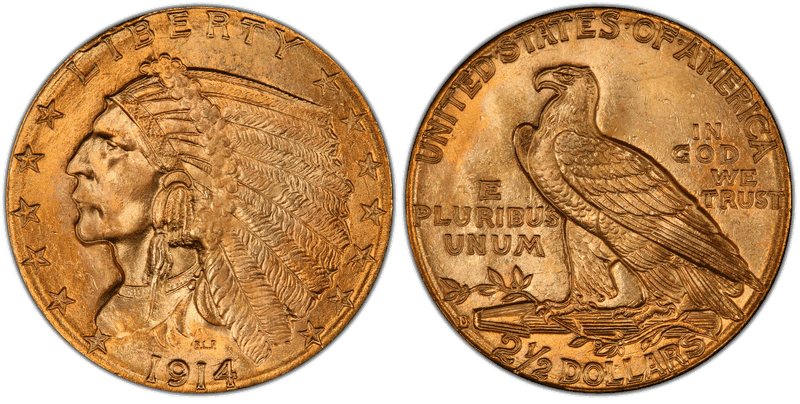

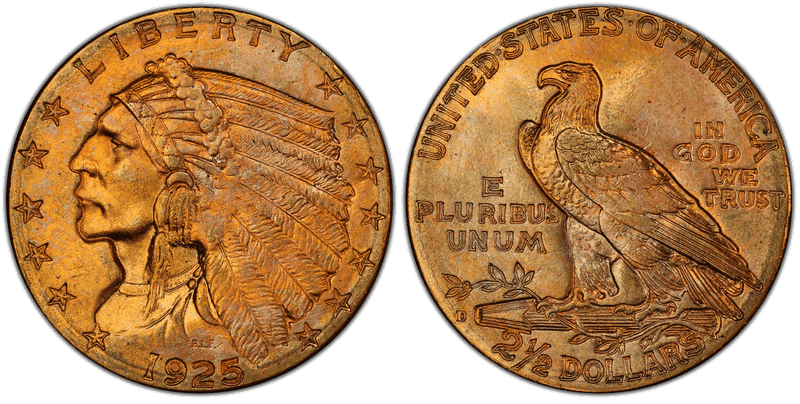
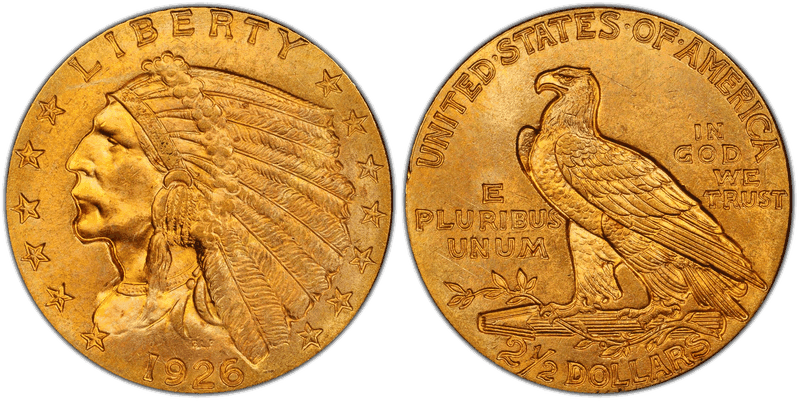
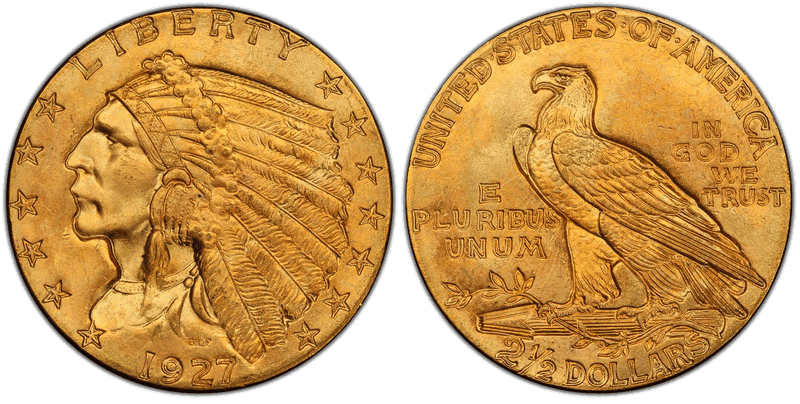
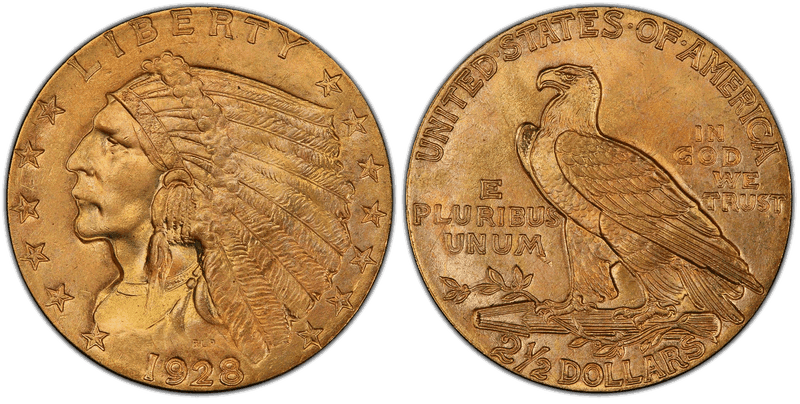
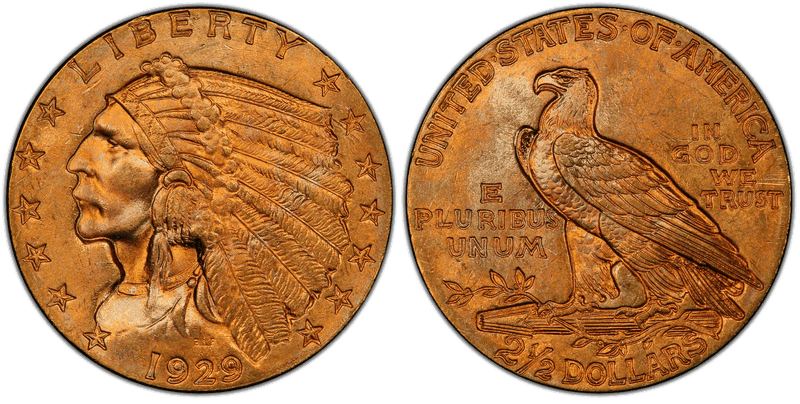
President Theodore Roosevelt began pressing for better-looking American coins in 1904, and the Mint hired the sculptor Augustus Saint-Gaudens to give new designs to the four gold coins and the cent. Saint-Gaudens died in August 1907 having finished only the $10 and $20 designs. The Mint then planned to shrink his double eagle design onto the $2.50 and $5 pieces, but Chief Engraver Charles E. Barber struggled to fit the required legends on such small coins.
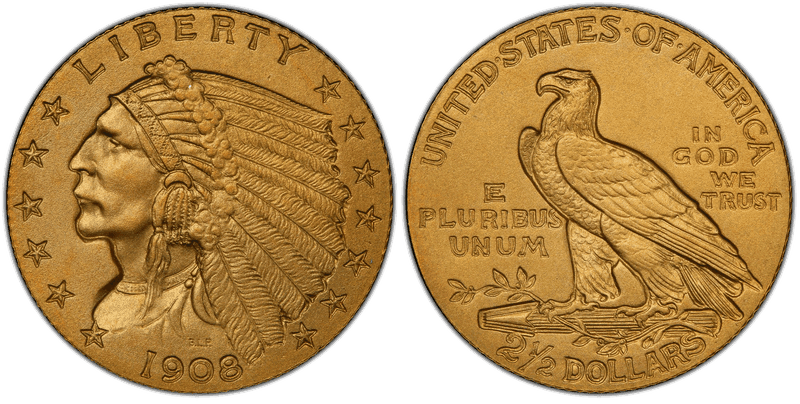
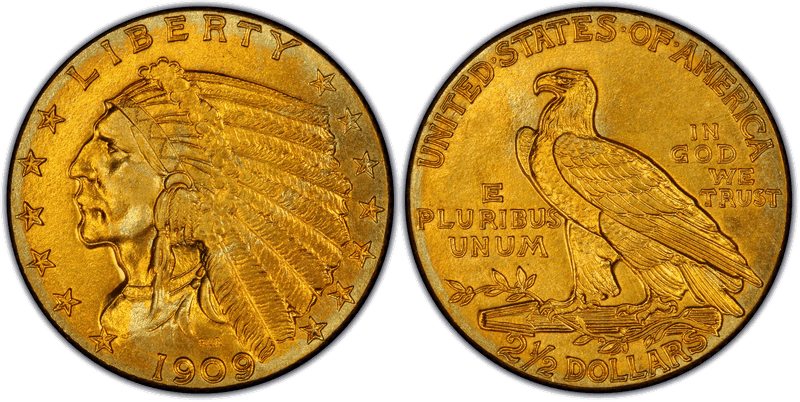
A different idea came from Dr. William Sturgis Bigelow, a Boston friend of the President. In January 1908 he wrote to Roosevelt that he was working with the Boston sculptor Bela Lyon Pratt on a coin whose design would be sunk below a flat surface. Such a coin would stack evenly and protect its design from wear. CoinWeek notes that Bigelow had admired Egyptian reliefs of this kind. At a White House lunch on April 3, 1908, Roosevelt and Bigelow won over Mint Director Frank Leach, who dropped the double eagle plan. Pratt based his obverse on Saint-Gaudens's $10 piece but used a Native American man rather than Liberty, and he adapted Saint-Gaudens's standing eagle for the reverse. Barber then reworked the models, to Pratt's great annoyance.
The new quarter eagles reached circulation in early November 1908. Within weeks the Philadelphia dealer Samuel Chapman wrote to the President that the sunken design would collect dirt and germs, would be easy to counterfeit, would not stack, and showed an Indian who looked "emaciated." Bigelow answered him in a letter, and the design stayed.
Leach planned for the quarter eagle to be coined only at Philadelphia, and it was until Denver struck the 1911-D. Small gold pieces were popular as Christmas presents, bought from banks in December. Production stopped after 1915: banknotes were spreading after the Federal Reserve opened in 1913, and World War I drew gold out of circulation. When demand for gift coins returned, the Treasury still held its prewar stock, so the next quarter eagles were the 1925-D, followed by Philadelphia coins from 1926 to 1929. The Depression ended demand, and none were struck after 1929.
In 1933 President Franklin Roosevelt stopped the Treasury from paying out gold coin, and Executive Order 6102 of April 5 required gold coins to be turned in, with exceptions for small amounts and for coins of special value to collectors. Coins never released, and many that came back from banks and the public, were melted in the mid-1930s.