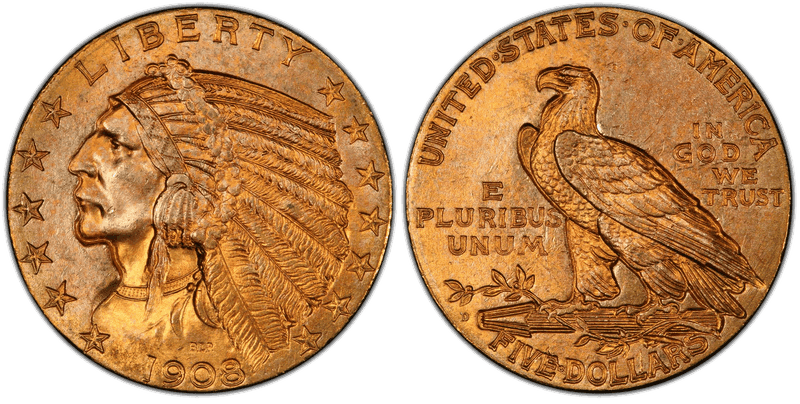
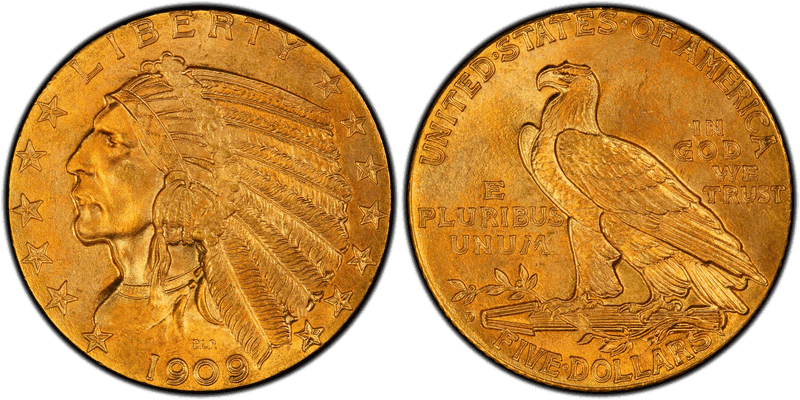
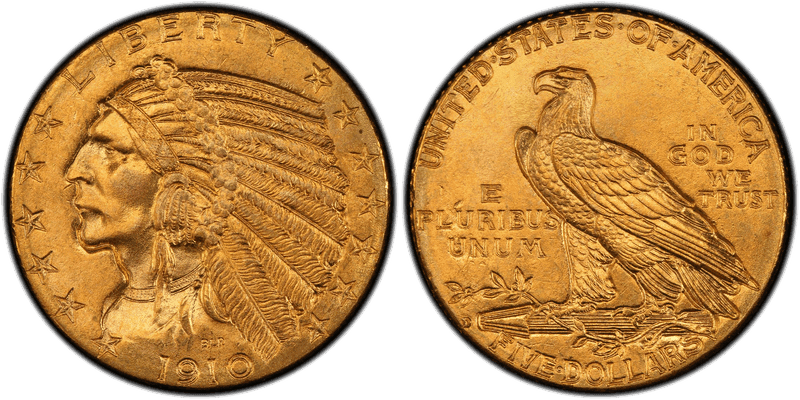
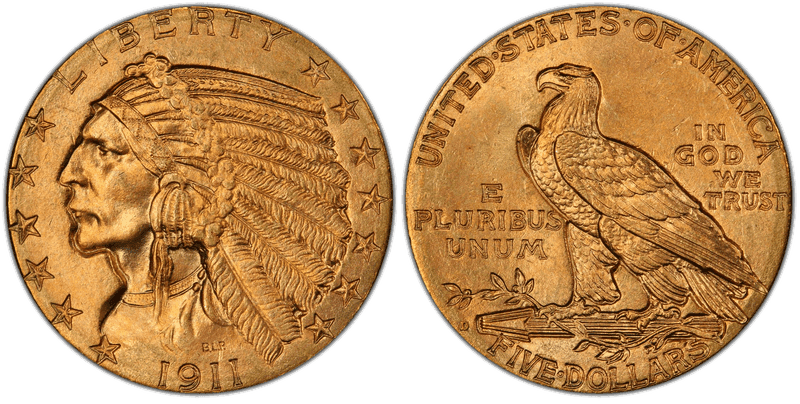
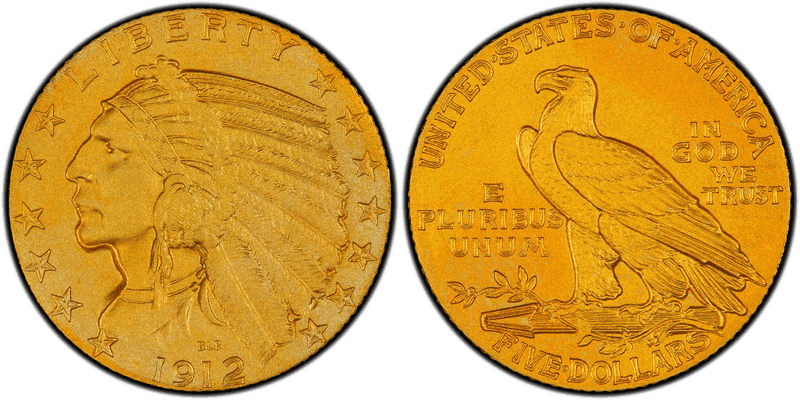
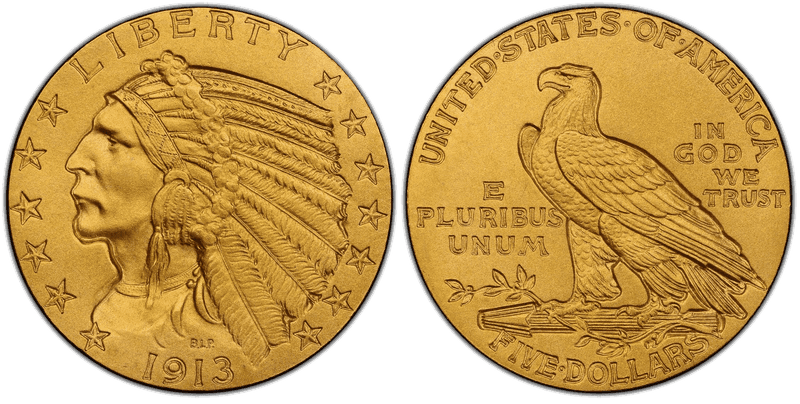
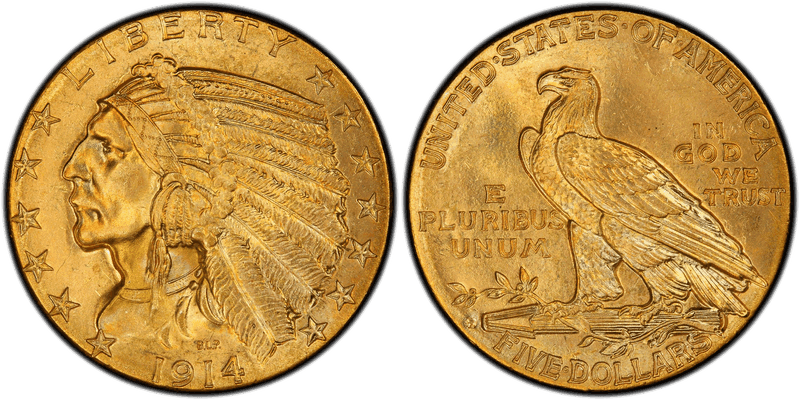
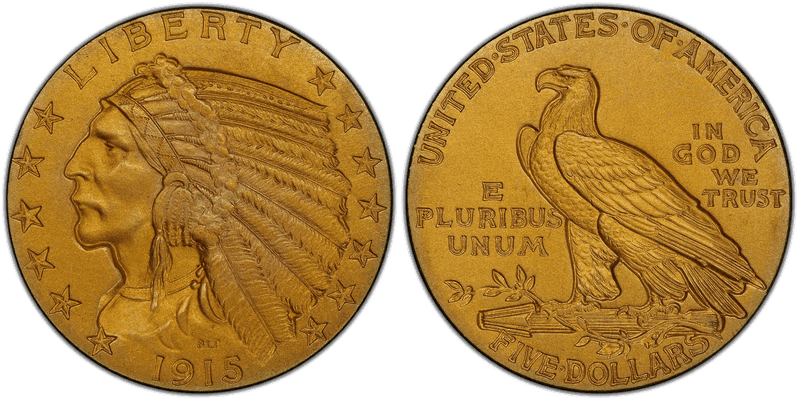
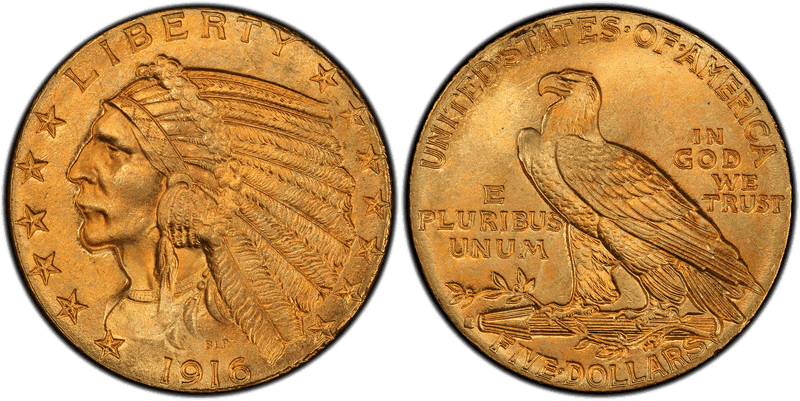
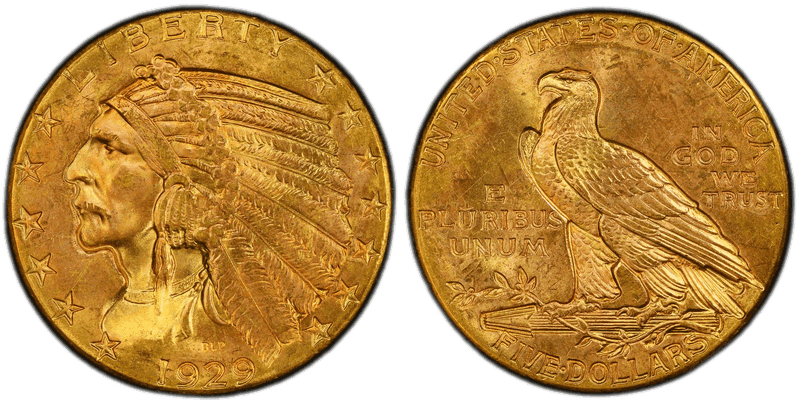
The half eagle got its new design at the same time as the quarter eagle, and for the same reasons. After Augustus Saint-Gaudens died in 1907, the Mint meant to put a reduced version of his double eagle on the two small gold coins, but Chief Engraver Charles E. Barber could not fit the legends the law required. Dr. William Sturgis Bigelow, a Boston friend of President Theodore Roosevelt who had admired Egyptian sunken reliefs at the Boston Museum of Fine Arts, proposed instead a design cut below a flat surface, and he brought in the sculptor Bela Lyon Pratt. Roosevelt and Mint Director Frank Leach agreed to it in April 1908.
Pratt kept the layout of Saint-Gaudens's $10 eagle but replaced its Liberty with a Native American man drawn from a photograph, and he adapted Saint-Gaudens's standing eagle for the reverse. Barber's engravers then modified the models, which Pratt resented. Unlike the quarter eagle, the half eagle went to the branch mints from the start. Denver and San Francisco both had trouble striking it, and Philadelphia advised them to shave the planchets slightly. The finished coins were thinner than older half eagles because the fields stand above the design, which upset automatic sorting machines.
The coins reached circulation in early November 1908, and the Philadelphia dealer Samuel Chapman soon complained to the President that the recesses would hold dirt and germs and that the coins would not stack. Philadelphia had already struck 421,874 Liberty Head half eagles dated 1908, so both designs carry that year.
New Orleans struck 34,200 half eagles in 1909 before it stopped coining in March of that year. Half eagles came from Philadelphia, Denver and San Francisco every year through 1916, much of the output going to gift-giving and to the West, where gold still circulated. After 1916 the spread of Federal Reserve notes and the gold drain of World War I ended the need for them. The only later issue was Philadelphia's 1929, struck when there was little demand. Most of those coins never left the vaults, and after the Treasury stopped paying out gold in 1933 and Executive Order 6102 called gold coins in, they were melted along with recalled coins in the mid-1930s.