Hawaiian Coinage (1847-2018)

Coin Series
Hawaiian Coinage (1847-2018) series coin

About This Series

This series holds the coins of the Kingdom of Hawaii and the pieces collected with them. The Kingdom issued two coinages: copper cents dated 1847, ordered from the United States, and silver dimes, quarters, half dollars and dollars dated 1883, which the San Francisco Mint struck under contract in 1883 and 1884. Around them are patterns (the 1881 nickel five-cent piece struck in Paris and the copper and silver trial pieces of 1883), later copies and impressions made from the 1883 hubs, the medals Reginald Huth had struck in London in the 1890s, the tokens of Hawaiian merchants, plantations and railroads, and modern private medals and bullion pieces with Hawaiian themes.

From NumisDex News

Browse by Base(6 bases)

Showing all 6 listings

History

The Kingdom of Hawaii issued money of its own only twice. In 1846 the government, through its agent James Jackson Jarves, ordered 100,000 copper cents from the United States, and Edward Hulseman designed and engraved them. The coins are dated 1847 and show Kamehameha III in uniform with KAMEHAMEHA III. KA MOI, with HAPA HANERI in a wreath on the reverse. No record names the maker; Walter Breen put the work at the private mint of H. M. & E. I. Richards in Attleboro, Massachusetts. The cents never caught on. Medcalf and Russell found 11,595 still in the treasury in 1862, and 88,305 were sold as scrap metal in 1885, the year after they lost legal tender status. The 1847 cent has its own page here, with die varieties beside it.

King Kalakaua looked at a coinage again after his world tour of 1881. The owner of a nickel mine in New Caledonia proposed a nickel five-cent piece, dies were cut in Paris and about 200 patterns were struck there, but the reverse transposed the first two letters of the motto and the coinage went no further (1881 nickel pattern).

The silver coinage came in 1883. Under the currency act of 1880 and a contract arranged by the merchant Claus Spreckels, the United States Mint agreed to coin one million dollars in silver to American weight and fineness. Chief Engraver Charles E. Barber designed all four coins. The Director of the Mint's report for 1884 records that the San Francisco Mint began work on November 17, 1883 and finished in June 1884, and that the request for an eighth-dollar piece was changed to a ten-cent piece. Every coin is dated 1883, though the dime dies did not reach San Francisco until February 1884. After Hawaii became an American territory, Congress set January 1, 1904 as the last day to exchange the coins, and those turned in were melted at San Francisco.

How to Identify It

The 1883 silver. All four coins carry Kalakaua's head facing right with KALAKAUA I KING OF HAWAII and the date 1883. The dime has UMI KENETA in a crowned wreath with ONE DIME below; the quarter (HAPAHA) and half dollar (HAPALUA) carry the royal arms; the dollar (AKAHI DALA) shows the arms on a mantle under a crown with the star of the Order of Kamehameha below. The motto UA MAU KE EA O KA AINA I KA PONO runs around the reverse. There is no mint mark on any of them, even though they were struck at San Francisco.

Proofs and patterns. Proofs were made apart from the circulating coinage for presentation, and the proof dollar and its companions have their own pages. The copper pieces of the same dies are proof patterns struck at Philadelphia, numbered 2CPC-1 to 2CPC-4 by Medcalf and Russell; PCGS lists one of them, the copper eighth dollar, as a fantasy strike in bronze, although Stack's Bowers catalogues the same number as 2CPC-1.

Later pieces. Around 1900 someone struck pieces from Barber's 1883 hubs in other metals and as one-sided impressions; PCGS dates them about 1900 and records some under 1884. The copies of the 1881 nickel pattern made about the same time lack the cross on top of the crown that the Paris originals carry (copy). The medals of the 1890s with Princess Kaiulani or Queen Liliuokalani, such as Huth's 2MH-3, are private pieces struck in London.

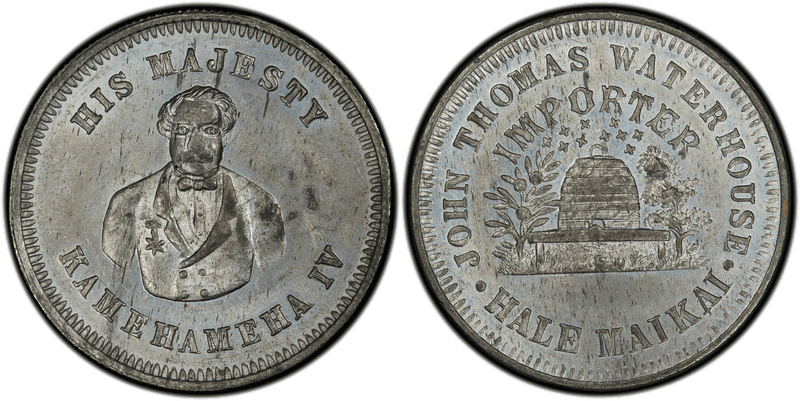
Tokens. Merchants, plantations and a railroad on Maui issued their own tokens, spent at the issuer's store and not legal tender: the J. T. Waterhouse token of Honolulu, the Wailuku Plantation pieces of 1871 and 1880 (12 1/2 cents, narrow starfish), Thomas Hobron's railroad tokens of 1879 marked T.H.H. (25 cents), the Haiku token of 1882, the Grove Ranch pieces of 1886 and 1887 and the Kahului Railroad tokens of 1891 (10 cents).

Key Dates and Varieties

1847 cents. Medcalf and Russell divide the cents by the 4 in the date and the berries in the wreath. The crosslet 4, which they call the large bust, comes with 18 berries (2CC-1) or 15 berries (2CC-2, this page); the plain 4, the small bust, with 17, 15 or 13 berries (2CC-3 to 2CC-6).

1883 silver. The Mint's report gives 250,000 dimes, 500,000 quarters, 700,000 half dollars and 500,000 dollars. Medcalf and Russell, as reported by Wikipedia, put the melted totals at 79 dimes, 257,400 quarters, 612,245 halves and 453,652 dollars. One quarter die shows the 8 of the date cut over a 3, the 1883/1383 quarter (2CS-3a).

1883 patterns. The eighth dollar, HAPAWALU, was struck only as a proof, in silver (2CS-2) and in copper. PCGS reports eighteen sets of copper proofs of the eighth, quarter, half and dollar (copper dollar).

After 1884. No Hawaiian coinage is known after the 1883 and 1884 strikings, and the obverse dies were defaced in 1888. The pieces dated later in this series are medals, tokens and modern private issues sold with Hawaiian themes, and none of them is a coin of Hawaii.

In Our Catalog

1 error or variety is listed for this series. Browse them by type:

Recently added

    Composition and Silver Content

    The 1847 cent is copper, about 27 mm across. The 1883 coins were struck to the weight and fineness of the American coins of the same values, so they are .900 silver: the dime 2.5 grams, the quarter 6.25 grams, the half dollar 12.5 grams and the dollar 26.73 grams. The 1881 five-cent patterns are nickel. The 1883 patterns exist in silver and copper, and the pieces made about 1900 from the hubs are known in copper, gold, platinum and other metals.

    FAQ

    Do 1883 Hawaiian coins have a mint mark?

    No. The San Francisco Mint struck the dimes, quarters, half dollars and dollars for the Hawaiian government between November 17, 1883 and June 1884, according to the Director of the Mint's report for 1884, but the dies carried no mint letter and every piece is dated 1883. The proofs and the copper patterns, made at Philadelphia, carry no mark either.

    How many 1883 Hawaiian coins were struck?

    The Mint's report gives 250,000 dimes, 500,000 quarter dollars, 700,000 half dollars and 500,000 dollars, one million dollars in face value. Many were later melted. Medcalf and Russell's figures, as reported by Wikipedia, are 79 dimes, 257,400 quarters, 612,245 half dollars and 453,652 dollars melted after the coins were called in for exchange before January 1, 1904.

    Who made the 1847 Hawaiian cent?

    The Kingdom ordered 100,000 copper cents in 1846 through its agent James Jackson Jarves, and Edward Hulseman designed and engraved them. No record names the maker. Walter Breen attributed the striking to the private mint of H. M. & E. I. Richards at Attleboro, Massachusetts, and other writers have followed him with some caution.

    Was there an 1883 Hawaiian eighth dollar?

    Only as a pattern. The original request asked for a piece of one-eighth of a dollar, HAPAWALU, but the Mint's report says it was changed to a ten-cent piece. Proofs of the eighth dollar were made in silver and in copper; Medcalf and Russell, as reported by Wikipedia, give 20 silver proofs.

    What are the 1884-dated Hawaiian pieces in gold and platinum?

    They are not coins of the Kingdom. Heritage describes pieces made around 1900 by an unknown die sinker, apparently from Barber's 1883 hubs, in several metals; PCGS calls them fantasy strikes or hub impressions and records some of them under 1884, a date no Hawaiian coin carries.

    Are the 1893 Princess Kaiulani dollars Hawaiian coins?

    No. They are medals that the British collector Reginald Huth had John H. Pinches of London strike in the style of Hawaiian coins. They carry the date 1893, the princess's eighteenth birthday, but were made in 1895, and Medcalf and Russell list them as 2MH medals.

    ↑ Back to the coins: every year, mint, variety and error

    Explore Other Denominations

    Collector Essentials

    Tools and references for building and protecting your coin collection.

    As an Amazon Associate, NumisDex earns from qualifying purchases.