The California Gold Rush that began in 1848 sent far more gold to the Mint than before, and Congress answered with two new coins, the gold dollar and a $20 piece. President James K. Polk signed the law on March 3, 1849. The new coin was twice an eagle, so it was called a double eagle, and bankers liked it because it held a large sum in a small space.
Chief Engraver James B. Longacre designed it amid open hostility from Chief Coiner Franklin Peale, whose department ruined his first model and cracked a die while hardening it. Longacre had dies finished in December 1849, but Peale objected that the head was in too high relief to strike properly, and regular coinage did not begin until early 1850. NGC says only two pieces dated 1849 were struck. One is in the Smithsonian and the other has not been traced.
Philadelphia struck double eagles every year from 1850 to 1907, and New Orleans did from 1850 to 1861 and once more in 1879. San Francisco opened in 1854 and in the end struck just over half of all double eagles made from 1850 to 1933. Carson City struck them in most years from 1870 to 1893, and Denver in 1906 and 1907. IN GOD WE TRUST joined the reverse in 1866, and in 1877 the value on the reverse was spelled out as TWENTY DOLLARS. Of all the gold the Mint coined from 1795 to 1933, about 78% went into double eagles.
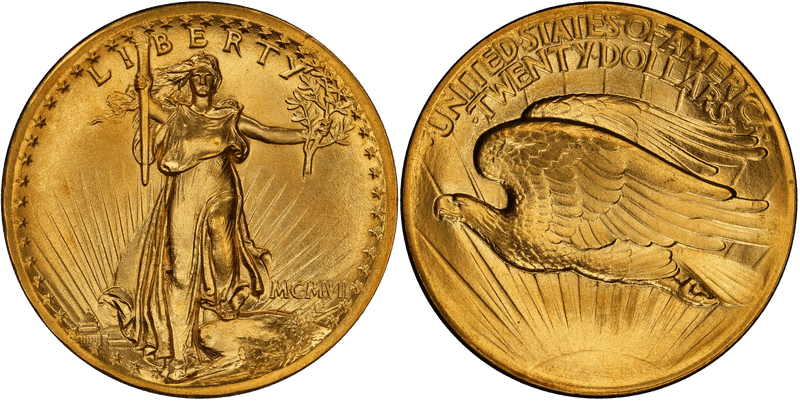
Many of the coins never stayed in the country. From the 1880s millions were shipped to Europe in cloth bags of 250 to settle international payments, and many that were not melted lay in foreign bank vaults until dealers brought them back. Others went down with ships: the Central America in 1857, the Brother Jonathan and the Republic in 1865, and the Yankee Blade. Salvage from those wrecks has brought thousands of early San Francisco coins back in high grade. Augustus Saint-Gaudens's design replaced the Liberty Head late in 1907.