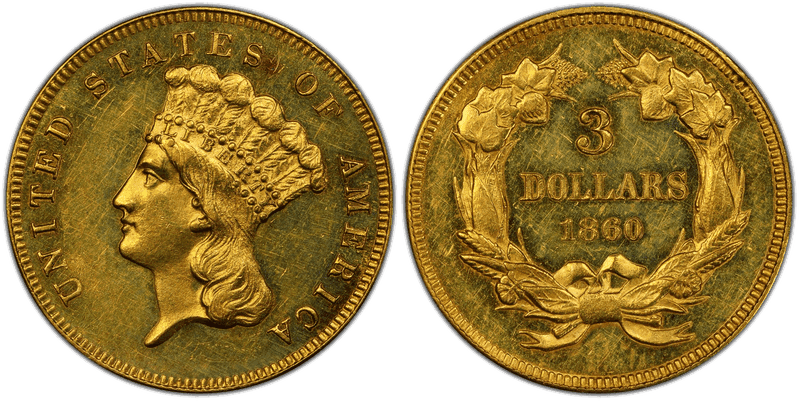
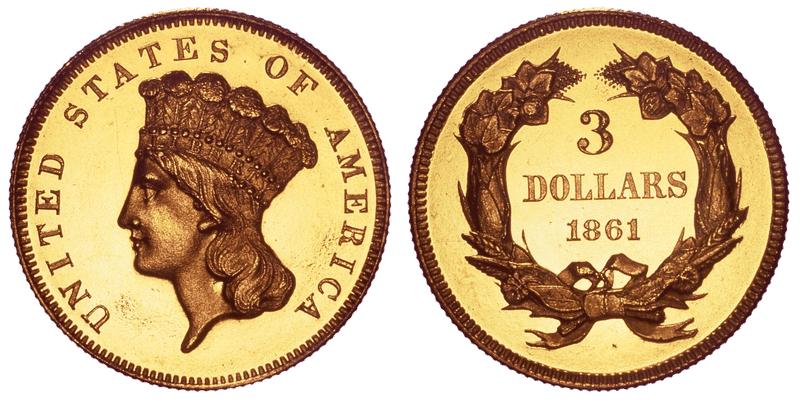
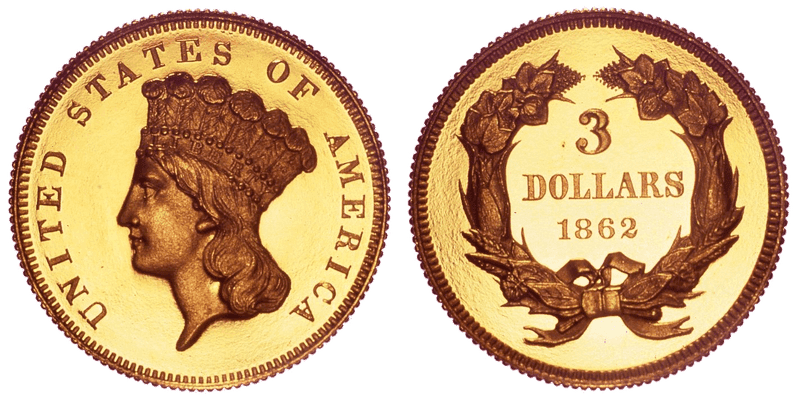
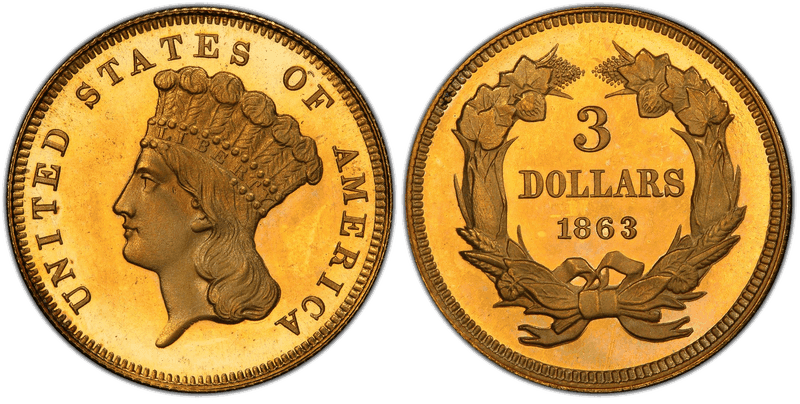
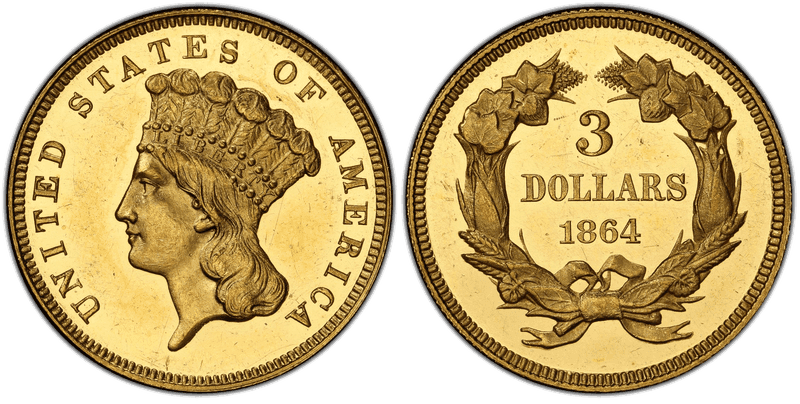
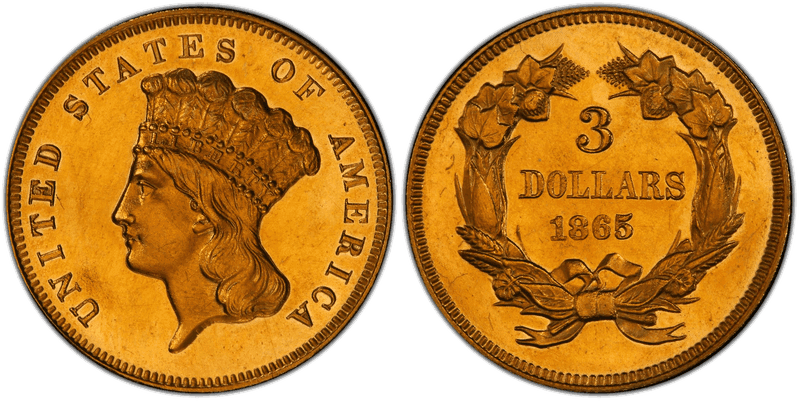
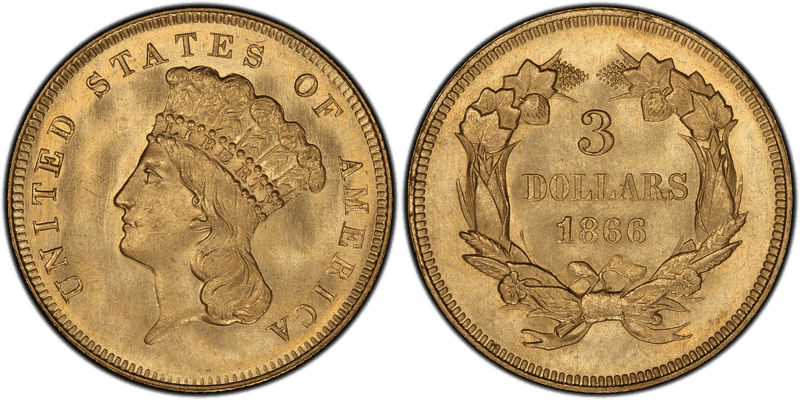
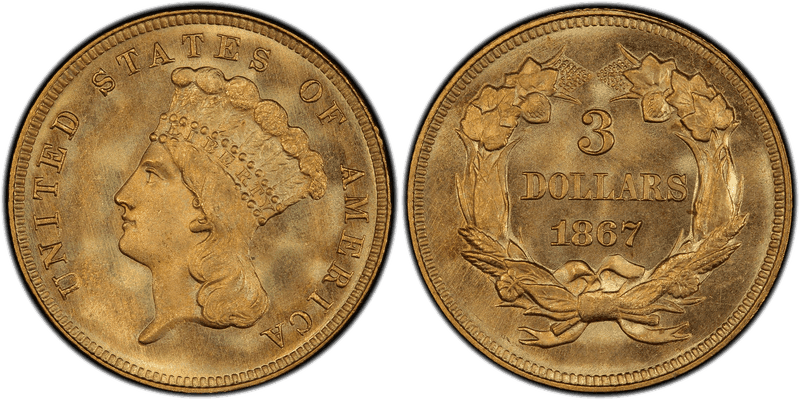
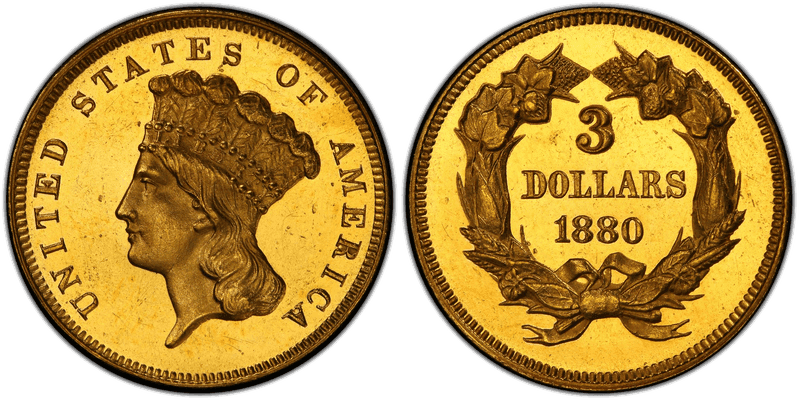
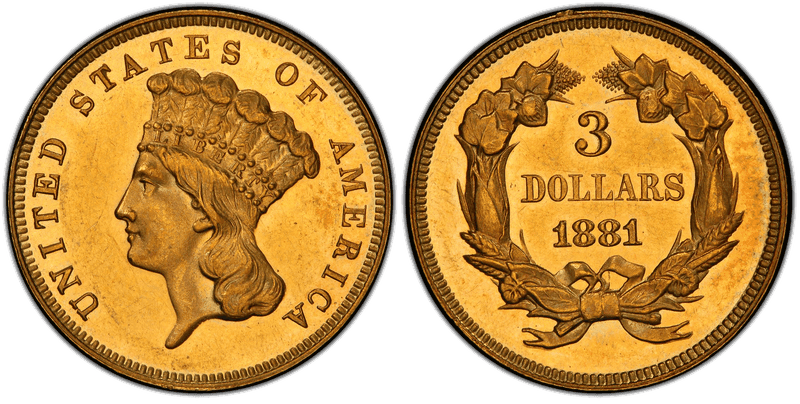
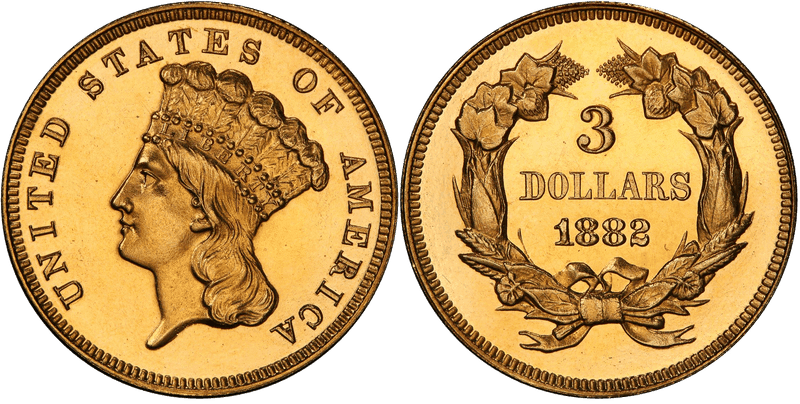
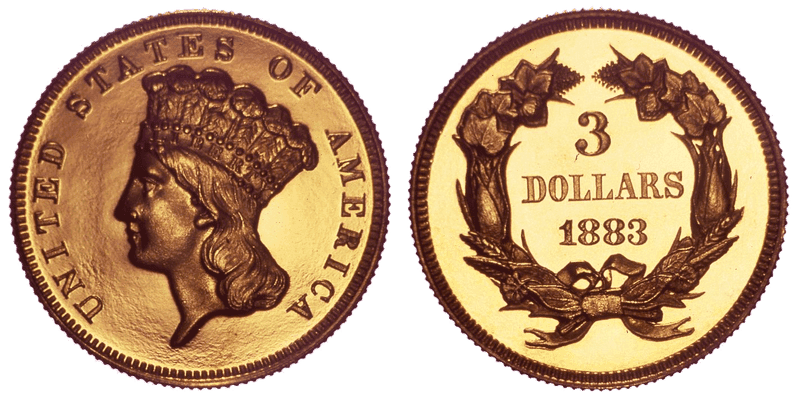
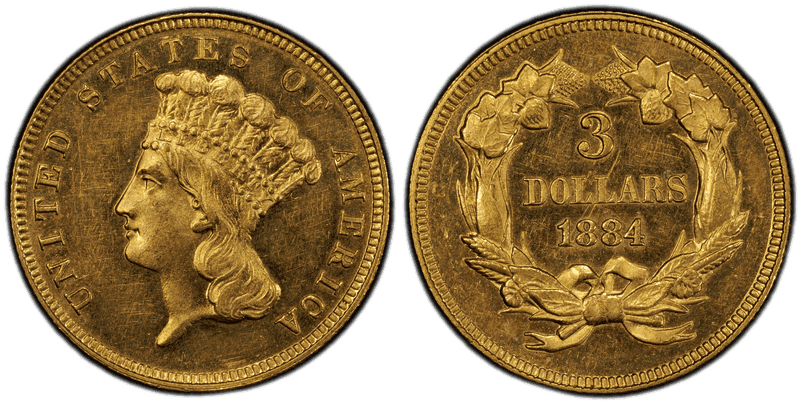
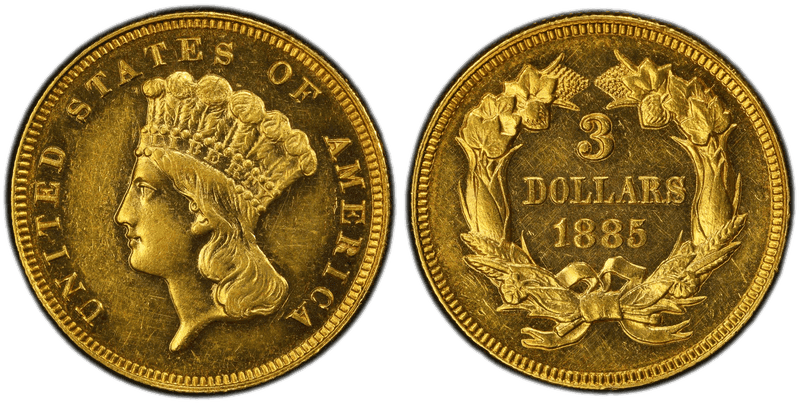
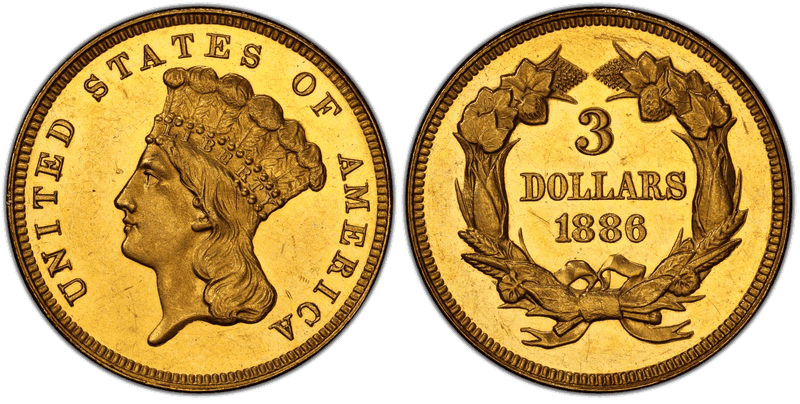
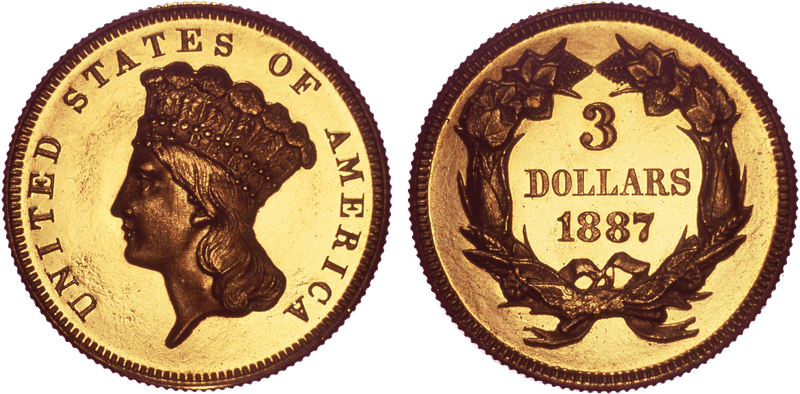
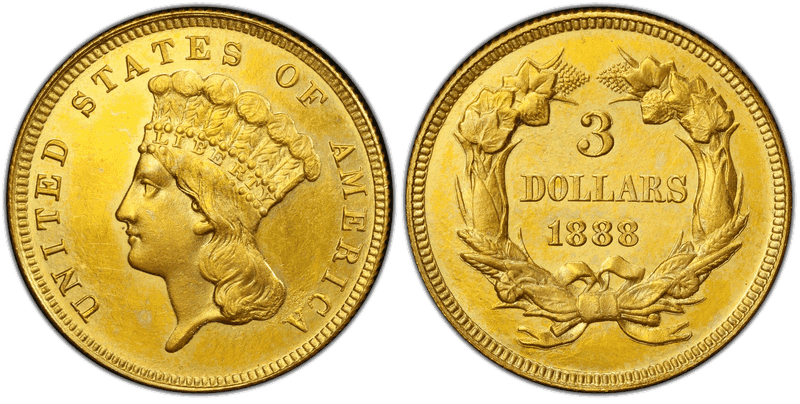
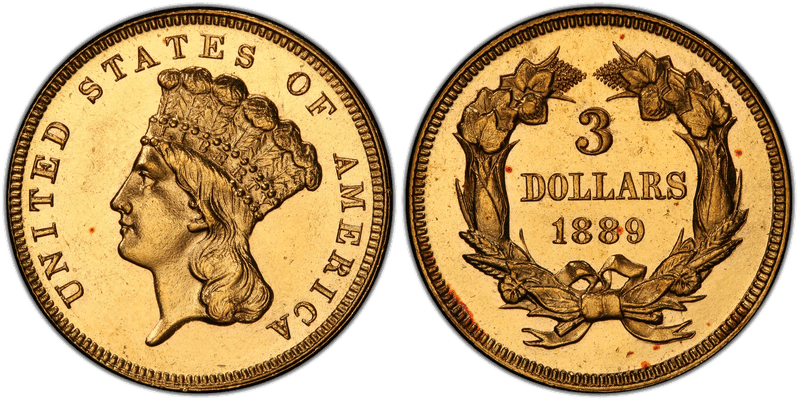
Indian Princess Three Dollars 1854-1889

Coin Series
Indian Princess Three Dollars 1854-1889 series coin

About This Series

The three-dollar gold piece was authorized by the Act of February 21, 1853, ostensibly to facilitate the purchase of sheets of one hundred three-cent stamps. Chief Engraver James B. Longacre designed the Indian Princess obverse with feathered headdress, while the reverse features an agricultural wreath of corn, wheat, cotton, and tobacco. Despite its rationale, the three-dollar piece never gained commercial acceptance — the public found it confusingly similar to the quarter eagle. Only one 1870-S is known, and the 1875 was struck only as a proof, 20 pieces. Struck in .900 fine gold at 20.5 mm, the three-dollar piece occupies a unique niche as a denomination that existed for decades without finding its intended purpose.

Series Information

Production Years
1854-1889
Designer
James Barton Longacre
Composition
90% Gold, 10% Copper
Weight
5.015g
Diameter
20.5mm

Browse by Base(36 bases)

1854 Indian Princess Three Dollar
BaseVerified

1854 Indian Princess Three Dollar

4 Strike Types
1855 Indian Princess Three Dollar
BaseVerified

1855 Indian Princess Three Dollar

4 Strike Types
1856 Indian Princess Three Dollar
BaseVerified

1856 Indian Princess Three Dollar

3 Strike Types
1857 Indian Princess Three Dollar
BaseVerified

1857 Indian Princess Three Dollar

3 Strike Types
1858 Indian Princess Three Dollar
BaseVerified

1858 Indian Princess Three Dollar

2 Strike Types
1859 Indian Princess Three Dollar
BaseVerified

1859 Indian Princess Three Dollar

2 Strike Types
1860 Indian Princess Three Dollar
BaseVerified

1860 Indian Princess Three Dollar

3 Strike Types
1861 Indian Princess Three Dollar
BaseVerified

1861 Indian Princess Three Dollar

2 Strike Types
1862 Indian Princess Three Dollar
BaseVerified

1862 Indian Princess Three Dollar

2 Strike Types
1863 Indian Princess Three Dollar
BaseVerified

1863 Indian Princess Three Dollar

2 Strike Types
1864 Indian Princess Three Dollar
BaseVerified

1864 Indian Princess Three Dollar

2 Strike Types
1865 Indian Princess Three Dollar
BaseVerified

1865 Indian Princess Three Dollar

3 Strike Types
1866 Indian Princess Three Dollar
BaseVerified

1866 Indian Princess Three Dollar

2 Strike Types
1867 Indian Princess Three Dollar
BaseVerified

1867 Indian Princess Three Dollar

2 Strike Types
1868 Indian Princess Three Dollar
BaseVerified

1868 Indian Princess Three Dollar

2 Strike Types
1869 Indian Princess Three Dollar
BaseVerified

1869 Indian Princess Three Dollar

2 Strike Types
1870 Indian Princess Three Dollar
BaseVerified

1870 Indian Princess Three Dollar

3 Strike Types
1871 Indian Princess Three Dollar
BaseVerified

1871 Indian Princess Three Dollar

2 Strike Types
1872 Indian Princess Three Dollar
BaseVerified

1872 Indian Princess Three Dollar

2 Strike Types
1873 Indian Princess Three Dollar
BaseVerified

1873 Indian Princess Three Dollar

3 Strike Types
1874 Indian Princess Three Dollar
BaseVerified

1874 Indian Princess Three Dollar

2 Strike Types
1875 Indian Princess Three Dollar
BaseVerified

1875 Indian Princess Three Dollar

1 Strike Type
1876 Indian Princess Three Dollar
BaseVerified

1876 Indian Princess Three Dollar

1 Strike Type
1877 Indian Princess Three Dollar
BaseVerified

1877 Indian Princess Three Dollar

2 Strike Types
1878 Indian Princess Three Dollar
BaseVerified

1878 Indian Princess Three Dollar

2 Strike Types
1879 Indian Princess Three Dollar
BaseVerified

1879 Indian Princess Three Dollar

2 Strike Types
1880 Indian Princess Three Dollar
BaseVerified

1880 Indian Princess Three Dollar

2 Strike Types
1881 Indian Princess Three Dollar
BaseVerified

1881 Indian Princess Three Dollar

2 Strike Types
1882 Indian Princess Three Dollar
BaseVerified

1882 Indian Princess Three Dollar

2 Strike Types
1883 Indian Princess Three Dollar
BaseVerified

1883 Indian Princess Three Dollar

2 Strike Types
1884 Indian Princess Three Dollar
BaseVerified

1884 Indian Princess Three Dollar

2 Strike Types
1885 Indian Princess Three Dollar
BaseVerified

1885 Indian Princess Three Dollar

2 Strike Types
1886 Indian Princess Three Dollar
BaseVerified

1886 Indian Princess Three Dollar

2 Strike Types
1887 Indian Princess Three Dollar
BaseVerified

1887 Indian Princess Three Dollar

2 Strike Types
1888 Indian Princess Three Dollar
BaseVerified

1888 Indian Princess Three Dollar

2 Strike Types
1889 Indian Princess Three Dollar
BaseVerified

1889 Indian Princess Three Dollar

2 Strike Types
Showing all 36 listings

History

The same law of February 21, 1853 that lightened the silver coins also authorized a gold coin worth three dollars. Why is still argued over. One explanation, repeated since the 19th century, is that it matched the new 3-cent postage rate: a sheet of one hundred 3-cent stamps, or a roll of silver 3-cent pieces, could be paid for without touching the unpopular copper cents. Other writers point instead to the flood of California gold and to the gold interests that wanted it used.

Chief Engraver James B. Longacre had a free hand with the design for the first time. He chose an Indian princess for Liberty, wanting a symbol drawn from America rather than from Greece or Rome, and gave the reverse a wreath of crops grown in both the North and the South. To keep the coin from being taken for a quarter eagle, he struck it on a thinner, wider blank.

The Mint delivered 15 proofs on April 28, 1854 and went on to strike 138,618 coins at Philadelphia that year, while New Orleans added 24,000 and Dahlonega 1,120. Neither southern branch struck the coin again, and Charlotte never used the dies it was sent. San Francisco struck it in 1855, 1856, 1857 and 1860. The coin was little used. It saw some service on the West Coast, where people paid in gold and silver, but in the East it disappeared once banks stopped paying out gold in December 1861, and it never came back. Philadelphia kept striking a few thousand a year because the Mint's policy was to coin every denomination annually.

After the Civil War most three dollar pieces were bought by collectors or given as presents. Larger batches in 1874 and 1878 were struck in expectation of the return to gold payments at the end of 1878, but the public showed little interest. In 1889 Mint Director James P. Kimball told Congress the coin served no useful purpose, and it was abolished, along with the gold dollar, on September 26, 1890. In the 1890s the Mint melted 49,087 unsold pieces.
How to Identify It

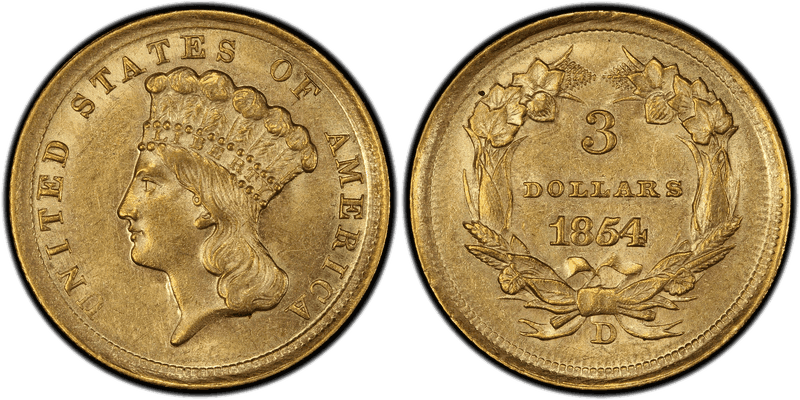
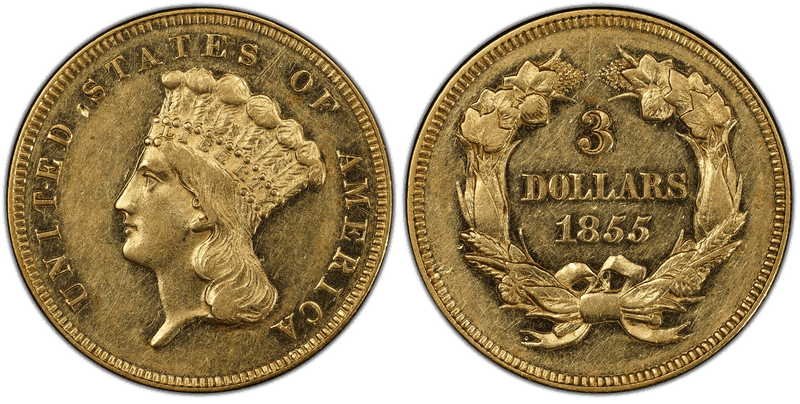
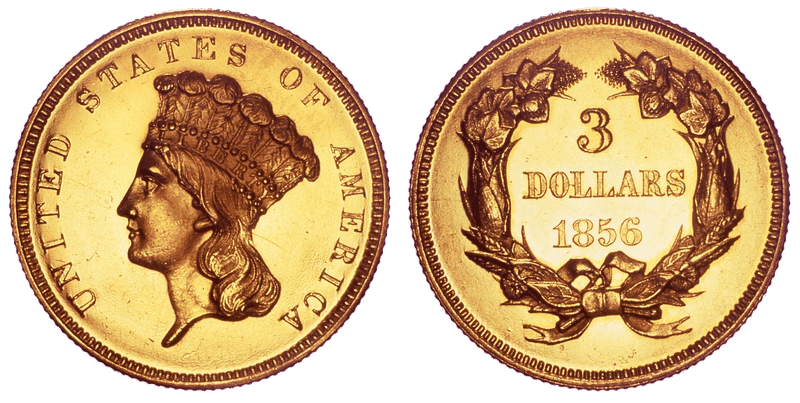
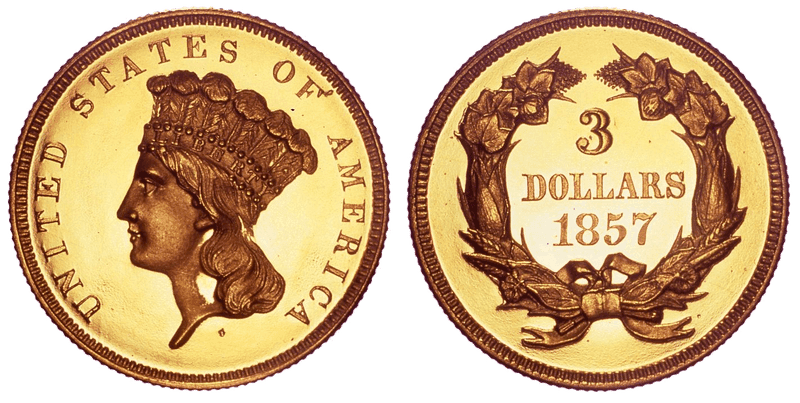
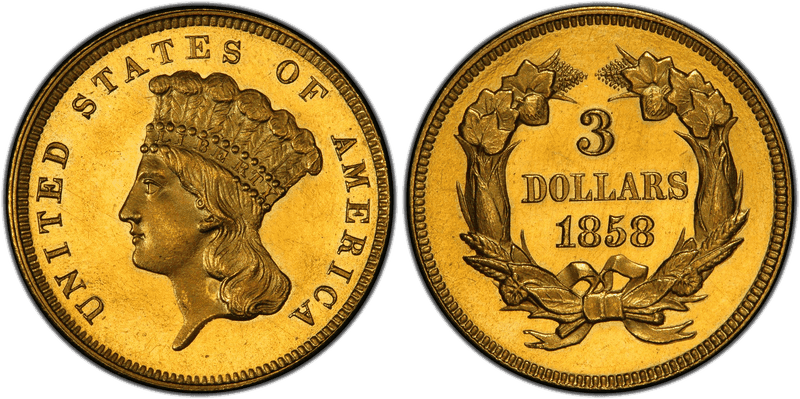
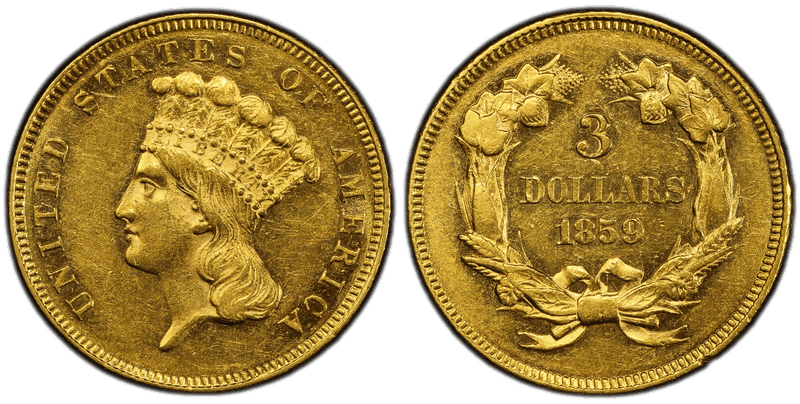
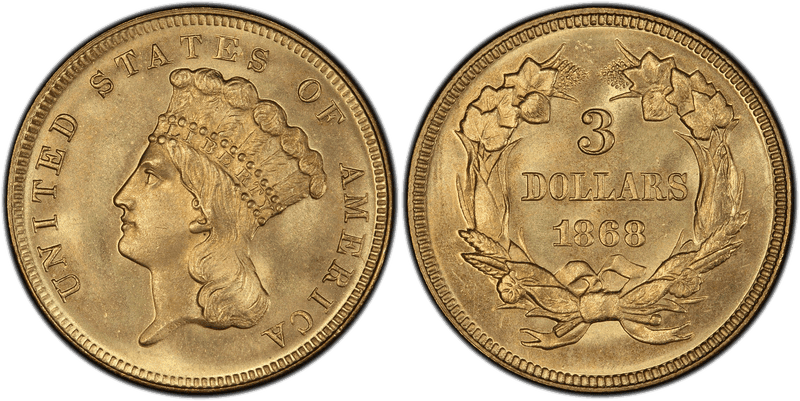
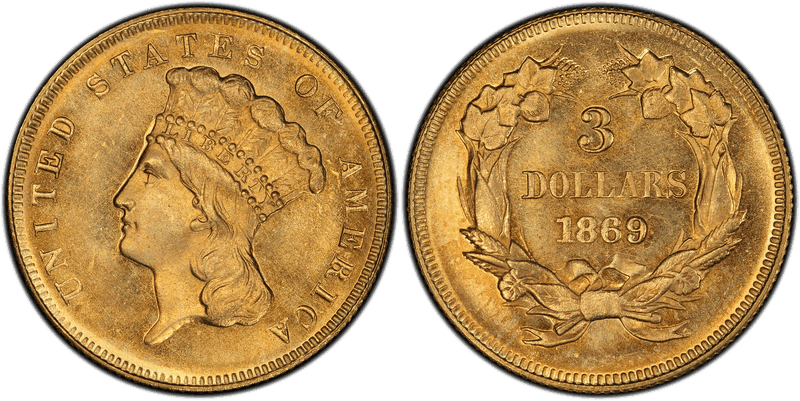
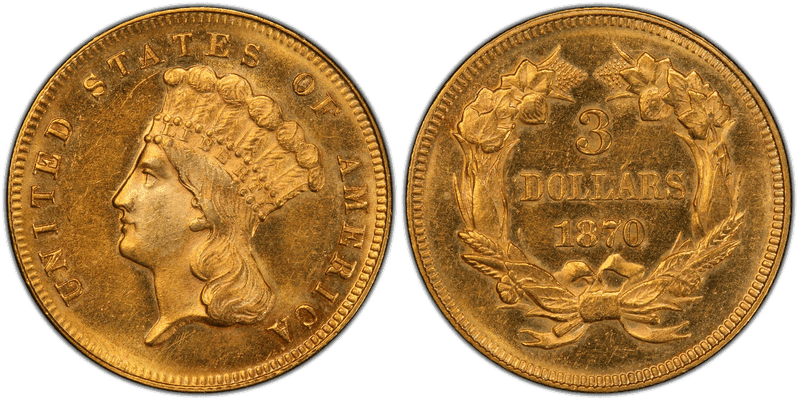
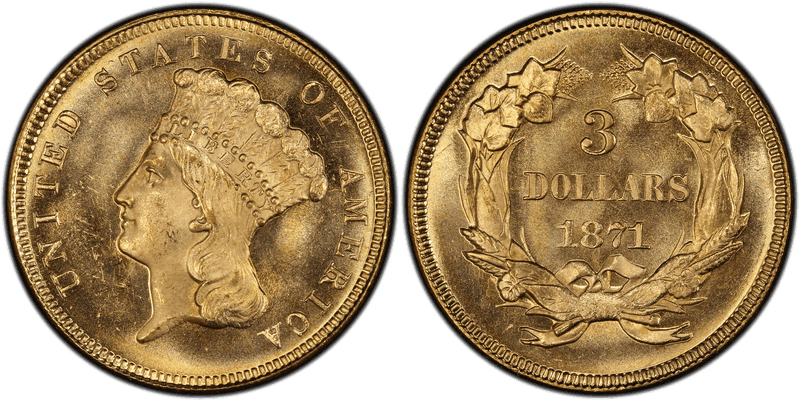
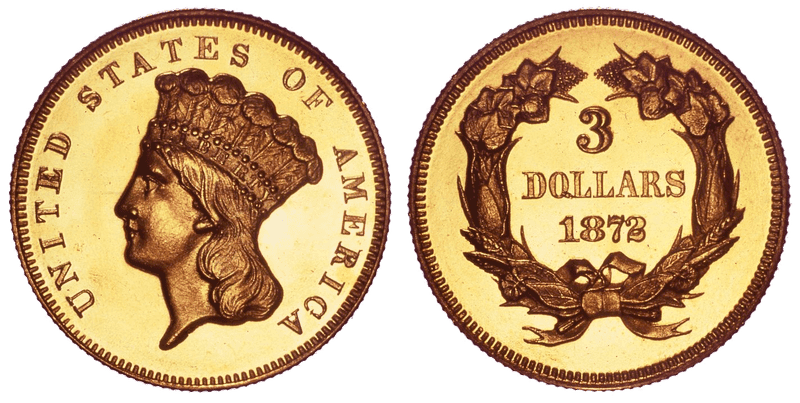
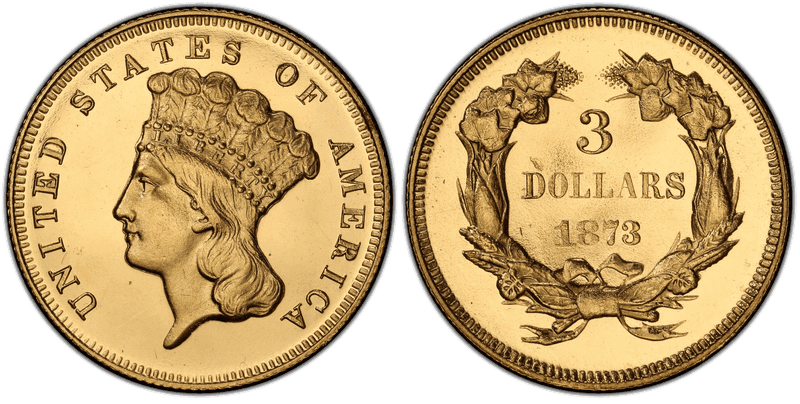
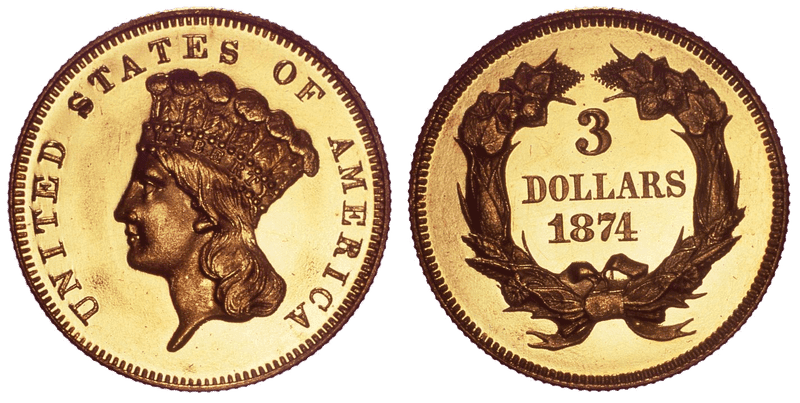
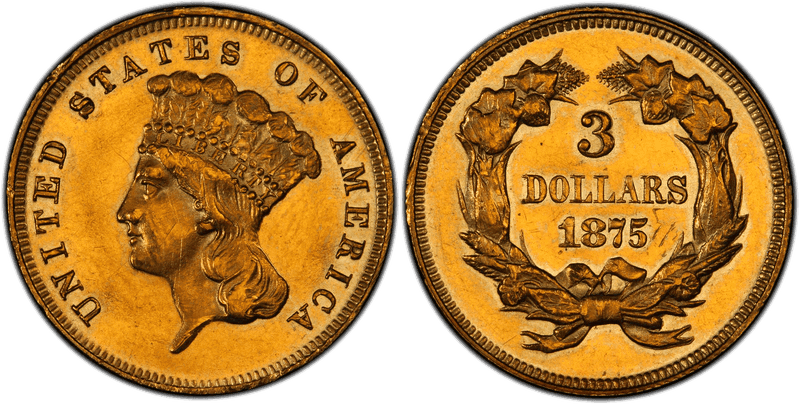
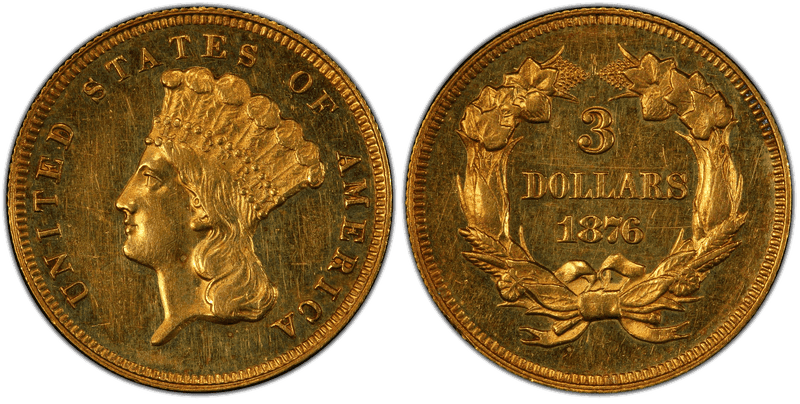
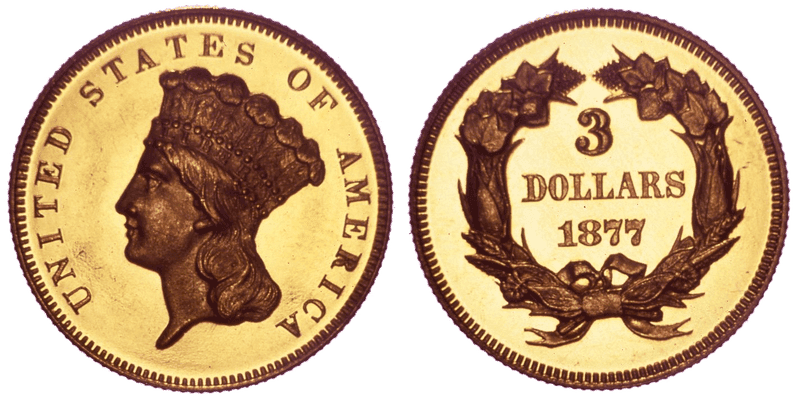
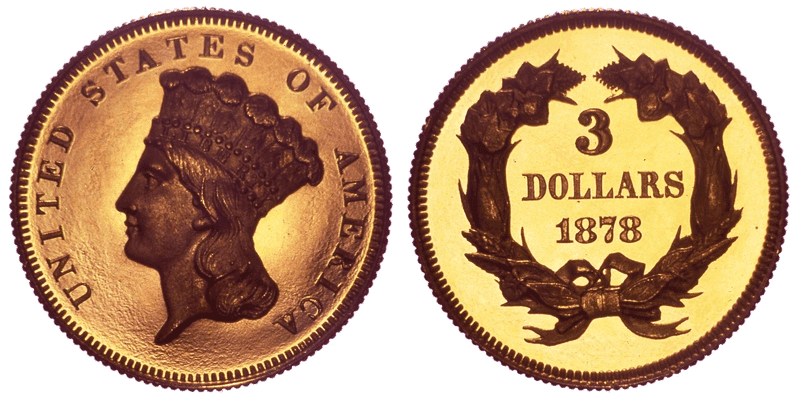
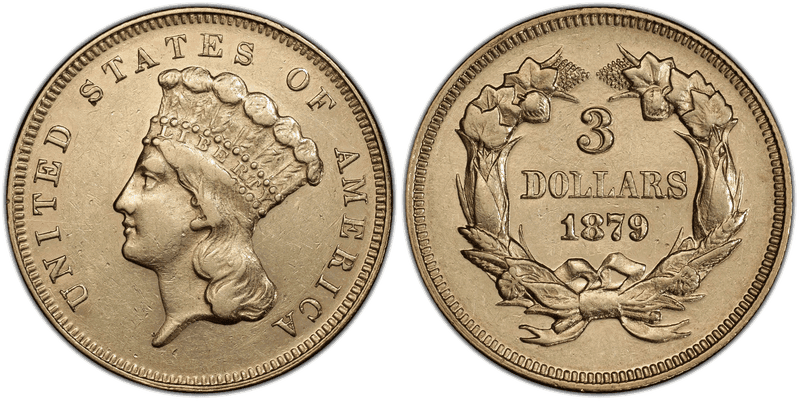
Obverse. Liberty as an Indian princess faces left, wearing a feathered headdress whose band reads LIBERTY. UNITED STATES OF AMERICA runs around her.

Reverse. A wreath of corn, cotton, wheat and tobacco surrounds the value, 3 DOLLARS, and the date. Longacre used the same wreath on the gold dollar.

Mint mark. Below the wreath, just under its ribbon. D, O and S are the branch mints; Philadelphia coins have no letter.

Things that cause confusion.

  • 1854 small DOLLARS. On the 1854 coins the word DOLLARS is in small, short letters, smaller than the digits of the date. The Mint enlarged it in 1855 after complaints, so the 1854 is a one-year type.
  • The gold dollar. The small-head and large-head Indian princess gold dollars carry nearly the same portrait on a much smaller coin.
  • The quarter eagle. Despite Longacre's thinner blank, people mistook the $3 for a $2.50 piece. An 1859 writer, Montroville Dickeson, complained that it was even counted as a $5 coin.
  • Love tokens and jewelry. Many three dollar pieces were mounted as jewelry or had one side ground smooth and engraved with initials as gifts, especially around 1887.

Key Dates and Varieties

  • 1854: 138,618 struck at Philadelphia, the first-year coins with small DOLLARS. The first 15 proofs were delivered on April 28, 1854, and NGC believes 10 to 14 exist.
  • 1854-D: 1,120 struck at Dahlonega in August 1854, the only Dahlonega three dollar issue. NGC estimates about a tenth of them survive.
  • 1854-O: 24,000 struck, the only New Orleans three dollar issue.
  • San Francisco. The 1855-S (6,600), 1856-S (34,500), 1857-S and 1860-S (7,000) mostly went into circulation in the West. For the 1857-S, USA Coin Book and NGC's specification give 14,000 and NGC's write-up 14,250. Breen reports that 2,592 of the 1860-S coins were found to be underweight, held back, and melted in 1869. One 1855-S proof is known; it surfaced at the 1984 ANA convention.
  • 1870-S: San Francisco's 1870 dies arrived without a mint mark and were sent back, but coiner J. B. Harmistead first engraved an S on one by hand so that a coin could be laid in the cornerstone of the new mint building. He struck one for himself too, which was once mounted as jewelry and became known only in 1907. It is the only 1870-S known, and for many years it belonged to the Harry W. Bass Jr. collection.
  • 1873 Open and Closed 3. The Mint changed its date punches in 1873 after Chief Coiner A. Loudon Snowden complained that the 3 looked like an 8. Mint records list 25 proofs and no business strikes, but both kinds of date exist in both finishes: most proofs have the Open 3 and most business strikes the Closed 3. Q. David Bowers estimates 600 to 900 Closed 3 business strikes, and Winter and Bowers know of four to six Closed 3 proofs. Sources still disagree over which variety the official 25 proofs were.
  • 1874 (41,800) and 1878 (82,304): the two large coinages of the later years, which R. W. Julian ties to the expected resumption of gold payments. Bowers suggests many of the pieces melted in the 1890s carried these dates.
  • 1875 (20) and 1876 (45): struck only as proofs. Bowers blames later illicit strikings of these dates on Mint insiders of the late 1870s and 1880s; R. W. Julian thinks no restrikes were made.
  • The 1880s. Philadelphia's business strikes fell as low as 500 in 1881, and dealer Thomas L. Elder later gathered many 1879 to 1881 coins from bank tellers. The 1887 rose to about 6,000 because of a fashion for turning gold coins into engraved love tokens, and the Mint struck 291 proofs in 1888, holding many back for trades with collectors.

In Our Catalog

No errors or varieties are listed for Indian Princess Three Dollars 1854-1889 yet. Submit one

Mintages

Indian Princess Three Dollars 1854-1889 mintages by year and mint, taken from each coin's page in our catalog. Each figure opens that coin's page, which lists its varieties and errors. A dash means no figure was recorded. Where one issue was struck in more than one type, each type is listed.

Composition and Gold Content

  • Composition: 90% gold, 10% copper
  • Weight: 5.015 grams
  • Gold content: 0.1451 troy ounce
  • Diameter: 20.5 mm
  • Edge: reeded
  • Designer: James B. Longacre

Philadelphia struck proofs for collectors in every year of the series. The 1855-S proof is the one branch-mint exception.

FAQ

Where is the mint mark on a three dollar gold piece?

On the reverse, below the wreath and just under its ribbon. You will find D (Dahlonega, 1854 only), O (New Orleans, 1854 only) or S (San Francisco: 1855, 1856, 1857, 1860 and the single 1870-S). Philadelphia coins have no mint mark.

How much gold is in a three dollar gold piece?

Each coin weighs about 5.015 grams and is 90% gold and 10% copper, so it holds about 0.1451 troy ounce of pure gold.

Why did the United States make a three dollar coin?

The Act of February 21, 1853 authorized it. One long-repeated explanation is that it would buy a sheet of one hundred 3-cent stamps or a roll of silver 3-cent pieces without using copper cents, but historians have also tied it to the flood of California gold and to pressure from gold interests. The coin never caught on, and Congress abolished it on September 26, 1890.

What is the 1870-S three dollar gold piece?

San Francisco received 1870 dies without a mint mark, and its coiner engraved an S on a reverse die by hand so that a coin could be placed in the cornerstone of the new mint building. He also struck one for himself. That piece, once mounted as jewelry, is the only 1870-S known; what became of the cornerstone coin is not certain.

How can I tell an 1854 three dollar piece from the later years?

Look at the word DOLLARS on the reverse. On the 1854 coins it is in small, short letters, smaller than the digits of the date. From 1855 the Mint enlarged it after complaints from the public.

Which three dollar gold pieces were struck only as proofs?

The 1875 and 1876. Philadelphia made no business strikes in those years, and the Mint recorded 20 proofs for 1875 and 45 for 1876. Some writers believe more were struck on the quiet in later years; R. W. Julian does not.

↑ Back to the coins: every year, mint, variety and error

Explore Other Denominations

Collector Essentials

Tools and references for building and protecting your coin collection.

As an Amazon Associate, NumisDex earns from qualifying purchases.