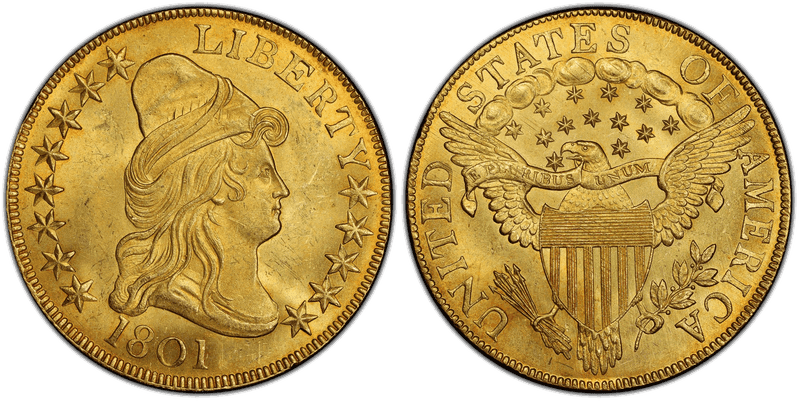
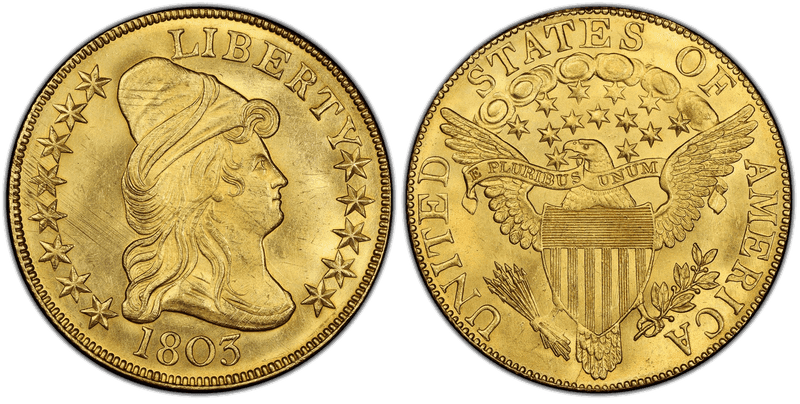
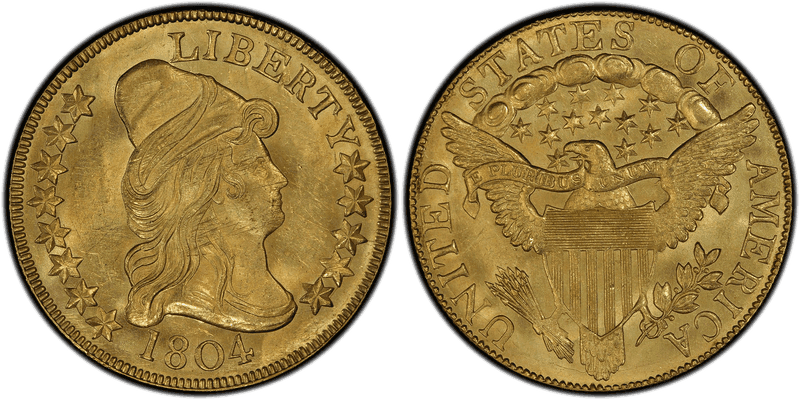
Capped Bust to Right Eagles 1795-1804

Coin Series
Capped Bust to Right Eagles 1795-1804 series coin

About This Series

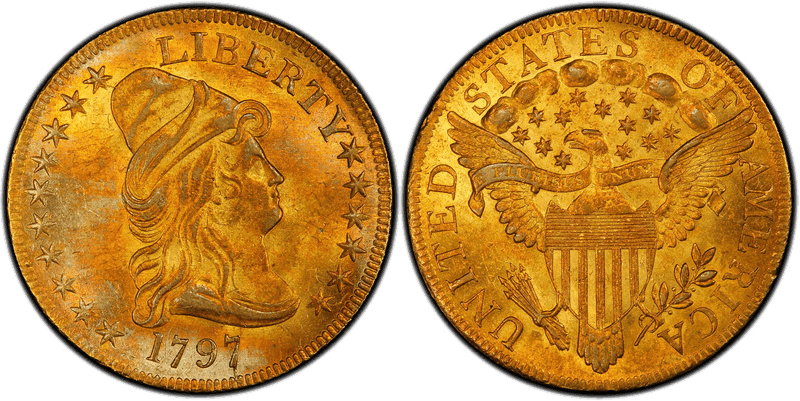
As the first ten-dollar gold coins struck by the United States Mint, Capped Bust to Right eagles held the distinction of being the largest denomination in regular American coinage when production began in 1795. The Coinage Act of 1792 made the eagle the base unit of the gold coinage, which is why the half eagle and quarter eagle are named as its fractions and the double eagle of 1849 as its multiple. Robert Scot's design pairs a Liberty portrait wearing a conical cap with two reverse types: the Small Eagle (1795-1797), featuring a slender eagle standing on a palm branch and holding a wreath in its beak, and the imposing Heraldic Eagle (1797-1804) displaying the Great Seal motif. The 1795 issue comes with two reverses, with 13 or 9 leaves on the palm branch. Production ceased entirely after 1804 because eagles were being exported to Europe and melted for their gold content — the coins' face value was lower than their bullion value at prevailing exchange rates, making them profitable for international speculators to extract from domestic circulation. No eagles were struck for circulation again until 1838. They were struck in .9167 fine gold at 17.50 grams on a 33mm planchet. Die marriages are numbered in the Bass-Dannreuther reference, Early U.S. Gold Coin Varieties.

From NumisDex News

Series Information

Production Years
1795-1804
Composition
91.7% Gold, 8.3% Silver and Copper

Browse by Base(9 bases)

Showing all 9 listings

History

The Mint Act of 1792 made the eagle, worth ten dollars, the largest of the new gold coins. Gold coinage waited until 1795, when the first deposit of gold arrived and Congress had lowered the bonds required of the officers who handled it. Robert Scot cut the dies, probably with help from Adam Eckfeldt. His Liberty faces right in a tall soft cap that later collectors took for a turban, and the reverse shows a slender eagle standing on a palm branch with a wreath held up in its beak. The first 1,097 eagles were released on September 22, 1795, and 400 of them were paid to the Bank of Pennsylvania, the depositor of the gold.

The obverse stars followed the count of states: fifteen in 1795, sixteen once Tennessee joined in June 1796. Rather than add a star for every new state, Mint officials then settled on thirteen. In 1797 the small eagle, criticized as too thin for a national emblem, gave way to a heraldic eagle adapted from the Great Seal, a design the quarter eagle had already carried since 1796. Scot placed the arrows in the eagle's more honorable right claw and the olive branch in its left, a reversal of the Seal that Walter Breen called a blunder. The Mint reported 13,344 Small Eagle coins over 1795-1797; John Dannreuther's estimates run from 10,609 to 18,676.

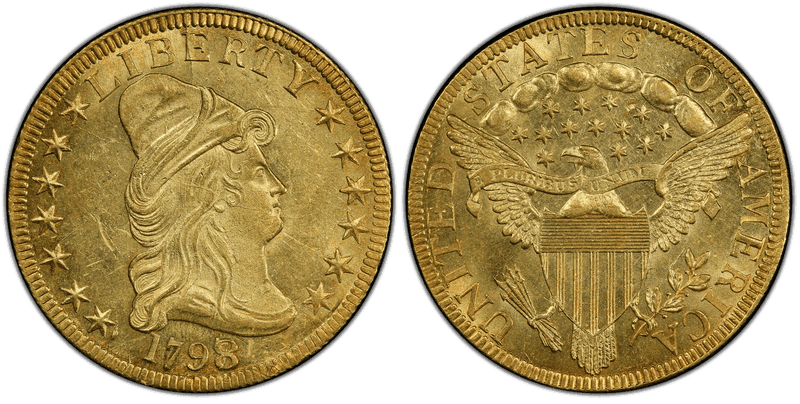
Output depended on deposits and on the city's health. Yellow fever epidemics in 1796, 1797, 1801 and 1803 slowed the Mint's work, and it often favored smaller coins. Dies were used until they wore out and re-dated when needed, so every eagle dated 1798 is a 1797 die with an 8 cut over the 7, and old 1797 dies stayed in use after them. Demand rose in 1799, when 37,449 were reported. Yet by then gold was worth more against silver abroad than the United States' legal ratio of fifteen to one allowed, and eagles bought with silver at face were shipped to Europe and melted. President Thomas Jefferson then halted the coinage of eagles and silver dollars, by an order dated December 31, 1804. Eagles were not struck for circulation again until 1838, after Congress had lowered the gold content of the coinage.

One more group of 1804 eagles followed thirty years later. In 1834 the State Department ordered sets of the coins then current for gifts to rulers in Asia on Edmund Roberts' mission. Neither eagles nor dollars had been coined since 1804, and Mint Director Samuel Moore had both struck with that date. The new eagles have a plain 4 without the crosslet of the originals. Roberts delivered two of the sets, to the rulers of Muscat and Siam, before his death in Macao.
How to Identify It

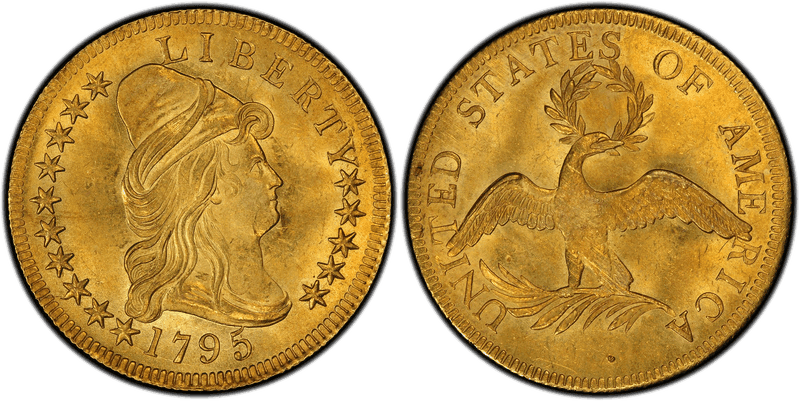
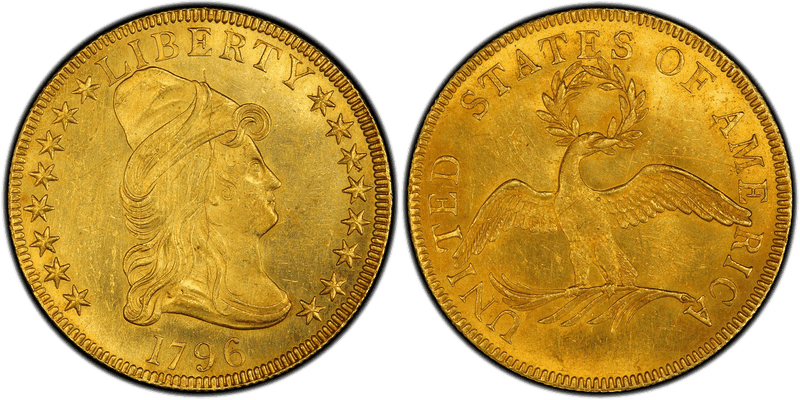
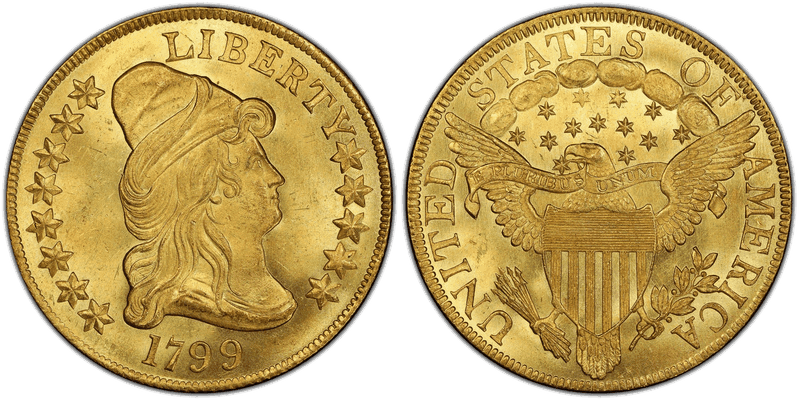
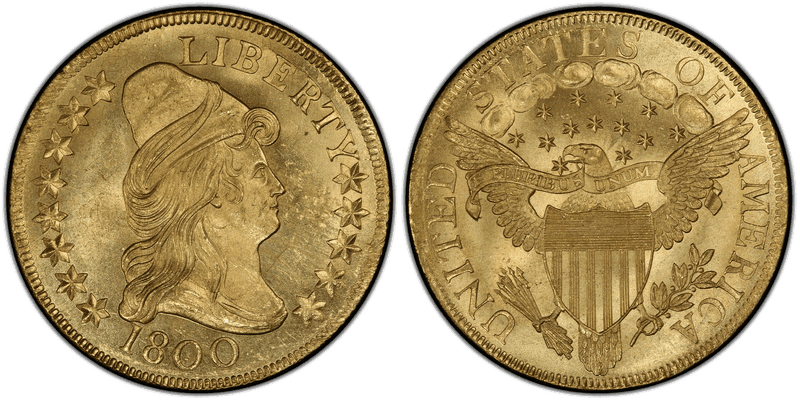
Obverse. Liberty faces right in a large soft cap, with LIBERTY above and the date below. Stars: fifteen in 1795 (ten left, five right); sixteen in 1796 (eight and eight), on the 1797 Small Eagle (twelve and four) and on the 1797 Heraldic Eagle (ten and six); thirteen on the 1798/7 coins, either nine and four or seven and six; and thirteen, eight and five, from 1799 to 1804.

Reverse, 1795-1797 (Small Eagle). A thin eagle with raised wings stands on a palm branch and holds a wreath in its beak, with UNITED STATES OF AMERICA around it.

Reverse, 1797-1804 (Heraldic Eagle). An eagle with a shield on its breast holds arrows and an olive branch, with E PLURIBUS UNUM on a scroll, clouds above, and thirteen small stars around its head.

Denomination and mint mark. Neither appears. Every coin was struck at Philadelphia.

Edge. Reeded.

Die marriages. Each pairing has a Bass-Dannreuther (BD) number; NGC counts 33 marriages for the series and eight dates, as no eagles are dated 1802.

Key Dates and Varieties

  • 1795 13 Leaves and 9 Leaves: 5,583 struck in the first year. The 9 Leaves reverse, BD-3, has a branch of nine thin leaves; Dannreuther estimates 210 to 500 coins from it.
  • 1796: 4,146 struck, with sixteen obverse stars.
  • 1797 Small Eagle and Heraldic Eagle: Breen read the delivery records as 3,615 Small Eagle and 10,940 Heraldic Eagle coins; Dannreuther suggests 1,250 to 3,615 of the first and 8,750 to 12,500 dated 1797 in all.
  • 1798/7 9x4 Stars and 7x6 Stars: 900 and 842 struck, the only eagles dated 1798.
  • 1799 Small Stars and Large Stars obverses: 37,449 struck in all.
  • 1800: 5,999 reported, the total of two November deliveries, all from one pair of dies.
  • 1801: 44,344 delivered in 1801 and 1802.
  • 1803 Small Stars and Large Stars reverses: 15,017 struck. The Extra Star reverse, BD-5, has a tiny fourteenth star on the cloud at the right, first noticed by Harry W. Bass, Jr.
  • 1804 Crosslet 4: 3,757 struck in 1804, the last regular eagles before Jefferson's order.
  • 1804 Plain 4 proof: struck in 1834 for Roberts' presentation sets, four by Dean Albanese's count, three confirmed today. It is also listed among patterns as Judd 33.

In Our Catalog

2 errors and varieties are listed for this series. Browse them by type:

Recently added

    Mintages

    Capped Bust to Right Eagles 1795-1804 mintages by year and mint, taken from each coin's page in our catalog. Each figure opens that coin's page, which lists its varieties and errors. A dash means no figure was recorded. Where one issue was struck in more than one type, each type is listed.

    Composition and Gold Content

    • Weight: 17.50 grams
    • Composition: .9167 gold (22 carat); the rest copper and silver
    • Gold content: 0.5154 troy ounce (NGC)
    • Diameter: about 33 mm
    • Edge: reeded
    • Designer: Robert Scot

    FAQ

    Why did the Mint stop making eagles in 1804?

    American law valued gold at fifteen times its weight in silver, while abroad it brought closer to fifteen and three quarters. Merchants could buy eagles with silver at face value and ship them to Europe for their gold, so few stayed in circulation. On the last day of 1804 Jefferson told the Mint to stop striking eagles and silver dollars, and no eagles were coined for circulation again until 1838.

    What is the 1804 Plain 4 eagle?

    A proof eagle dated 1804 but struck in 1834 for the presentation sets Edmund Roberts carried on his diplomatic mission to Asia. The Mint did not want to date the coins 1834 while Jefferson's order stood, so it used the last year of eagle coinage. The 4 lacks the crosslet of the 1804 business strikes. Dean Albanese counts four struck; three are confirmed today, one in the King of Siam set.

    What is the difference between the 13 Leaves and 9 Leaves 1795 eagles?

    The count of leaves on the palm branch under the small eagle's feet. One 1795 reverse die, BD-3, has nine thinner leaves; the others have thirteen. John Dannreuther estimates that 210 to 500 coins were struck from that pair of dies.

    Are all 1798 eagles overdates?

    Yes. The Mint re-dated 1797 dies by cutting an 8 over the 7. One overdated obverse has nine stars left and four right, the other seven and six. Unaltered 1797 dies were also used after the overdates.

    Do the Capped Bust eagles show their value?

    No. Neither the Small Eagle nor the Heraldic Eagle reverse carries a denomination or a mint mark; at the time the coin's value was understood from its gold.

    How much gold is in a Capped Bust to Right eagle?

    The coin weighs 17.50 grams at .9167 fine, 0.5154 troy ounce of pure gold by NGC's figure.

    ↑ Back to the coins: every year, mint, variety and error

    Explore Other Denominations

    Collector Essentials

    Tools and references for building and protecting your coin collection.

    As an Amazon Associate, NumisDex earns from qualifying purchases.