Civil War Patterns (1860-1865)

Coin Series
Civil War Patterns (1860-1865) series coin

About This Series

Between 1860 and 1865, the United States Mint produced a series of experimental pattern coins during the Civil War. With gold and silver coins hoarded and even the copper-nickel cent gone from circulation in much of the country, Mint officials tried new designs, alloys and denominations. These patterns include trials in copper, nickel, aluminum, and various bronze alloys, testing whether base metals could replace the precious-metal coins that had vanished from commerce. Many carry religious mottoes proposed after Treasury Secretary Salmon P. Chase asked in November 1861 for the nation's trust in God to be declared on its coins, among them GOD OUR TRUST and GOD AND OUR COUNTRY; Chase, answering the patterns Mint Director James Pollock sent him in December 1863, chose IN GOD WE TRUST, which first appeared on the regular two-cent piece of 1864. Cataloged comprehensively in the Judd reference (United States Pattern Coins), Civil War patterns document proposals ranging from revised cent and two-cent designs to experimental five-cent pieces that would eventually lead to the Shield nickel of 1866. Many pieces dated 1860 to 1865 were struck years later, from about 1869 into the early 1870s, as backdated restrikes sold to collectors in sets.

Browse by Base(50 bases)

1860 Cent Patterns
BaseVerified

1860 Cent Patterns

3 Strike Types
1860 Double Eagle Patterns
BaseVerified

1860 Double Eagle Patterns

2 Strike Types
1860 Half Dime Patterns
BaseVerified

1860 Half Dime Patterns

1 Strike Type
1860 Half Dollar Patterns
BaseVerified

1860 Half Dollar Patterns

1 Strike Type
1860 Half Eagle Patterns
BaseVerified

1860 Half Eagle Patterns

2 Strike Types
1860 Quarter Eagle Patterns
BaseVerified

1860 Quarter Eagle Patterns

1 Strike Type
BaseVerified

1860 Quarter Patterns

1 Strike Type
1861 Cent Patterns
BaseVerified

1861 Cent Patterns

1 Strike Type
BaseVerified

1861 Cent Patterns

1 Strike Type
1861 Double Eagle Patterns
BaseVerified

1861 Double Eagle Patterns

2 Strike Types
1861 Eagle Patterns
BaseVerified

1861 Eagle Patterns

4 Strike Types
1861 Half Dollar Patterns
BaseVerified

1861 Half Dollar Patterns

6 Strike Types
1861 Half Eagle Patterns
BaseVerified

1861 Half Eagle Patterns

1 Strike Type
1861 Quarter Eagle Patterns
BaseVerified

1861 Quarter Eagle Patterns

2 Strike Types
BaseVerified

1861 Quarter Patterns

2 Strike Types
1862 Cent Patterns
BaseVerified

1862 Cent Patterns

4 Strike Types
1862 Eagle Patterns
BaseVerified

1862 Eagle Patterns

2 Strike Types
1862 Half Dollar Patterns
BaseVerified

1862 Half Dollar Patterns

4 Strike Types
1863 Cent Patterns
BaseVerified

1863 Cent Patterns

8 Strike Types
1863 Dime Patterns
BaseVerified

1863 Dime Patterns

19 Strike Types
1863 Dollar Patterns
BaseVerified

1863 Dollar Patterns

4 Strike Types
1863 Eagle Patterns
BaseVerified

1863 Eagle Patterns

4 Strike Types
1863 Half Dime Patterns
BaseVerified

1863 Half Dime Patterns

2 Strike Types
1863 Half Dollar Patterns
BaseVerified

1863 Half Dollar Patterns

7 Strike Types
1863 Quarter Patterns
BaseVerified

1863 Quarter Patterns

3 Strike Types
1863 Three Cent Patterns
BaseVerified

1863 Three Cent Patterns

5 Strike Types
1863 Two Cent Patterns
BaseVerified

1863 Two Cent Patterns

16 Strike Types
1864 Cent Patterns
BaseVerified

1864 Cent Patterns

23 Strike Types
1864 Dime Patterns
BaseVerified

1864 Dime Patterns

3 Strike Types
1864 Dollar Patterns
BaseVerified

1864 Dollar Patterns

4 Strike Types
1864 Half Dime Patterns
BaseVerified

1864 Half Dime Patterns

3 Strike Types
1864 Half Dollar Patterns
BaseVerified

1864 Half Dollar Patterns

5 Strike Types
1864 Quarter Patterns
BaseVerified

1864 Quarter Patterns

7 Strike Types
1864 Three Cent Patterns
BaseVerified

1864 Three Cent Patterns

3 Strike Types
BaseVerified

1864 Three Dollar Patterns

3 Strike Types
1864 Two Cent Patterns
BaseVerified

1864 Two Cent Patterns

13 Strike Types
1865 Cent Patterns
BaseVerified

1865 Cent Patterns

8 Strike Types
1865 Dime Patterns
BaseVerified

1865 Dime Patterns

2 Strike Types
1865 Dollar Patterns
BaseVerified

1865 Dollar Patterns

5 Strike Types
1865 Double Eagle Patterns
BaseVerified

1865 Double Eagle Patterns

5 Strike Types
1865 Eagle Patterns
BaseVerified

1865 Eagle Patterns

3 Strike Types
1865 Half Dime Patterns
BaseVerified

1865 Half Dime Patterns

1 Strike Type
1865 Half Dollar Patterns
BaseVerified

1865 Half Dollar Patterns

6 Strike Types
1865 Half Eagle Patterns
BaseVerified

1865 Half Eagle Patterns

4 Strike Types
1865 Nickel Patterns
BaseVerified

1865 Nickel Patterns

5 Strike Types
1865 Quarter Eagle Patterns
BaseVerified

1865 Quarter Eagle Patterns

1 Strike Type
1865 Quarter Patterns
BaseVerified

1865 Quarter Patterns

7 Strike Types
1865 Three Cent Patterns
BaseVerified

1865 Three Cent Patterns

8 Strike Types
1865 Three Dollar Patterns
BaseVerified

1865 Three Dollar Patterns

5 Strike Types
1865 Two Cent Patterns
BaseVerified

1865 Two Cent Patterns

6 Strike Types
Showing all 50 listings

About the Era

The years 1860 to 1865 opened with routine work at the Philadelphia Mint and ended with a different coinage. Early pieces were trials of single dies or ideas. In 1860 the half eagle was struck on wide planchets as a guard against counterfeiting (J-271), a half dollar was given a lettered edge, and Anthony C. Paquet's reverse for the double eagle was tried in gold and copper (J-272a); his reverse reached regular coinage briefly in 1861, as the 1861 Paquet reverse double eagle in the Liberty Head tree shows.

The war changed the Mint's problem. By 1861 and 1862 gold and silver had left circulation in much of the country, and even the copper-nickel cent was hoarded. Merchants issued cent-sized tokens, and the Treasury put out small paper notes, first as Postage Currency. In his report of October 1, 1863, Mint Director James Pollock argued that people only needed small change to be convenient, not to contain their worth in metal, and he proposed a bronze cent. The 1863 bronze cent (J-299), the postage currency ten-cent pieces of May 1863, the two-cent designs he sent to Treasury Secretary Salmon P. Chase in December 1863 and the 1864 copper-aluminum cents all belong to that search. The Coinage Act of April 22, 1864 settled it with a bronze cent and a bronze two-cent piece. A three-cent piece of copper and nickel followed on March 3, 1865, and the 1865 five-cent pieces led to the Shield nickel authorized in May 1866.

The second thread is the motto. In November 1861 Chase, answering a minister's letter, asked the Mint to prepare a device that declared the nation's trust in God. Chief Engraver James B. Longacre's half dollars and eagles of 1861 to 1863 tried GOD OUR TRUST, on a scroll or in the open field, and the 1863 two-cent designs added GOD AND OUR COUNTRY. Chase chose IN GOD WE TRUST, it first appeared on the 1864 two-cent piece, and a law of March 3, 1865 allowed it on any coin large enough. The 1865 quarters, half dollars, dollars and gold coins with the motto on the reverse are the patterns for the designs of 1866.

A large share of the coins dated in these years were struck later. USPatterns.com describes the off-metal half dimes, dimes and minor coins of 1863 and 1864, the 1863-dated two-cent pieces with IN GOD WE TRUST, and many of the motto quarters, half dollars and dollars of 1863 to 1865 as pieces made from about 1869 into the early 1870s and sold to collectors in sets. W. Elliot Woodward wrote in 1880 of Mint officials selling such sets, and the dealer William Idler is named as one of the channels.
How Patterns Are Identified

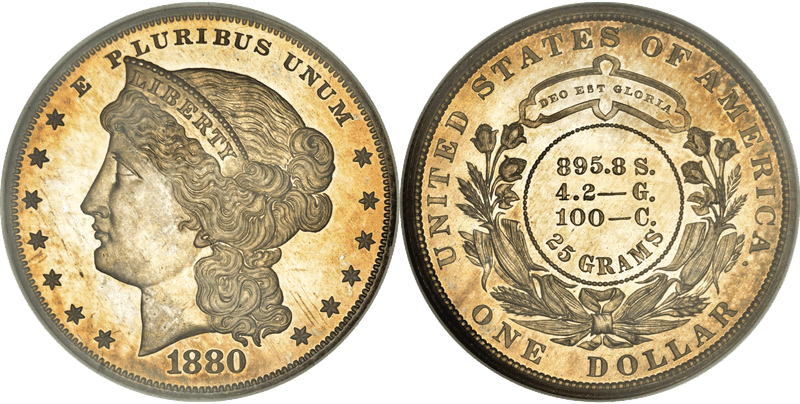
Judd and Pollock numbers. Each page carries the piece's number in Judd's United States Pattern Coins, which gives one number to one pair of dies in one metal with one edge. The 1861 half dollar with GOD OUR TRUST on a scroll is J-277 in silver and J-278 in copper, and the field version is J-279 and J-280. A letter marks a later addition, such as J-312a for the copper version of the GOD OUR TRUST two-cent piece. Pollock's numbers often split what Judd joins: J-277 is Pollock-326 and Pollock-328 for two obverse dies. A few numbers have been withdrawn or moved. USPatterns.com says the old J-364 is the broad-planchet piece now listed as J-371a, J-409b was a silver-plated J-408, and J-444a is J-442.

Metal and edge. The metals of these years are copper, bronze, copper-nickel, nickel, aluminum, oroide, tin, billon, silver and gold, plus the 1864 copper-aluminum cents and a rolled sheet of silver and copper used for J-407 and J-428a. Copper and bronze are hard to tell apart without analysis, and the references sometimes differ on which a number is. The postage currency pieces need testing before they can be attributed. Gilt and bronzed copper pieces are surface treatments and carry the same Judd number as plain ones.

Die pairs. The design usually settles the number. For the 1863 two-cent patterns, look for Washington or a shield on the obverse, and on the reverse for CENTS curved more strongly than on the adopted coin. For 1864, the small or large motto on the obverse matters. The restrikes are often known by their dies: a D in UNITED with a broken top, a first S in STATES with a break, rust on a reverse or a heavily polished die.

Grading. NGC and PCGS grade most of these as proofs. Several numbers also exist as business strikes (J-267, J-290, J-300, J-353 to J-356b, J-404, J-406, J-409, J-414, J-432), and those have their own pages here. Grading labels and dealer catalogs separate originals from restrikes for some numbers, as with the two pages for J-319.

Key Patterns of the Era

1860. The transitional half dime, J-267, pairs the starred obverse with the new reverse so that no side names the country. The double eagle patterns carry Paquet's reverse, and the half eagle patterns show the wide-planchet design with an inverted A for the V in FIVE. The intaglio cent J-264 was struck from the hubs.

1861 and 1862. The 1861 half dollars introduce GOD OUR TRUST (J-277 on a scroll, J-279 in the field), with matching copper eagles; the 1862 half dollars repeat both, and Woodward wrote in May 1863 that 25 sets were struck. J-288 is a copper double eagle on a concave planchet; Judd and Walter Breen linked it to J. T. Barclay's ideas against counterfeiting, and an 1887 Mint list of patterns describes such a piece.

1863. The cent patterns begin with J-299, the Mint's first bronze cent, and include the copper-nickel cent with a reeded edge (J-300) and the backdated cents with Longacre's L (J-301 to J-304). The two-cent patterns show Washington with GOD AND OUR COUNTRY and a shield with GOD OUR TRUST. The three-cent pattern J-319 uses a Liberty head taken from the Coronet large cent. The ten-cent patterns are mostly the postage currency trials of May 1863, starting with J-325. George Eckfeldt's journal records the GOD OUR TRUST half dollars struck in November 1863 for Pollock, and two gold eagles struck in August, one of them the unique J-349.

1864. The cent patterns test three copper-aluminum alloys (J-353 to J-355), an alloy of copper and tin (J-356) and a thin copper-nickel cent of 48 grains (J-356b), the weight Pollock sent Chase in March 1864. The off-metal cents with the L (J-361 and others) are later pieces. The two-cent patterns pair the 1864 obverse with the curved 1863 reverse or strike the regular dies in other metals. The quarters include Paquet's tall-letter reverse.

1865. The three-cent patterns include J-410, a nickel design almost the same as the adopted coin but with a higher date. The five-cent patterns pair a shield with a 5 inside stars and rays (J-416); some may be originals, and J-418 is a restrike of about 1870 from a worn reverse die. J-407 is a two-cent piece on a rolled planchet of silver and copper said to come from Michigan ore. The quarters, half dollars, dollars and gold coins with IN GOD WE TRUST (J-425, J-452 and the rest of the double eagle patterns) preview 1866, and J-440 is a gold three-dollar restrike from a later obverse die.

These pieces were never legal tender issues, and most left the Mint through private channels. USPatterns.com cites Woodward's 1880 account of officials selling sets, Eckfeldt's journal entries for sets struck for Director Pollock, and the June 1870 Mason & Co. sale that stated only two gold sets of the 1865 motto half eagle, eagle and double eagle were made. One of those sets went to the Mint's own collection in 1892 and is now in the Smithsonian.

Public collections hold several pieces that will not come to market, among them the gold J-272a in the Smithsonian, a GOD OUR TRUST two-cent piece given to the British Museum in 1864, and groups in the Connecticut State Library and the Durham Museum.

Attribution needs care. Copper and bronze look alike, many postage currency pieces have tested as a different alloy from their label, some off-metal trials are probably mint errors on the wrong planchet, and counterfeits of J-432 are known. Pieces that carry an 1860s date but were struck around 1870 are still listed under that date, so the die details USPatterns.com gives are the way to tell original strikings from the later ones.

Some pieces dated in these years belong to other trees: private patterns such as the 1861 Chormann pieces are in the privately issued patterns, die and hub trials and splashers in die trials, hub trials and splashers, and coins struck for the Confederacy in the Confederate States tree. The regular coins these patterns led to are in the two-cent pieces, nickel three-cent pieces, Shield nickels and Indian Head cents, and the story continues in the Reconstruction era patterns.

In Our Catalog

No errors or varieties are listed for Civil War Patterns (1860-1865) yet. Submit one

FAQ

What is the 1860 transitional half dime?

It is Judd-267, a half dime with the 1859 pattern obverse, where stars surround the seated figure instead of the country's name, dated 1860 and paired with the new reverse of 1860. The starred obverse carries no legend and the new reverse has none either, so the piece names the United States on neither side. USPatterns.com reports that 100 are said to have been struck, all as business strikes, and gives it a rarity of R-4, which on the Sheldon scale it uses means 76 to 200 known.

Were the 1863 two-cent pieces with IN GOD WE TRUST really struck in 1863?

Probably not. The two-cent patterns Mint Director James Pollock sent to Treasury Secretary Salmon P. Chase in December 1863 carried GOD OUR TRUST or, with a head of Washington, GOD AND OUR COUNTRY, and it was Chase who asked for IN GOD WE TRUST. USPatterns.com shows that the 1863-dated pieces with the adopted motto (J-316 to J-318) come from a large-motto hub and a damaged D that match coins of about 1870, and no example appears in an auction catalog before then.

What were the 1863 postage currency patterns?

In May 1863 the Mint struck small ten-cent pieces meant to stand in for the Postage Currency notes then in use. One side reads EXCHANGED FOR U.S. NOTES around a small shield in a wreath; the other reads POSTAGE CURRENCY and ACT JULY 1862 around 10 CENTS 1863. They were struck in silver, billon, copper, aluminum, tin and nickel, on several weights, and Judd numbers them J-325 to J-332. David Cassel's research, reported by USPatterns.com, found that many of the alloys and weights given in the older references are wrong, so testing is the only sure way to attribute one.

Why are so many of these patterns in copper or aluminum?

Some were genuine experiments, such as the 1863 bronze cent and the 1864 copper-aluminum cents. Many others were made for collectors. USPatterns.com describes the copper, aluminum and nickel strikings of the 1863 and 1864 minor coins and the 1863 to 1865 quarters, half dollars and dollars with IN GOD WE TRUST as pieces made from about 1869 into the early 1870s and sold in complete sets.

What is the difference between a restrike, a novodel and a fantasy piece?

In the definitions USPatterns.com uses, a restrike comes from a correctly matched pair of regular dies struck after the date they carry, a novodel comes from new dies made later and backdated, and a fantasy piece is an unauthorized striking by Mint personnel, made in small numbers for their own profit. The 1863 and 1864 cents with Longacre's L on the ribbon in off metals, and the 1863-dated two-cent pieces with IN GOD WE TRUST, are described there as novodels.

What do the R-numbers on these pages mean?

They are rarity ratings on William H. Sheldon's scale, which USPatterns.com uses. R-8 means 2 or 3 known (a single known piece is called unique), R-7 means 4 to 12, R-6 means 13 to 30, R-5 means 31 to 75, R-4 means 76 to 200 and R-3 means 201 to 500. Many ratings are estimates, and USPatterns.com revises its counts as pieces are traced.

↑ Back to the coins: every year, mint, variety and error

Explore Other Denominations

Collector Essentials

Tools and references for building and protecting your coin collection.

As an Amazon Associate, NumisDex earns from qualifying purchases.