Nickel Three Cent Pieces 1865-1889

Coin Series
Nickel Three Cent Pieces 1865-1889 series coin

About This Series

Introduced during the Civil War's devastating impact on the monetary system, the Nickel Three Cent Piece was authorized by the Act of March 3, 1865, to replace the silver trime hoarded out of circulation alongside virtually all precious-metal coinage. James B. Longacre designed the Liberty Head obverse — a youthful profile with a coronet inscribed LIBERTY — paired with a Roman numeral III reverse surrounded by a laurel wreath. Struck in 75% copper and 25% nickel, the base-metal composition ensured circulation rather than hoarding. The coin was also meant to retire the unpopular three-cent fractional currency notes, and its copper-nickel alloy owed much to lobbying by Pennsylvania nickel producer Joseph Wharton. The denomination's purpose — facilitating three-cent stamp purchases — became obsolete as postal rates changed, and mintages declined through the 1870s and 1880s. In several of the final years proof mintages exceeded business strikes (in 1884, about 1,700 circulation pieces against 3,942 proofs), so proofs of some mid-1880s dates are easier to find than circulation strikes. The 1877, 1878, and 1886 were struck only as proofs; published figures for the 1877 are 510 and 900, both reconstructions, while the 1878 proof mintage was 2,350. The series was discontinued in 1889 as part of a broader consolidation of redundant denominations. Although the last pieces are dated 1889, the denomination was formally abolished by the Act of September 26, 1890, which also ended the gold dollar and the three-dollar gold piece.

From NumisDex News

Series Information

Production Years
1865-1889
Composition
75% Copper, 25% Nickel

Browse by Base(25 bases)

Showing all 25 listings

History

During the Civil War, gold and silver coins disappeared into hoards, and even cents sold at a premium. Congress filled the gap with paper fractional currency, including a three-cent note first issued in 1864. The public disliked the small notes, which quickly became dirty and ragged. The bronze cent and two-cent piece of 1864 showed that base-metal coins would circulate, and the industrialist Joseph Wharton, who controlled the American supply of nickel, pressed for coins of 75% copper and 25% nickel.

Legislation for a three-cent coin of that alloy passed both houses without debate in the last hours of the session and was signed by President Abraham Lincoln; it is known as the Act of March 3, 1865. The coin was legal tender up to 60 cents, and it was issued in exchange for the three-cent notes, which were no longer printed. Between 1865 and 1876 about 17 million of the coins went to redeem those notes.

The three-cent nickel was welcomed at first, but the five-cent nickel of 1866, larger and easier to reckon with, soon took most of its work. Mintages passed eleven million in 1865 and fell below a million by 1871. The Mint Act of 1873 left the coin in place, but by 1876 only 162,000 were struck for circulation, and none at all in 1877 and 1878, when only proofs were made.

Its original purpose ended in 1883, when the postage on a letter dropped from three cents to two. No business strikes were made in 1886, and production ended with the coins dated 1889. Congress abolished the denomination in a law of September 26, 1890 that also ended the gold dollar and the $3 gold piece, and many of the coins held by the Treasury were melted and recoined as nickels.

How to Identify It

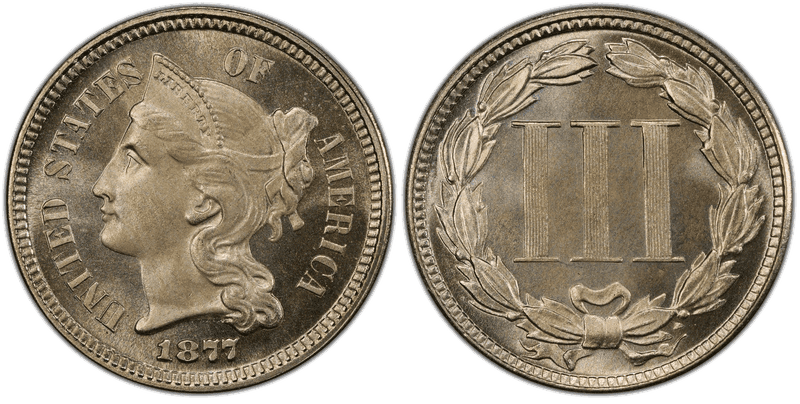
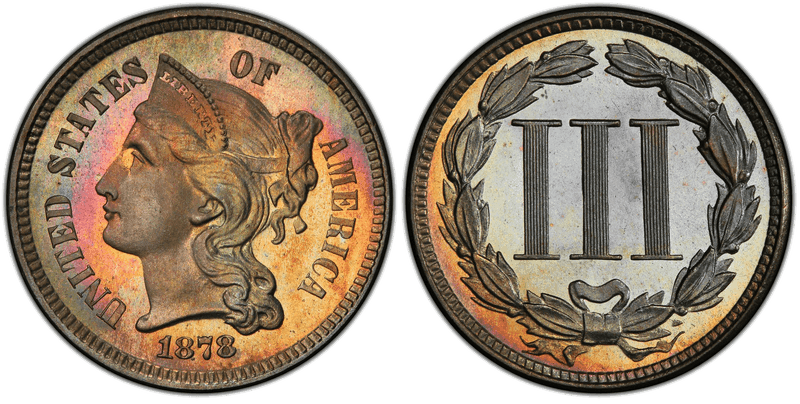
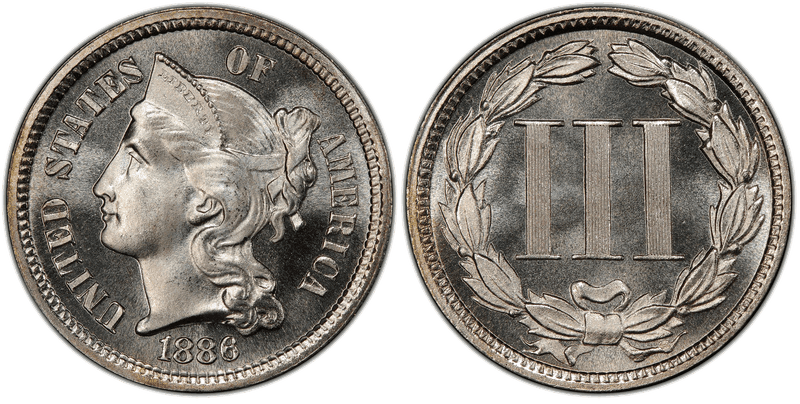
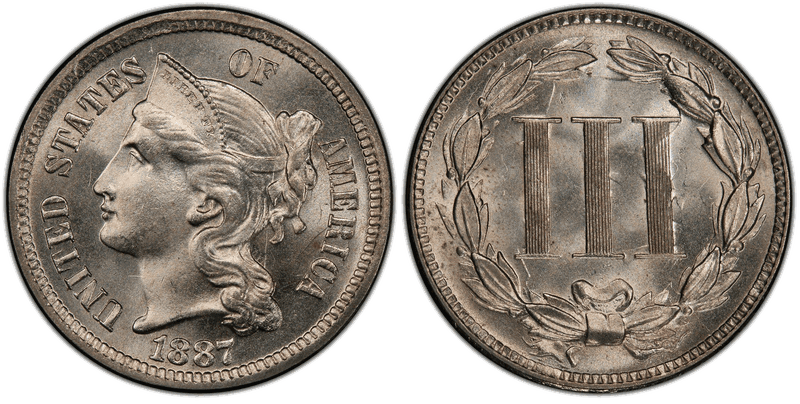
Obverse. Liberty faces left, wearing a coronet inscribed LIBERTY, with her hair tied by a ribbon. UNITED STATES OF AMERICA surrounds her and the date is below. There is no motto; the coin was judged too small for one.

Reverse. The Roman numeral III inside a laurel wreath, combining the numeral of the silver three-cent piece with the wreath of the 1859 Indian Head cent.

Mint mark. None. Every three-cent nickel was struck at Philadelphia.

Strike. Liberty's head sits directly opposite the III, and the hard alloy often failed to fill both, so many coins are weak at the high points. The early dates often show clash marks and die cracks.

Key Dates and Varieties

  • 1865: 11,382,000 struck in the first year, from many dies; NGC notes frequent clash marks, die cracks and small cuds, and MadDieClashes lists several 1865 clashes such as ADC-3C-1865-01. Some 1865 proofs have a reverse whose wreath comes much closer to the rim, probably a pattern die, but they were placed in proof sets and are accepted as regular issues.
  • 1873 Closed 3 and Open 3: of the 1,173,000 struck, 390,000 had the early Closed 3 and 783,000 the revised Open 3. The proofs are all Closed 3.
  • 1877: proofs only. Figures of 510 and 900 have both been published, and NGC calls each an incomplete reconstruction.
  • 1878: proofs only, 2,350 struck, the first year the Mint counted the minor proof sets in its records.
  • 1879 to 1885: business strikes of 38,000 (1879), 21,000 (1880), 1,077,000 (1881), 22,200 (1882), 4,000 (1883), 1,700 (1884) and 1,000 (1885), against proof mintages from 3,100 to 6,609 a year.
  • 1886: proofs only, 4,290 struck.
  • 1887/6 proof: the 1887 proof dies were made over an 1886 date. NGC finds the overdate on most 1887 proofs, with plain-date coins a minority; PCGS separates weak overdates from strong ones. The 1887 business strikes numbered 5,001.
  • 1889: the last year, 18,125 business strikes and 3,436 proofs; NGC suggests many were melted without leaving the Mint.

In Our Catalog

14 errors and varieties are listed for this series. Browse them by type:

Recently added

Mintages

Nickel Three Cent Pieces 1865-1889 mintages by year and mint, taken from each coin's page in our catalog. Each figure opens that coin's page, which lists its varieties and errors. A dash means no figure was recorded. Where one issue was struck in more than one type, each type is listed.

Composition

  • Composition: 75% copper, 25% nickel. Three-cent nickels contain no silver.
  • Weight: 1.94 grams
  • Diameter: 17.9 mm
  • Edge: plain

The specification never changed from 1865 to 1889.

FAQ

Is the three-cent nickel made of nickel?

Partly. It is 75% copper and 25% nickel, the same alloy the five-cent nickel still uses, and weighs 1.94 grams. It contains no silver. The silver three-cent piece, struck from 1851 to 1873, is a different and much smaller coin.

Which three-cent nickels were struck only as proofs?

The 1877, 1878 and 1886. No business strikes were made in those years. NGC notes that published figures of 510 and 900 for the 1877 are both incomplete reconstructions; the 1878 figure is 2,350 and the 1886 is 4,290.

Why are there more proofs than business strikes for some 1880s dates?

By the 1880s the coin had almost no use in commerce, while collectors bought proofs every year. In 1883 the Mint struck 4,000 business strikes and 6,609 proofs, in 1884 1,700 and 3,942, and in 1885 1,000 and 3,790.

What is the 1887/6 three-cent nickel?

A proof overdate. An 1886 date on the die was overpunched with 1887, and the 6 shows under the 7. NGC says the overdate makes up most 1887 proofs, with plain-date proofs a minority found in the silver proof sets; PCGS thinks every 1887 proof die was overdated and divides them into strong and weak overdates. A few 1887 business strikes show a much fainter overdate.

Why doesn't the three-cent nickel say IN GOD WE TRUST?

The law that created the coin in 1865 also ordered the motto on every coin large enough to carry it, but this coin was judged too small.

When was the three-cent nickel discontinued?

Production ended with the coins dated 1889. Congress abolished the denomination in a law of September 26, 1890 that also ended the gold dollar and the $3 gold piece, and many of the coins still held by the Treasury were melted to make five-cent pieces.

↑ Back to the coins: every year, mint, variety and error

Explore Other Denominations

Collector Essentials

Tools and references for building and protecting your coin collection.

As an Amazon Associate, NumisDex earns from qualifying purchases.