The six years from 1874 to 1879 were busy ones in the engraving department at Philadelphia. The Mint had a new trade dollar to perfect, Congress created a twenty-cent piece in 1875, Mint Director Henry R. Linderman wanted the silver coins redesigned, and the silver dollar returned in 1878. Through all of it ran the idea of an international coinage, gold and silver pieces sized to match European coins or marked with their metric weight.
The twenty-cent piece came from Senator John P. Jones of Nevada, who introduced a bill on February 10, 1874, citing a shortage of small change in the West. Patterns were ready by August 1874, with a seated Liberty obverse modeled by the Philadelphia sculptor Joseph A. Bailly and an eagle reverse that Chief Engraver William Barber cut. Superintendent James Pollock thought Bailly's seated Liberty too close to the design already on the silver coins. After the bill became law on March 3, 1875, Barber struck more patterns, and Linderman settled on a Seated Liberty obverse and a smaller version of the trade dollar eagle. Barber's Sailor Head and Liberty at the Seashore obverses, used on twenty-cent patterns of 1875, also appear on trade dollar patterns of 1875 and 1876. In 1876 Linderman also paid the former assistant engraver Anthony C. Paquet for a trade dollar design.
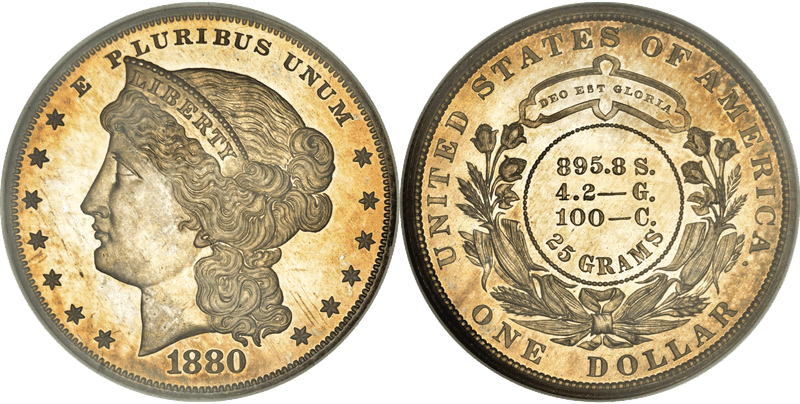
The international idea took several forms. In 1874 Dana Bickford, a New York inventor, brought Linderman a design for an eagle that stated its worth in dollars and in several European currencies, and the Mint struck it in gold and other metals. In 1879 John A. Kasson's proposal for a coin matching the 20-franc piece produced the four dollar Stella, and goloid, an alloy of gold, silver and copper patented by William Wheeler Hubbell in 1877, was tried on metric dollars and on a $20 piece marked with its metal content.
New engravers changed the work after 1876. Linderman asked the Royal Mint in London to recommend a die-sinker, and George T. Morgan reached the Philadelphia Mint on October 9, 1876. In 1877 he and Barber made competing half dollars, and Morgan's head of Liberty, modeled by Anna Willess Williams, moved to his dollar prototypes late that year. When the Bland-Allison Act passed over the President's veto on February 28, 1878, Linderman chose Morgan's dies, and dollar production began on March 11. William Barber died in 1879, and his son Charles E. Barber made the Flowing Hair Stella and shared credit for that year's metric sets.
Many pieces in this tree were not design experiments at all. In 1874 and 1875 the Mint struck its regular dies, cent through double eagle, in copper and aluminum, and USPatterns.com believes those sets were made to sell to collectors. Fantasies such as the 1875 and 1876 Seashore obverses paired with the No Motto dollar reverse were made for the same buyers, and Linderman kept unique white metal pieces of 1875 for his own cabinet.