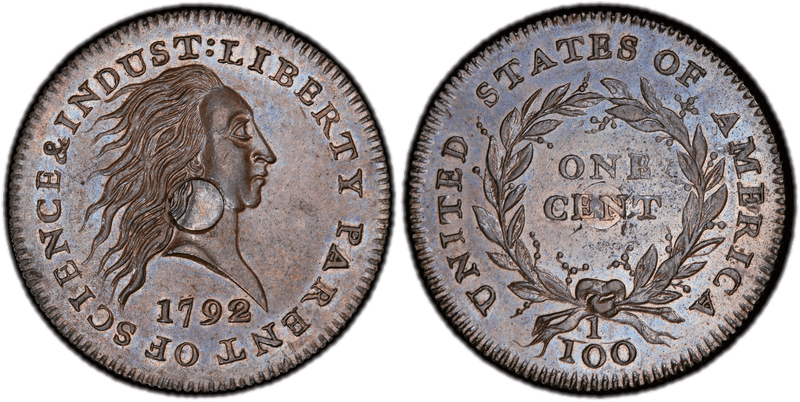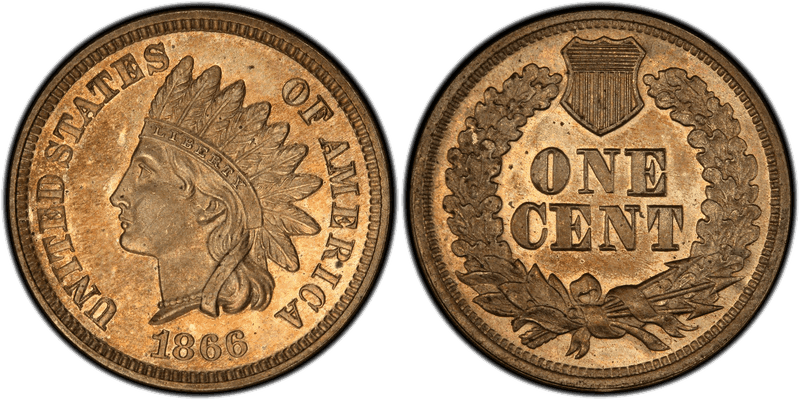
Modern Patterns (1943 to Date)

Coin Series
Modern Patterns (1943 to Date) series coin

About This Series

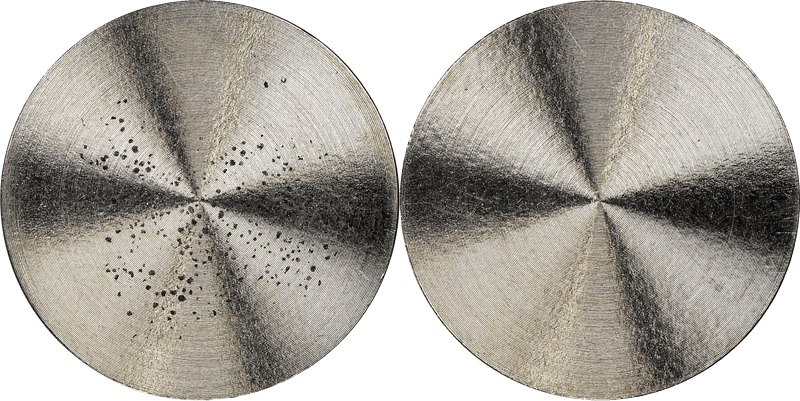
Modern Patterns (1943 to Date) collects the pattern, trial and test pieces of the clad and modern eras. The Mint's own pieces include the 1965 Martha Washington trials struck for the Treasury's alloy study, the 1974 aluminum cent, the 1976 Bicentennial proofs without the S mintmark, the eleven-sided pieces of 1979 and the 2011-2013 alternative metals trials. Private companies made many others at their own expense or for the Mint's studies: the International Nickel Company in 1964 and 1965, DuPont in 1964, Gould Incorporated in 1976 to 1978, General Motors with its roller press, and Frank Zinkann in 1987. Judd numbers the Mint's pieces, Pollock numbers most of the private ones, and Roger W. Burdette numbered the International Nickel and Gould pieces again in 2019.

From NumisDex News

Browse by Base(24 bases)

Showing all 24 listings

About the Era

Most of the pieces in this tree test metal rather than design: they ask what a coin could be made of when its usual metal grew scarce or expensive. In 1942 the Mint and several private firms tried metals, plastics and glass for the cent, and the zinc-coated steel cent of 1943 was the result; cents dated 1944 to 1946 were made from salvaged shell-case brass with added copper. A handful of 1943 cents in experimental platings are known, such as J-2085, which is plated with zinc, antimony and iron. Roger W. Burdette catalogues the wartime pieces, the 1943 cents among them, in his book on World War II patterns.

The great test series came with the silver shortage of the early 1960s. In 1963 the Treasury hired the Battelle Memorial Institute of Columbus, Ohio, to study replacement alloys, and its final report is dated February 12, 1965. For the study, the Philadelphia Mint struck dime, quarter and half dollar size pieces from special dies with Martha Washington on one side and Mount Vernon on the other. Industry joined in. The International Nickel Company (INCO), hoping to win a contract to supply the new alloy, had a long series of test pieces made by Medallic Art Company, and DuPont had August Frank Co. strike pieces in its explosion-bonded Detaclad. The Coinage Act of July 23, 1965 adopted copper-nickel faces bonded to a copper core for the dime and quarter and a 40% silver clad for the half dollar.

Later tests followed the same pattern. Copper's climb in late 1973 led to the aluminum cent; Philadelphia struck 1,571,167 of them before Congress turned the change down. A smaller dollar was planned from 1976, and Gould Incorporated made test tokens in titanium and powdered metal for it while the Mint struck eleven-sided pieces for vending machine makers. In 1999 the Martha Washington dies were used again to test the manganese brass planchets of the Sacagawea dollar, and from 2011 to 2013 a new set of those dies served the Mint's study of cheaper metals for the cent, five-cent piece and quarter.

How Patterns Are Identified

Three numbering systems. The Mint's own pieces carry Judd numbers in the 2000s (J-2101 for the 1965 Martha Washington dime, J-2151 for the 1974 aluminum cent), and die and hub trials carry Judd's Appendix A numbers (J-A1948-2). Andrew Pollock's 1994 book numbers most of the same pieces and also the private ones, which Judd leaves out: the 1942 plastic cents and the General Motors pieces in his 4000s, and the INCO, DuPont, Gould and Zinkann pieces in his 5000s. Roger W. Burdette's 2019 book renumbers the INCO and Gould pieces with RB numbers and gives a concordance to Pollock's, and NGC certifies them by RB number. A few pieces carry both a Judd and a Pollock number for the same coin (J-2176 is P-2090), and some carry a Pollock and an RB number (Gould's titanium P-5425 is RB-1055).

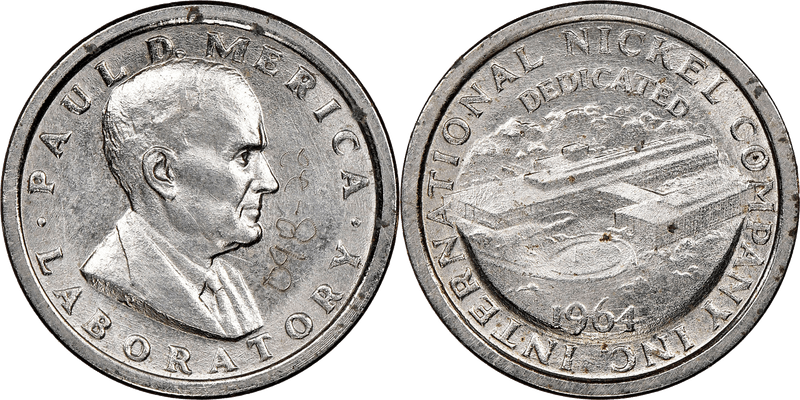
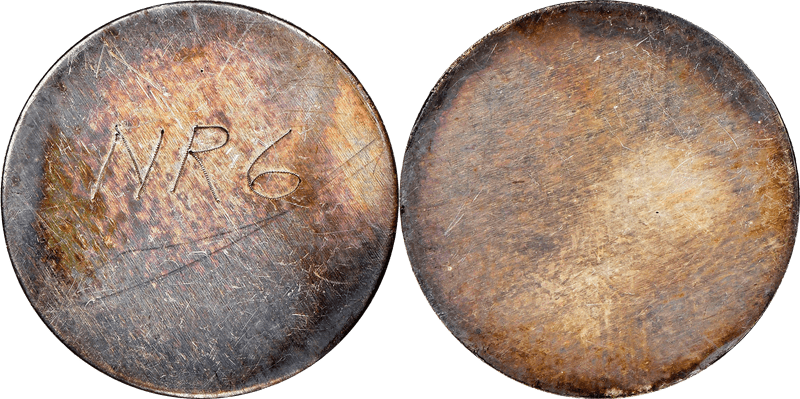
Metal is the variety. Many of these pieces share a single design struck in many metals, so the alloy is what tells them apart. The INCO TEST PIECE quarters of early 1964 have a space on the reverse where an alloy number was engraved or penciled; USPatterns.com's concordance gives the alloy behind many of those numbers, from aluminum and magnesium to stainless steel and German silver. The Merica pieces often carry a short alloy code engraved in the right obverse field, such as NiSi or CuNi. The 1999 Martha Washington dollars are sorted by alloy and edge: manganese brass with a plain edge is J-2185, six notches is J-2185a, a reeded edge J-2187, and a copper, zinc and nickel alloy with dotted N's is J-2188.

Dies and dates. The Martha Washington pieces are all dated 1759, so the year they are filed under is the year of the test, and that is not always known: USPatterns.com places the cent in 1982 and the five-cent piece in 1985 because of the planchet and press tests of those years. The 1965 dies have the lettering close to the rim and Grove's initials under the bust; the later dies have neither. The INCO pieces of 1964 carry their date; NGC gives the 1965 pieces and the blanks years in parentheses.

Grading. NGC and PCGS grade nearly all of these on the Mint State scale. The proofs are the exceptions: the 1976 Bicentennial pieces without S, a few 1999 Martha Washington dollars, and three Gould dollars that NGC lists as proofs.

Key Patterns of the Era

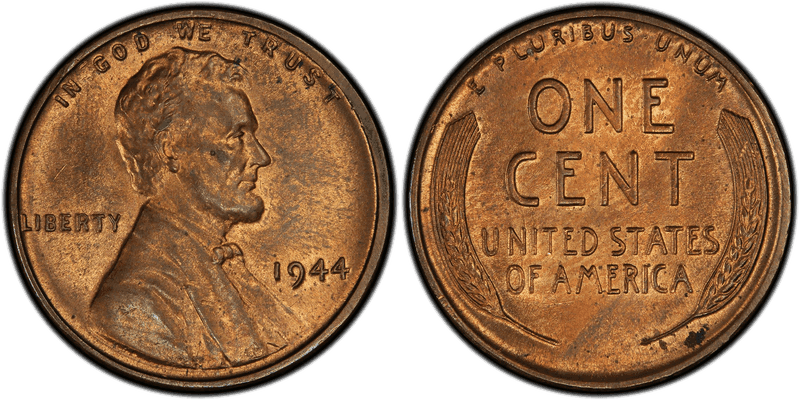
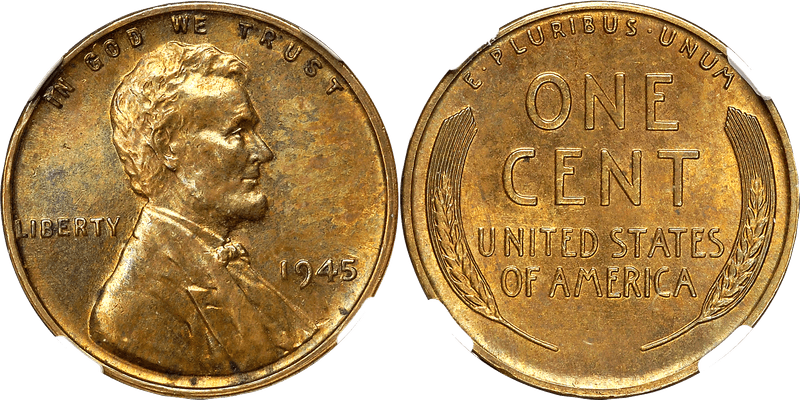
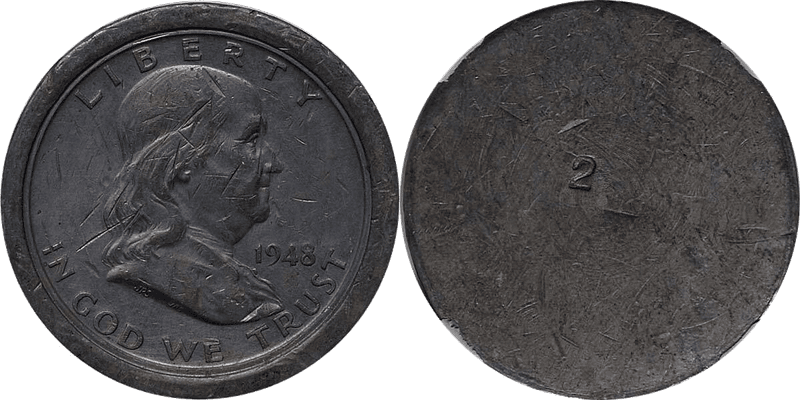
1943 to 1948. Beyond J-2085, the wartime pieces are mostly 1942 trials in other trees, such as the 1942 white metal cent. The 1944 and 1945 cent patterns are Pollock's thick planchet cents, which USPatterns.com doubts are experiments. The 1948 half dollar pattern is a lead die trial of the Franklin obverse. In 1952 the Mint struck 146 cents with James Earle Fraser's new Lincoln design, and all were certified destroyed in March 1953.

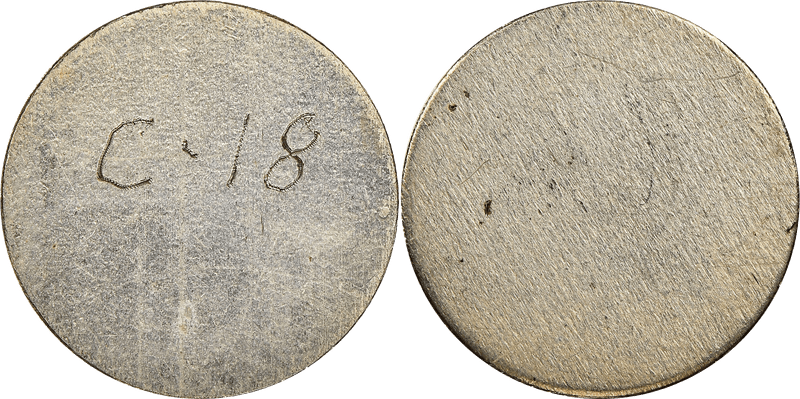
1964. The INCO quarter-size pieces begin with the TEST PIECE design, among them RB-1410 in copper-nickel on a copper core, the structure the Mint adopted. From late summer INCO used Gilroy Roberts's portrait of Paul D. Merica in dime, quarter and half dollar sizes and supplied unstruck blanks as well. DuPont's Franklin Detaclad piece names its own process on the reverse. Corning Glass made uniface glass halves showing Kennedy for AT&T, without any government contract. The Kennedy half dollar trials of 1964 are in the die trials tree, among them a copper reverse hub trial with two D mintmarks.

1965. The Mint's Martha Washington dime J-2101 and quarter J-2116 in the adopted clad were sealed in blue Lucite with silver-clad halves, and President Johnson spoke of those blocks when he signed the Coinage Act. The 1965 half dollar patterns hold the same design in nickel, in copper-nickel clad and in a copper, zinc and silver alloy. The Battelle report lists the same designs in other metals, from Monel to stainless steel, most of which are not known to survive. INCO's 1965 quarter-size pieces and dime and half sizes use a second version of the Merica design.

1974 and 1975. The 1974 aluminum cent, J-2151, was struck at Philadelphia in an alloy of 96% aluminum, 1,571,167 pieces in all, and was recalled when Congress rejected it. The Mint also tried bronze-clad steel (J-2152), and a Denver Mint die setter later recalled striking fewer than a dozen aluminum cents there, which the Mint says it never authorized. Some 66 aluminum cents dated 1975 (J-2155) were struck as well.

1976 to 1979. For the Bicentennial the Mint struck proofs on 40% silver clad without the S mintmark; the only one known is the Type II dollar, J-2164. For the smaller dollar, Frank Gasparro's Liberty head design, J-2171, lost to Susan B. Anthony in the 1978 bill. Gould's dollar-size tokens come in seven designs and metals from nickel and brass to powdered titanium, such as RB-1055. The 1979 eleven-sided pieces went to vending machine makers ahead of the Anthony dollar.

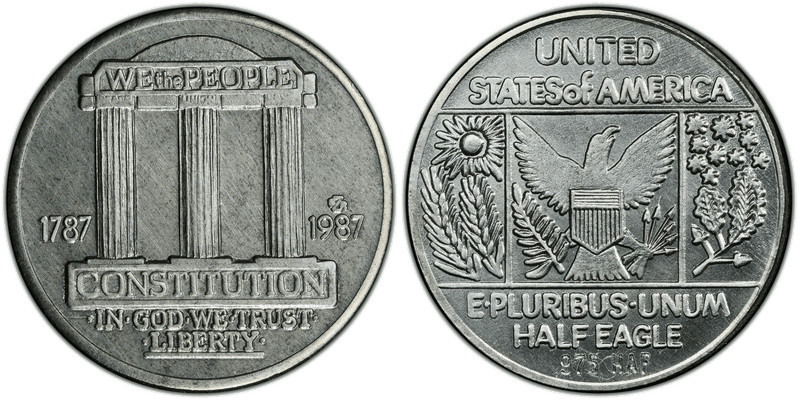
1982 to 1999. Martha Washington test pieces appear again on a copper-plated zinc cent planchet of about 1982 and on a five-cent piece probably struck to test the Schuler press. The 1987 half eagle patterns are not Mint pieces at all but Frank Zinkann's private Constitution Bicentennial pieces in hafnium, silver and tungsten. The 1999 dollar trials, such as J-2185, tested the golden planchets of the Sacagawea dollar with notched, reeded and partly reeded edges; the 39 Sacagawea dollars struck in 22 karat gold that USPatterns.com counts among the trials are filed with the Sacagawea dollars. The 1971-S Eisenhower dollars from prototype dies, recently numbered J-2147, are filed with the Eisenhower dollars.

2011 to 2013. The five-cent and quarter trials from the alternative metals study cover stainless steel, plated steel, plated zinc and several brasses from makers that include the Royal Mint, the Royal Canadian Mint and Jarden Zinc Products.

Two kinds of piece sit side by side here, and for the Mint's own trials the question of title can be open. Martha Washington pieces in collectors' hands may have come from the outside contractors who were lent the dies, and USPatterns.com says it is not known whether they were struck inside or outside the Mint; Coin World reported, from the president of IDX Inc., that recipients of the 1999 samples had to return every piece. The 1974 and 1975 aluminum cents are the one group the government has acted on: the Mint holds that they remain federal property, the Secret Service has said it will seize them, and the 1974-D example was surrendered in 2016. USPatterns.com is unsure whether the Mint would treat the 2011-2013 trials the same way.

Many of the private pieces have reached collectors, some from the estate of an INCO official (Coin World), and a single 2021 sale offered more than 150 INCO and Gould pieces certified by NGC. They were struck outside the Mint and never proposed as designs, and USPatterns.com notes that the 1987 Zinkann pieces were never authorized by the Mint at all. Earlier private pieces have their own tree, privately issued patterns, and the die and hub trials of these years sit with the die trials, hub trials and splashers.

Attribution rests on the alloy. For many INCO numbers the alloy is known only from Burdette's concordance, and some lack it, so metal tests are the usual way to confirm a piece. The 1944 and 1945 thick planchet cents show why: without an analysis, a thick cent is more likely a mint error than a pattern.

In Our Catalog

No errors or varieties are listed for Modern Patterns (1943 to Date) yet. Submit one

FAQ

What do the RB numbers on INCO and Gould pieces mean?

They are Roger W. Burdette's numbers, from his 2019 book Private Pattern and Related Pieces - International Nickel & Gould Incorporated. Andrew Pollock had already numbered many of these pieces, mostly in his 5000s, in United States Patterns and Related Issues (1994). Burdette's book adds varieties Pollock missed, corrects his listings, and gives a concordance from Pollock's numbers to the new RB numbers, which are spaced widely so that new finds can be fitted in. NGC certifies the pieces by RB number. Burdette also used RB numbers in his earlier book on World War II patterns (RB43-81 is a 1943 experimental cent). There is no "Reed-Brenner" or "Robinson-Breen" catalogue.

Is it legal to own a 1974 aluminum cent?

The Mint says no. In a 2009 letter its chief counsel described the 1974-dated aluminum cents as experimental prototypes that were never issued and remain United States property, and the Secret Service has said it will confiscate any that come to market. When a 1974-D example surfaced in 2014, the Mint demanded it back, and in March 2016 its holders surrendered it under a settlement. One Philadelphia piece is in the Smithsonian. The 1975 aluminum cents and the bronze-clad steel trials of 1974 have the same status in USPatterns.com's account.

Why does Martha Washington appear on so many modern patterns?

She is on the Mint's test dies, not on a proposed coin. For the Battelle Memorial Institute's alloy study the Mint made special dies with Martha Washington by Edward R. Grove and Mount Vernon by Philip Fowler, dated 1759, the year she married George Washington. Because the dies carry no real portrait or denomination, the Mint has kept using them to test planchets and presses and has lent them to contractors, which is why Martha Washington cents, five-cent pieces and dollars from 1982, 1985 and 1999 exist.

Were the INCO and DuPont pieces made by the Mint?

No. The International Nickel Company had its pieces made by Medallic Art Company, according to NGC, and Coin World says the private August Frank Co. of Philadelphia struck DuPont's. The sources differ on whether the Mint asked for them; NGC says the companies paid for them in hopes of a contract, and USPatterns.com describes INCO and DuPont as companies the Mint commissioned. The Mint's own trials of 1964-1965 are the Martha Washington pieces.

Are the 1944 and 1945 thick planchet cents patterns?

Probably not. Pollock numbered a 1944 thick planchet cent P-2078 and a 1945 one P-2079, and NGC certifies them under those numbers, but USPatterns.com thinks the 1944 piece is more likely a mint error on foreign or misrolled stock, since no analysis has shown a special alloy, and notes that thick planchet cents are known for many other years.

What are waffle-cancelled patterns?

They are test pieces from the Mint's 2011-2013 study of cheaper metals for the cent, five-cent piece and quarter, struck from newer Martha Washington dies; the pieces that left the Mint were cancelled with a waffle pattern. USPatterns.com lists them as J-2200 to J-2233 by metal and maker, and the few in collectors' hands are waffle-cancelled.

↑ Back to the coins: every year, mint, variety and error

Explore Other Denominations

Collector Essentials

Tools and references for building and protecting your coin collection.

As an Amazon Associate, NumisDex earns from qualifying purchases.