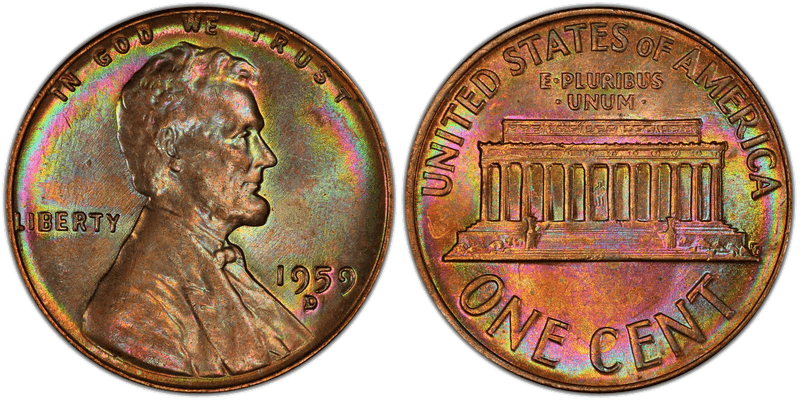
Two Cent Pieces 1864-1873

Coin Series
Two Cent Pieces 1864-1873 series coin

About This Series

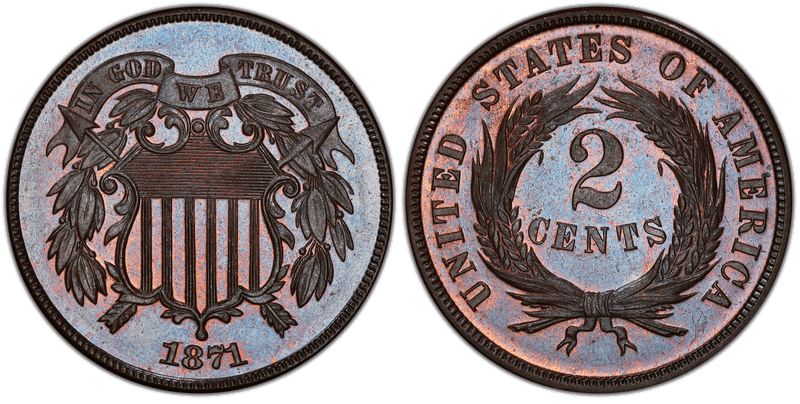
Historic significance elevates the two-cent piece far beyond its brief ten-year production run: this denomination was the first United States coin to carry the motto IN GOD WE TRUST, introduced during the Civil War when religious sentiment and national anxiety converged to produce lasting changes to American coinage. The motto grew out of an 1861 letter from Pennsylvania minister Mark R. Watkinson asking Treasury Secretary Salmon P. Chase to acknowledge God on the coinage; the Act of April 22, 1864 left the wording to the Treasury, and the phrase IN GOD WE TRUST was settled on for this coin. James B. Longacre designed the shield obverse — symbolizing the defense of the Union — paired with a wreath reverse enclosing the denomination. The 1864 Small Motto variety, distinguished by narrower lettering in IN GOD WE TRUST, was struck first, from a prototype die; NGC puts the circulation strikes at several thousand. First-year mintages exceeded 19 million pieces, but production fell sharply thereafter as the coin's denomination proved impractical alongside the existing cent and nickel: by 1872, just 65,000 business strikes were produced, and the final 1873 issue was proof-only. Struck in bronze (95% copper, 5% tin and zinc) at 23mm diameter and 6.22 grams, two-cent pieces saw genuine circulation during the Civil War era when hoarding had created severe small-change shortages. The denomination was officially abolished by the Coinage Act of 1873, but its legacy endures through the IN GOD WE TRUST motto that gradually spread to all American coins and remains in use today.

From NumisDex News

Series Information

Production Years
1864-1873
Composition
Bronze

Browse by Base(10 bases)

Showing all 10 listings

History

The Civil War emptied the country of federal coins. People hoarded silver and gold, and by 1862 even the copper-nickel cent had vanished, leaving shopkeepers to make change with private tokens, many of them thin bronze pieces worth far less than a cent. Mint Director James Pollock noticed that those tokens circulated freely, and late in 1863 he proposed a bronze cent and a bronze two-cent piece. A two-cent coin let the Mint put more face value into circulation for the same press time.

The Coinage Act of 1864, signed by President Abraham Lincoln on April 22, 1864, authorized both coins in French bronze. It was also the first law to make base-metal coins legal tender, up to ten pieces at a time.

The new coin carried a new motto. In 1861 the Reverend Mark R. Watkinson had asked Treasury Secretary Salmon P. Chase to recognize God on the coinage, and Chase told the Mint to prepare a suitable motto. Pollock's patterns tried "God Our Trust", and Chase asked that the shield design read IN GOD WE TRUST instead. The 1864 act let the Mint Director, with the Secretary's approval, set the mottoes, so the two-cent piece became the first United States coin to bear the phrase. A law of March 3, 1865 extended it to every coin large enough to carry it.

The coin was welcomed at first, but its moment passed quickly. The copper-nickel three-cent piece arrived in 1865 and the five-cent nickel in 1866, and the two-cent mintage fell every year after 1864. Surplus coins could not be redeemed until a law of March 3, 1871 allowed it in lots of $20. The 1872 circulation mintage was just 65,000, and the Mint Act of February 12, 1873 abolished the denomination. About 17 million of the roughly 45.6 million issued had been redeemed and recoined into cents by 1909.

How to Identify It

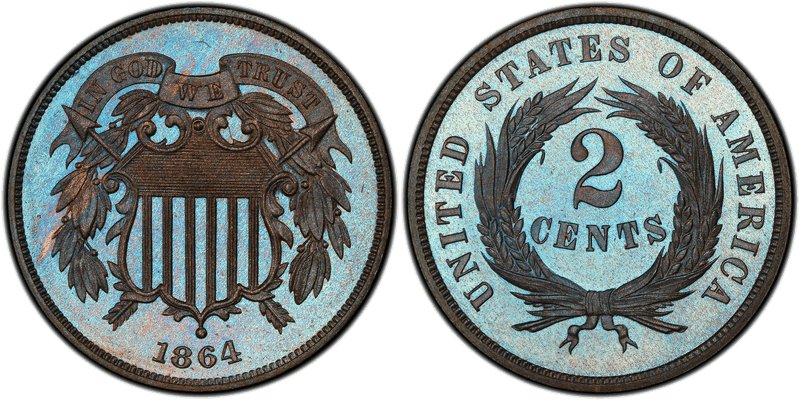
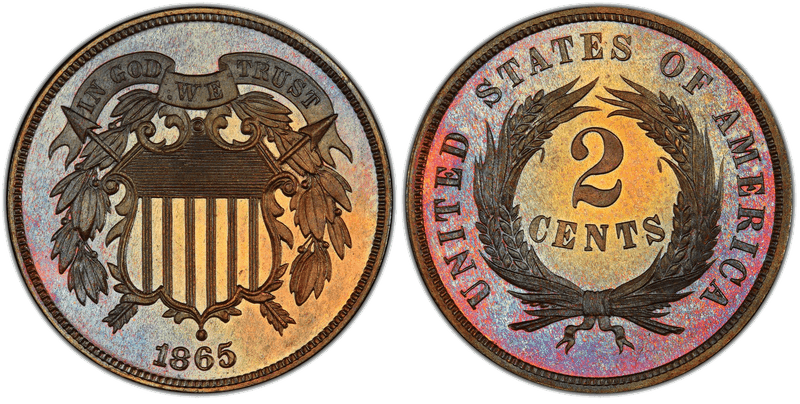
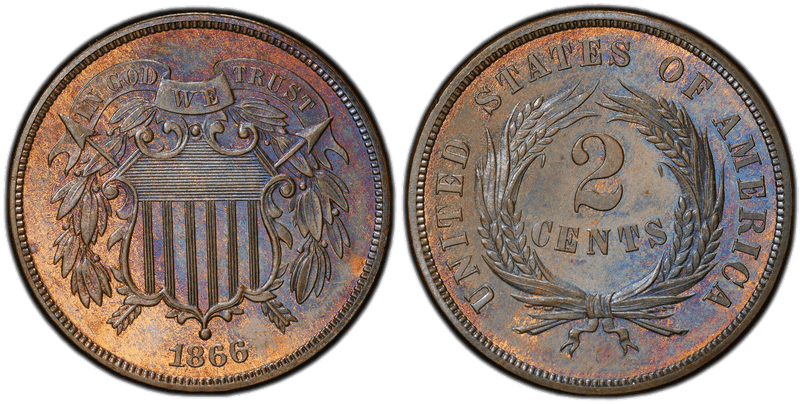
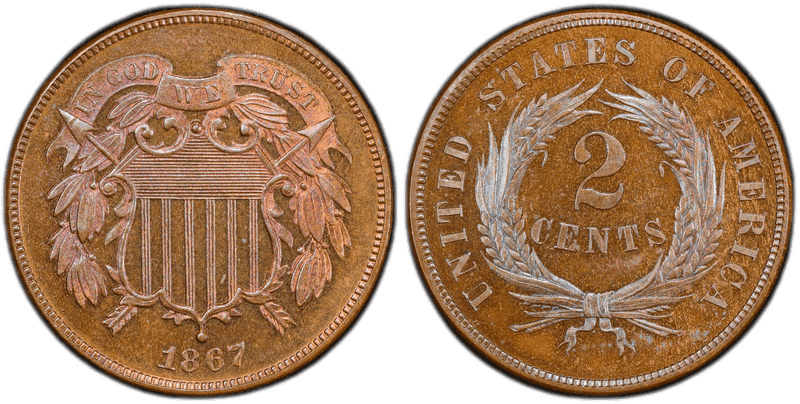
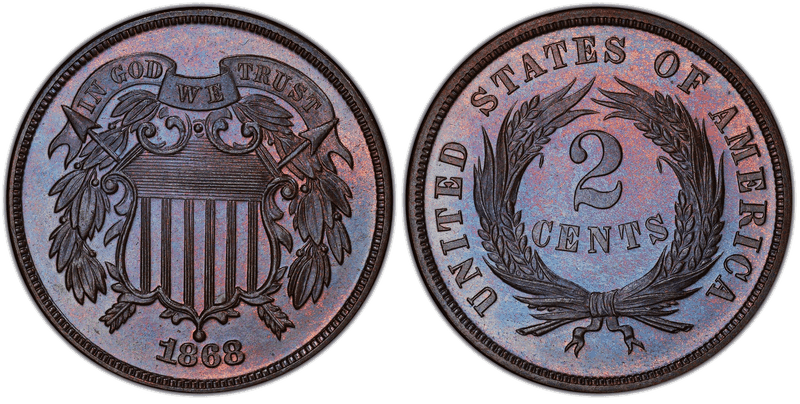
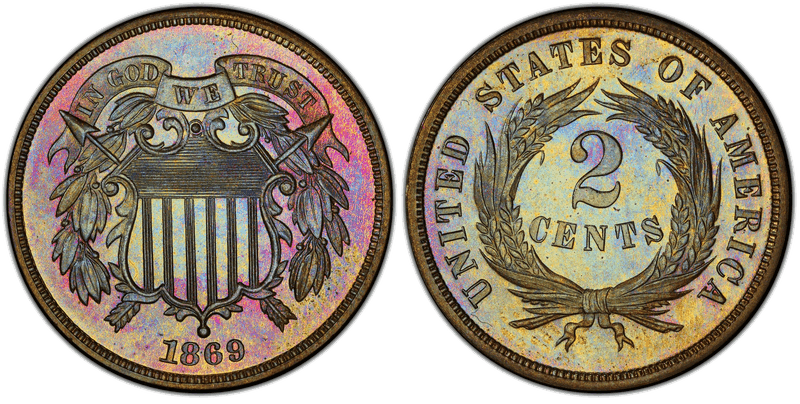
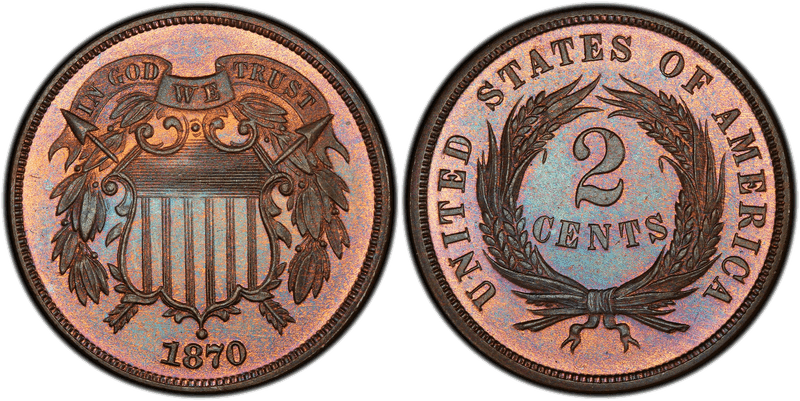
Obverse. A shield with crossed arrows behind it and a laurel branch on each side, adapted from the Great Seal. IN GOD WE TRUST runs on a scroll above the shield, and the date is below.

Reverse. 2 CENTS inside a wheat wreath, with UNITED STATES OF AMERICA around the edge.

Mint mark. None. Every two-cent piece was struck at Philadelphia.

Small Motto and Large Motto (1864). The earliest 1864 coins were struck from a prototype obverse whose motto letters were smaller. CoinWeek's checks: a smaller D in GOD on the Small Motto, the first T of TRUST closer to the ribbon fold on the Large Motto, and a stem visible under GOD on the Small Motto only. Wear on the motto makes this harder on circulated coins.

Plain 5 and Fancy 5 (1865). The 1865 date was punched in two styles, one with a plain 5 and one with a fancy 5 whose flag curves sharply. The same date styles appear on the cent of that year.

Key Dates and Varieties

  • 1864 Small Motto: a few thousand struck for circulation from the prototype die before the Large Motto took over. Proofs are few; NGC puts the survivors at about a dozen (Small Motto proof).
  • 1864 Large Motto: the Mint's figure for the year is 19,847,500, which R. W. Julian argues is 25,000 too high; the Guide Book now uses his 19,822,500. A reverse die that clashed with an Indian Head cent obverse is listed by MadDieClashes as MUDC-2C-1864-01. The Large Motto proofs are estimated at 100, and NGC notes restrikes made a few years later.
  • 1865: 13,640,000 struck, in Plain 5 and Fancy 5 date styles. All of the estimated 500 proofs have the Plain 5.
  • 1867 doubled die obverse: strong doubling on the motto and the arrows. The year's mintage was 2,938,750.
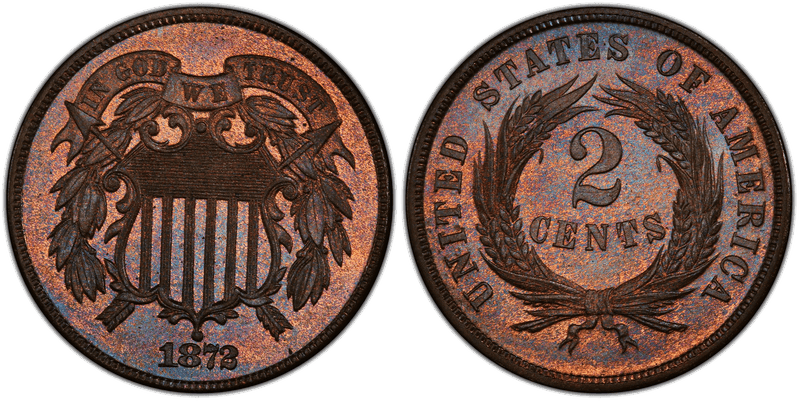
  • 1872: 65,000 struck for circulation, and NGC thinks some were still in the Mint's vaults when the coin was abolished and were melted. The proofs are estimated at 950.
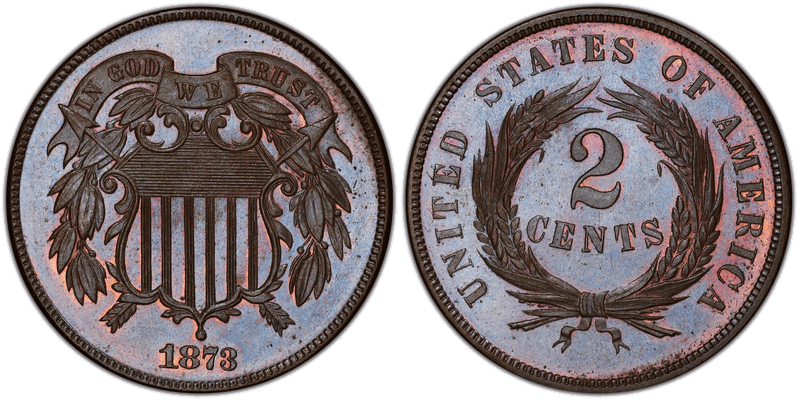
  • 1873 Closed 3 and Open 3: proofs only. NGC's reconstruction is 600 Closed 3 and 500 Open 3, and it calls the numbers tentative. The Open 3 date style was only ordered after a complaint of January 18, 1873, weeks before the coin was abolished, and Breen believed those pieces were struck later.

In Our Catalog

24 errors and varieties are listed for this series. Browse them by type:

Recently added

Mintages

Two Cent Pieces 1864-1873 mintages by year and mint, taken from each coin's page in our catalog. Each figure opens that coin's page, which lists its varieties and errors. A dash means no figure was recorded. Where one issue was struck in more than one type, each type is listed.

Composition

  • Composition: 95% copper, 5% tin and zinc (bronze). Two-cent pieces contain no silver.
  • Weight: 6.22 grams
  • Diameter: 23 mm
  • Edge: plain

The specification never changed from 1864 to 1873.

FAQ

Was the two-cent piece the first coin with IN GOD WE TRUST?

Yes. The 1864 two-cent piece was the first United States coin to carry the motto. Treasury Secretary Salmon P. Chase chose the wording for the shield design, and the law that created the coin let the Mint Director and the Treasury set its mottoes. A law of March 3, 1865 then called for the motto on every coin large enough to hold it.

How do I tell an 1864 Small Motto from a Large Motto?

Look closely at the motto on the scroll above the shield. CoinWeek gives three checks. The D in GOD is noticeably smaller on the Small Motto. On the Large Motto, the first T of TRUST sits closer to the fold of the ribbon. And the stem of the wreath under GOD can be seen on the Small Motto but is hidden on the Large Motto. Only a few thousand Small Motto coins were struck, early in 1864, so check any example carefully.

How many two-cent pieces were made?

About 45.6 million were issued from 1864 to 1873, all at the Philadelphia Mint. Production fell every year, from 19,847,500 in 1864 by the Mint's own figure (R. W. Julian argues 19,822,500) to 65,000 in 1872. In 1873 only proofs were made.

Why was the two-cent piece discontinued?

It was no longer needed. The copper-nickel three-cent piece of 1865 and the five-cent nickel of 1866 took its place in commerce, unwanted coins piled up with no way to redeem them until a law of 1871, and the Mint Act of February 12, 1873 abolished the denomination.

Is there an 1873 two-cent piece for circulation?

No. Every 1873 two-cent piece is a proof. They exist with a Closed 3 and an Open 3 in the date. NGC's reconstruction is 600 Closed 3 and 500 Open 3, and it calls the figures tentative. Walter Breen believed the Open 3 coins were struck later, perhaps quietly.

What is a two-cent piece made of?

Bronze, 95% copper with the other 5% tin and zinc, the same alloy adopted for the cent in 1864. It weighs 6.22 grams and is 23 mm across.

↑ Back to the coins: every year, mint, variety and error

Explore Other Denominations

Collector Essentials

Tools and references for building and protecting your coin collection.

As an Amazon Associate, NumisDex earns from qualifying purchases.