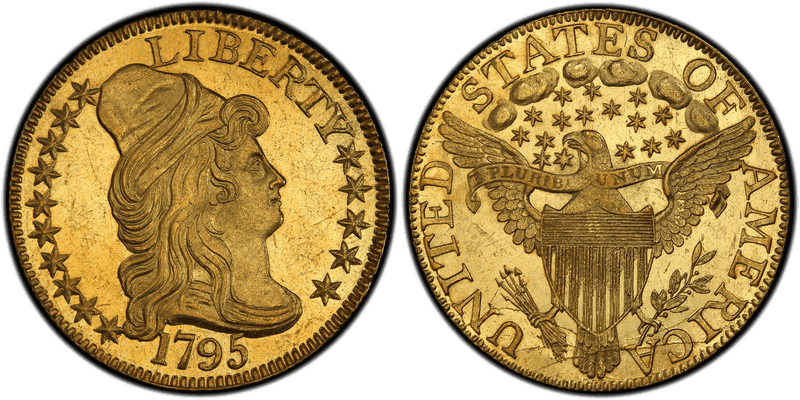
Shield Nickels 1866-1883

Coin Series
Shield Nickels 1866-1883 series coin

About This Series

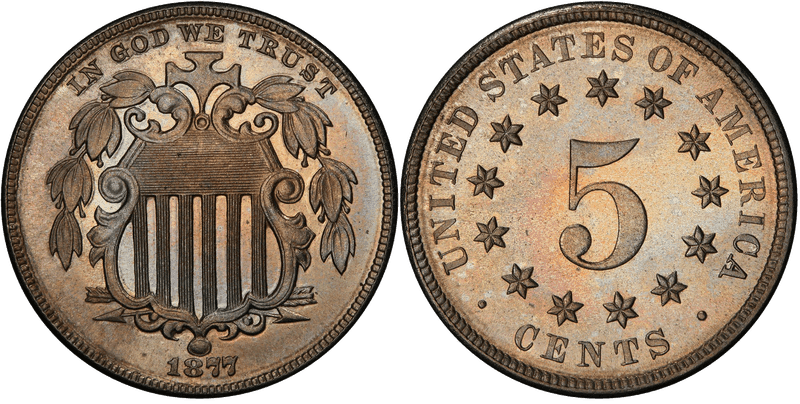
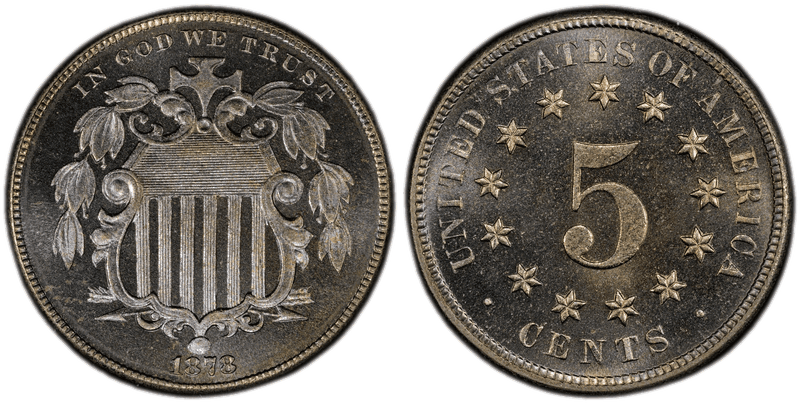
America's first five-cent nickel coin arrived in 1866 as a direct response to the Civil War's disruption of the nation's monetary system, replacing fractional currency notes and supplementing the silver half dime that had largely vanished from circulation due to hoarding. James B. Longacre designed the Union shield obverse — echoing the patriotic imagery of his two-cent piece — with a reverse displaying a large numeral 5 surrounded by stars and rays. The rays between the stars were removed early in 1867 to reduce die breakage and improve the strike, creating the With Rays (1866-1867) and Without Rays (1867-1883) subtypes. The 1877 and 1878 are proof-only issues with no business strikes. The 1880 had a business-strike mintage of 16,000, and because many coins offered as circulation strikes prove to be proofs, it is usually bought certified. The 1883/2 overdate comes from 1882 dies whose date was punched over with an 1883 logotype (NGC 13814). Struck in 75% copper and 25% nickel at 20.5 mm diameter and 5.0 grams, the Shield nickel established the composition and approximate specifications that would define the five-cent piece for over a century. Authorized by the Act of May 16, 1866, the Shield nickel's introduction reflected a broader post-war reorganization of minor coinage. The series remains popular with type collectors and variety specialists.

From NumisDex News

Series Information

Production Years
1866-1883
Composition
75% Copper, 25% Nickel

Browse by Base(18 bases)

Showing all 18 listings

History

The Civil War emptied American pockets of coins. Silver and gold were hoarded, and even the copper-nickel cent disappeared, so small change came from private tokens and from paper fractional currency in amounts as low as three cents. Congress began restoring coins in 1864 with the bronze cent and the two-cent piece, then added a copper-nickel three-cent piece in 1865. The industrialist Joseph Wharton, who controlled most American nickel mining, pressed for more nickel in the coinage.

A five-cent coin in the same alloy followed. Mint Director James Pollock proposed a coin of no more than 60 grains, but the House raised the weight to 5 grams. That was presented as a metric round number, but the historian Don Taxay thought the real aim was to let Wharton sell more nickel. The bill passed on May 16, 1866. NGC dates the first coining to June 11, 1866, and more than 14 million were made in the second half of the year.

Chief Engraver James B. Longacre adapted the shield from his two-cent piece. Other patterns showed George Washington and the newly assassinated Abraham Lincoln, but Pollock never showed the Lincoln design to Treasury Secretary Hugh McCulloch, expecting it to offend the South, and McCulloch chose the shield. The new coins were the first five-cent pieces called nickels, since the silver coin of that value was the half dime.

The hard alloy made trouble from the start. Dies cracked and broke quickly, and most coins were weakly struck. Critics disliked the look as well: Wharton compared the shield to a tombstone, and the stars and rays of the reverse reminded many people of the Confederate stars and bars. Early in 1867 the rays were removed in the hope of easing production, with February 1 the planned date of the change. NGC notes that this cut down the die breaks without curing the weak strikes.

By late 1869 there were enough nickels in circulation, and output fell. The Mint Act of 1873 ended the half dime, and the same law let the Mint stop striking a denomination that was not needed. Late in 1876 nickel production stopped. In 1877 and 1878 only proofs were made for collectors, and from 1879 to 1881 the Mint struck business strikes only in small numbers, until full production resumed on December 12, 1881.

Charles E. Barber's Liberty Head nickel replaced the design in 1883 and was first struck on January 30. Shield proofs were kept in production until June 26, 1883, to discourage speculation in them.

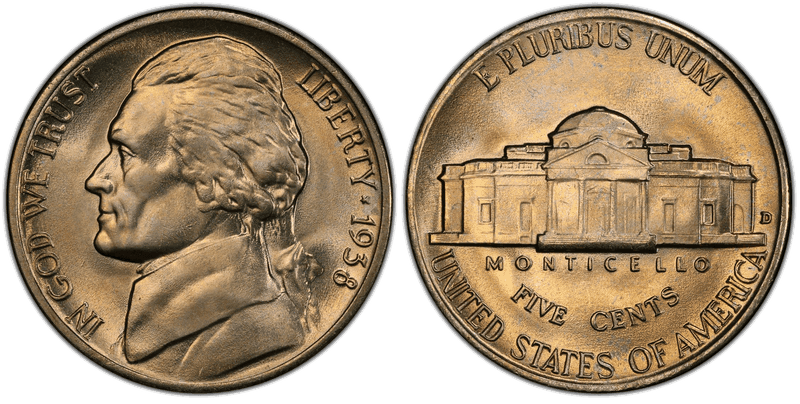
How to Identify It

Obverse. A shield with a small cross on top, flanked by leaves, with the ends of two crossed arrows showing at its lower sides. IN GOD WE TRUST runs across the top and the date is at the bottom (search).

Reverse. A large numeral 5 sits inside a ring of 13 stars, with UNITED STATES OF AMERICA around the edge.

  • With Rays (1866 and early 1867): short rays run between the stars.
  • Without Rays (1867 to 1883): stars only.

Mint mark. None. Every Shield nickel was struck at Philadelphia, and no date carries a mint mark.

Proofs and business strikes. The 1879, 1880 and 1881 business strikes are often prooflike, and some dies were used for both. NGC advises certification for any 1879 or 1880 sold as a business strike.

Key Dates and Varieties

  • 1867 With Rays: 2,019,000 struck before the rays were dropped, against 28,890,500 without rays. The With Rays proof is estimated at about 25, a figure NGC thinks is probably low.
  • 1871: 561,000 business strikes.
  • 1873 Closed 3 and Open 3: the first date punch made the 3 look like an 8, and a new punch with an open 3 replaced it. The usual split of 436,050 Closed 3 and 4,113,950 Open 3 is a reconstruction, and NGC doubts it.
  • 1877 and 1878: proofs only. About 510 1877 nickels went into silver proof sets, and one report gives 900 in all. The 1878 total of 2,350 is the first that counts both kinds of proof set.
  • 1879, 1880 and 1881: 25,900, 16,000 and 68,800 business strikes. The proofs of these years number 3,200, 3,955 and 3,575.
  • 1879/8 proof: listed for decades as an overdate. NGC no longer recognizes it, and CoinWeek reports that Dannreuther's study points to a repunched 8; PCGS still lists it.
  • 1883/2: struck from leftover 1882 dies redated for 1883. Five such dies are known, and Bowers estimates 118,975 coins. Wexler lists the FS-301 die as 1883 WOVD-001.
  • Repunched dates and doubled dies. Because Shield nickel dies wore out so fast, the Mint made many of them in a hurry, and the series is full of minor varieties. Bowers reports more than 180 known doubled dies, and repunched dates turn up across the series, for example 1866 WRPD-001 (FS-05-1866-302). The rim breaks of the early years are catalogued by Cuds on Coins.

In Our Catalog

65 errors and varieties are listed for this series. Browse them by type:

Recently added

Mintages

Shield Nickels 1866-1883 mintages by year and mint, taken from each coin's page in our catalog. Each figure opens that coin's page, which lists its varieties and errors. A dash means no figure was recorded. Where one issue was struck in more than one type, each type is listed.

Composition

  • Composition: 75% copper, 25% nickel. Shield nickels contain no silver.
  • Weight: 5.0 grams
  • Diameter: 20.5 mm
  • Edge: plain

The specification never changed from 1866 to 1883, and proofs were struck in the same alloy.

FAQ

What is the difference between a Shield nickel with rays and without rays?

Look at the reverse. On the With Rays type, short rays run outward between the 13 stars that circle the 5. All 1866 nickels and the first 2,019,000 of 1867 have them. Early in 1867 the Mint dropped the rays, hoping to ease its striking problems, and every nickel from later in 1867 through 1883 has stars only.

Where is the mint mark on a Shield nickel?

There isn't one. Every Shield nickel, business strike and proof, was made at the Philadelphia Mint, and the design carries no mint mark at all.

Which Shield nickels were made in small numbers?

The 1877 and 1878 were struck only as proofs for collectors, with estimates of about 510 to 900 for 1877 and a recorded 2,350 for 1878. Business strikes were also tiny from 1879 to 1881, at 25,900, 16,000 and 68,800, because the Treasury already held more nickels than commerce needed. The 1871 had 561,000. Many 1879 to 1881 business strikes look like proofs, and NGC advises buying the 1879 and 1880 certified.

Is a Shield nickel made of silver?

No. The Shield nickel is 75% copper and 25% nickel, the same alloy as today's nickel, and weighs 5 grams. It was the first United States five-cent coin made of that metal, which is why it was the first one people called a nickel. The silver five-cent coin of the time was the half dime.

What is the 1883/2 Shield nickel?

An overdate. The Mint kept some 1882 dies and punched the 1883 date over them, so traces of the 2 show near the 3. Five reused dies are known, and Q. David Bowers estimates 118,975 coins came from them. Several die varieties exist; the clearest is catalogued as FS-301. It should not be confused with an 1883 with a plain repunched date.

Is the 1879/8 Shield nickel a real overdate?

The experts disagree. The Guide Book has long listed an 1879/8 proof, and PCGS still certifies it under that name (search). NGC no longer recognizes it as an overdate, and CoinWeek reports that John Dannreuther's study points to a repunched 8. PCGS notes that the die struck most of the 3,200 proofs of 1879 (search).

↑ Back to the coins: every year, mint, variety and error

Explore Other Denominations

Collector Essentials

Tools and references for building and protecting your coin collection.

As an Amazon Associate, NumisDex earns from qualifying purchases.