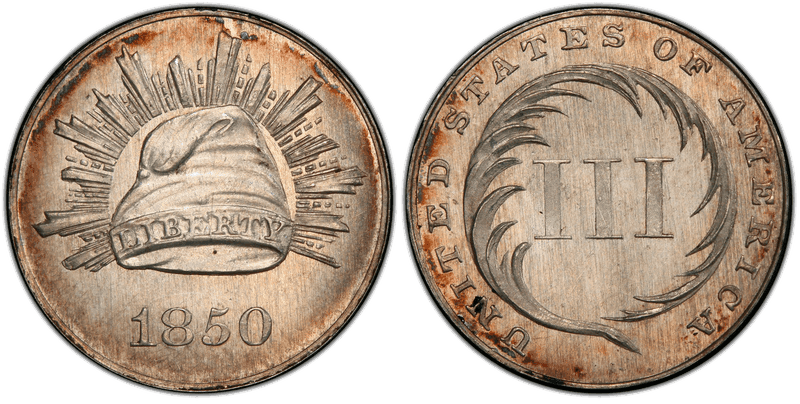
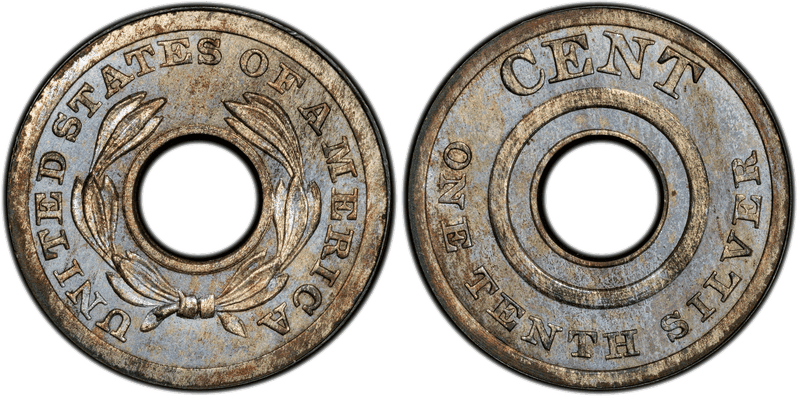
Early Republic Patterns (1792-1859)

Coin Series
Early Republic Patterns (1792-1859) series coin

About This Series

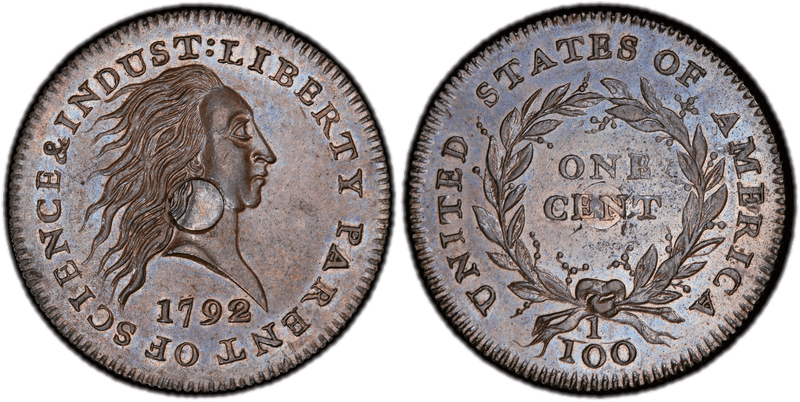
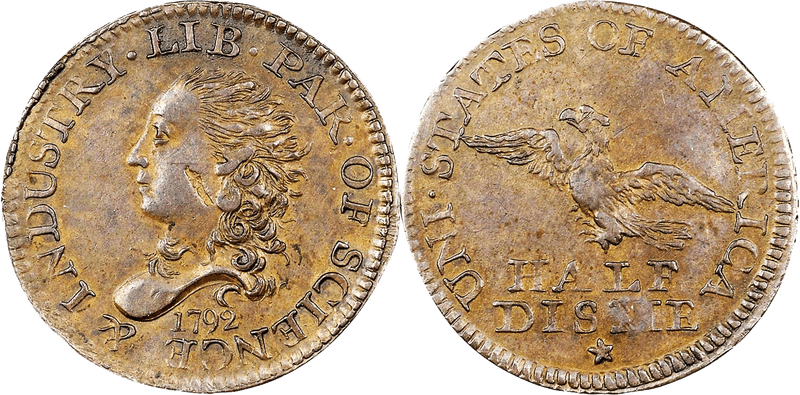
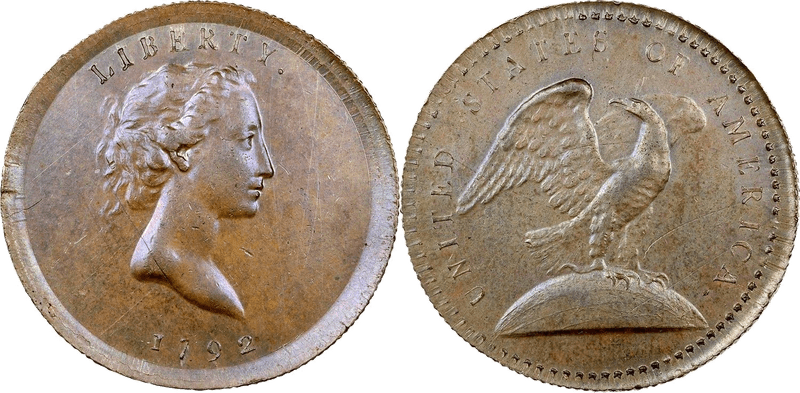
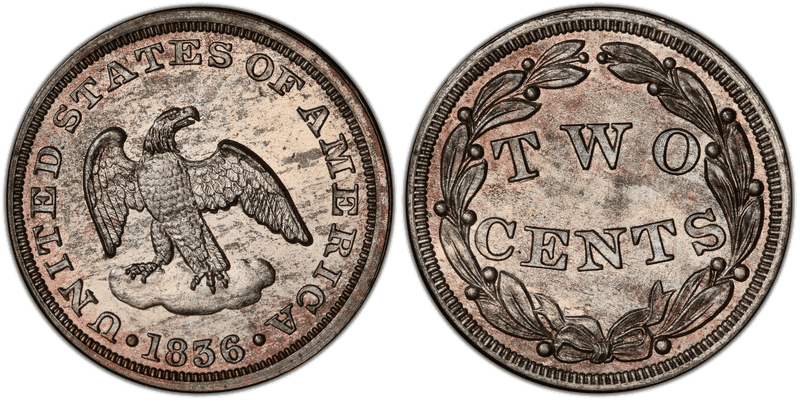
From the experimental half dismes and cents of 1792 through mid-19th-century design proposals, Early Republic patterns document the creative evolution of the United States Mint during its foundational decades. The series opens with the celebrated 1792 patterns — including the Birch cent, Silver Center cent, and various Washington pieces — that tested designs and compositions before Congress settled on specifications in the Coinage Act of April 2, 1792. Subsequent decades produced patterns exploring alternative Liberty portraits, eagle configurations, and denominational formats, including the Gobrecht dollar patterns of the 1830s and experimental cent designs preceding the Flying Eagle. Among them is an 1836 two-cent pattern in billon, a copper alloy with about 10 percent silver; the denomination was dropped after Franklin Peale showed it could be easily counterfeited, and no two-cent piece was issued until 1864. The Judd reference catalog provides the standard numbering system, assigning each distinct combination of obverse, reverse, composition, and edge treatment its own number. Many survive in quantities below 10 specimens, with some being unique. These pieces illuminate the decision-making process behind America's evolving coinage, preserving both rejected and eventually adopted designs.

From NumisDex News

Browse by Base(80 bases)

1792 Cent Patterns
BaseVerified

1792 Cent Patterns

8 Strike Types
1792 Dime Patterns
BaseVerified

1792 Dime Patterns

4 Strike Types
1792 Half Dime Patterns
BaseVerified

1792 Half Dime Patterns

1 Strike Type
1792 Quarter Patterns
BaseVerified

1792 Quarter Patterns

2 Strike Types
1794 Dollar Patterns
BaseVerified

1794 Dollar Patterns

2 Strike Types
1794 Half Dime Patterns
BaseVerified

1794 Half Dime Patterns

3 Strike Types
BaseVerified

1794 Half Dollar Patterns

1 Strike Type
BaseVerified

1795 Cent Patterns

1 Strike Type
BaseVerified

1795 Half Dime Patterns

1 Strike Type
BaseVerified

1795 Half Dollar Patterns

1 Strike Type
1795 Half Eagle Patterns
BaseVerified

1795 Half Eagle Patterns

1 Strike Type
1796 Quarter Eagle Patterns
BaseVerified

1796 Quarter Eagle Patterns

1 Strike Type
BaseVerified

1797 Eagle Patterns

1 Strike Type
1797 Half Eagle Patterns
BaseVerified

1797 Half Eagle Patterns

1 Strike Type
BaseVerified

1799 Eagle Patterns

1 Strike Type
BaseVerified

1803 Half Eagle Patterns

1 Strike Type
1804 Cent Patterns
BaseVerified

1804 Cent Patterns

1 Strike Type
1804 Eagle Patterns
BaseVerified

1804 Eagle Patterns

3 Strike Types
1804 Half Eagle Patterns
BaseVerified

1804 Half Eagle Patterns

4 Strike Types
1805 Half Eagle Patterns
BaseVerified

1805 Half Eagle Patterns

3 Strike Types
BaseVerified

1805 Quarter Patterns

1 Strike Type
BaseVerified

1806 Quarter Patterns

1 Strike Type
1808 Half Eagle Patterns
BaseVerified

1808 Half Eagle Patterns

2 Strike Types
1810 Cent Patterns
BaseVerified

1810 Cent Patterns

1 Strike Type
1813 Half Dollar Patterns
BaseVerified

1813 Half Dollar Patterns

2 Strike Types
1814 Half Dollar Patterns
BaseVerified

1814 Half Dollar Patterns

2 Strike Types
1818 Cent Patterns
BaseVerified

1818 Cent Patterns

2 Strike Types
BaseVerified

1823 Cent Patterns

1 Strike Type
BaseVerified

1823 Half Dollar Patterns

1 Strike Type
1827 Quarter Patterns
BaseVerified

1827 Quarter Patterns

2 Strike Types
1831 Quarter Eagle Patterns
BaseVerified

1831 Quarter Eagle Patterns

1 Strike Type
BaseVerified

1834 Half Eagle Patterns

2 Strike Types
BaseVerified

1834 Quarter Patterns

1 Strike Type
1836 Dollar Patterns
BaseVerified

1836 Dollar Patterns

16 Strike Types
1836 Half Dollar Patterns
BaseVerified

1836 Half Dollar Patterns

1 Strike Type
1836 Two Cent Patterns
BaseVerified

1836 Two Cent Patterns

10 Strike Types
BaseVerified

1837 Half Dollar Patterns

1 Strike Type
1838 Dollar Patterns
BaseVerified

1838 Dollar Patterns

7 Strike Types
1838 Half Dollar Patterns
BaseVerified

1838 Half Dollar Patterns

23 Strike Types
1839 Dollar Patterns
BaseVerified

1839 Dollar Patterns

6 Strike Types
1839 Half Dollar Patterns
BaseVerified

1839 Half Dollar Patterns

15 Strike Types
1840 Quarter Patterns
BaseVerified

1840 Quarter Patterns

1 Strike Type
BaseVerified

1849 Double Eagle Patterns

2 Strike Types
BaseVerified

1849 Eagle Patterns

1 Strike Type
1849 Gold Dollar Patterns
BaseVerified

1849 Gold Dollar Patterns

2 Strike Types
1849 Three Cent Patterns
BaseVerified

1849 Three Cent Patterns

8 Strike Types
1850 Cent Patterns
BaseVerified

1850 Cent Patterns

14 Strike Types
1850 Double Eagle Patterns
BaseVerified

1850 Double Eagle Patterns

2 Strike Types
1850 Three Cent Patterns
BaseVerified

1850 Three Cent Patterns

1 Strike Type
1851 Cent Patterns
BaseVerified

1851 Cent Patterns

12 Strike Types

About the Era

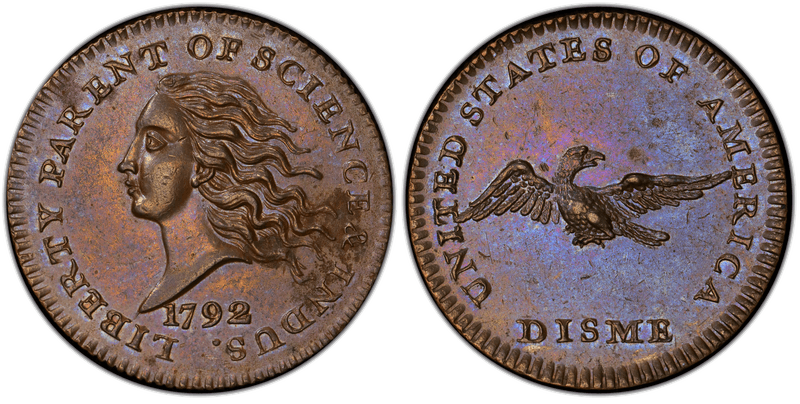
The Mint began work in Philadelphia in 1792, and its first products were experiments. The coinage law of April 2, 1792 called for a cent of 264 grains of pure copper, a coin so heavy that Thomas Jefferson favored adding a little silver to bring a smaller cent up to its metal value. The result was the silver-center cent, a small copper disc with a silver plug in the middle, and a solid companion in copper or billon. Beside it came the Birch cents, signed BIRCH on the bust, which uspatterns.com sees as the forerunner of the large cent, a disme (ten-cent piece) in silver and copper, and Joseph Wright's quarter dollar with an eagle on a globe. The silver half dismes of July 1792, struck in John Harper's workshop before the Mint's own building was ready, are listed by Judd as patterns but went into circulation, and NumisDex keeps them in their own 1792 half disme series.

From 1794 to about 1800 most of what Judd lists are die trials: regular dies for half dimes, half dollars, dollars, half eagles and eagles tried out in copper before the precious metal was struck. Several 1794 and 1795 half dollar trials were cut down and reused as half cent planchets. Then the record goes quiet for three decades, and the pieces dated 1803 to 1823 are mostly later inventions, struck from old dies long after their dates.

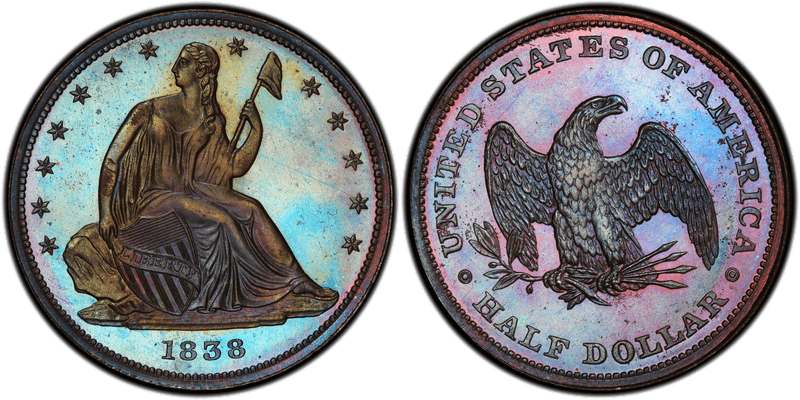
A second burst of experiment began in 1836, when Director Robert M. Patterson set out to renew the coinage. Christian Gobrecht, then the second engraver, prepared a silver dollar with a seated Liberty and a flying eagle, a gold dollar with a Liberty cap in rays, and, with refiner Franklin Peale, a billon two-cent piece that was dropped when Peale showed how easily it could be counterfeited. In 1838 and 1839 the Mint tried a run of half dollar designs, William Kneass's draped Liberty head and Gobrecht's seated Liberty among them, before settling on the seated figure for silver coinage.

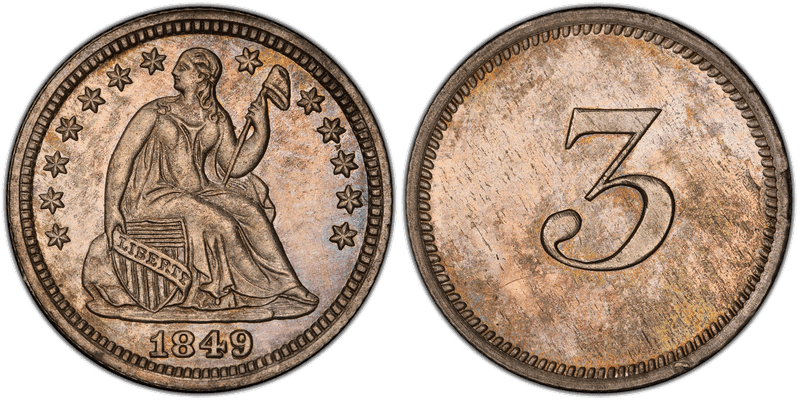
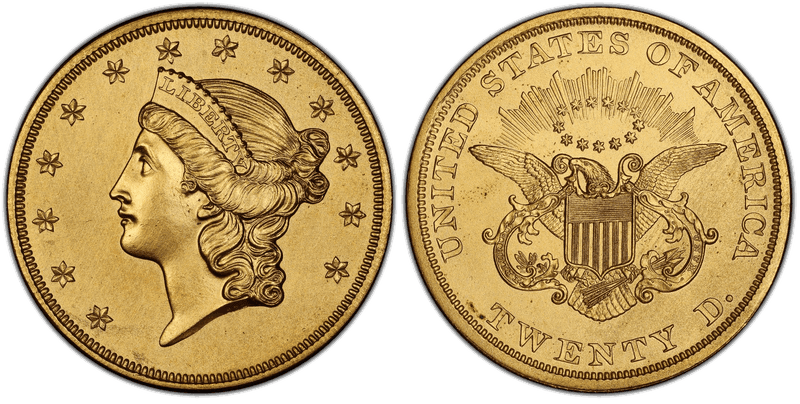
The California gold of 1848 brought new denominations. Congress authorized a gold dollar and a double eagle in March 1849, and Chief Engraver James B. Longacre cut the patterns for both; the only confirmed 1849 double eagle is in the Smithsonian. In January 1849 Representative Samuel Vinton asked the Mint about a three-cent coin, and the first three-cent patterns paired a half dime obverse with a reverse showing only 3 or III. The 1850s were the decade of the small cent: ring cents with a center hole in 1850 and 1851, cents in German silver and copper-nickel from 1853, Liberty head and flying eagle cents in 1854 and 1855, the 1856 Flying Eagle cent given to members of Congress before the small cent was authorized in February 1857, and in 1858 a dozen cent designs, including the Indian head adopted for 1859. The era closes with Anthony Paquet's seated Liberty and the "French head" half dollars of 1859 and the transitional dime and half dime that lack the words UNITED STATES OF AMERICA.

How Patterns Are Identified

Judd numbers. The standard reference is J. Hewitt Judd's United States Pattern Coins. Each Judd number is one pairing of dies in one metal with one edge, so the 1792 disme is J-9 in silver, J-10 in copper with a reeded edge and J-11 in copper with a plain edge. Pieces made outside the Mint sit in appendices, with numbers such as J-C1792-1. Andrew Pollock's reference gives a second set of numbers, and older works by Adams and Woodin and by Taxay a third and fourth; NumisDex lists them together in each page's cross-references.

What kind of piece it is. Saul Teichman's tables on uspatterns.com classify each number: an essai is a new design; an experimental piece tests a metal or an edge; a die trial is struck from regular dies in another metal; a mule pairs dies never meant to go together; a Mint restrike is a later striking from dies that had produced originals, and a fantasy restrike is a combination that never existed at the time. Private strikings from Mint dies were made from dies the Mint had sold as scrap, mostly by or for the Philadelphia collectors Joseph J. Mickley and Montroville Dickeson. Some pieces long listed by Judd are now thought to be counterfeits (the copper 1823 half dollar, J-47, and the 1834 copper half eagles, J-51 and J-51a) or Mint errors (the 1831 quarter eagle on a dime planchet, J-49).

Originals and restrikes. Restrikes usually show the dies in a later state, with cracks and rust that the originals lack. Weight helps for silver: half dollars struck before 1853 should weigh about 206 grains, later ones about 192. For the Gobrecht dollars, the turn of the reverse against the obverse (die alignments I to IV) is part of the evidence, and specialists still argue over which alignments mark the originals.

Grading. NGC and PCGS grade patterns like other coins, often as proofs (PF or PR) or specimens (SP). The grading-service label is not a different coin: one Judd number can appear under an MS entry and a PF entry, or under several color designations.

Key Patterns of the Era

1792. The 1792 cent patterns: the silver-center cent (J-1) and its solid companion (J-2), and the Birch cents (J-3 to J-6). The 1792 dismes (J-9 in silver, J-10 and J-11 in copper). The Wright quarter (J-12 copper, J-13 white metal) and the unique copper half disme (J-8).

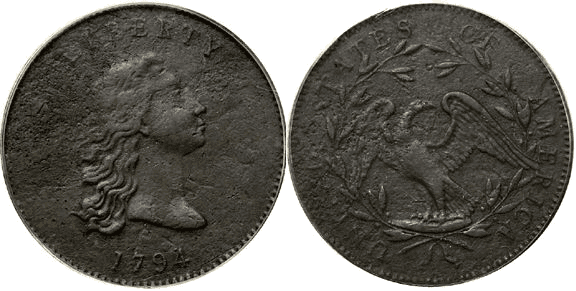
1794-1799. Copper die trials: the 1794 dollar (J-18 and J-19), the 1794 half dimes (J-14 to J-16), the 1794 half dollar (J-17), the 1795 reeded-edge large cent (J-20, also Sheldon 79), and copper trials of the 1797 and 1799 eagles (J-25, J-26).

1803-1823. Mostly private strikings from scrap dies, made in the 1850s to 1870s: the 1804 restrike cent in tin (J-28), 1804, 1805 and 1808 half eagles in silver, copper and tin, the 1810 cent (J-41), the 1813 half dollars in copper and brass (J-42, J-43) and the 1823 silver cents (J-46). Two exceptions are Mint products: the 1804 Plain 4 eagles (J-33 in gold, J-34 and J-34a in silver), struck in 1834 for presentation sets sent to Asian rulers, and the platinum half dollars of 1814 (J-44), a metal trial from the regular dies.

1827-1834. The 1827 quarter restrikes in copper (J-48) and silver (J-48a), struck by the Mint for collectors, and the doubtful 1834 pieces.

1836. Gobrecht's gold dollar pattern (J-67 in gold, J-68 to J-71 in other metals, most of them later restrikes), the Gobrecht silver dollar's restrikes and mulings in copper and silver (J-59 to J-66, on the 1836 dollar patterns page; the circulating Gobrecht dollars are in the Gobrecht dollar series), the two-cent pieces (J-52 to J-56a) and the reeded edge half dollar (J-57).

1838-1840. The 1838 half dollars (J-72 to J-83): Kneass's head with several eagles, and Gobrecht's seated Liberty with flying eagle, spread eagle and regular reverses, such as J-79a, one of which was struck in 1843 for the collector Matthew Stickney. The 1839 half dollars (J-91 to J-103), built around a head of Liberty facing right that a Mint letter of 1843 credits to Kneass. The 1838 and 1839 Gobrecht dollars and their restrikes (J-84 to J-90, J-104 to J-109), and the 1840 brass quarter (J-110), Robert Ball Hughes's version of the seated Liberty.

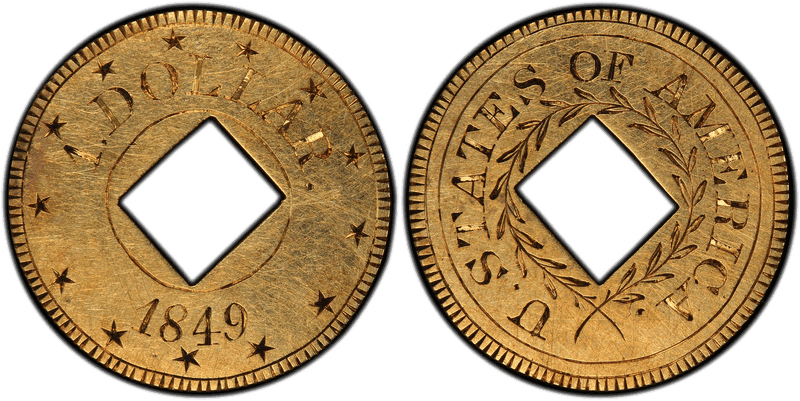
1849. Longacre's hand-cut gold dollars with a center hole (J-115, J-116), the 1849 double eagle (J-117) and its later gilt brass copy (J-118), and the first three-cent pieces (J-111 to J-114). The 1849 eagle by Charles Bouvet (J-C1849-1) is a private pattern.

1850-1859. The small cent experiments, year by year: the ring cents of 1850 and 1851, the 1853 cents struck from a quarter eagle obverse in German silver and copper-nickel, the 1852 ring gold dollars (J-136 to J-148), an attempt to make the gold dollar a little larger, many of them restrikes of about 1859, the Liberty head and flying eagle cents of 1854 and 1855, the first of them sent by Director Snowden to Treasury Secretary James Guthrie on March 18, 1854 with a head reduced on a copying lathe from a silver dollar pattern, the copper-nickel 1856 half cents sent to the Treasury in July 1856 to show the alloy, the 1856 cents with the Flying Eagle (J-180; see the Flying Eagle cent series), and the 1858 cent designs sold by the Mint in twelve-piece sets. Also the 1850 three-cent piece (J-125), the 1850 double eagle trial of Longacre's second obverse (J-126), the 1855 aluminum half dollar (J-175), the first Mint striking in that metal, and the 1859 group: the 1859 cents with the Indian cent and the 1860 reverse (J-228), Paquet's seated Liberty and the "French head" half dollars (J-235 to J-253), and the transitional dime and half dime (J-233, J-232) without the country's name.

Collectors were asking the Mint for old rarities almost from the start. Q. David Bowers records that Adam Eckfeldt, at the Mint since the 1790s, supplied restrikes to collectors in the 1830s, and that the Mint Cabinet, its own collection, was founded in 1838; its pieces are now in the Smithsonian's National Numismatic Collection, which holds many of the unique early patterns. Teichman notes that one 1838 half dollar pattern was struck for Matthew Stickney in July 1843 at an extra charge, perhaps the first coin made to a collector's order.

By January 1859 Director James Ross Snowden was receiving several requests a day for patterns. Bowers writes that the business then went underground: old dies for the Gobrecht dollars, the 1856 cent and other rarities were brought out and struck for sale, and a writer in The Nation later estimated that $50,000 worth of patterns left the Mint in 1859 and 1860 without benefit to the government. Snowden himself had the 1858 cent designs struck in sets of twelve that were given to officials and quietly sold. The practice continued, Bowers says, until a new Mint director stopped it in the summer of 1885; by then more than 1,500 pattern varieties had been made, and most early patterns in collections today come from those years. Restrikes and pieces struck privately from scrap dies are collected beside the originals, and the catalog keeps each one, original or restrike, on its own page.

Pattern coins never had a mintage in the usual sense. NumisDex leaves the mintage field empty for them and gives each page's rarity as rated by uspatterns.com on that scale, from R-1 to R-8 (two or three known) or unique.

In Our Catalog

No errors or varieties are listed for Early Republic Patterns (1792-1859) yet. Submit one

FAQ

What is a pattern coin?

A piece struck to try out a design, a metal, a size or an edge that was not, or not yet, adopted for coinage. The pattern reference site uspatterns.com sorts the early pieces into several kinds, essais from new designs, experimental pieces testing an alloy, die trials struck from regular dies in another metal, mules from dies never meant to go together, Mint restrikes and fantasy restrikes made later for collectors, and private strikings from dies the Mint had sold as scrap. One coin can fit more than one of these.

What does a Judd number mean?

It is the catalog number in J. Hewitt Judd's United States Pattern Coins, the standard reference. Each number stands for one design pairing in one metal with one edge, so the same dies struck in silver and in copper, or with a reeded and a plain edge, carry different numbers. A letter after the number (J-111a) marks a related striking, usually in another metal or with another edge. Pieces that are not Mint products sit in appendices with letters before the year, such as J-C1792-1.

Are early patterns originals or restrikes?

Often restrikes. The Mint kept many old pattern dies and from about 1859 struck new pieces from them for collectors, sometimes pairing dies that had never been used together. For the 1838 and 1839 half dollar patterns, for example, uspatterns.com treats only a few die pairs as true originals and dates most of the rest to the 1860s and 1870s. Die cracks, rust on the dies, weight and the turn of the reverse are the usual clues.

Were all early patterns made by the Mint?

No. Some are private strikings. Philadelphia collectors such as Joseph J. Mickley and Montroville Dickeson obtained old dies the Mint had sold as scrap and struck pieces from them in the 1850s and 1860s, among them the so-called 1804, 1810 and 1823 restrike cents and odd half eagles of 1804, 1805 and 1808. Others, like the 1818 Perkins cent or the 1849 Bouvet eagle, were made outside the Mint from dies that were never the Mint's.

Why are there so few early pattern mintages?

Because the Mint kept no count of most of them. The figures quoted for patterns are usually estimates of how many survive, expressed as a rarity rating on the scale uspatterns.com uses, from R-1 (more than 1,250 known) through R-8 (two or three known) to unique. A rare exception is the 1849 three-cent piece, where a Mint official wrote in 1849 that only 12 or 15 of each alloy were struck.

Does the 1856 Flying Eagle cent count as a pattern?

Technically yes, since it was struck before Congress approved the small cent in February 1857, and Judd lists it as J-180. Because hundreds went to congressmen and officials and many more were restruck for collectors, most collectors keep it with the regular Flying Eagle cents.

↑ Back to the coins: every year, mint, variety and error

Explore Other Denominations

Collector Essentials

Tools and references for building and protecting your coin collection.

As an Amazon Associate, NumisDex earns from qualifying purchases.