



The Civil War drove gold and silver out of circulation, and for a while even the copper-nickel cent sold at a premium. Small paper notes, some for as little as three cents, did the work of change, and the public disliked them. In 1864 the Mint replaced the copper-nickel cent with a bronze cent and a bronze two-cent piece, and both circulated. Nickel was out of the coinage, and Joseph Wharton, who controlled the main American source of the metal at Gap, Pennsylvania, wanted it back. In an 1864 pamphlet he proposed that all base-metal coins be made of 75% copper and 25% nickel. Congress gave him the three-cent piece in that alloy on March 3, 1865.
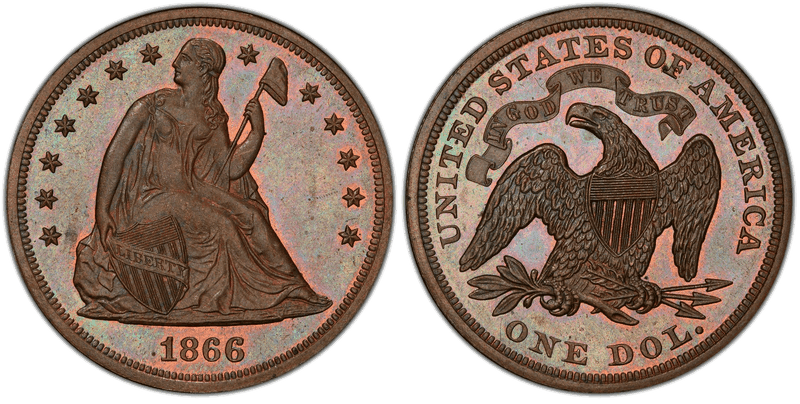
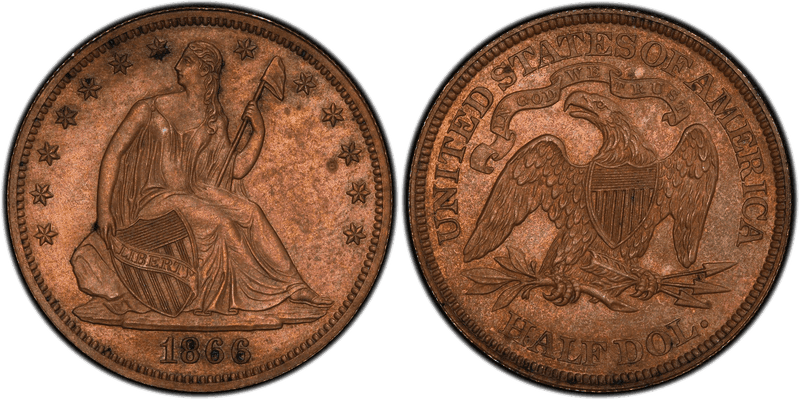
The same day, a law allowed the Mint to put IN GOD WE TRUST on gold and silver coins large enough to carry it. In 1866 Chief Engraver James B. Longacre added the motto to the quarter, half dollar and dollar and to the half eagle, eagle and double eagle, and the new five-cent piece carried it from its first year.
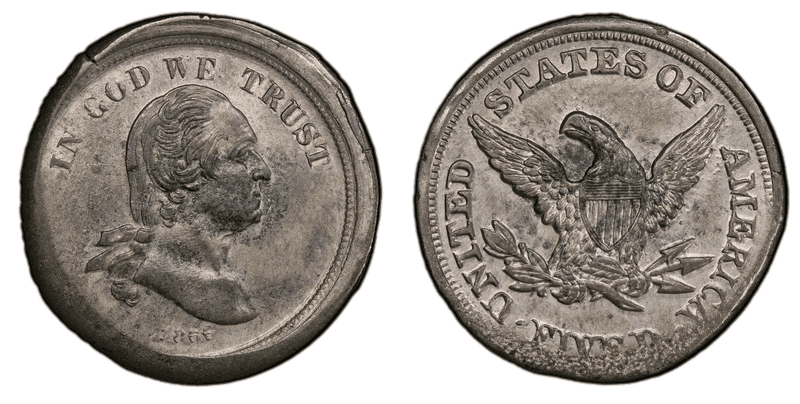
The five-cent piece came next. Mint Director James Pollock drafted a bill for a copper-nickel coin weighing no more than 60 grains, and the House raised the weight to five grams. Don Taxay read the change as a way for Wharton to sell more nickel. The bill passed on May 16, 1866. Longacre had started on designs in late 1865, and the 1866 patterns show his ideas side by side: a shield adapted from the two-cent piece, George Washington in two versions, Abraham Lincoln, and reverses with the numeral 5 in several styles. Treasury Secretary Hugh McCulloch took the shield and the stars and rays reverse on Pollock's advice. Pollock never showed him the Lincoln design.
The new nickel was hard to strike, and early in 1867 the rays came off the reverse. Longacre proposed aluminum for the five-cent piece in June 1867, and the new Director, Henry Linderman, turned it down on cost and supply. Longacre still made aluminum and copper pieces with an Indian head, and a series of Liberty heads modeled on his nickel three-cent design. In 1868 Wharton's interests proposed a copper-nickel dime and changes to the cent, three-cent and five-cent pieces, and the base-metal dime was dropped. The 1868 patterns include a nickel cent, three-cent and five-cent set and nickel ten-cent designs. Longacre also re-engraved the gold designs and finished a new eagle (J-661). He died on January 1, 1869, and his assistant William Barber, hired in 1865, succeeded him. In 1869 the Mint struck new cent, three-cent and five-cent sets and the first Standard Silver patterns. Those were lighter dime, quarter and half dollar designs that Pollock, Director again from May 1869, hoped would replace the fractional notes (search).
Many pieces in this tree were never meant to change a design. From 1867 the Mint struck its regular dies in copper and sold complete sets to collectors, and in 1868 it did the same in aluminum. The 1866 No Motto silver coins and the 1868 large cent were made only for collectors. Some mulings of 1866 and 1867 dies were struck outside the Mint, from dies that USPatterns.com believes Joseph Mickley bought as scrap.