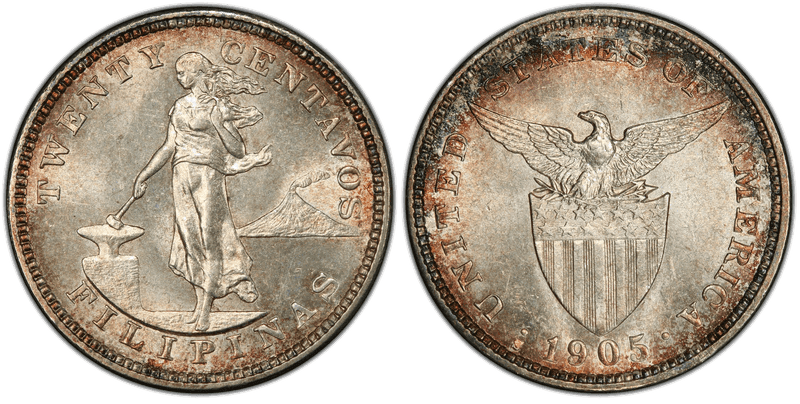
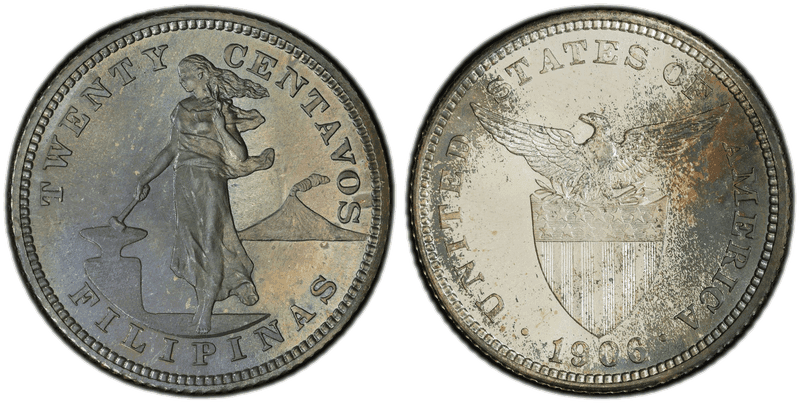
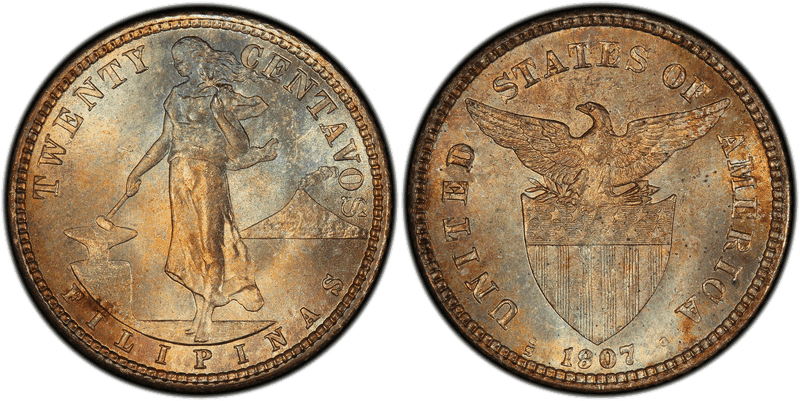
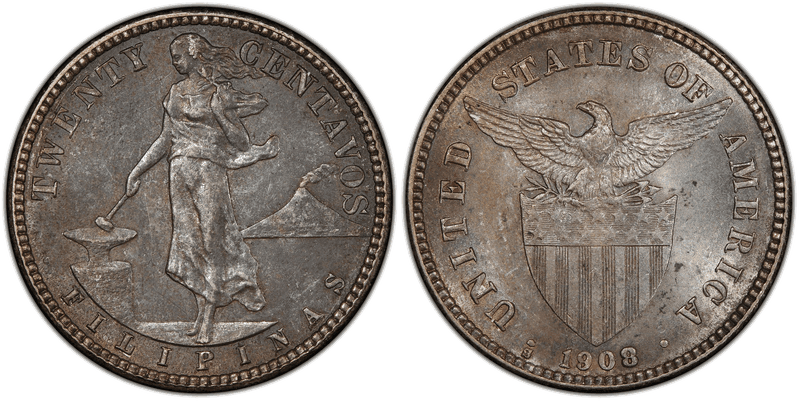
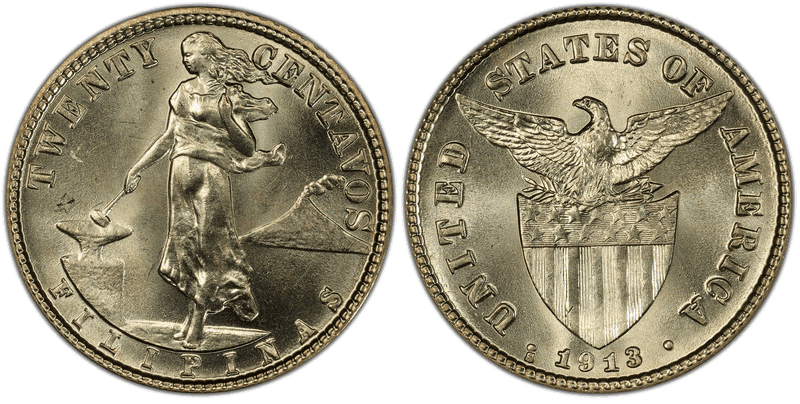
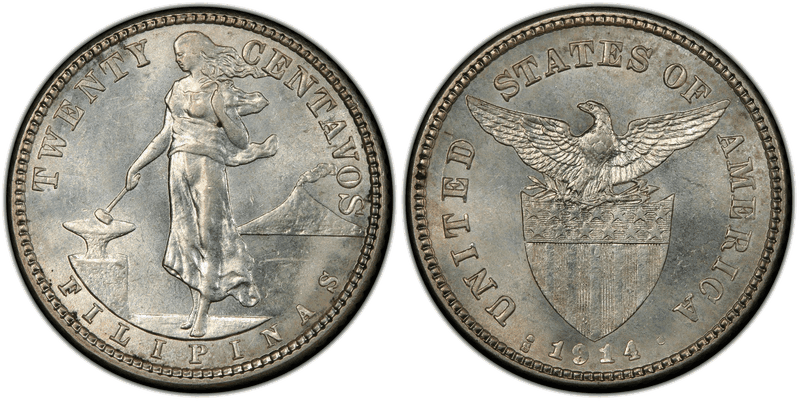
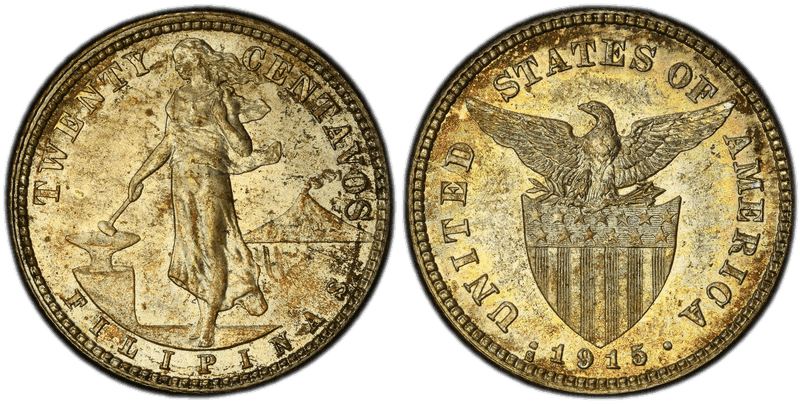
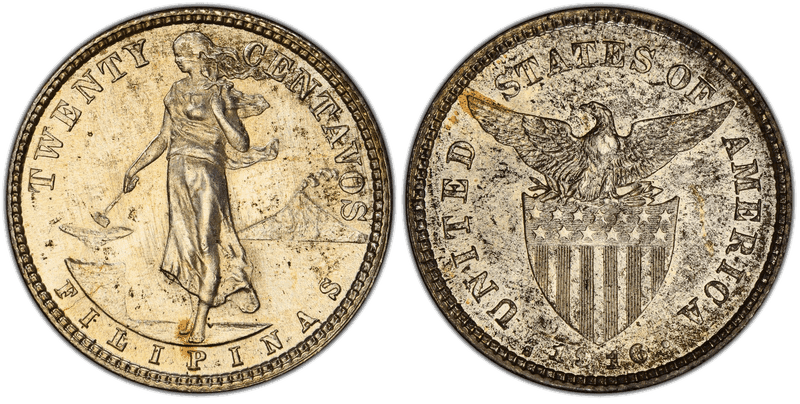
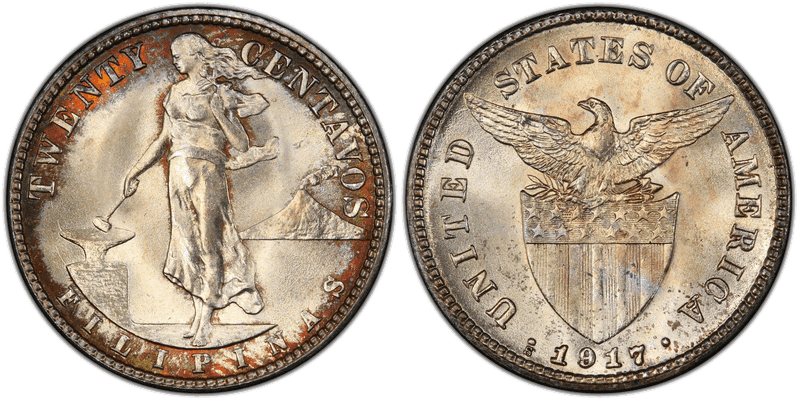
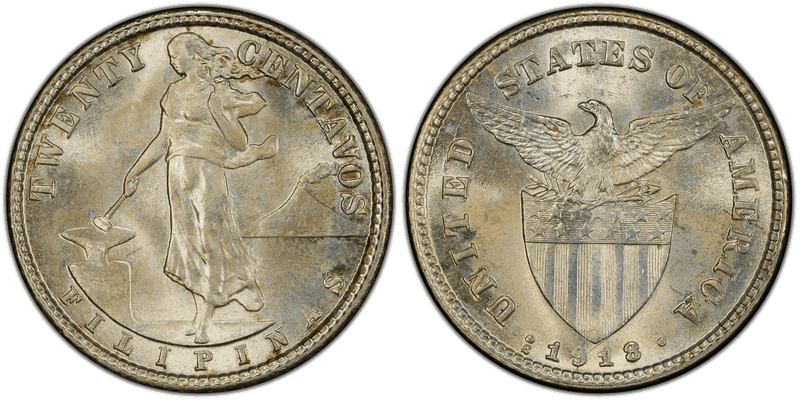
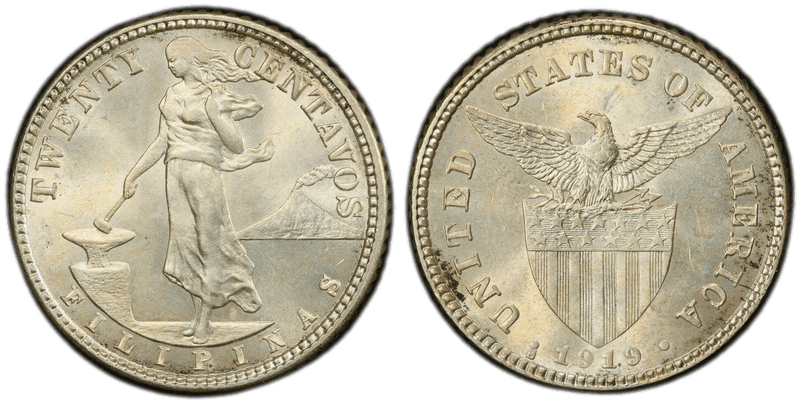
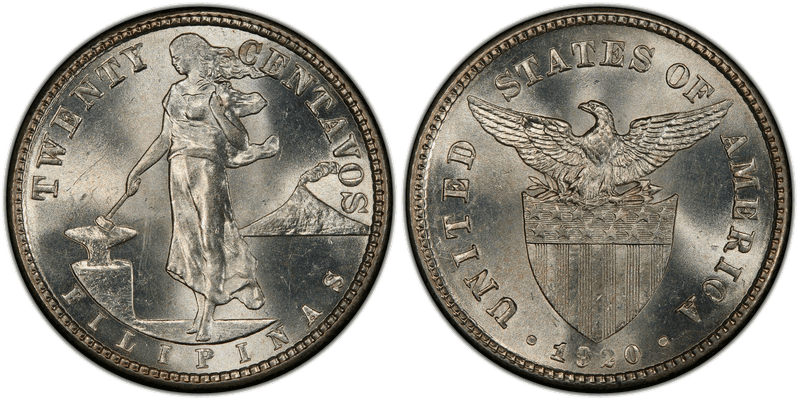
Philippines Twenty Centavos 1903-1945

Coin Series
Philippines Twenty Centavos 1903-1945 series coin

About This Series

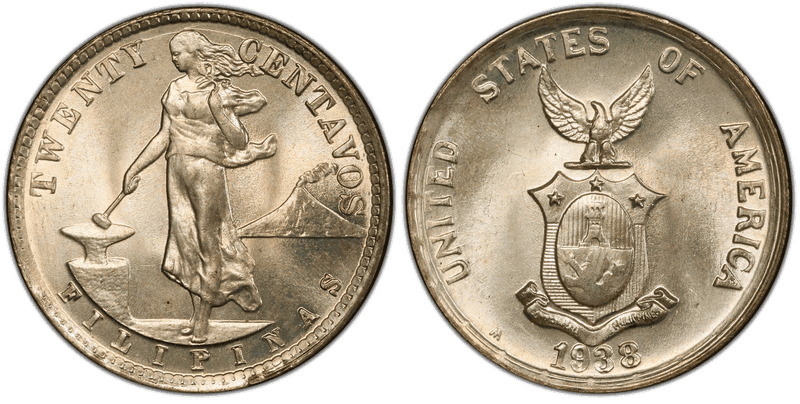
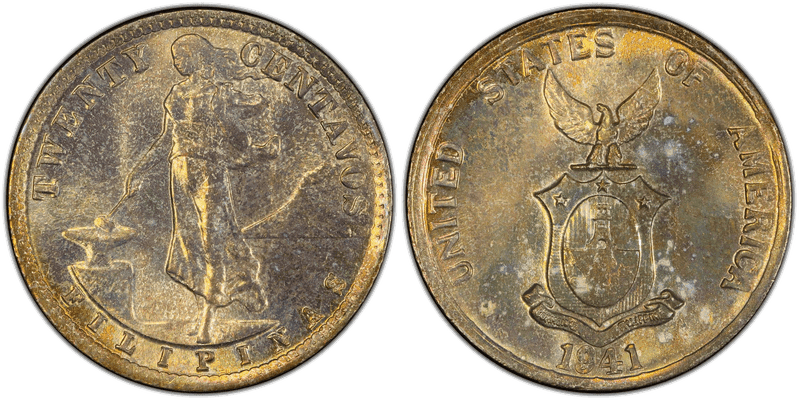
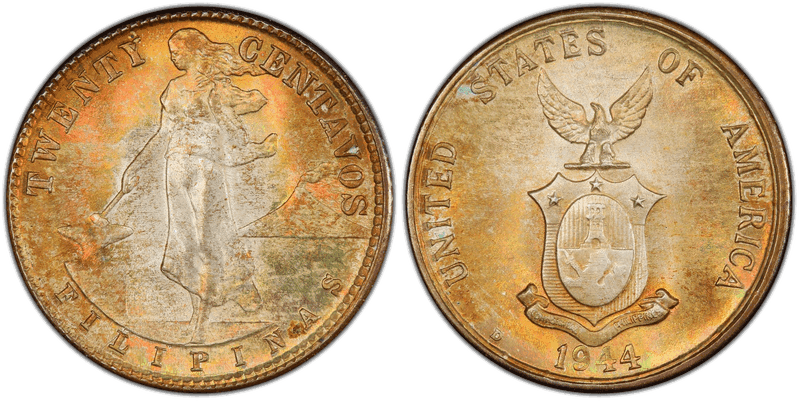
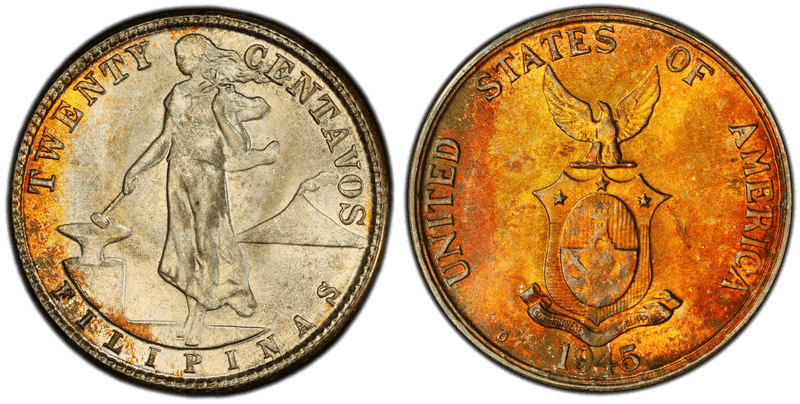
The twenty centavos was one of the silver coins the United States struck for the Philippine Islands under the act of March 2, 1903, worth one fifth of a peso. Melecio Figueroa designed the obverse, a young woman striking an anvil with Mount Mayon behind her. The first coins of 1903 to 1906 were 90 percent silver; from 1907 the coin was made smaller at 4 grams and 75 percent silver. Philadelphia and San Francisco struck it from 1903 to 1919, the Manila Mint in 1920 and 1921, again in 1928 and 1929 and, with the Commonwealth arms on the reverse, in 1937, 1938 and 1941, and Denver struck the last of them in 1944 and 1945. Proofs were made at Philadelphia from 1903 to 1908.

Browse by Base(26 bases)

Showing all 26 listings

History

In 1903 Congress gave the Philippine Islands a coinage of their own. The act of March 2, 1903 set the peso at half a United States dollar and provided silver coins of ten, twenty and fifty centavos beside it, and the twenty centavos was a fifth of a peso. The Filipino engraver Melecio Figueroa designed the coins, and the first twenty centavos were struck at Philadelphia and San Francisco in 1903. Philadelphia also struck proofs for collectors' sets every year from 1903 to 1908.

The first standard did not last. When silver became dearer, an act of June 23, 1906 let the Philippine government reduce the weight and fineness of its silver coins, and from 1907 the twenty centavos was made smaller: 4 grams of 75 percent silver instead of 5.385 grams of 90 percent. San Francisco struck it every year from 1907 to 1919.

In 1920 the Manila Mint opened, in the old Intendencia building where the Spanish mint had worked, and it struck twenty centavos in 1920 and 1921. When the coin was needed again in 1928, Manila had no reverse dies for it and used a five-centavo reverse instead, producing the 1928 mule. After the Commonwealth of the Philippines was founded in 1935, the reverse changed in 1937 to the Commonwealth arms, and Manila struck the new type until 1941, when the Japanese invasion stopped the mint. In May 1942 the government dumped millions of pesos in silver coins into Caballo Bay off Corregidor rather than let them be captured; much of it was recovered after the war. The last twenty centavos were struck at Denver in 1944 and 1945 for the liberation of the islands.
How to Identify It

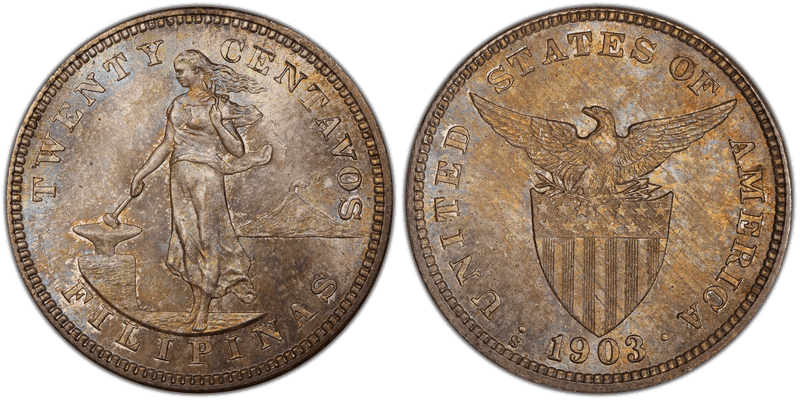
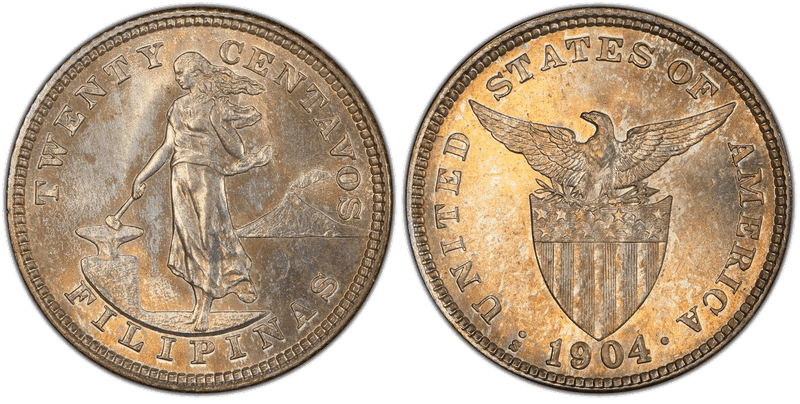
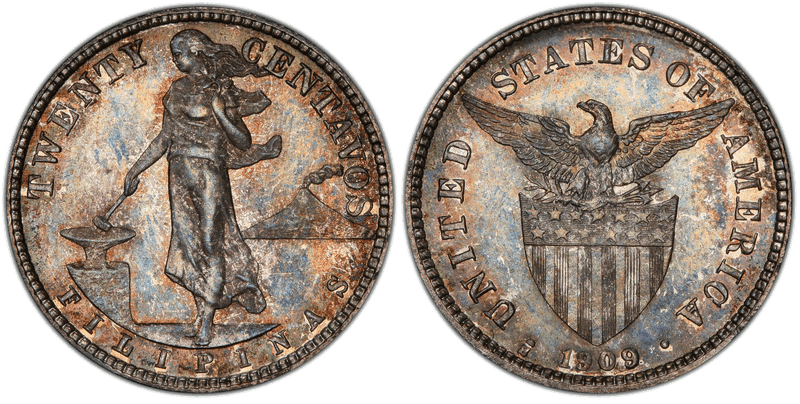
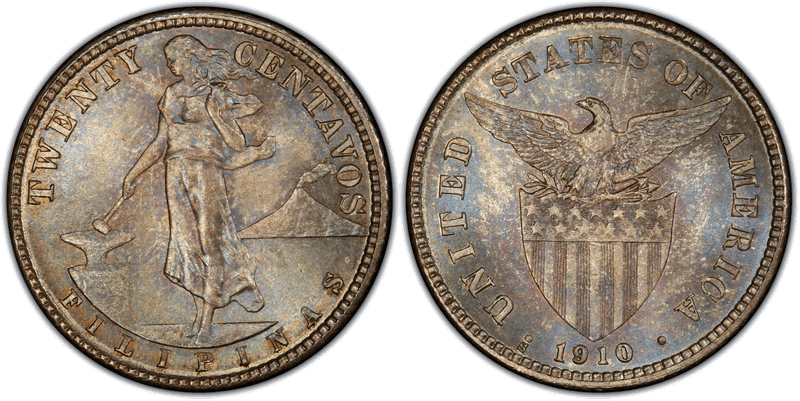
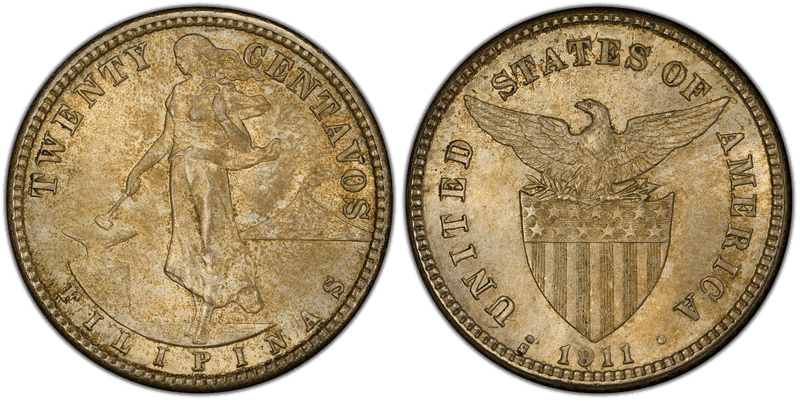
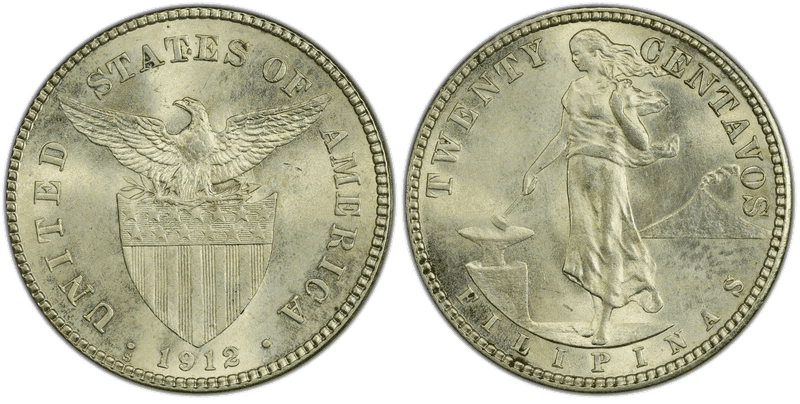
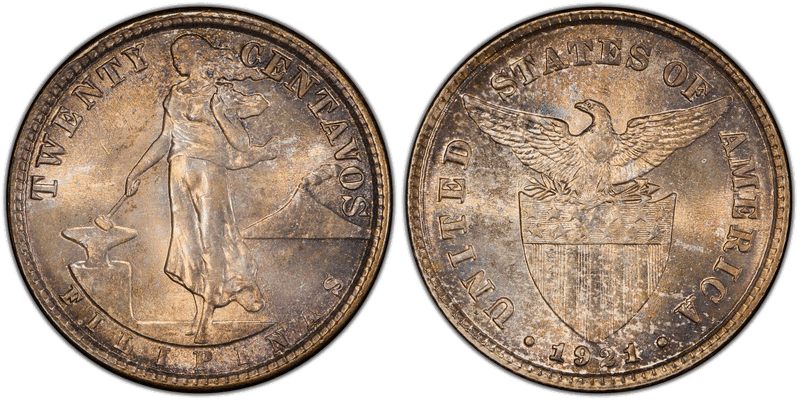
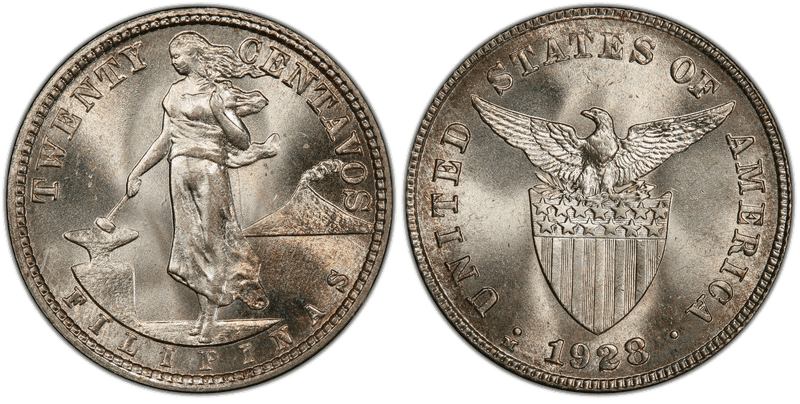
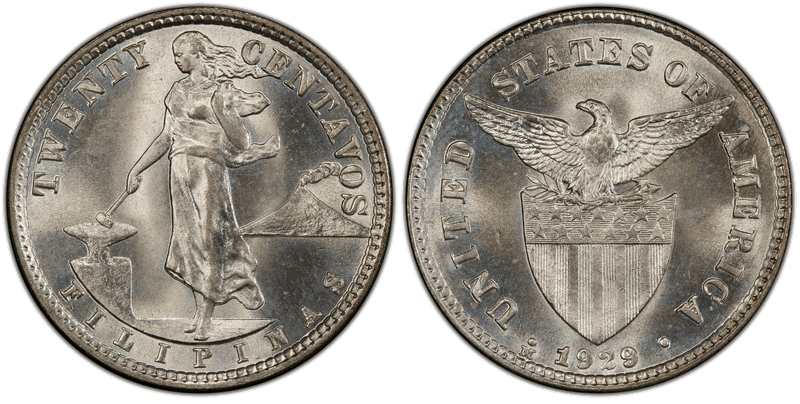
Obverse. A young woman in a flowing gown strikes an anvil with a hammer, with the smoking cone of Mount Mayon behind her. TWENTY CENTAVOS is above her and FILIPINAS below. The design stayed the same from 1903 to 1945.

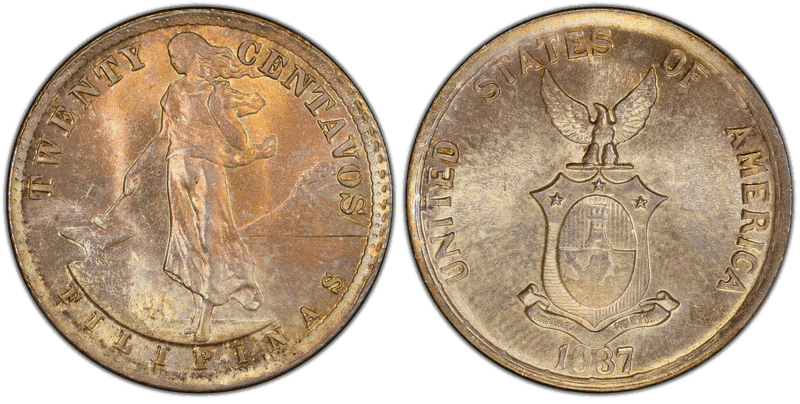
Reverse. Until 1936 the reverse shows the American eagle over a striped shield, with UNITED STATES OF AMERICA and the date. From 1937 it carries the arms of the Commonwealth of the Philippines, with the same legend.

Mint mark. The letter is on the reverse, to the left of the date:

  • No letter: Philadelphia (1903, 1904, 1907 and all proofs), and Manila in 1920 and 1921, before the Manila Mint began using its letter in 1925.
  • S: San Francisco, 1903 to 1919.
  • M: Manila, 1928, 1929, 1937, 1938 and 1941.
  • D: Denver, 1944 and 1945.

Size. The coins of 1903 to 1906 are visibly larger and heavier (5.385 grams, about 23 millimeters) than those of 1907 to 1945 (4 grams, about 20 millimeters).

Key Dates and Varieties

  • 1903. Philadelphia struck 5,350,231 business strikes and 2,558 proofs; San Francisco struck 150,080 (1903-S).
  • 1904. Philadelphia struck only 10,000 business strikes beside 1,355 proofs, while San Francisco made 2,060,000.
  • 1905 and 1906. Philadelphia struck these years only as proofs: 471 in 1905 and 500 in 1906. The 1905 coins for circulation all came from San Francisco, and no 1906 coins were struck for circulation at all.
  • 1908 proofs. The 500 proofs of 1908 were the last Philippine proofs of the American period, on the reduced standard of 1907.
  • 1913-S. The references disagree on the mintage (795,000 or 948,565). One die shows the S punched twice, the 1913-S S/S (Allen-11.09a).
  • 1928 mule. All 100,000 coins of 1928 carry the five-centavo reverse; the five-centavo design has a smaller eagle and shield and a larger date.
  • 1937 to 1941. The Commonwealth type from Manila: 2,665,000 in 1937, 3,000,000 in 1938 and 1,500,000 in 1941.
  • 1944-D and 1945-D. Denver struck 28,596,000 in 1944 and 82,804,000 in 1945. Some 1944 dies have the D punched over an S, the 1944-D/S (Allen-12.04a).

In Our Catalog

2 errors and varieties are listed for this series. Browse them by type:

Recently added

    Mintages

    Philippines Twenty Centavos 1903-1945 mintages by year and mint, taken from each coin's page in our catalog. Each figure opens that coin's page, which lists its varieties and errors. A dash means no figure was recorded. Where one issue was struck in more than one type, each type is listed.

    Composition and Silver Content

    YearsWeightFinenessPure silverDiameter
    1903-19065.385 g90% silver, 10% copper4.85 g (0.156 oz)about 23 mm
    1907-19454.00 g75% silver, 25% copper3.00 g (0.0965 oz)about 20 mm

    All have a reeded edge. Greysheet gives the early coins as 22 millimeters and the Commonwealth coins as 20.5, so the diameters above are approximate.

    FAQ

    Where is the mint mark on a Philippine twenty centavos?

    On the reverse, to the left of the date. San Francisco coins of 1903 to 1919 carry an S, Manila coins from 1928 an M, and the Denver coins of 1944 and 1945 a D. Philadelphia coins and all proofs have no letter, and neither do the twenty centavos the Manila Mint struck in 1920 and 1921, because Manila did not begin using its M until 1925.

    Why is the 1928 twenty centavos called a mule?

    A mule pairs dies that were never meant to go together. No twenty centavos had been struck since 1921 and the Manila Mint had no reverse dies for it, so in 1928 it used a reverse die of the five centavos, a coin of almost the same size. All 100,000 coins of that year were struck this way.

    How much silver is in a Philippine twenty centavos?

    The coins of 1903 to 1906 weigh 5.385 grams of 90 percent silver, about 4.85 grams or 0.156 troy ounces of pure silver. From 1907 to 1945 the coin weighs 4 grams of 75 percent silver, 3 grams or about 0.0965 troy ounces.

    Who designed the twenty centavos?

    The obverse is by the Filipino engraver Melecio Figueroa, who showed a young woman striking an anvil with Mount Mayon behind her; his daughter Blanca said she had been his model. The American eagle and shield were on the reverse until 1936. From 1937 the reverse carries the arms of the Commonwealth, designed by Ambrosio Morales.

    Why are there no twenty centavos dated between 1921 and 1928 or between 1929 and 1937?

    The Manila Mint coined twenty centavos only when they were needed. It struck them in 1920 and 1921, then not again until 1928 and 1929, and next in 1937, 1938 and 1941 with the new Commonwealth reverse. The Japanese invasion stopped the Manila Mint, and the last twenty centavos came from Denver in 1944 and 1945.

    ↑ Back to the coins: every year, mint, variety and error

    Explore Other Denominations

    Collector Essentials

    Tools and references for building and protecting your coin collection.

    As an Amazon Associate, NumisDex earns from qualifying purchases.