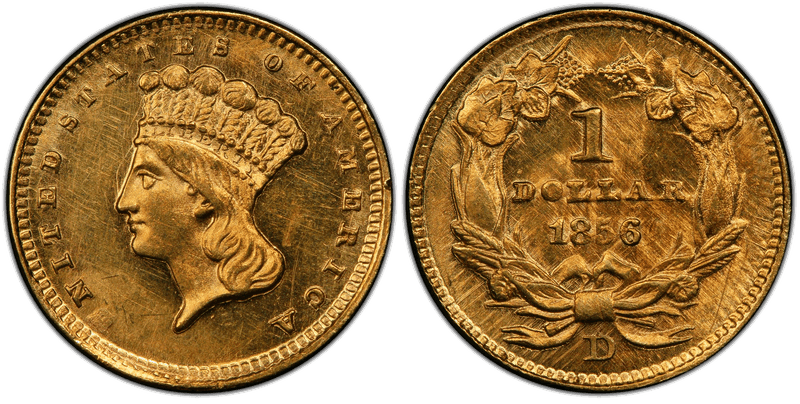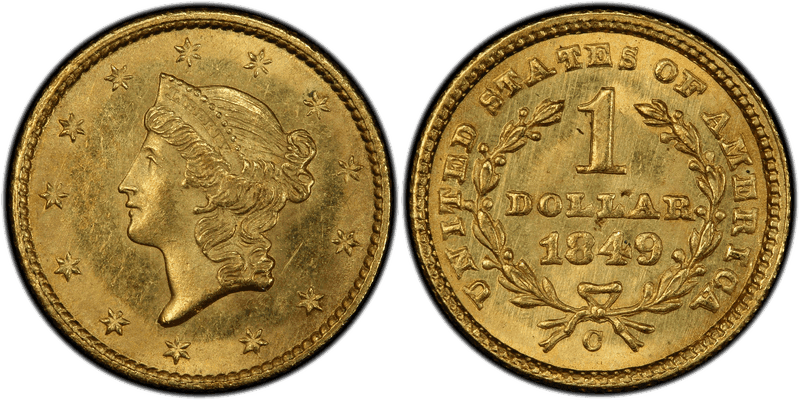
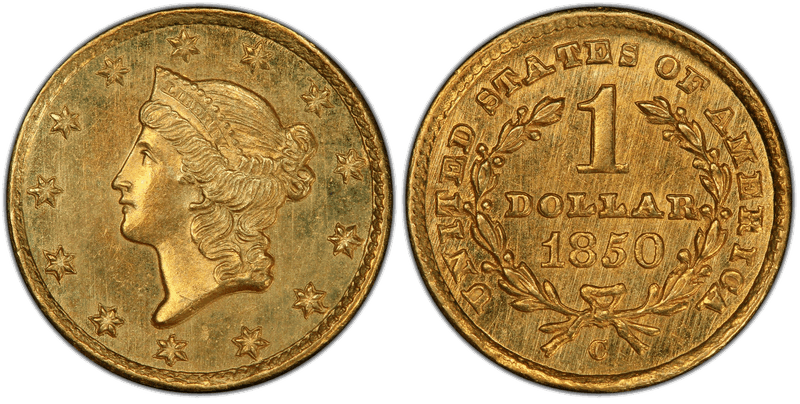
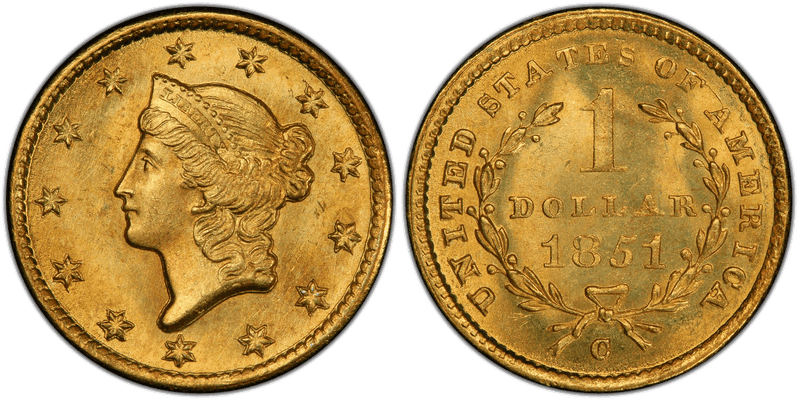
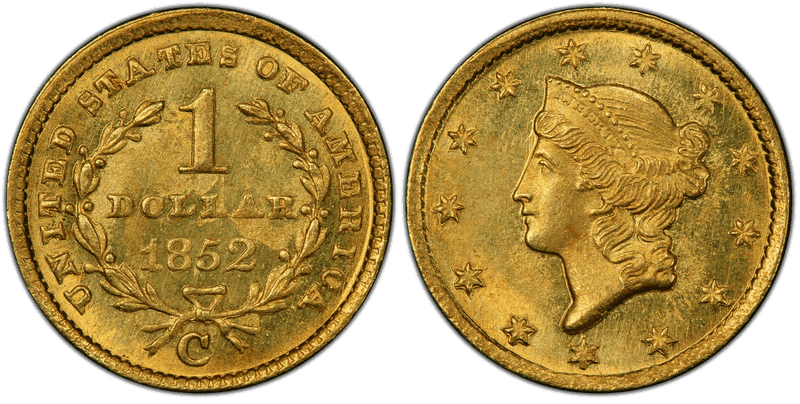
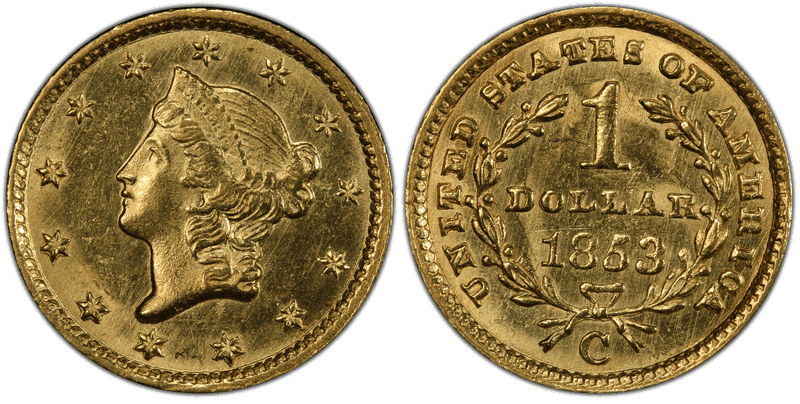
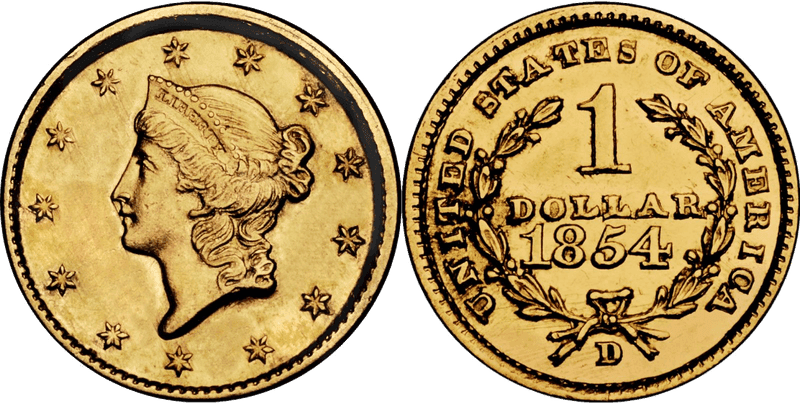
Gold dollars had been proposed in Congress more than once in the 1830s and 1840s without success. The California Gold Rush changed that. With record quantities of gold reaching the mints, Congress passed the Act of March 3, 1849, which authorized two new coins at once: the gold dollar and the double eagle. Chief Engraver James B. Longacre finished the dollar first. Mint records date the first strikes to May 7, 1849, while Longacre's own diary says May 8; a few proofs were made that first day.
Opponents in Congress had warned that a gold coin worth one dollar would be too small, easy to lose and easy to mistake for a silver half dime. They were right about the size: at 12.7 mm by Wikipedia's figure, the Type 1 is the smallest-diameter coin the United States has issued. It still found plenty of work. The flood of gold made silver worth more than its face value, and from 1849 silver coins were exported and melted. With little silver in circulation, the gold dollar was the only federal coin between the cent and the quarter eagle that many people saw, and the Mint struck it by the million. Q. David Bowers calls 1850 to 1853 the gold dollar's high-water mark; Philadelphia alone struck 3,317,671 in 1851 and 4,076,051 in 1853.
Philadelphia struck the Type 1 every year from 1849 to 1854. The branch mints in Charlotte, North Carolina, and Dahlonega, Georgia, which had opened in 1838 to coin gold from the Southern mines, struck it from 1849 (Charlotte until 1853, Dahlonega until 1854), and New Orleans struck it from 1849 to 1853. San Francisco, which opened in 1854, made the design only in that year.
Longacre kept adjusting the design during 1849, and the Philadelphia coins of that year come in several varieties. The earliest coins had an open wreath on the reverse and no initial on Liberty's neck; Longacre then added his initial L to the truncation, the first time a designer's initial appeared on a U.S. coin meant for general circulation, and later in the year a closed wreath replaced the open one. Every gold dollar from 1850 on has the closed wreath.
The size complaints never went away. In 1853 Congress lowered the weight of the silver coins so that they would circulate again, and the same law created a three-dollar gold piece that was made thin and broad. The Mint applied the same idea to the dollar: in 1854 it introduced a thinner, wider gold dollar with the same weight and a new Indian princess design, now called the Type 2. Philadelphia struck both types in 1854.