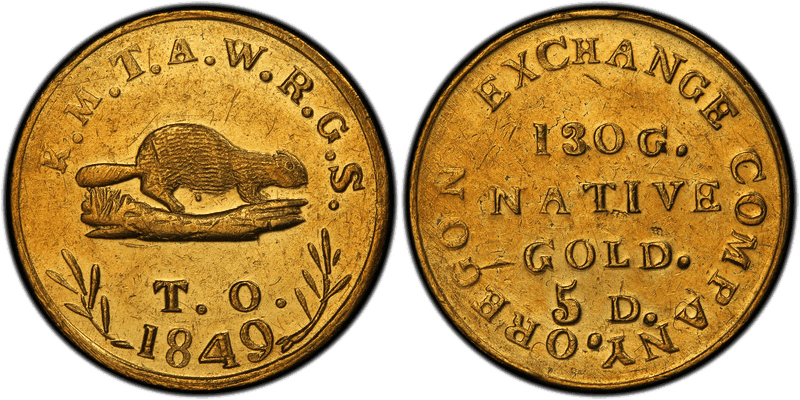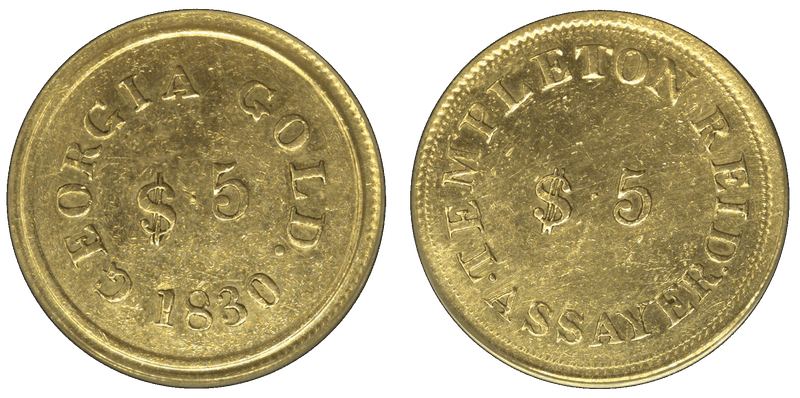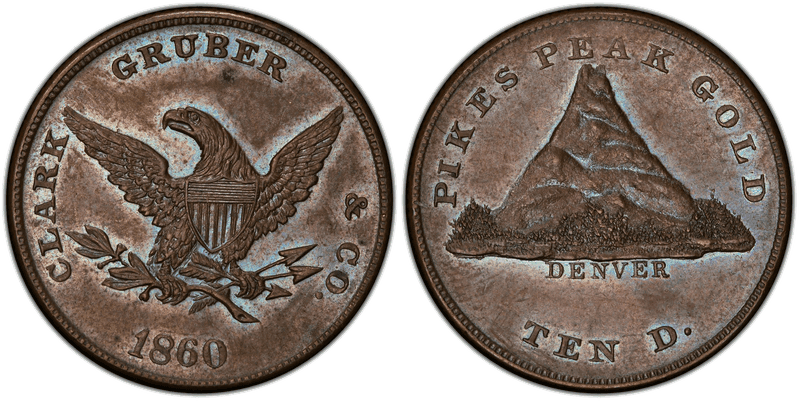
Colorado Gold (1860-1861)

Coin Series
Colorado Gold (1860-1861) series coin

About This Series

Gold struck in Colorado during the Pikes Peak gold rush by Clark, Gruber & Co. in Denver, John Parsons & Co. near the Tarryall Mines and J. J. Conway & Co. at Georgia Gulch, with die trials and later pieces in the same designs. None of these pieces was struck at a United States Mint; the Denver Mint grew out of the Clark, Gruber building, which the Treasury bought in 1863.

Browse by Base(9 bases)

Showing all 9 listings

History

Placer gold was found in the Colorado streams in 1858, the year Denver was founded, and the Pikes Peak gold rush followed. As in California a decade earlier, the miners had gold dust but little coin. Austin M. Clark, Milton E. Clark and Emanuel H. Gruber, who ran a brokerage firm in Leavenworth, Kansas, opened an office in Denver and, rather than pay to ship dust east for coining, set up their own mint in a brick building at Market and 16th Streets. It opened on July 25, 1860 with ten-dollar pieces, and twenty-, five- and two-and-a-half-dollar pieces followed in 1860 and 1861.

Two smaller firms coined in the mining camps. John Parsons & Co. worked near the Tarryall Mines in South Park, and J. J. Conway & Co. at Georgia Gulch; both struck undated two-and-a-half and five-dollar pieces, and Conway also a ten-dollar piece. Raymond describes their output as small next to Clark, Gruber & Co. A few copper trial pieces name a Denver City Assay Office, about which little is known.

Clark, Gruber & Co. coined $594,305 in almost three years. An act of Congress of April 21, 1862 provided for a mint at Denver, and in April 1863 the Treasury bought the Clark, Gruber building and equipment. It opened late in 1863 as a United States Assay Office that cast and stamped bars of gold for depositors; no coins were struck in Denver until the new Denver Mint began work in 1906.
How to Identify It

Clark, Gruber & Co. The 1860 ten- and twenty-dollar pieces show a mountain, meant for Pikes Peak, with PIKES PEAK GOLD around it and DENVER and the value below, and an eagle with the firm's name and the date on the other side. The two-and-a-half and five-dollar pieces have a Liberty head with the firm's name on the coronet and PIKES PEAK GOLD DENVER on the reverse. Each piece is dated 1860 or 1861. The twenty-dollar piece was made heavier than the federal coin of the same value to allow for the lower fineness of the gold.

Parsons and Conway. These pieces carry no date. The Conway pieces name the firm and are described as reading PIKES PEAK on the reverse (search).

No mint mark. None of these pieces was struck at a United States Mint, and the catalog pages carry no mint mark.

Trials and later pieces. Pieces in copper, bronze, brass, white metal, nickel alloy or silver are die trials; NGC and Greysheet number them as Kagin varieties, such as K-9 for the 1861 two-and-a-half-dollar trial and K-12 numbers for the 1861 twenty-dollar trials. The goldine Conway pieces of 1956 and the Conway five-dollar pieces of about 1960 are modern.

Key Types and Varieties

Clark, Gruber & Co., 1860. Two and a half dollars (K-1), five dollars (K-2), the ten-dollar mountain piece (K-3) and the twenty-dollar mountain piece (K-4), with a special strike of the twenty.

Clark, Gruber & Co., 1861. Two and a half dollars (K-5), five dollars (K-6), ten dollars (K-7) and twenty dollars (K-8).

Parsons and Conway. The Parsons two and a half and five dollars; the Conway two and a half, five and ten dollars.

Trials. Clark, Gruber die trials such as the 1860 ten-dollar copper proof, the 1861 twenty-dollar bronze proof and the 1861 twenty-dollar bronze K-12c; the Parsons brass trial; and the Denver City Assay Office copper trial.

Composition and Gold Content

The Colorado firms coined local gold, which, like California gold, is naturally alloyed with silver and fell below the federal .900 standard. Clark, Gruber & Co. made its pieces slightly heavy so that they held at least their stated value in gold, and contemporary reports promised a twenty-dollar piece heavier than the federal coin at the same value. Raymond records weights of 73.5 grains for the Parsons two and a half dollars, 128.3 grains for the Parsons five dollars, and 68, 140 and 260 grains for the three Conway pieces. The die trials are in copper, bronze, brass, white metal, nickel alloy or silver, some gilt; the later Conway pieces are in goldine, a brass alloy, as well as copper and silver.

In Our Catalog

No errors or varieties are listed for Colorado Gold (1860-1861) yet. Submit one

FAQ

Is Clark, Gruber & Co. the same as the Denver Mint?

Not quite. Clark, Gruber & Co. was a private firm that coined gold in Denver from July 1860. The Treasury bought its building and equipment in April 1863 and opened it late that year as a United States Assay Office, which cast and stamped bars but struck no coins. The Denver Mint began striking coins only on February 1, 1906, in a new building, and its D mint mark has nothing to do with the Clark, Gruber pieces, which carry no mint mark.

Why are the Parsons and Conway pieces undated?

The dies simply carry no date. Raymond places both issues in 1861, and the catalog follows that year. Both firms coined far less than Clark, Gruber & Co.

What are the Conway pieces in goldine, and the Confederate five-dollar pieces with Conway's name?

They are modern. PCGS lists goldine pieces in the Conway designs as restrikes made in 1956, and NGC files the copper, silver and goldine five-dollar pieces naming J. J. Conway & Co. with the Confederate States pieces and dates them about 1960. None of them is a coin of 1861.

What are the copper, bronze and white metal Clark, Gruber pieces?

They are die trials, impressions from the firm's dies in base metal, some of them gilt or in proof. NGC and Greysheet list them by Kagin number. They were never issued as money.

↑ Back to the coins: every year, mint, variety and error

Explore Other Denominations

Collector Essentials

Tools and references for building and protecting your coin collection.

As an Amazon Associate, NumisDex earns from qualifying purchases.