Small Indian Princess Head Gold Dollars 1854-1856

Coin Series
Small Indian Princess Head Gold Dollars 1854-1856 series coin

About This Series

James B. Longacre's Type 2 gold dollar expanded the denomination's diameter from the original Liberty Head's tiny 13mm to a broader 15mm, placing a female figure wearing a feathered Native American headdress on a slightly larger canvas — but the increase created new problems. The high-relief design proved extremely difficult to strike properly, with the result that most surviving examples show weakness in the central details and hair definition. Produced for just three years at Philadelphia, Charlotte (C), Dahlonega (D), New Orleans (O), and San Francisco (S), the Type 2 gold dollar is the shortest-lived of the three gold dollar types. The Dahlonega Mint struck 1,811 gold dollars dated 1855. The Charlotte Mint struck 9,803 gold dollars dated 1855. Struck in .900 fine gold at 1.672 grams, these tiny coins carried a full dollar's purchasing power. The design's striking difficulties led Longacre to create the Type 3 (Large Indian Princess Head) in 1856, which reduced the relief to resolve production issues.

From NumisDex News

Series Information

Production Years
1854-1856

Browse by Base(3 bases)

Showing all 3 listings

History

The Type 1 gold dollar had been criticized from the start as too small to handle. In 1853 the Mint found a way to make a gold coin larger without adding gold. The Act of February 21, 1853, which lightened the silver coins, also created a three-dollar gold piece, and to keep that coin from being confused with the others it was struck thin and broad, with a new design by Chief Engraver James B. Longacre showing Liberty as an Indian princess. In 1854 the Mint gave the gold dollar the same treatment: a thinner, wider planchet of the same weight and fineness, and a smaller version of the princess head. Philadelphia struck both the old and the new design that year.

The new dollar had a problem of its own. Its relief was high, and on so thin a coin the presses often failed to bring up every detail. The three Southern branch mints, Charlotte, Dahlonega and New Orleans, had the most trouble. Many of the coins wore quickly to the point of being illegible and were sent back to Philadelphia to be melted, and on most of the survivors the 85 in the date is weak.

The design lasted only about two years. Philadelphia struck it in 1854 and 1855, the three Southern branches struck it in 1855 only, and San Francisco struck it in 1856, after the decision to replace it had been made. In 1856 Longacre enlarged the head, lowered its relief and moved the legend closer to the rim, producing the Type 3, which struck up far better. He did not change the reverse; the two types share one reverse.
How to Identify It

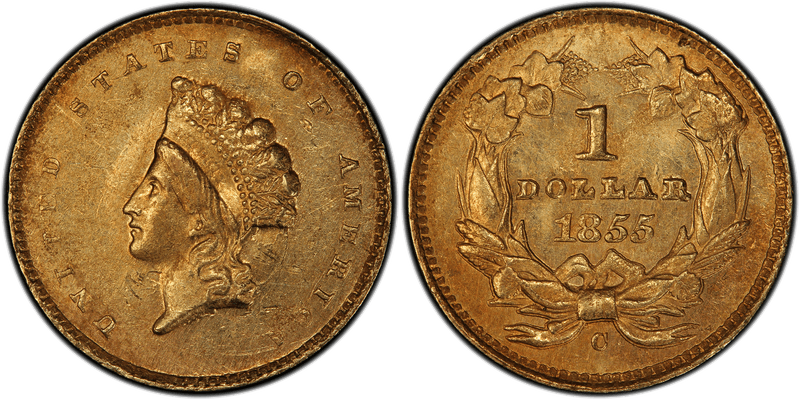
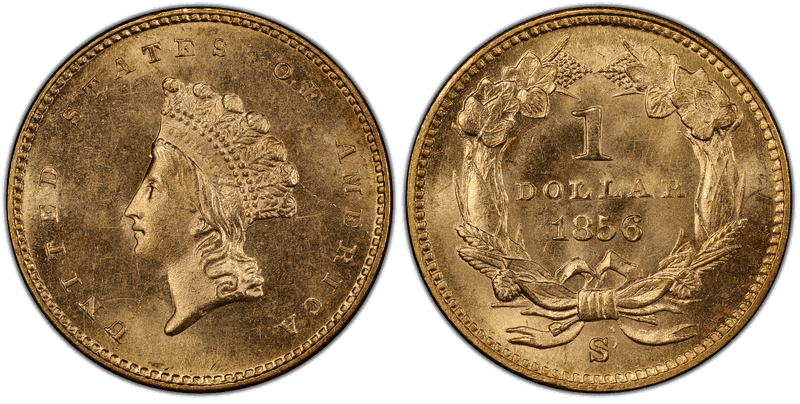
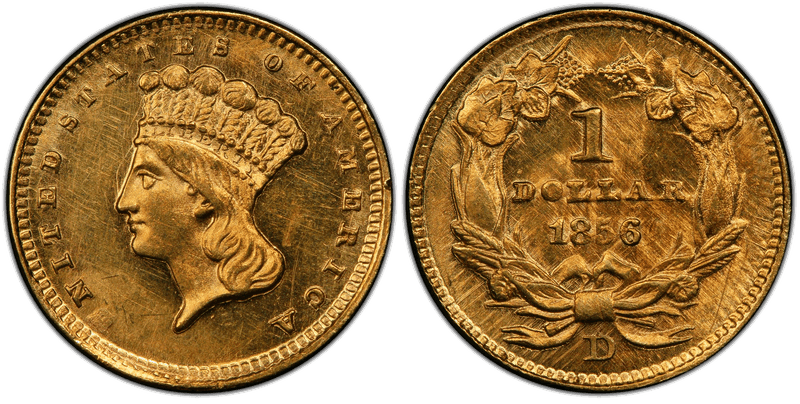
Obverse. Liberty is shown as an Indian princess wearing a feathered headdress inscribed LIBERTY. Longacre based the face on a classical sculpture, the Crouching Venus, then on display in Philadelphia; the headdress resembles nothing worn by any real tribe. UNITED STATES OF AMERICA surrounds the head.

Reverse. An agricultural wreath of cotton, corn, tobacco and wheat encloses 1 DOLLAR and the date.

Mint mark. On the reverse, below the wreath: C, D, O or S. Philadelphia coins have none, and D means Dahlonega.

Things that cause confusion.

  • Type 2 or Type 3. The Type 2 head is small, with plenty of space between it and the legend. The Type 3 head is larger and flatter, and its lettering sits nearer the rim. All 1854 and 1855 Indian princess dollars are Type 2; of the 1856 coins, only the 1856-S is.
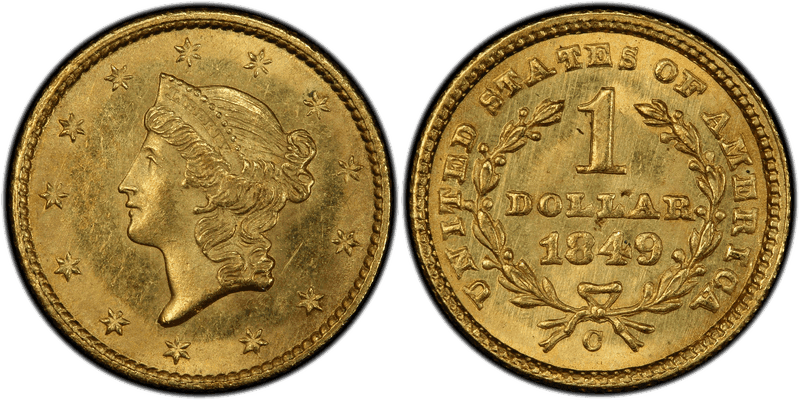
  • Type 1 of 1854. Philadelphia also struck the old coronet design in 1854. It is visibly smaller, with stars around Liberty and the country's name on the reverse.
  • Weak dates. A soft 85 in the date is typical of this design; Wikipedia says it is weak on most survivors, and Doug Winter says the same of the 1855-D.

Key Dates and Varieties

  • 1855-D: 1,811 struck, Dahlonega's only Type 2 issue.
  • 1855-C: 9,803 struck, Charlotte's only Type 2 issue. Doug Winter notes that most show weakness and planchet flaws.
  • 1855-O: 55,000 struck, the last gold dollars from New Orleans.
  • 1856-S: 24,600 struck, the only Type 2 coin dated 1856. A repunched S mint mark, listed by John Wexler as S/S Northeast (FS-G1-1856S-501), is known on this issue.
  • Philadelphia: 1854 (783,943 struck by Wikipedia's and CoinWeek's figure; NGC gives 783,953) and 1855 (758,269).
  • Proofs: five recorded for 1854 and 12 for 1855.

In Our Catalog

1 error or variety is listed for this series. Browse them by type:

Recently added

Mintages

Small Indian Princess Head Gold Dollars 1854-1856 mintages by year and mint, taken from each coin's page in our catalog. Each figure opens that coin's page, which lists its varieties and errors. A dash means no figure was recorded. Where one issue was struck in more than one type, each type is listed.

Composition and Gold Content

  • Composition: 90% gold, 10% copper
  • Weight: 1.672 grams
  • Gold content: 0.0484 troy ounce
  • Diameter: 14.3 mm (Wikipedia; NGC and CoinWeek give 15 mm)
  • Edge: reeded
  • Designer: James B. Longacre

The weight and fineness are the same as on the Type 1; the coin is simply thinner and wider.

FAQ

What is a Type 2 gold dollar?

It is the second gold dollar design, struck from 1854 to 1856. To make the coin easier to handle, the Mint made it thinner and wider than the Type 1 at the same weight, and James B. Longacre gave it an Indian princess head adapted from the new three-dollar gold piece. Collectors call it the Small Head type to set it apart from the Type 3 that followed.

Why are Type 2 gold dollars so often weakly struck?

The design was cut in high relief, and the mints had trouble forcing the metal into every part of the dies on such a thin coin. The Southern branch mints had the most difficulty. On most survivors the 85 of the date is not fully formed, and many worn or illegible pieces were sent back to Philadelphia to be melted and recoined.

Which mints struck Type 2 gold dollars?

Philadelphia in 1854 and 1855; Charlotte, Dahlonega and New Orleans in 1855 only; and San Francisco in 1856 only. That makes six issues in all, from five mints.

How do I tell a Type 2 gold dollar from a Type 3?

Look at the head. On the Type 2 it is small and sits well inside the legend; on the Type 3 Longacre enlarged it, flattened it, and moved the lettering nearer the rim. The reverses are identical. Every 1854 and 1855 Indian princess dollar is a Type 2; in 1856 only the San Francisco coin is.

How much gold is in a Type 2 gold dollar?

The same as every gold dollar: 1.672 grams at 90% gold, or about 0.0484 troy ounce of pure gold. Only the diameter changed in 1854.

↑ Back to the coins: every year, mint, variety and error

Explore Other Denominations

Collector Essentials

Tools and references for building and protecting your coin collection.

As an Amazon Associate, NumisDex earns from qualifying purchases.