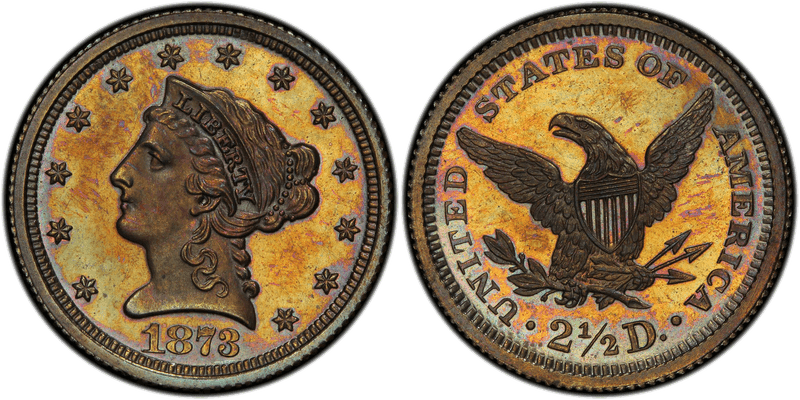
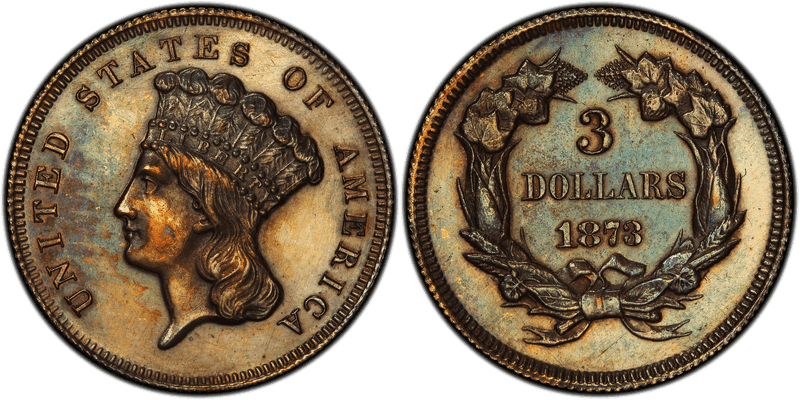
Trade Dollar Era Patterns (1871-1873)

Coin Series
Trade Dollar Era Patterns (1871-1873) series coin

About This Series

The Trade Dollar Era Patterns (1871-1873) series groups the pattern coins the Philadelphia Mint struck from 1871 to 1873, while Congress worked on the bill that became the Coinage Act of February 12, 1873. In 1871 William Barber, Chief Engraver since 1869, cut dies for James B. Longacre's Indian Princess design on the half dime through the dollar, and the first commercial dollar patterns, heavier coins meant for trade with Asia, carried the same obverse. In 1872 Barber produced the Amazonian quarter, half dollar and dollar and a matching design for all six gold denominations, along with more commercial dollar designs. In 1873 the commercial dollar became the trade dollar, and the Mint sold six of the trade dollar patterns in sets. Each year the Mint also struck its regular dies in copper, aluminum and other metals for sale to collectors.

Browse by Base(42 bases)

1871 Cent Patterns
BaseVerified

1871 Cent Patterns

2 Strike Types
1871 Dime Patterns
BaseVerified

1871 Dime Patterns

16 Strike Types
1871 Dollar Patterns
BaseVerified

1871 Dollar Patterns

51 Strike Types
1871 Double Eagle Patterns
BaseVerified

1871 Double Eagle Patterns

3 Strike Types
1871 Eagle Patterns
BaseVerified

1871 Eagle Patterns

3 Strike Types
1871 Half Dime Patterns
BaseVerified

1871 Half Dime Patterns

16 Strike Types
1871 Half Dollar Patterns
BaseVerified

1871 Half Dollar Patterns

15 Strike Types
1871 Half Eagle Patterns
BaseVerified

1871 Half Eagle Patterns

3 Strike Types
1871 Nickel Patterns
BaseVerified

1871 Nickel Patterns

10 Strike Types
1871 Quarter Eagle Patterns
BaseVerified

1871 Quarter Eagle Patterns

3 Strike Types
1871 Quarter Patterns
BaseVerified

1871 Quarter Patterns

15 Strike Types
1871 Three Cent Patterns
BaseVerified

1871 Three Cent Patterns

5 Strike Types
1871 Three Dollar Patterns
BaseVerified

1871 Three Dollar Patterns

3 Strike Types
1871 Two Cent Patterns
BaseVerified

1871 Two Cent Patterns

2 Strike Types
1872 Cent Patterns
BaseVerified

1872 Cent Patterns

4 Strike Types
1872 Dime Patterns
BaseVerified

1872 Dime Patterns

2 Strike Types
1872 Dollar Patterns
BaseVerified

1872 Dollar Patterns

26 Strike Types
1872 Double Eagle Patterns
BaseVerified

1872 Double Eagle Patterns

5 Strike Types
1872 Eagle Patterns
BaseVerified

1872 Eagle Patterns

5 Strike Types
1872 Half Dime Patterns
BaseVerified

1872 Half Dime Patterns

2 Strike Types
1872 Half Dollar Patterns
BaseVerified

1872 Half Dollar Patterns

5 Strike Types
1872 Half Eagle Patterns
BaseVerified

1872 Half Eagle Patterns

5 Strike Types
1872 Nickel Patterns
BaseVerified

1872 Nickel Patterns

2 Strike Types
1872 Quarter Eagle Patterns
BaseVerified

1872 Quarter Eagle Patterns

5 Strike Types
1872 Quarter Patterns
BaseVerified

1872 Quarter Patterns

5 Strike Types
1872 Three Cent Patterns
BaseVerified

1872 Three Cent Patterns

4 Strike Types
1872 Three Dollar Patterns
BaseVerified

1872 Three Dollar Patterns

5 Strike Types
1872 Two Cent Patterns
BaseVerified

1872 Two Cent Patterns

2 Strike Types
1873 Cent Patterns
BaseVerified

1873 Cent Patterns

4 Strike Types
1873 Dime Patterns
BaseVerified

1873 Dime Patterns

2 Strike Types
1873 Dollar Patterns
BaseVerified

1873 Dollar Patterns

60 Strike Types
1873 Double Eagle Patterns
BaseVerified

1873 Double Eagle Patterns

2 Strike Types
1873 Eagle Patterns
BaseVerified

1873 Eagle Patterns

2 Strike Types
1873 Half Dime Patterns
BaseVerified

1873 Half Dime Patterns

2 Strike Types
1873 Half Dollar Patterns
BaseVerified

1873 Half Dollar Patterns

2 Strike Types
1873 Half Eagle Patterns
BaseVerified

1873 Half Eagle Patterns

5 Strike Types
1873 Nickel Patterns
BaseVerified

1873 Nickel Patterns

2 Strike Types
1873 Quarter Eagle Patterns
BaseVerified

1873 Quarter Eagle Patterns

2 Strike Types
1873 Quarter Patterns
BaseVerified

1873 Quarter Patterns

2 Strike Types
1873 Three Cent Patterns
BaseVerified

1873 Three Cent Patterns

5 Strike Types
1873 Three Dollar Patterns
BaseVerified

1873 Three Dollar Patterns

2 Strike Types
1873 Two Cent Patterns
BaseVerified

1873 Two Cent Patterns

2 Strike Types
Showing all 42 listings

About the Era

Three things drove the patterns of 1871 to 1873. The first was a new Chief Engraver. Chief Engraver James B. Longacre died on the first day of 1869. William Barber, who had worked as his assistant since 1865, was appointed to the post later that month. The 1871 silver patterns use a design credited to Longacre and cut into dies by Barber, while the new designs of 1872 are Barber's own.

The second was the long coinage bill. In 1870 John Jay Knox, the Treasury's deputy comptroller of the currency, drafted a revision of the Mint laws, and it passed through Congress over nearly three years before President Grant signed it on February 12, 1873. Its last form dropped the standard silver dollar, ended the two-cent piece, the three-cent silver piece and the half dime, and added a trade dollar.

The third was the China trade. American merchants in East Asia had to buy Mexican dollars, which merchants there preferred to the lighter American silver dollar. Knox and the Treasury agent Henry Linderman took up the idea of a heavier coin made for export. A House committee wrote a 420-grain "commercial dollar" into the bill in February 1872, and the Senate restored it as a trade dollar after the House had swapped it out for a standard dollar. The Mint made patterns at every stage. The commercial dollar first appeared in 1871 with Longacre's Indian Princess obverse, several more designs followed in 1872, and the name on the coin changed to TRADE DOLLAR before the act was signed. Linderman then had Barber's designs compared with drawings from the Philadelphia firm Bailey Banks & Biddle, and in June 1873 he chose a seated Liberty facing left, toward Asia. The first regular trade dollars were struck on July 11, 1873.

Many of these pieces were made for collectors as much as for the Mint's own use. USPatterns.com reports that the 1871 Longacre designs were sold in sets from the half dime to the dollar, that complete off-metal sets from the regular dies were struck each year for sale, and that the six 1873 trade dollar designs were sold in sets for $30. One 1871 dollar, the J-1132 muling with a No Motto reverse, is a fantasy. USPatterns.com notes that the Mint had claimed its old dies were destroyed, and that no one knows whether this piece was struck in 1871 or later.

How Patterns Are Identified

Judd numbers. Each piece is identified by its number in J. Hewitt Judd's book United States Pattern Coins. In USPatterns.com's table the 1871 pieces run from J-1041 to J-1178, the 1872 pieces from J-1179 to J-1254 and the 1873 pieces from J-1255 to J-1345. A number covers a single die pair, metal and edge, so the 1871 Indian Princess dollar without stars is J-1120 in silver with a reeded edge, J-1121 in silver with a plain edge, and so on through J-1125 in aluminum. Letters mark later additions (J-1138a to J-1138f). Some numbers have moved or gone. The aluminum piece now numbered J-1138e was J-1138b in earlier editions. J-1083, a nickel dime listing, no longer appears in the USPatterns.com table because it is believed to describe the nickel half dime J-1067a. The 1873 listings J-1326A and J-1326B are discredited.

Other catalogues. USPatterns.com also gives each number's Pollock number, its Adams-Woodin number and, for many essais, Taxay's EP number. In 1871 Pollock's numbers run a little above Judd's, from Pollock-1176 for the aluminum cent J-1042 to Pollock-1320 for the nickel double eagle J-1178, and Pollock does not list a few pieces at all, such as the copper cent J-1041.

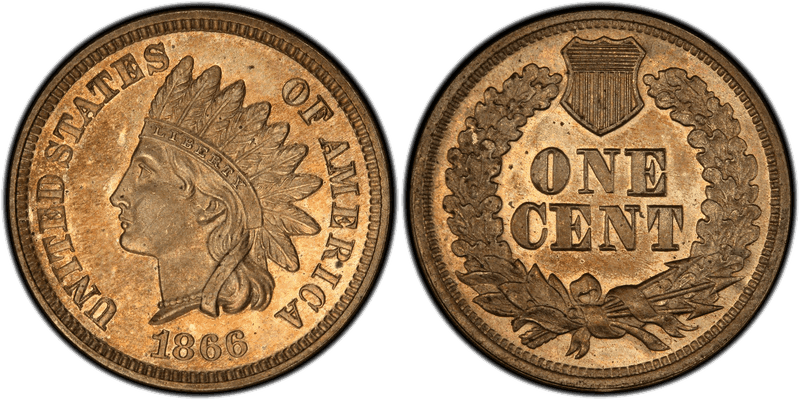
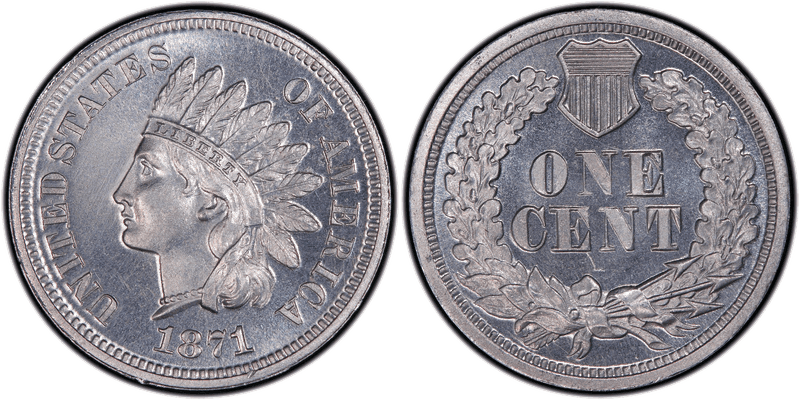
Telling the Indian Princess dies apart. On the 1871 silver denominations, look first for stars around the border, then at the reverse. The Standard Silver reverse of 1870 has STANDARD above the denomination in a wreath of corn, cotton and wheat. The regular reverse is the one used on the circulating coin. On the dollars, count the stars in the flag: 13 stars marks the die often called the obverse of 1871, and 22 stars the one called the obverse of 1870, though this 1871 die lacks Longacre's name. The commercial dollars of 1871 (J-1154 to J-1157) pair the 22-star obverse with a reverse reading COMMERCIAL DOLLAR, 420 GRS. and 900 FINE (search). Among the 1873 trade dollars, J-1300 has long plough handles beside Liberty, and pieces with short handles are J-1293.

Metals and edges. The 1871 patterns come in silver, copper, aluminum and nickel, with one steel or pure nickel five-cent piece (J-1058). The 1872 Amazonian gold set exists once in gold, and the 1873 trade dollars add white metal and tin. Gilt copper pieces are a surface finish, not separate Judd numbers, although NGC lists gilt examples of J-1164 and J-1173 under their own entries. Weight helps. The Bass example of J-1154 weighs 410 grains, close to a regular dollar, which suggests it was struck before 420-grain planchets were ready.

Trials, essais and errors. In Judd's terms, an off-metal striking of a regular design is a die trial, and a piece with a new design is an essai. USPatterns.com argues that the off-metal "trials" of these years were really made for sale to collectors, apart from the 1873 white metal and tin trade dollars. Some listings are mint errors. The nickel cent J-1042a is one example, a worn piece on a heavy 68.25-grain planchet. USPatterns.com warns that many nickel Indian cents in the pattern books are regular coins struck on three-cent or foreign planchets.

Grading. NGC and PCGS grade these pieces as proofs, and NGC files the three 1871 gold dollar trials (J-1161 to J-1163) as G$1 and the commercial dollars as T$1. Some pieces have turned up in the wrong holders. USPatterns.com records a J-1138c labelled as J-1147, and several J-1138a coins first sold as J-1145, so the stars in the flag are worth checking against the label.

Key Patterns of the Era

1871

  • Half dimes, dimes, quarters and half dollars: Longacre's Indian Princess design in four combinations each (J-1059 to J-1070, J-1074 to J-1086, J-1090 to J-1101, J-1105 to J-1116), in silver, copper and aluminum. The Smithsonian holds a complete set of the starred design with the Standard Silver reverse, the design of the quarter J-1096.
  • Dollars: the Indian Princess dollar without stars (J-1120 to J-1131) and with stars, using a 13-star flag (J-1133 to J-1138f) or a 22-star flag (J-1139 to J-1150), each struck in silver, copper and aluminum, with a reeded or a plain edge. J-1132 and J-1132a are the No Motto fantasies.
  • The first commercial dollar: J-1154 to J-1157, Longacre's 22-star obverse with a COMMERCIAL DOLLAR reverse, for a coin heavier than the standard dollar. Haseltine wrote in 1876 that only three of J-1154 were struck.
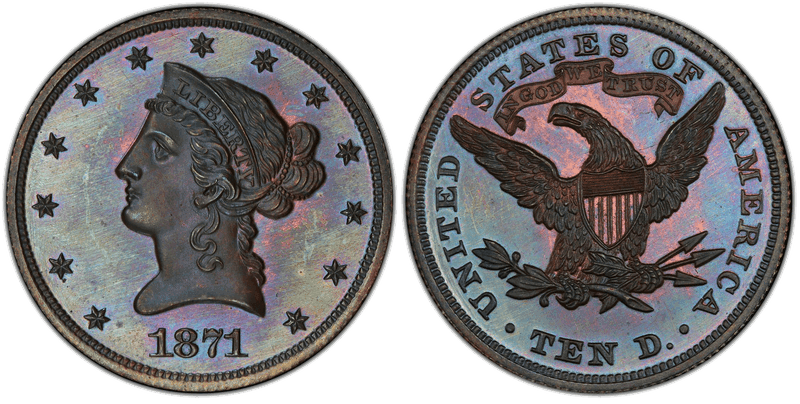
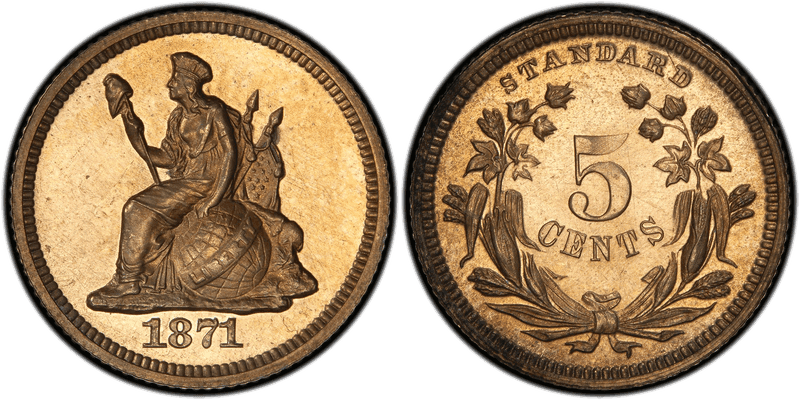
  • Five-cent pieces: two essais with a small coronet Liberty head, one with a V above CENTS (J-1050 to J-1052a) and one with 5 CENTS in a laurel wreath (J-1053 to J-1055).
  • Off-metal sets from the regular dies of every denomination, cent through double eagle, struck in copper, aluminum and nickel for collectors.

1872

  • The Amazonian quarter (J-1195), half dollar (J-1200) and dollar (J-1205), William Barber's seated Liberty with an eagle, in silver, copper and aluminum. The half dollar die, used for the silver, copper and aluminum pieces J-1200 to J-1202, adds an olive branch over the shield; the copper piece is J-1201.
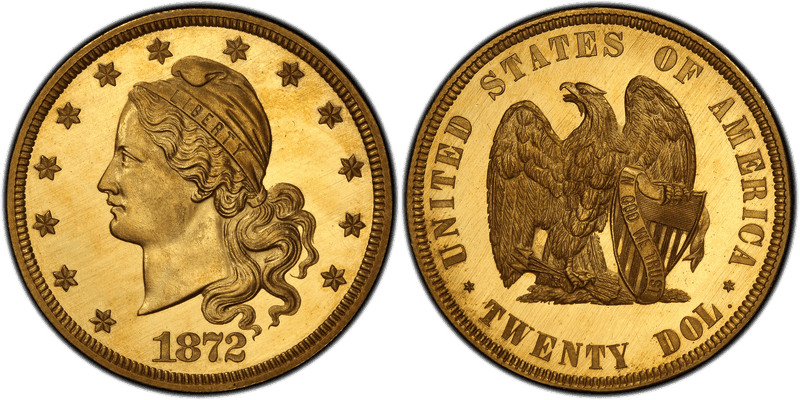
  • The gold set: one design for the gold dollar, quarter eagle, three-dollar piece, half eagle, eagle and double eagle (J-1224, J-1230, J-1235, J-1240, J-1245, J-1250), unique in gold and made in copper, gilt copper and aluminum. USPatterns.com calls it the only uniform design ever made for the gold coinage, and J-1235 the only pattern design for the three-dollar piece.
  • Commercial and trade dollars: Longacre's 22-star design with the commercial reverse (J-1212), Barber's lower-relief copy of the Indian Princess (J-1214 to J-1218, and J-1220 to J-1222 with TRADE DOLLAR), and the regular Seated Liberty obverse with the commercial reverse (J-1219).
  • Regular dies in copper and aluminum, cent to double eagle.

1873

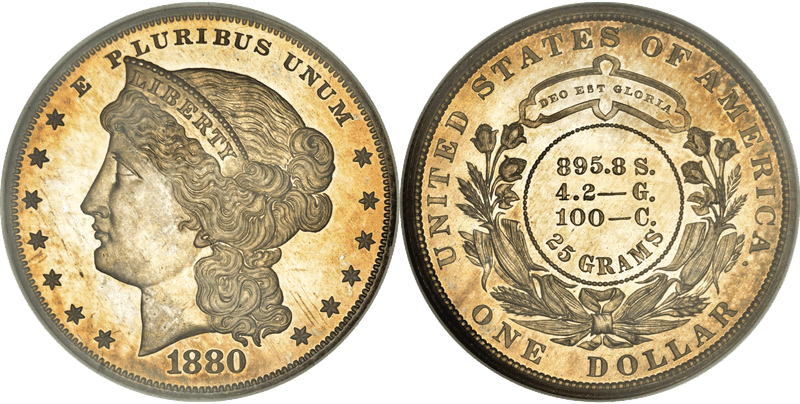
  • Trade dollars: USPatterns.com counts 17 patterns from nine obverse and six reverse dies. Six designs, those of J-1276, J-1281, J-1293, J-1310, J-1315 and J-1322, were sold in sets, in silver with reeded and plain edges, in copper and in aluminum. Others include Barber's head facing right (J-1287), an obverse like the double eagle's (J-1288) and J-1300 with long plough handles, of which Haseltine said seven were struck. See the 1873 dollar patterns.
  • The half eagle J-1337, which pairs the facing-right head of J-1287 with the Amazonian reverse of 1872, in gold, copper and aluminum.
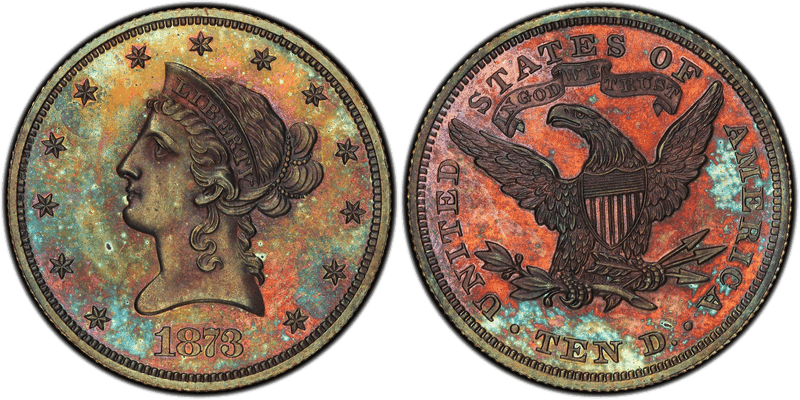
  • Regular dies in copper and aluminum, cent to double eagle, including the last two-cent dies (J-1258 and J-1259, from the closed 3 die) before the denomination ended. The tin and white metal trade dollars from the regular dies (J-1329, J-1330) are true trials.

The Mint itself sold much of this era to collectors. USPatterns.com describes sets of the 1871 Longacre designs, off-metal sets from the regular dies in all three years, and the 1873 trade dollar sets at $30. The earliest recorded sale of an 1873 set is in E. Cogan's October 1875 sale, and his December 1878 catalogue mentions 60 sets sold.

Original sets survive in public collections. USPatterns.com places 1871, 1872 and 1873 sets or pieces in the Smithsonian, the Durham Museum, the Connecticut State Library (the Mitchelson collection) and the American Numismatic Society.

Some pieces left the Mint by private arrangement. USPatterns.com believes William Woodin got the unique gold Amazonian set from Mint Superintendent A. L. Snowden in exchange for returning two gold half union patterns to the Mint cabinet. The set has stayed together since 1962. The No Motto dollars of 1871 come from a reverse die the Mint had said was destroyed.

Metal and attribution need checking. Several listings exist only in the old catalogues: USPatterns.com has not confirmed J-1041, J-1134, J-1136, J-1138, J-1138b, J-1138d, J-1138f or J-1158 to J-1160. Some nickel pieces may be mint errors, and plating does not make a new number: USPatterns.com treats the silver-plated 1872 gold dollar listed as J-1229 as a plated J-1227.

In Our Catalog

No errors or varieties are listed for Trade Dollar Era Patterns (1871-1873) yet. Submit one

FAQ

What is the Indian Princess design?

It is a seated figure of Liberty wearing an Indian headdress, her left hand on a globe with a LIBERTY scroll and her right holding a pole with a liberty cap, with flags behind her. The design is credited to James B. Longacre, who died in 1869, and USPatterns.com believes William Barber cut the dies after he became Chief Engraver. In 1871 it appeared on the half dime, dime, quarter, half dollar and dollar, without or with stars around the border, and with either the Standard Silver reverse of 1870 or the regular reverse. The starred dollar obverses come with 13 or 22 stars in the flag.

Why did the Mint make commercial and trade dollar patterns?

American merchants in China had to buy Mexican dollars because the U.S. silver dollar was lighter and less accepted there. John Jay Knox's coinage bill grew to include a heavier dollar for that trade, and a House committee added a 420-grain commercial dollar in February 1872. The Mint struck commercial dollar patterns from 1871 (J-1154 is the first, according to USPatterns.com) through 1872, and the name on the patterns changed to TRADE DOLLAR before the Coinage Act was signed on February 12, 1873.

Why are the 1872 patterns called Amazonian?

It dates from 1890, when the Parmelee collection was sold, and probably came from the cataloguer David Proskey. It was given to William Barber's quarter, half dollar and dollar of 1872, which show Liberty seated with a shield beside an eagle, and it was later applied to his matching gold set because the gold coins share the eagle reverse. Wikipedia reports that Mint officials turned the silver design down as too military, and USPatterns.com links the olive branch over the shield on the half dollar die to that criticism.

Could collectors buy these patterns from the Mint?

Yes, many of them. USPatterns.com reports that the 1871 Longacre designs were sold in sets from the half dime to the dollar, and that every year from 1871 to 1873 the Mint struck its regular dies in off metals (copper, aluminum and in 1871 nickel) for sale to collectors in complete sets. The six 1873 trade dollar designs were sold in sets for $30, and E. Cogan's December 1878 sale catalogue mentions 60 sets sold.

What did the Coinage Act of 1873 change?

President Grant signed it on February 12, 1873, and it took effect on April 1. It authorized the 420-grain trade dollar with legal tender up to five dollars and dropped the standard silver dollar. It also ended the two-cent piece, the three-cent silver piece and the half dime, made the dime, quarter and half dollar slightly heavier, and moved the Mint Director's office from Philadelphia to Washington.

Are the copper and aluminum pieces die trials?

Judd calls the off-metal strikings from regular dies die trials, but USPatterns.com argues that most of those from 1871 to 1873 were made to sell to collectors in sets. The exceptions it notes are the 1873 trade dollars in white metal and tin, which it treats as true trials; Superintendent James Pollock sent Director Henry Linderman a tin trade dollar on July 11, 1873, the day regular coinage began.

↑ Back to the coins: every year, mint, variety and error

Explore Other Denominations

Collector Essentials

Tools and references for building and protecting your coin collection.

As an Amazon Associate, NumisDex earns from qualifying purchases.