
1873 Quarter Eagle Patterns
Base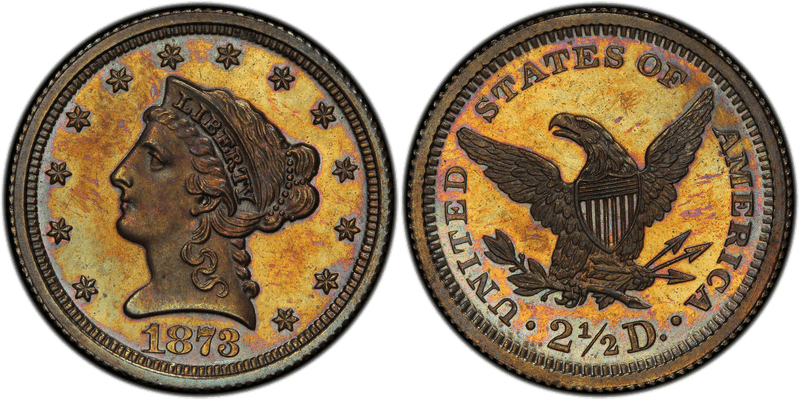
About This Coin
Within the Trade Dollar Era Patterns (1871-1873), the 1873 Quarter Eagle Patterns represent William Barber's redesign of the $2.50 gold denomination at the Philadelphia Mint. The quarter eagle occupied a distinctive position — smaller than the half eagle and eagle, it served as an accessible entry to gold coin ownership for middle-class Americans, frequently used as a gift denomination for birthdays and graduations. Barber's obverse features the seated Liberty facing left with olive branch and wheat sheaf, proposing departure from the Coronet Head design in continuous production since 1840. The reverse displays an eagle perched on a bale of goods with olive branch and three arrows, applying the Trade Dollar era's commercial design language to the smallest standard gold denomination. A notable result of $14K in PR65 grade at Heritage Auctions places these at a moderate price among Barber's gold denomination patterns. For specialists, the quarter eagle patterns demonstrate how Barber's design scaled down to the smaller format, where reduced diameter challenged the engraver to maintain compositional clarity within a more constrained canvas.
Specifications
Strike Types & Varieties(3)
1873 Proof Quarter Eagle Pattern - J-1333
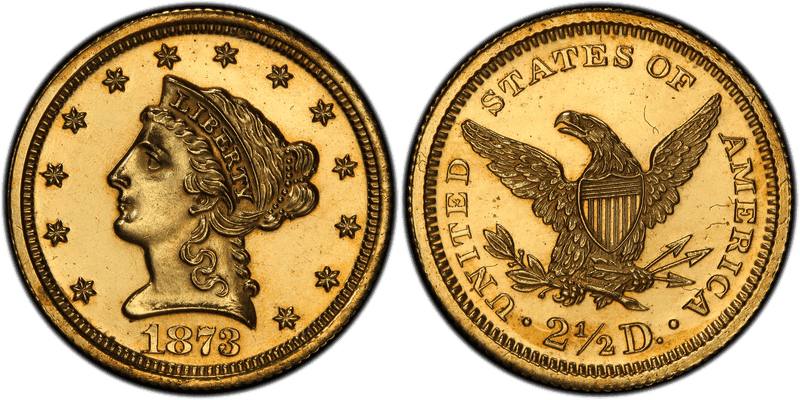
1873 Proof Quarter Eagle Pattern - J-1333, Gilt

1873 Proof Quarter Eagle Pattern - J-1334
Other Base Coins in This Series


Collector Essentials
Tools and references for building and protecting your coin collection.
10x-20x Jeweler's Loupe
A must-have for examining coin details, mint marks, and surface quality
Red Book — Guide to U.S. Coins
The essential annual reference for U.S. coin values, history, and mintages
Coin Albums & Storage
Archival-quality albums and holders to protect and display your collection
USB Digital Microscope
Capture detailed images for documentation and community submissions
As an Amazon Associate, NumisDex earns from qualifying purchases.