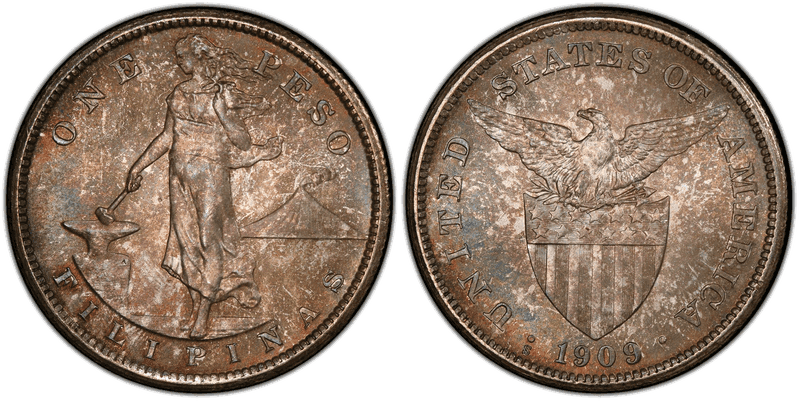
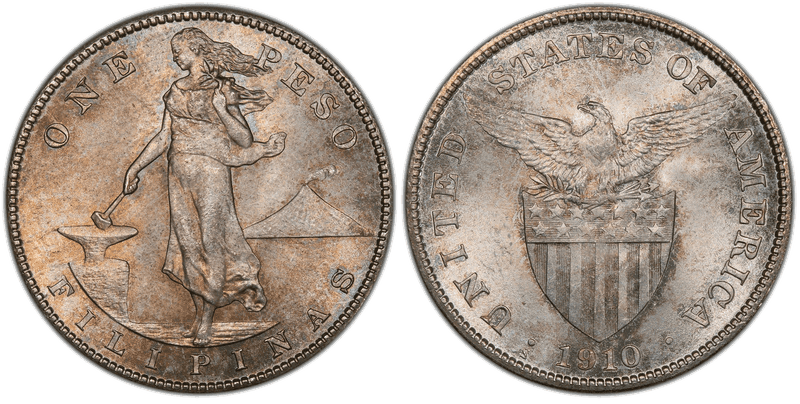
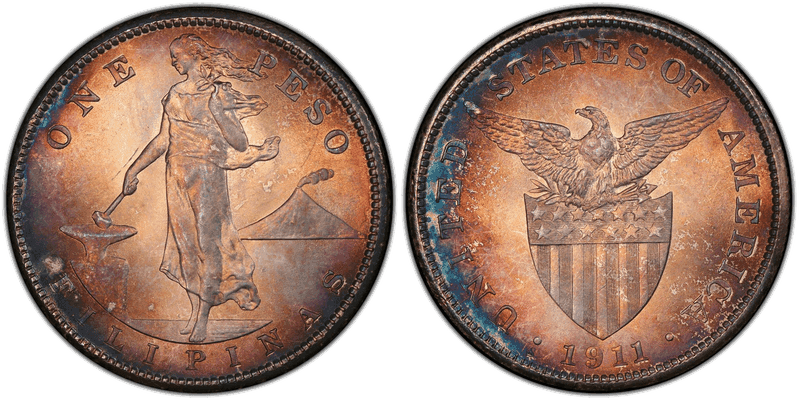
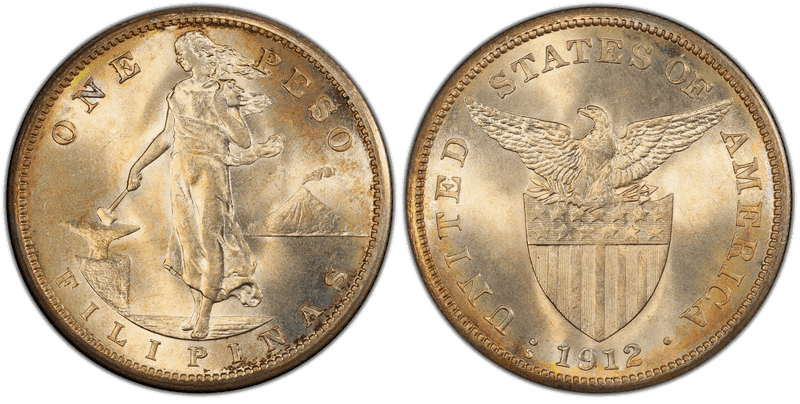
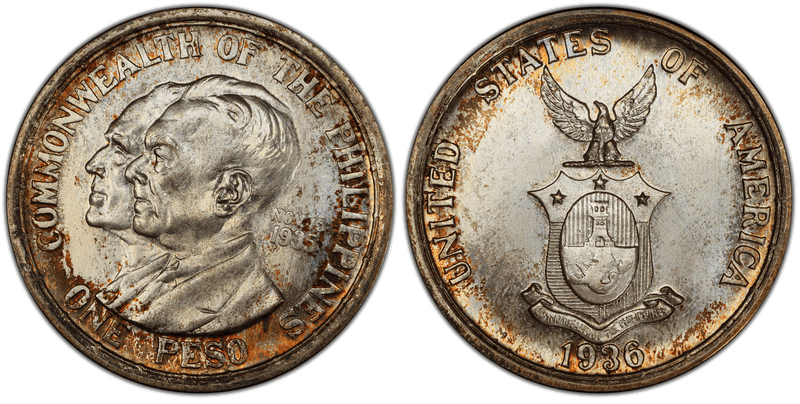
Philippines Peso 1903-1945

Coin Series
Philippines Peso 1903-1945 series coin

About This Series

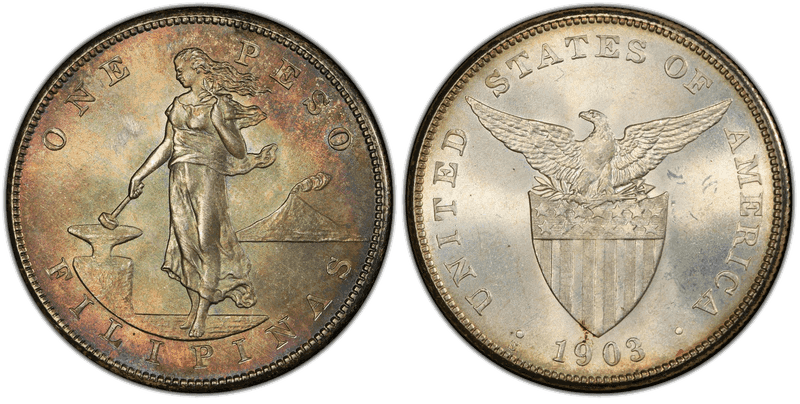
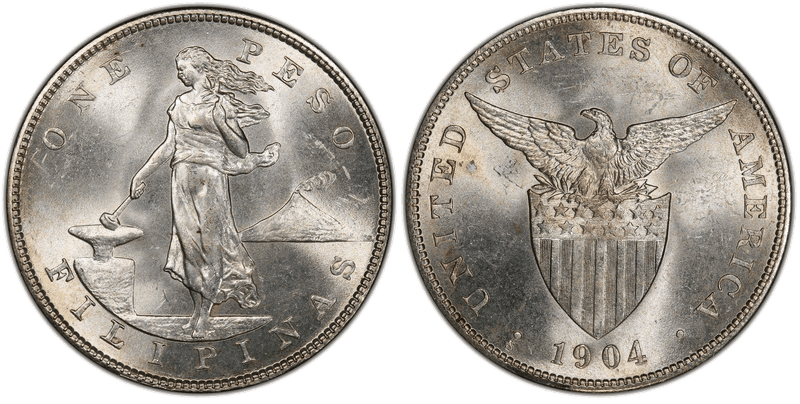
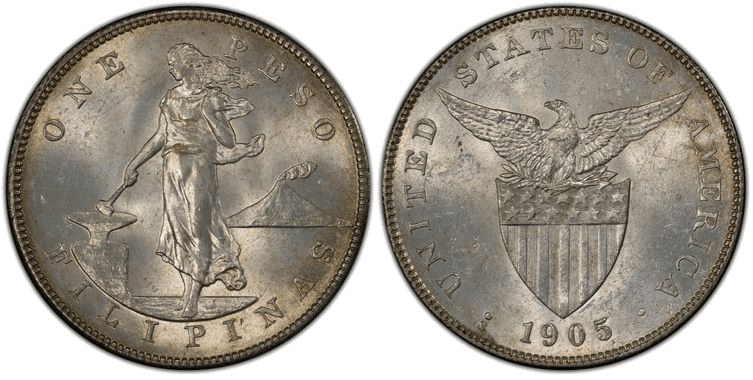
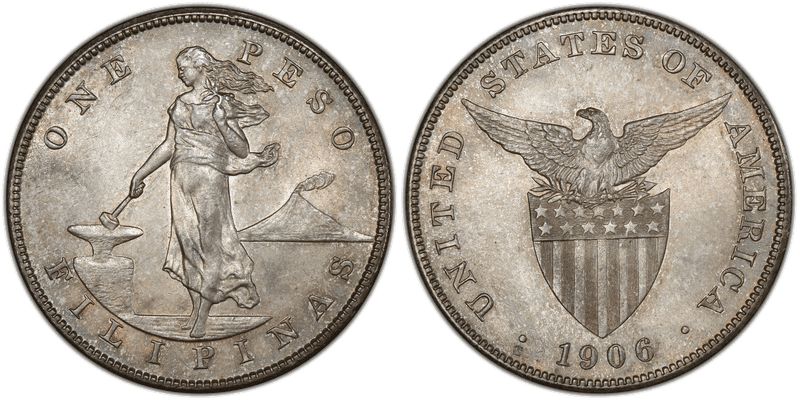
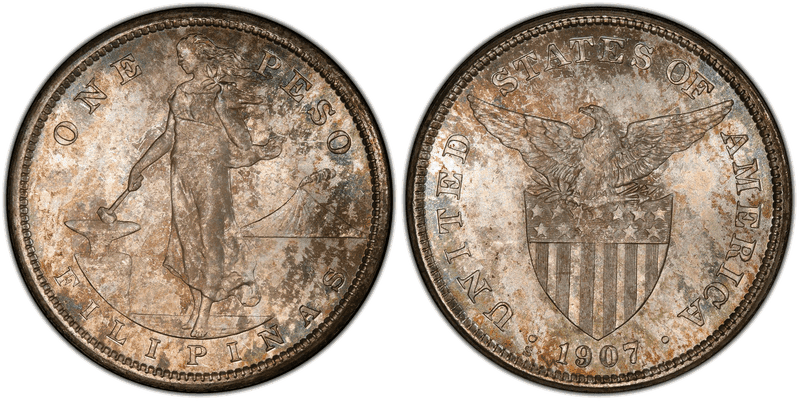
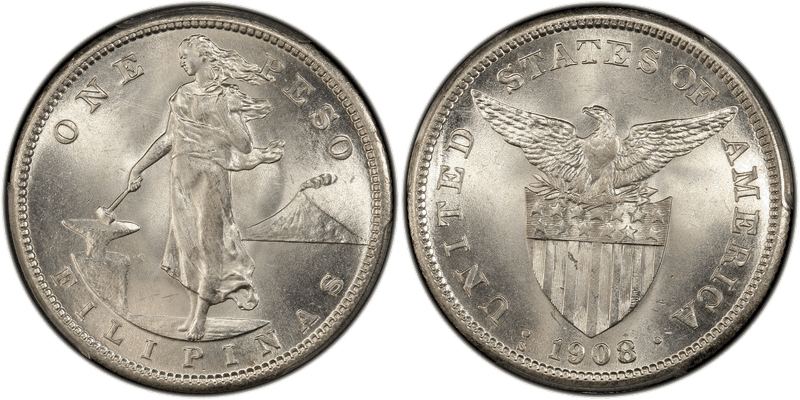
The silver peso of the Philippine Islands was set by the act of March 2, 1903 at half a United States dollar. Melecio Figueroa's obverse shows a young woman striking an anvil with Mount Mayon behind her, and the American eagle and shield are on the reverse. The pesos of 1903 to 1906 weighed about 26.95 grams of 90 percent silver; from 1907 they were cut to 20 grams of 80 percent silver. Philadelphia struck pesos in 1903 and 1904 and proofs until 1908, and San Francisco struck them from 1903 to 1912. After 1912 no peso was struck for circulation under American rule; the only later pesos are the two commemoratives the Manila Mint struck in 1936 for the founding of the Commonwealth.

Browse by Base(11 bases)

Showing all 11 listings

History

The peso was the standard coin of the system Congress set up for the Philippine Islands by the act of March 2, 1903, which fixed it at half a United States dollar. Filipinos came to call it the Conant, after the monetary adviser Charles A. Conant. Melecio Figueroa designed the obverse, a Filipina with a hammer raised over an anvil and the volcano Mayon smoking in the distance; the reverse took the American arms, an eagle above a shield. Philadelphia struck pesos for circulation in 1903 and 1904 and proofs every year from 1903 to 1908; San Francisco struck the great majority of them.

Rising silver costs soon caught up with the heavy 26.95-gram peso. Congress answered on June 23, 1906 by allowing the islands' government to make its silver coins lighter and baser, provided the peso stayed at 70 percent silver or more. From 1907 the peso weighed 20 grams of 80 percent silver and measured 35 millimeters. San Francisco struck the reduced coin from 1907 to 1912, and then no more pesos were made for circulation under American rule.

The only later pesos are the two 1936 commemoratives from Manila, Ambrosio Morales's work, marking the new Commonwealth. They sold slowly. In May 1942, as Corregidor was about to fall, silver coins with a face value of millions of pesos were dumped into Caballo Bay to keep them from the Japanese, and many of the reduced pesos and unsold commemoratives went with them; much was salvaged after the war.
How to Identify It

Obverse. Figueroa's Filipina bringing her hammer down on the anvil, Mayon in the background, ONE PESO at the top and FILIPINAS at the bottom. On the 1936 coins she is replaced by two overlapping portraits: Quezon with Murphy, or Quezon with Roosevelt.

Reverse. From 1903 to 1912, an eagle on a stars-and-stripes shield, encircled by UNITED STATES OF AMERICA with the date at the foot; on the 1936 coins, the Commonwealth arms.

Mint mark. A letter placed before the date on the reverse: S for San Francisco, M on the 1936 coins from Manila, none for Philadelphia and the proofs.

Size. The pesos of 1903 to 1906 are about 38 millimeters across; those of 1907 to 1912 and 1936 are 35 millimeters.

Key Dates and Varieties

  • 1903. San Francisco coined 11,361,000 (1903-S); Philadelphia added 2,788,901 pesos for circulation together with 2,558 proof pesos.
  • 1904. San Francisco struck 6,600,000. Philadelphia struck a small number for circulation, given as 11,355 or 11,000 in the references (1904), and 1,355 proofs.
  • 1905-S. San Francisco struck 6,056,000, with two forms of the 1 in the date: a curved serif (Allen-16.06) and a straight serif (Allen-16.06a). Philadelphia struck 471 proofs.
  • 1906-S. The last large peso for circulation, 201,000 struck (1906-S), beside 500 Philadelphia proofs.
  • 1907 proofs. Greysheet records two 1907 proof pesos, each unique, one on the old 90 percent standard and one on the new 80 percent standard.
  • 1907-S to 1912-S. The reduced peso: 10,278,000 in 1907, 20,954,944 in 1908, 7,578,000 in 1909, 3,153,559 in 1910, 463,000 in 1911 and 680,000 in 1912. The 1908 and 1909 dies include repunched S varieties (1908-S/S, 1909-S/S and 1909-S/S/S). The 1908 proofs (500) are on the reduced standard.
  • 1936. The Murphy-Quezon and Roosevelt-Quezon pesos, 10,000 each, struck at Manila.

In Our Catalog

No errors or varieties are listed for Philippines Peso 1903-1945 yet. Submit one

Mintages

Philippines Peso 1903-1945 mintages by year and mint, taken from each coin's page in our catalog. Each figure opens that coin's page, which lists its varieties and errors. A dash means no figure was recorded. Where one issue was struck in more than one type, each type is listed.

Composition and Silver Content

StruckWeight of the coinSilver standardSilver contentDiameter (mm)
1903-190626.95 g90% silver, 10% copper24.26 g (0.780 oz)about 38 mm
1907-191220.00 g80% silver, 20% copper16.00 g (0.514 oz)35 mm
193620.00 g90% silver, 10% copper18.00 g (0.579 oz)35 mm

All have a reeded edge. CoinVarieties gives the 1936 pesos as 80 percent silver; Wikipedia and Greysheet give 90 percent, which is used here.

FAQ

What was a US-Philippine peso equal to?

The act of March 2, 1903 fixed the Philippine peso at half a United States dollar, so two pesos equalled one dollar. When silver became dearer, the peso was reduced in 1907.

Why are there two sizes of Philippine peso?

The first pesos, 1903 to 1906, weigh about 26.95 grams of 90 percent silver and measure about 38 millimeters. Under a law of June 23, 1906 the Philippine government could reduce its coins, and from 1907 the peso weighed 20 grams of 80 percent silver and measured 35 millimeters. San Francisco struck the smaller peso until 1912.

What are the 1936 pesos?

Two commemoratives struck at the Manila Mint for the founding of the Commonwealth of the Philippines on November 15, 1935, both designed by Ambrosio Morales. One shows Manuel L. Quezon with the High Commissioner Frank Murphy, the other Quezon with President Franklin D. Roosevelt. 10,000 of each were struck, in 20 grams of 90 percent silver.

What happened to the pesos dumped into the sea in 1942?

In May 1942, as Corregidor was about to fall, silver coins with a face value of roughly 15 to 17 million pesos were dumped into Caballo Bay so the Japanese could not take them. About three quarters was later accounted for, according to a history published by the Bangko Sentral ng Pilipinas, by the Japanese during the war and by the US Navy and other salvors afterwards. Many reduced pesos and unsold 1936 commemoratives were in the hoard, and salvaged pieces often show corrosion.

Does a Philippine peso have a mint mark?

San Francisco pesos have an S placed just before the date on the reverse. Philadelphia pesos (1903 and 1904) and the proofs of 1903 to 1908 have no letter. The 1936 commemoratives from Manila carry an M.

↑ Back to the coins: every year, mint, variety and error

Explore Other Denominations

Collector Essentials

Tools and references for building and protecting your coin collection.

As an Amazon Associate, NumisDex earns from qualifying purchases.