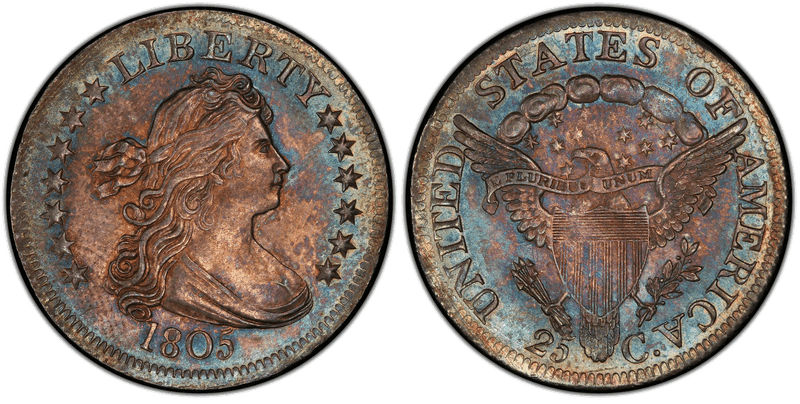
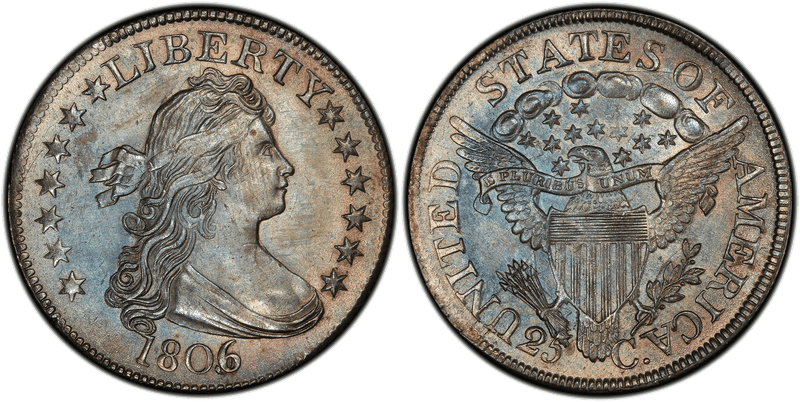
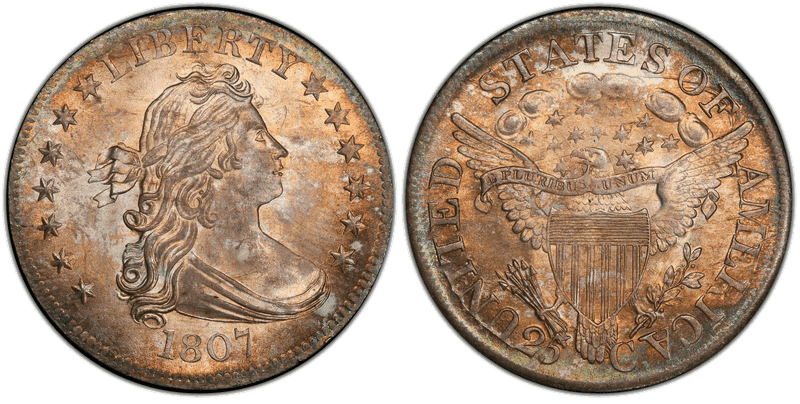
Draped Bust Quarters 1796-1807

Coin Series
Draped Bust Quarters 1796-1807 series coin

About This Series

Only 6,146 quarters were struck in 1796 — the first year of American quarter dollar production. Paired with the Small Eagle reverse for that single year, the 1796 is the only quarter of its type; the last 252 of them were delivered in February 1797. From 1804 onward, the Heraldic Eagle replaced the Small Eagle, though production remained sporadic: no quarters are dated 1797 through 1803; NGC attributes the small demand to the Spanish colonial two-reales coins that already circulated at the same value. Struck in .8924 fine silver at 6.74 grams, the 27.5mm Draped Bust quarter circulated alongside Spanish two-real coins of the same value. The Mint struck 6,738 quarters in 1804, 121,394 in 1805, 206,124 in 1806 and 220,643 in 1807. Die marriages are identified by Browning numbers, from Ard W. Browning's study of early quarters.

From NumisDex News

Series Information

Production Years
1796-1807
Composition
89.2% Silver, 10.8% Copper

Browse by Base(5 bases)

Showing all 5 listings

History

The Mint Act of 1792 provided for a quarter dollar, but the Mint did not strike one until 1796, two years after its first silver coins. NGC puts the delay down to the Spanish colonial two-reales pieces that already passed in large numbers at the same 25 cents. The first quarters carried Robert Scot's Draped Bust Liberty, drawn from a portrait by Gilbert Stuart, with the small eagle reverse then in use on the other silver coins. They were delivered in three batches between April and June 1796, and a last 252 coins dated 1796 followed on February 28, 1797, for a total of 6,146.

No more quarters were made until 1804. By then the reverse had changed to the heraldic eagle adapted from the Great Seal, so the 1796 is the only quarter with the small eagle. A delivery of 6,738 quarters on June 12, 1804 began the second type, and production rose each year: 121,394 in 1805, 206,124 in 1806 and 220,643 in 1807. The Mint reported calendar-year deliveries rather than coins of each date, and NGC thinks the first 1807 deliveries were coins dated 1806.

After 1807 the Mint again stopped making quarters. The next ones were John Reich's Capped Bust quarters, struck in December 1815 to fill a bank's order.
How to Identify It

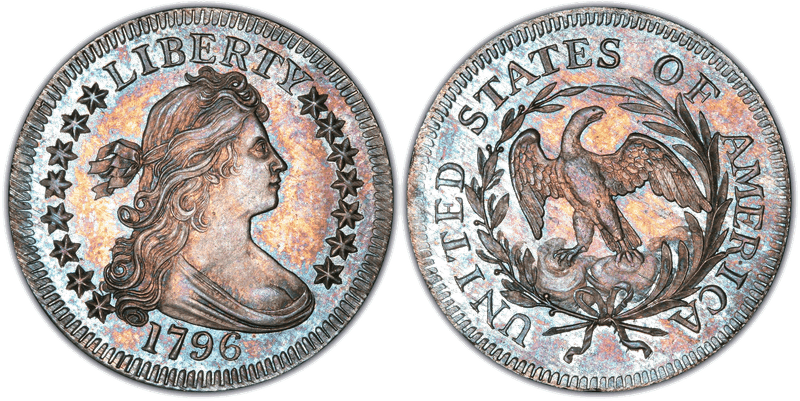
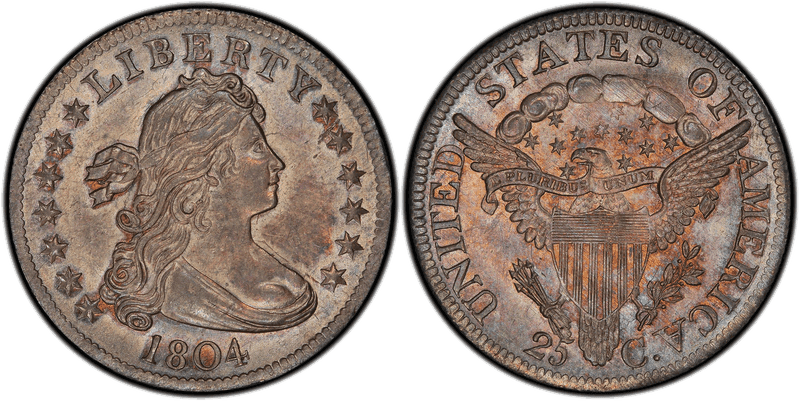
Obverse. Liberty faces right, her hair tied with a ribbon and a drape across her bust. LIBERTY is above her and the date below. The 1796 has 15 stars, eight on the left and seven on the right. The 1804–1807 coins have 13, seven on the left and six on the right.

Reverse, 1796. A small eagle stands on clouds inside an open wreath tied with a bow, with UNITED STATES OF AMERICA around it. There is no statement of value.

Reverse, 1804–1807. A heraldic eagle with a shield on its breast holds a bundle of arrows and an olive branch, in the reverse of the usual heraldic order. A scroll in its beak reads E PLURIBUS UNUM, thirteen stars and a band of clouds sit above it, and the value 25 C. is split by the eagle's tail at the bottom.

Edge. Reeded.

Mint mark. None. All Draped Bust quarters were struck at Philadelphia.

Telling the types apart.

TypeYearsReverseObverse starsValue shown
Small Eagle1796small eagle on clouds in a wreath15none
Heraldic Eagle1804–1807heraldic eagle with shield and motto1325 C.

Things that cause confusion.

  • The 1806/5. The 5 under the 6 is usually visible without magnification. A plain 1806 has a clean 6.
  • Strike. The coins were struck in an open collar, so rims are often uneven, and the centers, especially the eagle, are frequently weak.

Die marriages. Varieties are identified by Browning numbers, from Ard W. Browning's study of early quarters, with Steve Tompkins's Early United States Quarters 1796-1838 (2008) as the modern reference. 1796 has two marriages, 1804 two, 1805 five, 1806 ten and 1807 two.

Key Dates and Varieties

  • 1796: 6,146 struck, the only Small Eagle quarter. Its two marriages share one reverse: B-1 has a low 6 in the date and B-2 a high 6.
  • 1804: 6,738 struck, all delivered on June 12, 1804, from two marriages.
  • 1805: 121,394 struck, delivered in seven warrants between April 29 and July 31.
  • 1806/5 (B-1): the only overdate of the type. Browning found that both of its dies had already struck the 1805 B-4, so a used 1805 obverse was re-dated.
  • 1806: 206,124 struck from six obverses and eight reverses in ten marriages. CoinWeek notes an 1806 reverse on which the C of 25 C. was punched over an A.
  • 1807: 220,643 reported for 1807, from two marriages, the last Draped Bust quarters.

In Our Catalog

3 errors and varieties are listed for this series. Browse them by type:

Recently added

Mintages

Draped Bust Quarters 1796-1807 mintages by year and mint, taken from each coin's page in our catalog. Each figure opens that coin's page, which lists its varieties and errors. A dash means no figure was recorded. Where one issue was struck in more than one type, each type is listed.

YearP
1796
1804
1805
1806
1807

Composition and Silver Content

  • 1796–1807: 6.74 g, 89.24% silver and 10.76% copper, about 27.5 mm, holding 0.1933 troy oz of silver
  • Designer: Robert Scot, after a portrait by Gilbert Stuart

FAQ

Where is the mint mark on a Draped Bust quarter?

There is none. Every Draped Bust quarter was struck at Philadelphia, and no quarter carried a mint mark until the Seated Liberty quarters of New Orleans in 1840.

Why are there no quarters dated 1797 through 1803?

Hardly anyone asked for them. Spanish colonial two-reales coins, worth the same 25 cents, were already circulating in large numbers, and NGC calls the 1796 quarters a token issue that established the denomination. The last 252 coins dated 1796 were delivered in February 1797, and the Mint struck no more quarters until 1804.

How does the 1796 quarter differ from the 1804-1807 quarters?

The reverse. The 1796 has a small eagle standing on clouds inside an open wreath, and it carries no statement of value. The 1804-1807 coins have the heraldic eagle, with a shield on its breast, arrows and an olive branch in its claws, a scroll reading E PLURIBUS UNUM, and the value 25 C. below. The 1796 obverse also has 15 stars, while the later coins have 13.

What is a Browning number on a Draped Bust quarter?

A Browning number (B-1, B-2 and so on within each date) names one die marriage, a particular obverse die paired with a particular reverse die. The system comes from Ard W. Browning's study of early quarter dollars and is still used, alongside Steve Tompkins's Early United States Quarters 1796-1838 of 2008. 1796 has two marriages, B-1 and B-2, and 1806 has ten.

How much silver is in a Draped Bust quarter?

About 0.1933 troy ounce, according to NGC. The coins weigh 6.74 grams at .8924 fine, 89.24% silver and 10.76% copper, and measure about 27.5 mm.

Which year had more quarters, 1806 or 1807?

  1. The Mint reported 206,124 quarters for 1806 and 220,643 for 1807. CoinWeek points out that the 1806 is often wrongly given as the larger. NGC adds that the first 1807 deliveries were probably coins dated 1806, so the split by date is uncertain.

↑ Back to the coins: every year, mint, variety and error

Explore Other Denominations

Collector Essentials

Tools and references for building and protecting your coin collection.

As an Amazon Associate, NumisDex earns from qualifying purchases.