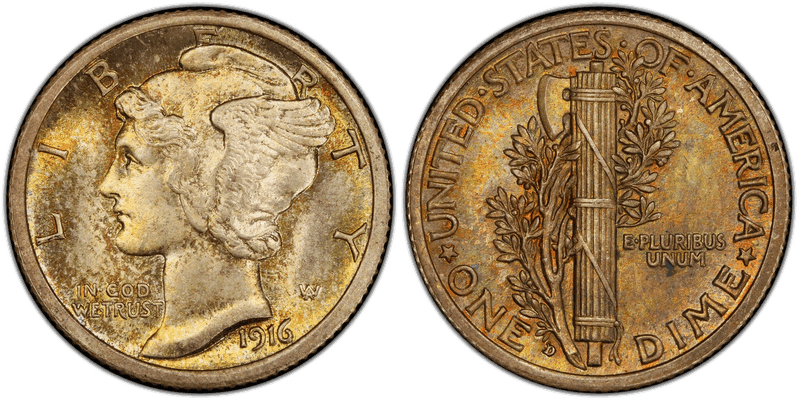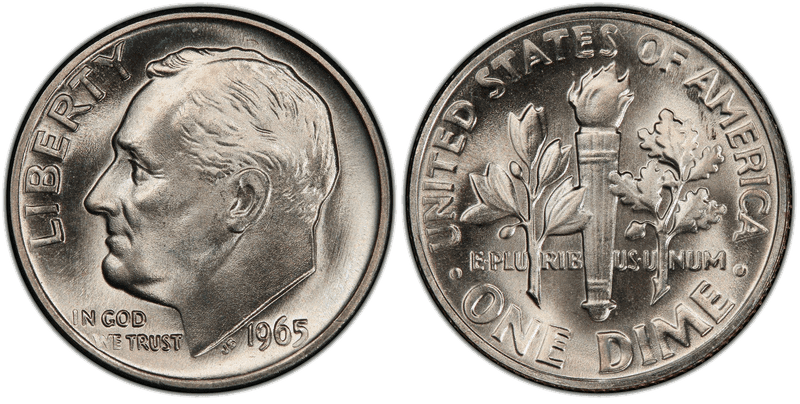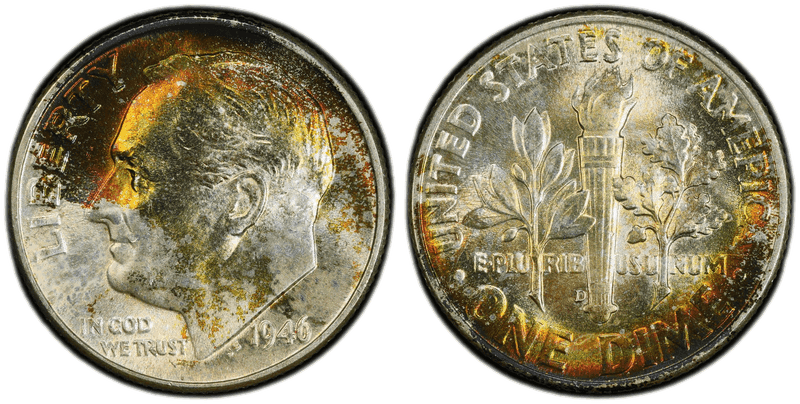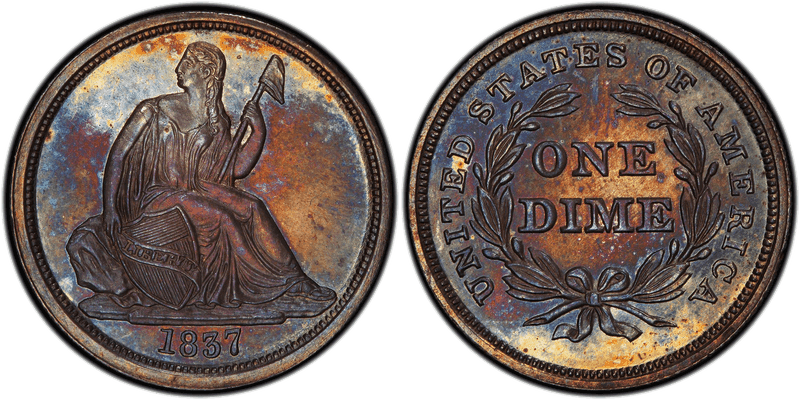
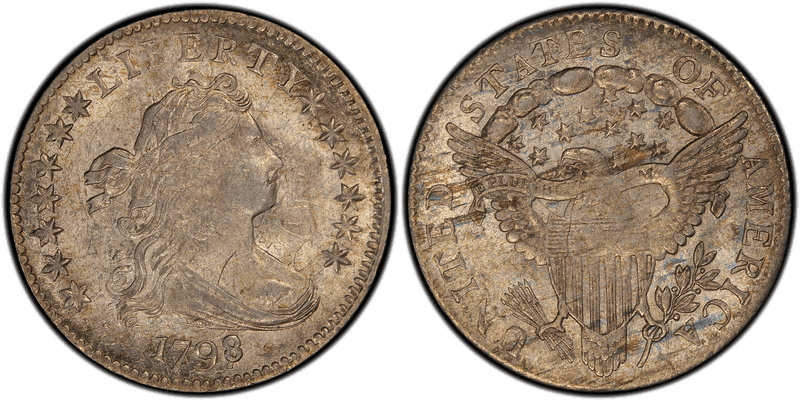
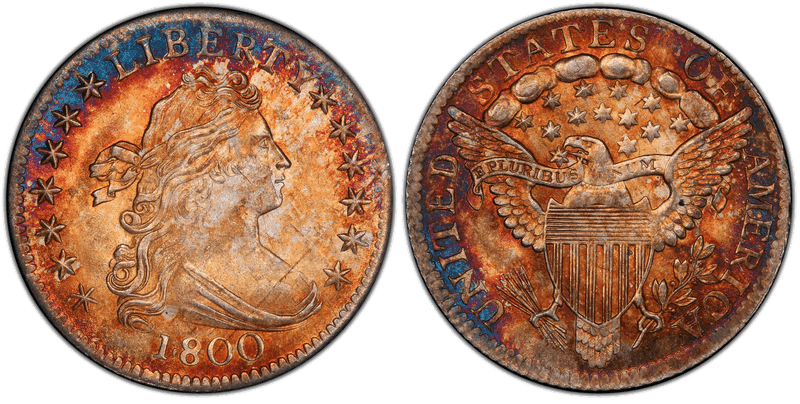
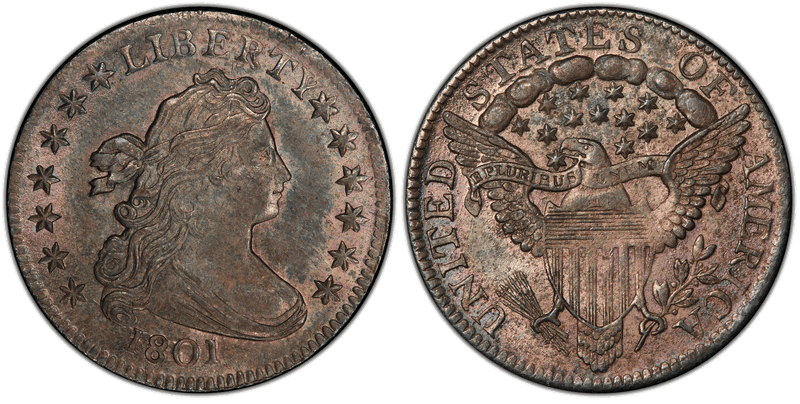
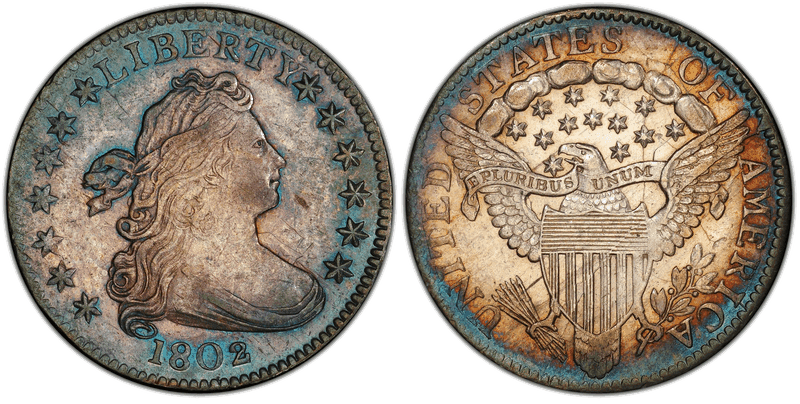
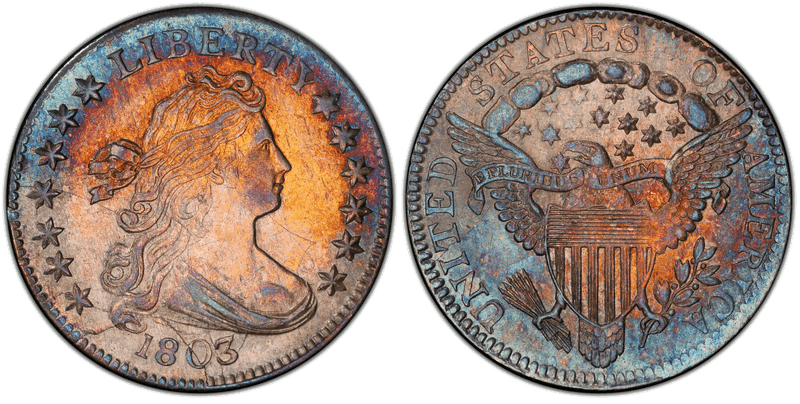
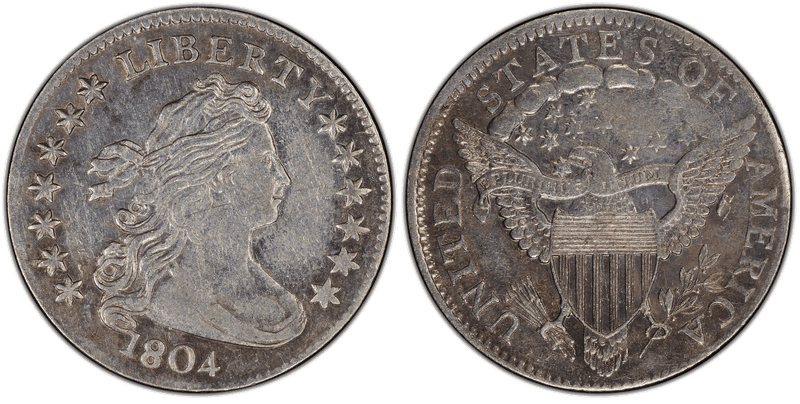
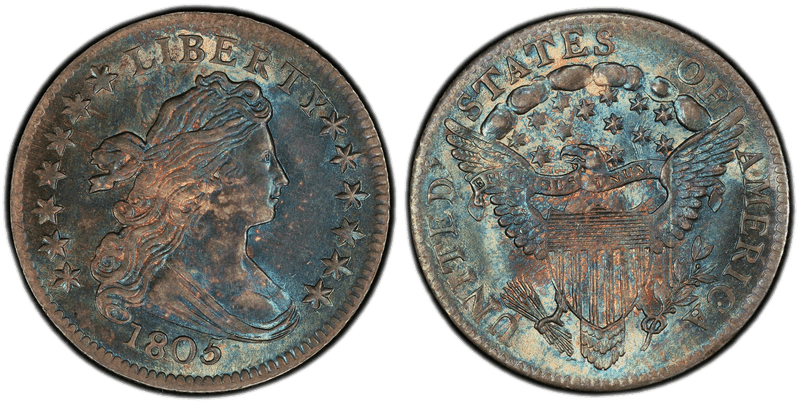
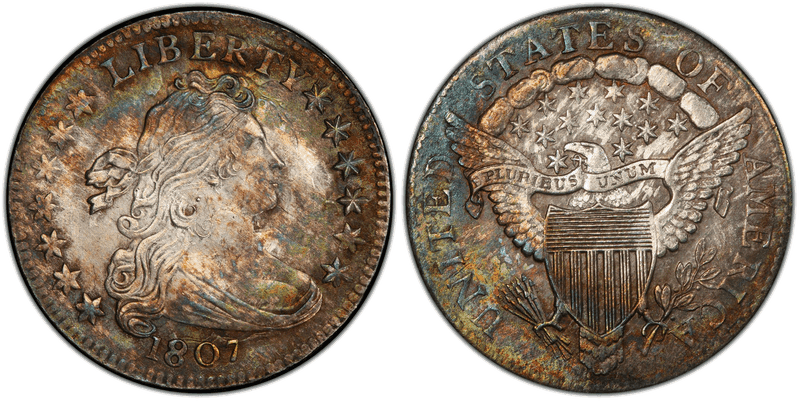
Draped Bust Dimes 1796-1807

Coin Series
Draped Bust Dimes 1796-1807 series coin

About This Series

America's first dime series emerged from Robert Scot's engraving shop at the Philadelphia Mint, placing a Draped Bust portrait of Liberty on the ten-cent piece, then the second-smallest silver denomination after the half dime. Early issues from 1796-1797 pair the portrait with a delicate Small Eagle reverse, while 1798 brought the more imposing Heraldic Eagle design that would carry the series through 1807. Draped Bust dimes carry no statement of value; the denomination first appeared on the dime as 10 C. on the Capped Bust reverse of 1809. The Mint delivered 22,135 dimes in 1796, the first year. The 1797 with 16 Stars reflects Tennessee's admission to the Union, and one 1804 reverse has 14 stars rather than 13, a die shared with an 1804 quarter eagle. Struck in .8924 fine silver at a weight of 2.70 grams, these diminutive 19mm coins circulated extensively in the cash-dependent commerce of the early republic. The series represents the foundational chapter in American dime coinage, establishing a denomination that has been struck for more than two centuries, though not in every year.

From NumisDex News

Series Information

Production Years
1796-1807
Composition
89.2% Silver, 10.8% Copper

Browse by Base(10 bases)

Showing all 10 listings

History

The Coinage Act of 1792 named the dime, spelled disme, as one tenth of a dollar. A small number of dismes were struck in 1792, some of them in copper, and they are regarded as patterns. The Mint began its silver coinage in 1794, but it did not turn to the dime until 1796. NGC dates the first delivery of dimes to January 18, 1796.

The first dimes carried the Draped Bust Liberty and small eagle that had appeared on the dollar in 1795. Robert Scot cut the dies, assisted by John Eckstein. The portrait is traditionally credited to a drawing by Gilbert Stuart of the Philadelphia hostess Ann Willing Bingham, though CoinWeek notes that no such drawing has been found and that recent research doubts Stuart's part. Since the law required a value only on the cent and half cent, the dime carried no denomination.

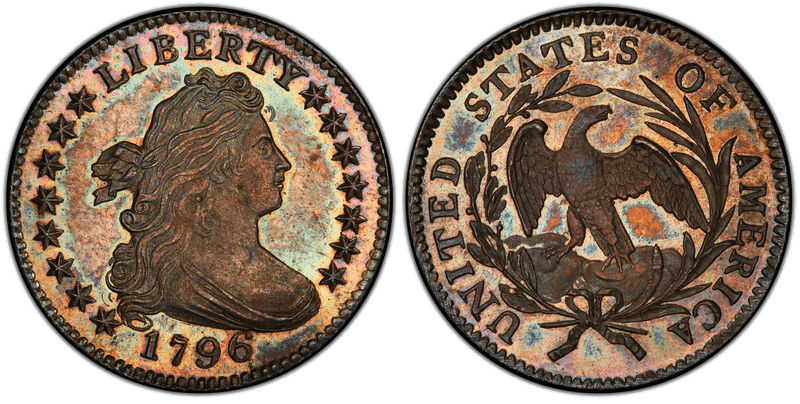
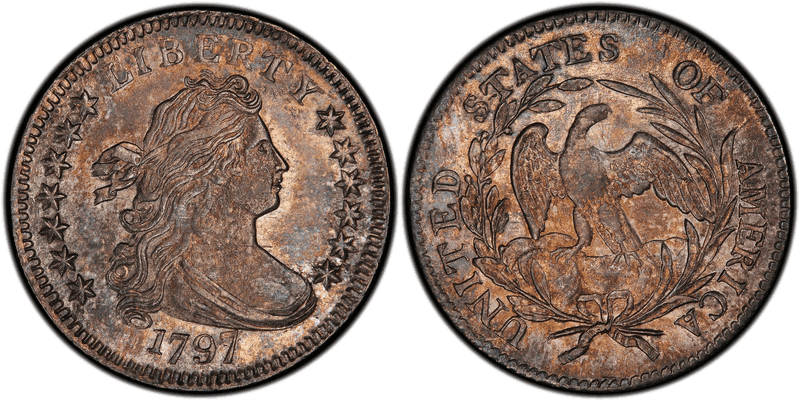
The 1796 dimes have 15 stars. After Tennessee joined the Union, the first 1797 dimes were struck from a 16-star obverse, and the rest from one with 13 stars, the number the Mint kept from then on. In 1798 Scot's Heraldic Eagle, based on the Great Seal, replaced the small eagle. Because the dime and the gold quarter eagle were nearly the same size, the Mint used reverse dies interchangeably between them, which is why some dimes show 16 or 14 stars above the eagle instead of 13.

No dimes are dated 1799 or 1806, and none were struck in 1808. The Capped Bust dime by John Reich replaced the Draped Bust in 1809.
How to Identify It

Obverse. Liberty faces right with long hair tied by a ribbon and her shoulders draped in cloth. LIBERTY is at the top and the date at the bottom, with 15 stars (1796), 16 or 13 stars (1797) or 13 stars (1798-1807).

Reverse, 1796-1797. A small eagle with raised wings stands on clouds, ringed by a palm branch and an olive branch tied with a bow. UNITED STATES OF AMERICA runs around the rim.

Reverse, 1798-1807. A heraldic eagle with a shield on its breast holds arrows and an olive branch. A ribbon reading E PLURIBUS UNUM is in its beak, with stars and an arc of clouds above.

Edge. Reeded.

Mint mark and value. Neither appears. All were struck at Philadelphia.

Things that cause confusion.

  • Draped Bust half dimes. The same designs on a smaller coin of 16.5 mm.
  • Reverse stars. Count the stars above the eagle on 1798/97 and 1804 dimes: 13 is usual, but 16 (1798/97) and 14 (1804) also occur.
  • Weak centers. Heraldic Eagle dimes are often weak at the center. NGC suggests the dies may have sunk because the Mint could not harden them evenly.

Die marriages. Attributed by JR number from Early United States Dimes 1796-1837, known to collectors as the JR book.

Key Dates and Varieties

Mintages are the Mint's calendar-year delivery figures as USA Coin Book, CoinWeek and NGC give them. NGC notes several years where they do not match the dates on the coins.

  • 1796: 22,135, the first dimes, from seven die marriages. NGC records one 1796 JR-1 dime struck as a specimen before its die cracked.
  • 1797: the reported 25,261 includes more than 10,000 dimes with a 1796 obverse. NGC reconstructs 9,099 for the 16 Stars (JR-1) and 5,918 for the 13 Stars (JR-2).
  • 1798: 27,550 for all varieties. Two use an overdated die, 1798 over 97, with a 16-star reverse first used on quarter eagles or a 13-star reverse. The others have a Small 8 (JR-3) or a Large 8 (JR-4).
  • 1800: 21,760 reported, though NGC says most 1800 dimes were delivered in 1801 and the figure may stand for 1798-dated coins.
  • 1801: 34,640 reported, including more than 9,000 dated 1800.
  • 1802: 10,975, from a single delivery on July 22, 1802, and four die marriages.
  • 1803: 33,040 reported; the JR authors estimated 10,000 to 12,000 actually dated 1803.
  • 1804: 8,265 delivered in June 1804, though the JR authors estimated about 17,000 bear the date. One obverse was paired with a 13-star reverse and a 14-star reverse shared with an 1804 quarter eagle.
  • 1805: 120,780, from deliveries in September and December. The 4 Berries reverse (JR-2) has narrow letters A, the 5 Berries (JR-1) wide ones.
  • 1807: 165,000 according to USA Coin Book and CoinWeek; NGC's delivery records give 80,000 and 95,000 pieces. All came from one pair of dies.

In Our Catalog

No errors or varieties are listed for Draped Bust Dimes 1796-1807 yet. Submit one

Mintages

Draped Bust Dimes 1796-1807 mintages by year and mint, taken from each coin's page in our catalog. Each figure opens that coin's page, which lists its varieties and errors. A dash means no figure was recorded. Where one issue was struck in more than one type, each type is listed.

YearP
1797
1798
1800
1801
1802
1803
1804
1805
1807

Composition and Silver Content

  • Composition: about 89.24% silver and 10.76% copper (NGC rounds it to .892)
  • Weight: 2.7 g, holding 0.0774 troy oz of silver (NGC)
  • Diameter: 19 mm
  • Edge: reeded
  • Designer: Robert Scot

FAQ

Why does a Draped Bust dime have no value on it?

The Coinage Act of 1792 required a statement of value only on the cent and half cent, so the early silver coins were left without one and were known by their size. The dime first carried its value, as 10C., on the Capped Bust dimes that began in 1809.

Why do 1797 dimes have either 16 or 13 stars?

The 1796 dimes carry 15 stars, one for each state. After Tennessee joined in 1796 a 16-star obverse was used for the first 1797 dimes, and then the Mint returned to 13 stars for the original states, a decision Wikipedia credits to Director Elias Boudinot. NGC links the 16-star coins (JR-1) to a delivery of 9,099 on May 26, 1797.

Why do some Heraldic Eagle dimes have 16 or 14 stars on the reverse?

The dime and the gold quarter eagle were so close in size that the Mint used the same reverse dies for both. The 16-star reverse on one 1798/97 dime had first struck 1797 quarter eagles, and the 14-star reverse on one 1804 dime was shared with an 1804 quarter eagle. The usual count above the eagle is 13.

What are JR numbers?

Die marriage numbers from Early United States Dimes 1796-1837, the reference collectors call the JR book. Each JR number names one pairing of obverse and reverse dies within a year, such as 1797 JR-1 for the 16-star dime.

Do the mintage figures match the dates on Draped Bust dimes?

Not always. The figures are the Mint's deliveries in each calendar year, and old dies stayed in use. NGC notes that the reported 1797 total includes more than 10,000 dimes struck from a 1796 obverse, that most 1800 dimes were delivered in 1801, and that the 1803 and 1804 totals do not match the coins carrying those dates.

How much silver is in a Draped Bust dime?

About 0.0774 troy ounce, according to NGC. The coins weigh 2.7 grams and are about 89.24% silver.

↑ Back to the coins: every year, mint, variety and error

Explore Other Denominations

Collector Essentials

Tools and references for building and protecting your coin collection.

As an Amazon Associate, NumisDex earns from qualifying purchases.