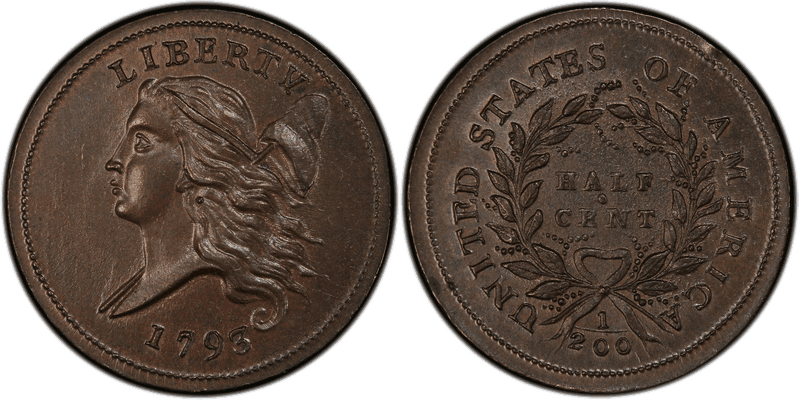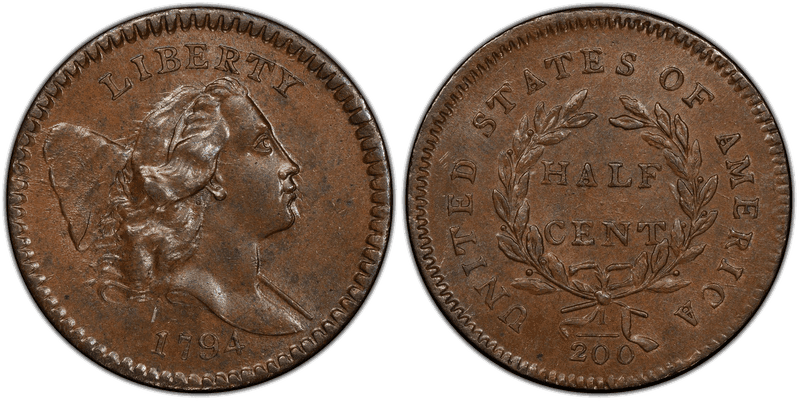
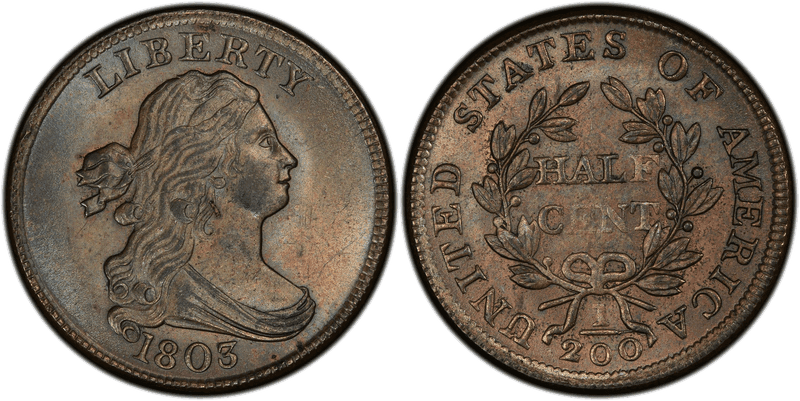
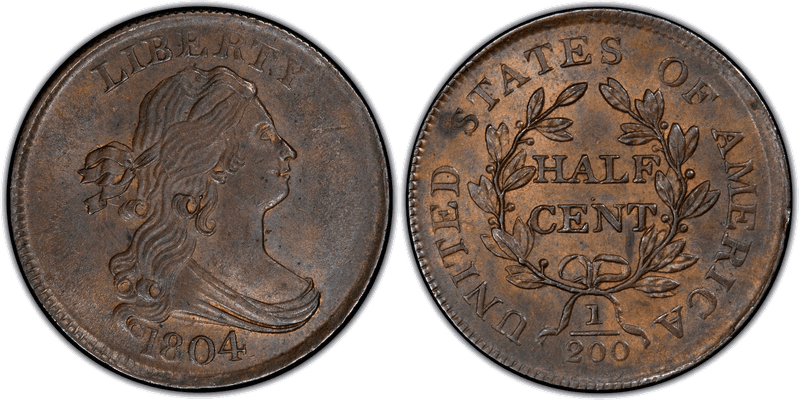
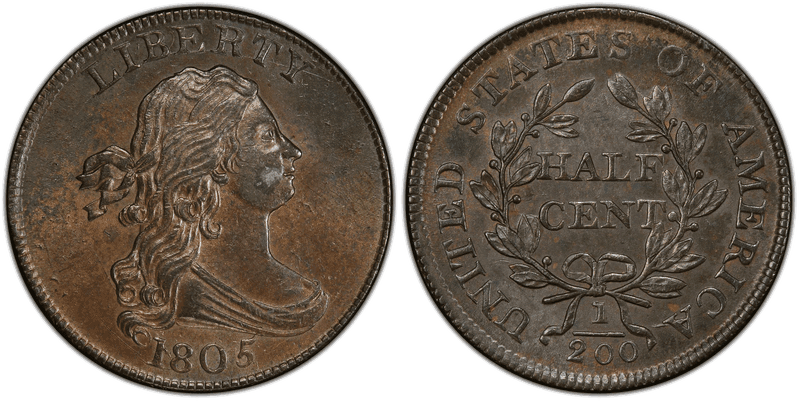
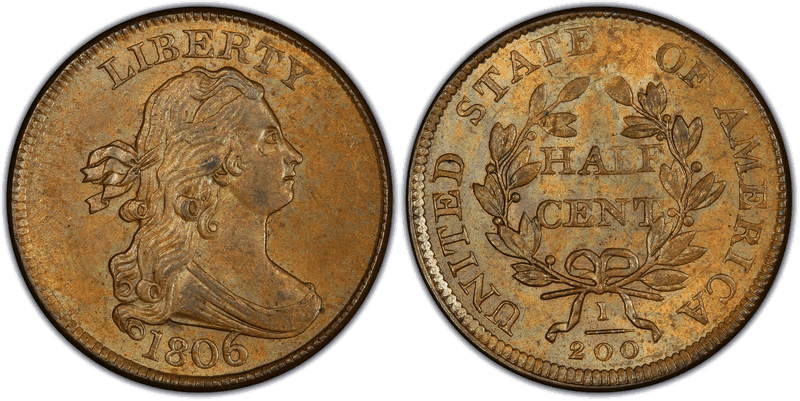
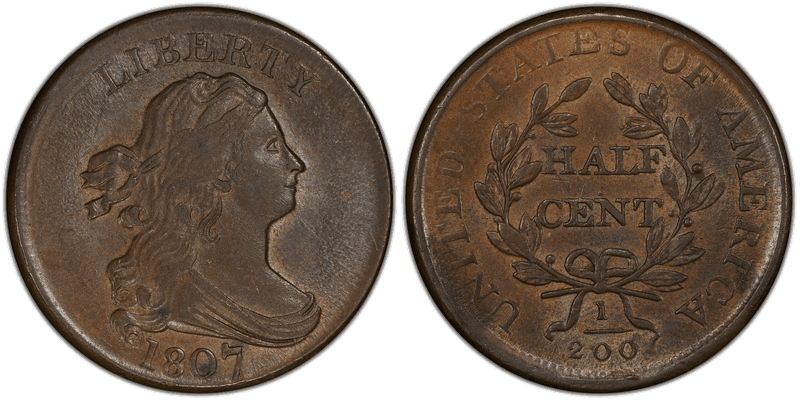
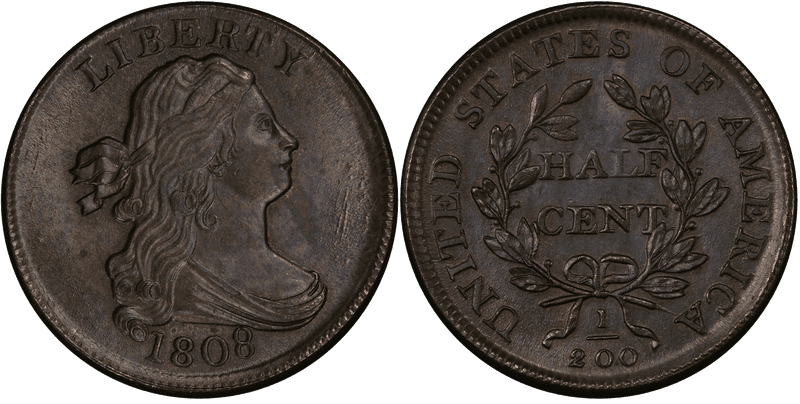
Draped Bust Half Cents 1800-1808

Coin Series
Draped Bust Half Cents 1800-1808 series coin

About This Series

Robert Scot's Draped Bust portrait, said to be adapted from a Gilbert Stuart portrait, graced the half cent denomination during a period when these tiny copper coins played a meaningful role in everyday American commerce. Production was irregular: no half cents are dated 1801, and mintages fluctuated with economic conditions and copper supply. The 1802/0 overdate comes with two reverses, and NGC believes fewer than two dozen of the Reverse of 1800 pairing exist. The 1805 dies have Small, Medium and Large 5s, while the 1804 comes in Plain 4 and Crosslet 4 types. Struck in copper at 23.5mm diameter and 5.44 grams, Draped Bust half cents circulated extensively in the early republic, where a half cent retained genuine purchasing power. The Cohen reference catalogs die varieties with characteristic thoroughness, identifying specific die marriages that attract dedicated collectors.

From NumisDex News

Series Information

Production Years
1800-1808
Composition
Copper

Browse by Base(8 bases)

Showing all 8 listings

History

Robert Scot's Draped Bust portrait was already on the cent in 1796, but it did not reach the half cent until 1800. No half cent dies had been dated 1798 or 1799; NGC says dies dated 1797 were still in use as late as 1800. Scot's Liberty is based on a portrait by Gilbert Stuart, and some accounts name the Philadelphia socialite Ann Willing Bingham as the sitter.

Most Draped Bust half cents were struck on ready-made copper blanks from Matthew Boulton's works in England; NGC says all of them from 1803 on used Boulton planchets. A few 1800 half cents were struck instead on misstruck cents cut down to size.

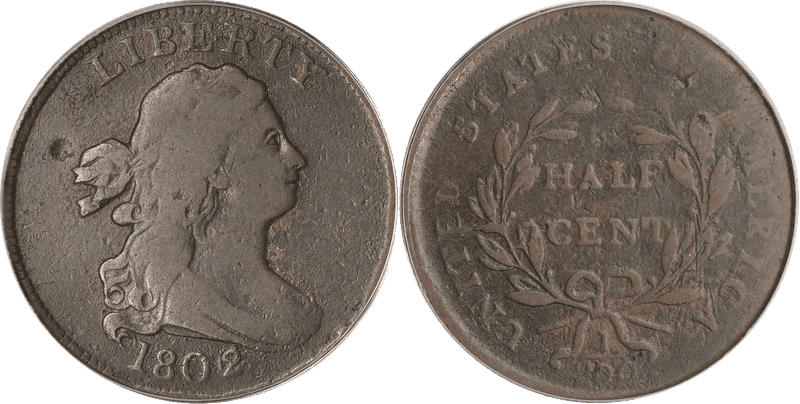
There are no half cents dated 1801. In 1802 the Mint took a leftover 1800 obverse, punched a 2 over the final 0 and paired it with two reverses, one of them an old die of the 1795 to 1797 style. The 1802/0 is the first overdate in the half cent series. Another overdate closes the series: the 1808/7. The other 1808 die was first dated just "180", and according to NGC its last digit was formed from two zeros, one stacked on the other.

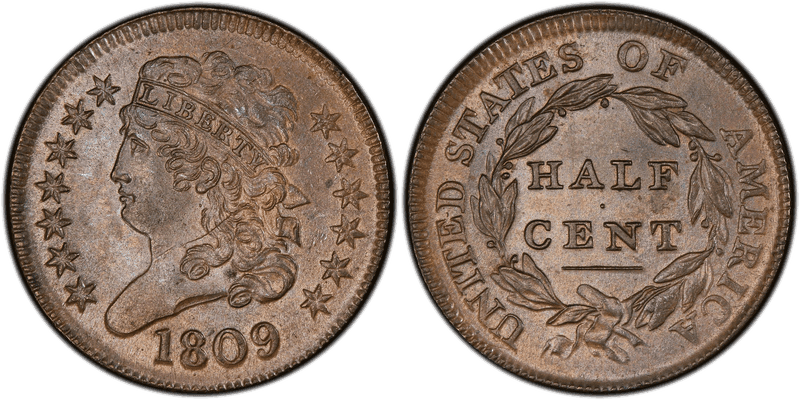
The mintage figures for these years count what the Mint delivered in each calendar year, and dies were used whatever date they carried, so the figures do not always match the coins. NGC notes that the 1807 half cents come from a single pair of dies, which it thinks could not have struck the 476,000 coins on record, and Walter Breen proposed lower net figures for 1803, 1804, 1805 and 1807. John Reich's Classic Head design replaced the Draped Bust in 1809.
How to Identify It

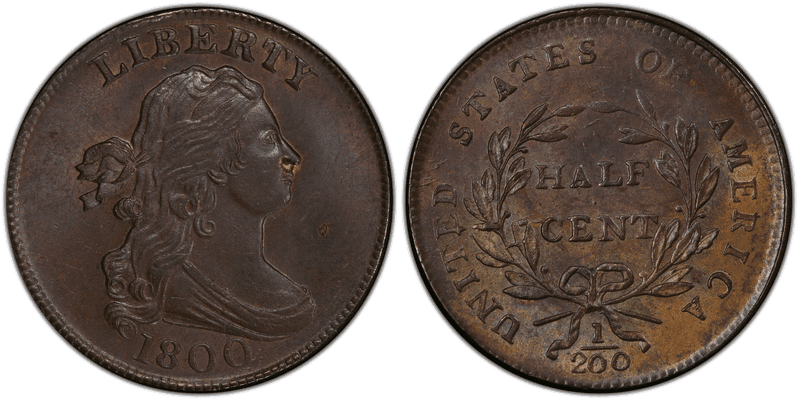
Obverse. Liberty faces right, her hair tied with a ribbon and a drape across her bust. LIBERTY is above and the date below.

Reverse. HALF CENT inside a wreath, UNITED STATES OF AMERICA around it, and the fraction 1/200 below the bow. Two details tell the reverses apart:

  • Leaves at the top right. The old style of 1795 to 1797, used for 1800 and for the 1802/0 Reverse of 1800, ends in a single leaf. The newer style ends in a pair of leaves.
  • Stems. Most dies show two stems below the bow. One die has none, and it was used for half cents dated 1804, 1805 and 1806.

Date styles. The 1804 dies have a Plain 4 or a Crosslet 4 (a 4 with a small serif on its crossbar). The 1805 dies each have a different 5, Small, Medium or Large, and the 1806 dies have a Small or Large 6.

Mint mark. None. All half cents were struck at Philadelphia.

Cohen numbers. Each die pairing has a number from Roger S. Cohen Jr.'s American Half Cents, such as C-1 for the 1802/0 Reverse of 1800. Specialists sort the series by these numbers.

Key Dates and Varieties

  • 1800: the first Draped Bust half cent, from a single pair of dies with a reverse of the 1795 to 1797 style. The usual mintage is 202,908; NGC gives 211,530.
  • 1802/0, Reverse of 1800 and 1802/0, Reverse of 1802: one overdated obverse with two reverses, Cohen 1 and Cohen 2. NGC believes fewer than two dozen of the Reverse of 1800 exist. The usual figure for 1802 is 20,266, which NGC explains as 14,366 delivered in 1802 and 5,900 struck in 1803.
  • 1803: four pairings, among them C-3 with a widely spaced 3. The figure is 92,000 in most references and 97,900 in NGC's.
  • 1804: thirteen die pairings, sorted by the 4 and by the stems: Plain 4, Stems, Plain 4, No Stems, Crosslet 4, Stems and Crosslet 4, No Stems. The Mint reported 1,055,312 half cents for 1804; Breen's net figure was 771,312 or more.
  • 1804 Spiked Chin: an obverse damaged so that a spike sticks out from Liberty's chin, used in Cohen 5 to 8. PCGS puts the damage down to a foreign object pressed into the die.
  • 1805: three obverses, each with a different 5, in four pairings: the No Stems coins have a Medium 5, and there are Small 5, Stems and Large 5, Stems. The Mint reported 814,464.
  • 1806: Small 6, No Stems, Small 6, Stems and Large 6, Stems, from four pairings. NGC says all sources agree on 356,000.
  • 1807: a single pair of dies. The published figure is 476,000; Breen's net estimate was 38,000 or more.
  • 1808/7 and 1808: two pairings share the overdated obverse; the third has the normal date with the 8 built from two zeros. The Mint reported 400,000 for 1808.

In Our Catalog

7 errors and varieties are listed for this series. Browse them by type:

Recently added

Mintages

Draped Bust Half Cents 1800-1808 mintages by year and mint, taken from each coin's page in our catalog. Each figure opens that coin's page, which lists its varieties and errors. A dash means no figure was recorded. Where one issue was struck in more than one type, each type is listed.

Composition

  • Composition: copper. Draped Bust half cents contain no silver.
  • Weight: 5.44 grams (84 grains)
  • Diameter: 23.5 mm
  • Edge: plain

The 84-grain standard dates from the reduction of December 1795 and lasted through the end of the half cent.

FAQ

Why are there no half cents dated 1798, 1799 or 1801?

No half cent dies were made with those dates. According to NGC, the Mint kept using dies dated 1797 for as late as 1800, and the next new date was 1800. The 1802 half cents were then struck from an 1800 die recut to read 1802.

What is the 1802/0 Reverse of 1800?

One of the two die pairings for 1802 (Cohen 1). Its obverse is an 1800 die overdated with a 2, and its reverse is an old die with the wreath style of 1795 to 1797, which ends in a single leaf at the upper right. NGC believes fewer than two dozen exist. The other pairing (Cohen 2) uses the newer reverse with two leaves at that spot.

What is the 1804 Spiked Chin half cent?

An 1804 obverse die that was damaged so that a spike juts out from Liberty's chin. PCGS describes the damage as a foreign object pressed into the die, and NGC says the die stayed in use for four pairings, Cohen 5 to 8.

What does "No Stems" mean on a Draped Bust half cent?

On one reverse die the stems below the wreath's bow were left off. That die was used for coins dated 1804, 1805 and 1806, so each of those dates has a No Stems variety.

How many Draped Bust half cents were made each year?

The usual figures are 202,908 for 1800, 20,266 for 1802, 92,000 for 1803, 1,055,312 for 1804, 814,464 for 1805, 356,000 for 1806, 476,000 for 1807 and 400,000 for 1808. They count what the Mint delivered each calendar year, not the date on the coins, and NGC and Walter Breen give lower or different figures for several years.

Where is the mint mark on a Draped Bust half cent?

There is none. Every half cent was struck at the Philadelphia Mint.

↑ Back to the coins: every year, mint, variety and error

Explore Other Denominations

Collector Essentials

Tools and references for building and protecting your coin collection.

As an Amazon Associate, NumisDex earns from qualifying purchases.