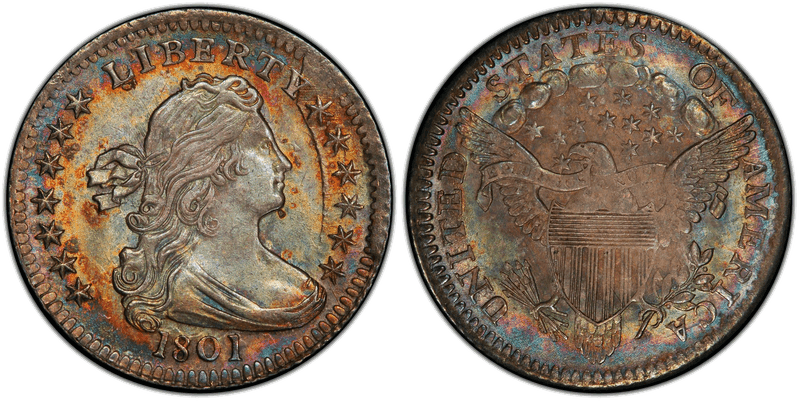
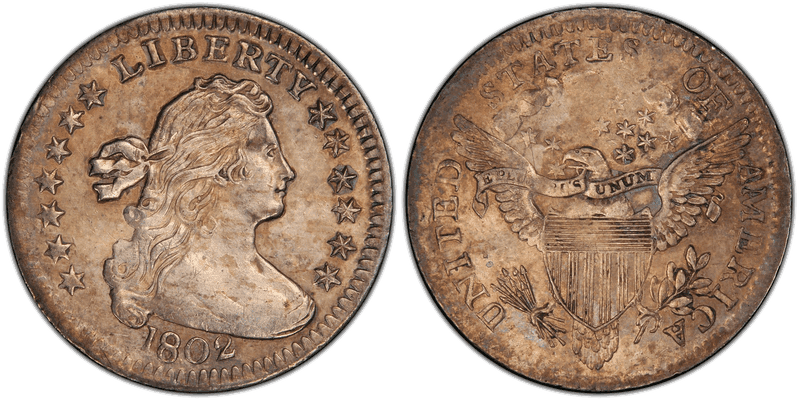
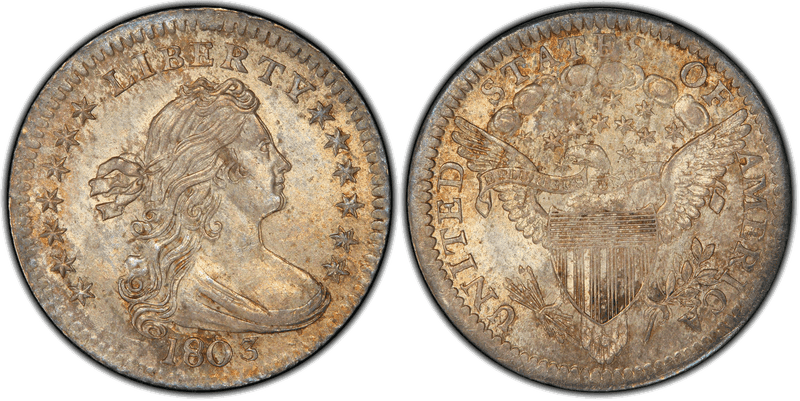
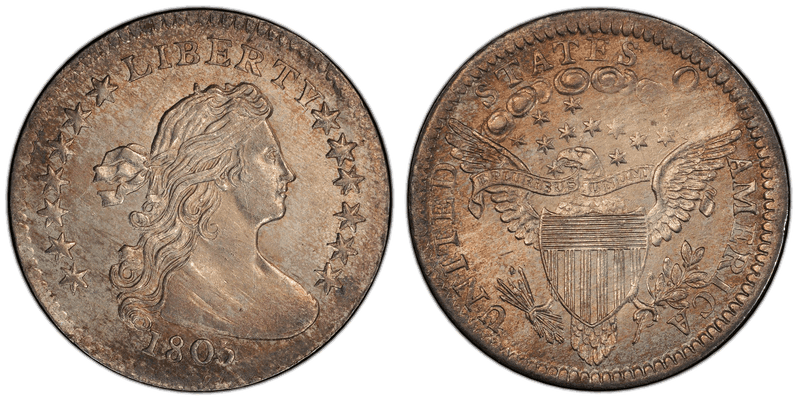
Draped Bust Half Dimes 1796-1805

Coin Series
Draped Bust Half Dimes 1796-1805 series coin

About This Series

Among the smallest silver coins produced by the early United States Mint, Draped Bust half dimes measured just 16.5mm in diameter and weighed a mere 1.35 grams — tiny coins that saw hard use in the cash-dependent commerce of the young republic. The Small Eagle reverse (1796-1797) preceded the Heraldic Eagle type (1800-1805), with no half dimes struck in 1798, 1799, or 1804. The 1802 was struck from a single pair of dies, with a recorded mintage of 3,060. The Valentine reference catalogs die varieties throughout the series, and specialists pursue these tiny coins with scholarly intensity. Struck in .8924 fine silver, these half dimes circulated as the smallest fractional silver coins available, complementing the half dollar, quarter, and dime in a decimal system still finding its footing alongside Spanish colonial coinage. The series documents the early Mint's struggle to supply the full range of denominations authorized by the Coinage Act of 1792.

From NumisDex News

Series Information

Production Years
1796-1805
Composition
89.2% Silver, 10.8% Copper

Browse by Base(7 bases)

Showing all 7 listings

History

In 1796 the Mint replaced Robert Scot's Flowing Hair with a new Liberty on every silver and copper coin. Mint Director Henry W. DeSaussure had set out to improve the designs, and the new portrait is traditionally said to follow a sketch by the painter Gilbert Stuart, with Philadelphia's Ann Willing Bingham as the model. No such sketch has been found, and CoinWeek notes that recent research doubts Stuart had a hand in it; Scot cut the dies, assisted by John Eckstein. The eagle on the reverse became smaller and sturdier and now stood inside a wreath of two kinds of branches.

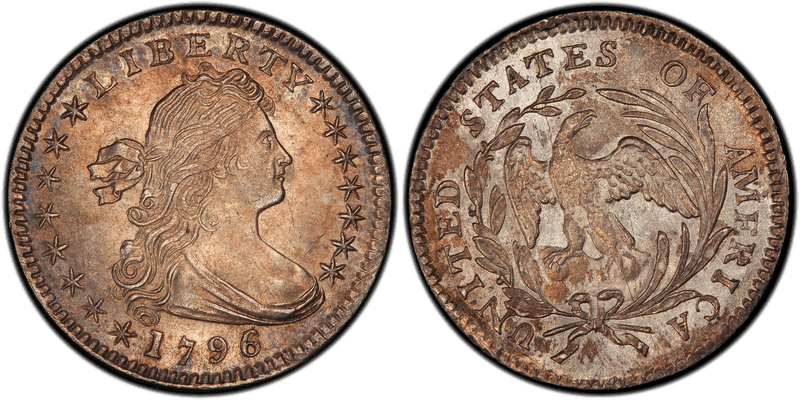
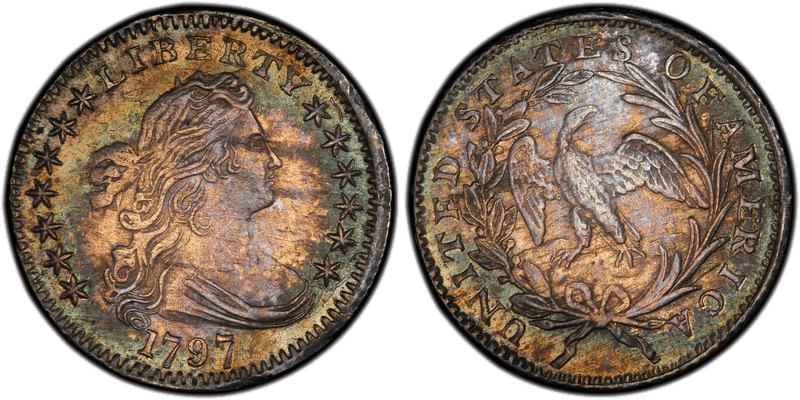
The two years of the Small Eagle type show the Mint working out how many stars to use. The 1796 coins have 15, one for each state. Dies for 1797 were made with 15 stars, then 16 after Tennessee joined the Union, and finally 13, after Director Elias Boudinot decided to honor only the original states. Of the two die pairs used for 1796, one obverse had first been dated 1795.

No half dimes were struck in 1798 or 1799. When the coin came back in 1800 it carried Scot's Heraldic Eagle, modeled on the Great Seal, which was already in use on the quarter eagle (from 1796), the eagle (from 1797) and, from 1798, the dime, the dollar and the half eagle. Output stayed small: no year's reported figure passed 40,000, none were dated 1804, and after 1805 the Mint made no more half dimes until 1829. CoinWeek reports that specialists blame weak demand from bullion depositors, limited Mint capacity, or both.

How to Identify It

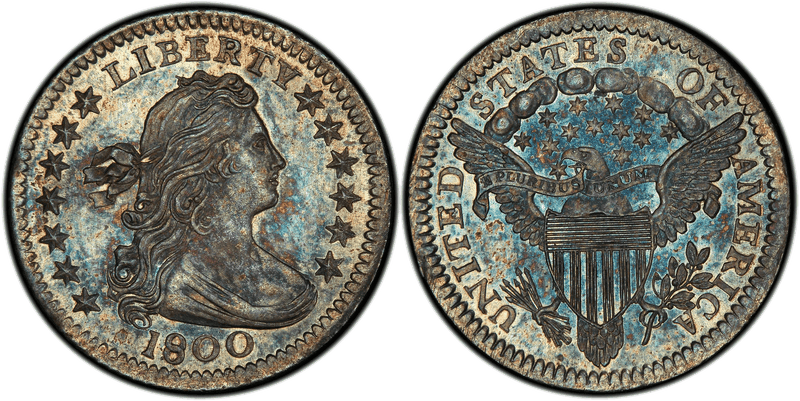
Obverse. Liberty faces right, her long hair tied with a ribbon at the back and her shoulders draped in cloth. LIBERTY is at the top and the date at the bottom, with stars on both sides: 15 on 1796 and some 1797 coins, 16 on others of 1797, and 13 on the last 1797 dies and every later year.

Reverse, 1796-1797. A small eagle with raised wings stands on clouds inside an open wreath of two branches, with UNITED STATES OF AMERICA around it.

Reverse, 1800-1805. A heraldic eagle with a shield on its breast holds an olive branch and a bundle of arrows. A ribbon in its beak reads E PLURIBUS UNUM, and 13 stars with an arc of clouds sit above its head.

Edge. Reeded.

Mint mark and value. Neither appears. All were struck at Philadelphia.

Things that cause confusion.

  • LIKERTY and LIBEKTY. These are broken letters, not misspellings in the die: the B on the 1796 dies and the R on one 1800 obverse lost parts of their bars.
  • Weak strikes. Many coins are soft where the deepest parts of the two dies face each other, such as Liberty's bust and the clouds on the reverse.
  • Draped Bust dimes. The dime of the same years has the same designs on a larger coin (19 mm against 16.5 mm).

Die marriages. Varieties are attributed by Logan-McCloskey (LM) numbers or by Daniel Valentine's older V-numbers.

Key Dates and Varieties

Mintages below are the figures USA Coin Book, CoinWeek or NGC give. They are the Mint's delivery records, which do not always match the date on the coins.

  • 1796: two die pairs, 10,230 struck in all. One is the 1796/5 overdate, from an obverse first dated 1795. The other is the LIKERTY, whose broken B reads like a K; the overdate shares that broken B.
  • 1797: 44,527 struck with three star counts, 15 Stars, 16 Stars and 13 Stars, from four die marriages.
  • 1800: the first Heraldic Eagle half dimes. The Mint's figure is 40,000 (CoinWeek); USA Coin Book divides it into 24,000 normal coins and 16,000 LIBEKTY, and NGC gives 24,000.
  • 1801: 27,760, about a third of them delivered in 1802. Both die marriages show large die failures.
  • 1802: 3,060 from a single pair of dies. The 8 in the date was made from two small zeros. NGC estimates perhaps three dozen survive.
  • 1803: 37,850 in all, with a Large 8 or a Small 8. The Small 8 obverse was used in only one of the three marriages.
  • 1805: 15,600 from one die pair, with a reverse first used in 1803.

No proof Draped Bust half dimes are known.

In Our Catalog

1 error or variety is listed for this series. Browse them by type:

Recently added

    Mintages

    Draped Bust Half Dimes 1796-1805 mintages by year and mint, taken from each coin's page in our catalog. Each figure opens that coin's page, which lists its varieties and errors. A dash means no figure was recorded. Where one issue was struck in more than one type, each type is listed.

    YearP
    1796
    1797
    1800
    1801
    1802
    1803
    1805

    Composition and Silver Content

    • Composition: about 89.24% silver and 10.76% copper (NGC rounds it to .892)
    • Weight: 1.35 g, holding 0.0387 troy oz of silver (NGC)
    • Designer: Robert Scot
    • Diameter: 16.5 mm
    • Edge: reeded

    FAQ

    What is the difference between the Small Eagle and Heraldic Eagle half dimes?

    The half dimes of 1796 and 1797 show a small eagle standing on clouds inside a wreath of two branches. When half dimes returned in 1800 the reverse carried a heraldic eagle taken from the Great Seal, with a shield on its breast, arrows and an olive branch in its claws, a motto ribbon in its beak, and stars and clouds above its head. The obverse is the same Draped Bust on both.

    Why do 1797 half dimes have 13, 15 or 16 stars?

    The Mint had been adding a star for each new state. The first 1797 dies had 15, a 16th was added for Tennessee, and then Mint Director Elias Boudinot settled on 13 stars for the original states, since each new state would have crowded the coin further. NGC says the dies were made in that order.

    What are the LIKERTY and LIBEKTY half dimes?

    Both come from broken letter punches. On the 1796 LIKERTY coins most of the top and bottom bars of the B are missing, so it reads like a K. On the 1800 LIBEKTY coins the R did not fully form and looks like a K. Neither die was cut with a K.

    Why are there no half dimes dated 1798, 1799 or 1804?

    The Mint struck none in 1798 and 1799, and no half dimes bear the date 1804. CoinWeek notes that specialists blame low demand from silver depositors, limited Mint capacity, or both. After 1805 the denomination stopped until 1829.
    How many 1802 half dimes were made?

    The figure usually given is 3,060, all struck from a single pair of dies. NGC estimates perhaps three dozen survive, most of them worn or damaged, and PCGS estimates about 35, according to CoinWeek.

    Does a Draped Bust half dime have a mint mark or a value on it?

    Neither. Every Draped Bust half dime was struck at Philadelphia, and the coins carry no statement of value.

    ↑ Back to the coins: every year, mint, variety and error

    Explore Other Denominations

    Collector Essentials

    Tools and references for building and protecting your coin collection.

    As an Amazon Associate, NumisDex earns from qualifying purchases.