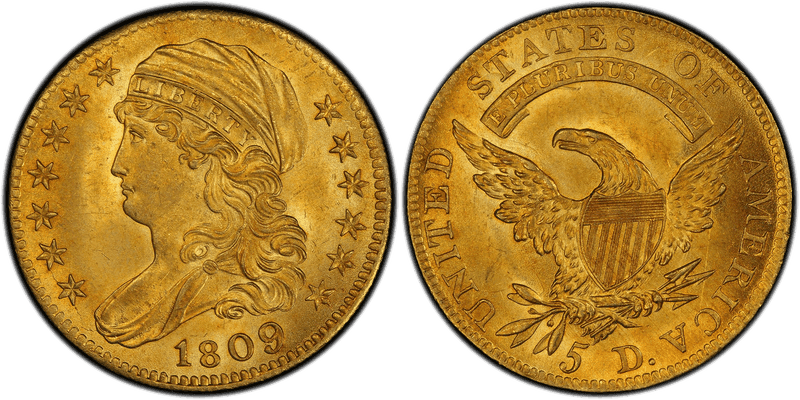
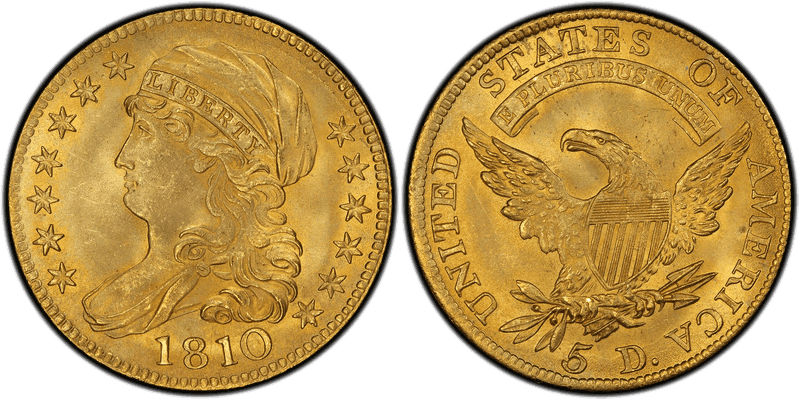
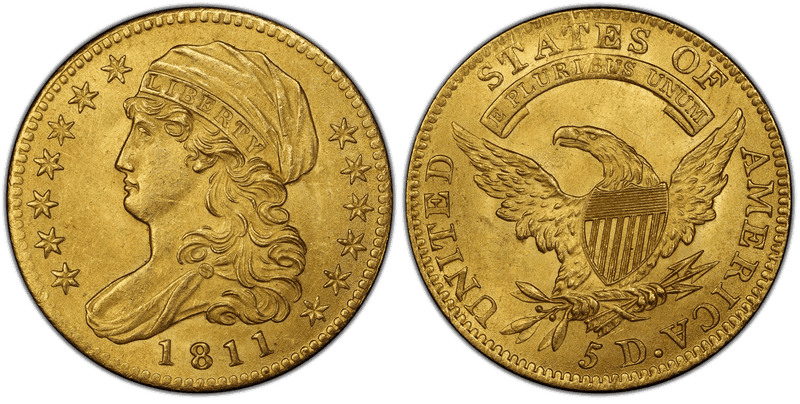
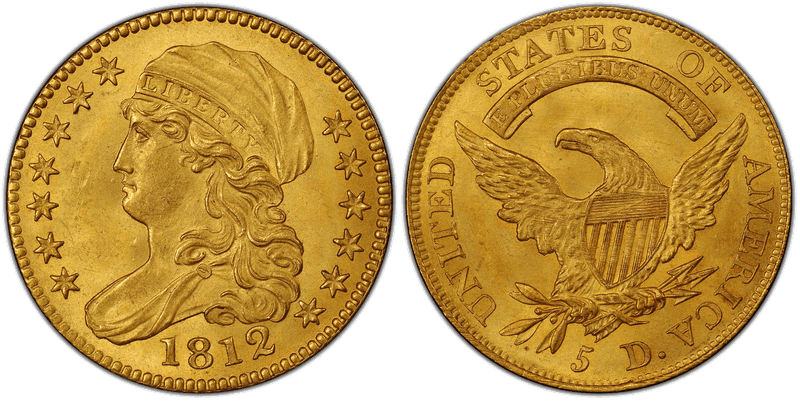
Draped Bust to Left Half Eagles 1807-1812

Coin Series
Draped Bust to Left Half Eagles 1807-1812 series coin

About This Series

Representing John Reich's reimagining of America's primary gold denomination, the Draped Bust to Left Half Eagle introduced the Capped Bust style that became standard across multiple denominations. Liberty faces left wearing a mob cap with ribbon, her bust draped in classical fashion — a departure from Robert Scot's earlier rightward orientation. The heraldic eagle reverse with shield, olive branch, and arrows continued with modest modifications. This compact six-year series produced coins that circulated widely in both domestic commerce and international trade, particularly with the Caribbean and South America. On the 1808/7 overdate, remnants of an underlying 7 show that an 1807 die was re-dated, a common Mint economy measure. The 1812 final year transitions toward the design modifications that would characterize subsequent Capped Head Left issues. Struck in .9167 fine gold at 8.75 grams, these coins document the early republic's evolving gold coinage during a period encompassing the Embargo Act and the War of 1812.

Series Information

Production Years
1807-1812
Composition
91.7% Gold, 8.3% Silver and Copper

Browse by Base(6 bases)

Showing all 6 listings

History

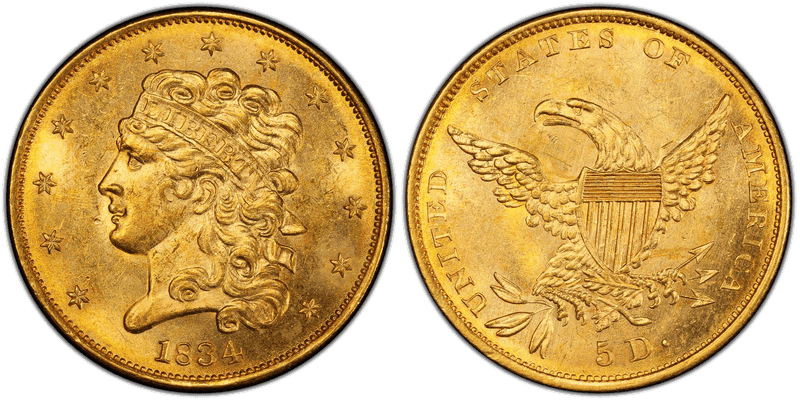
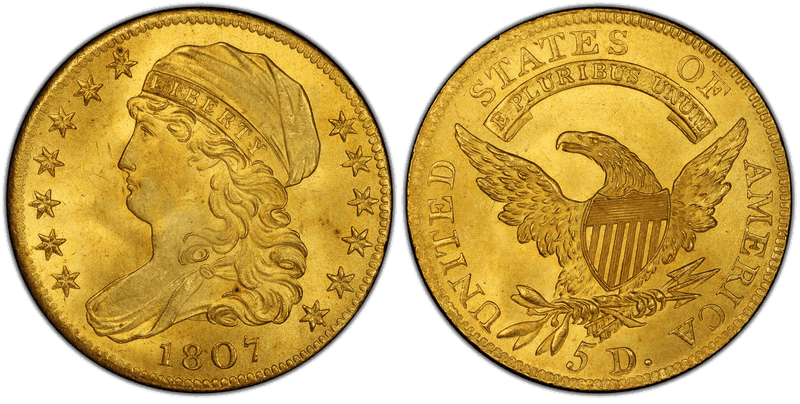
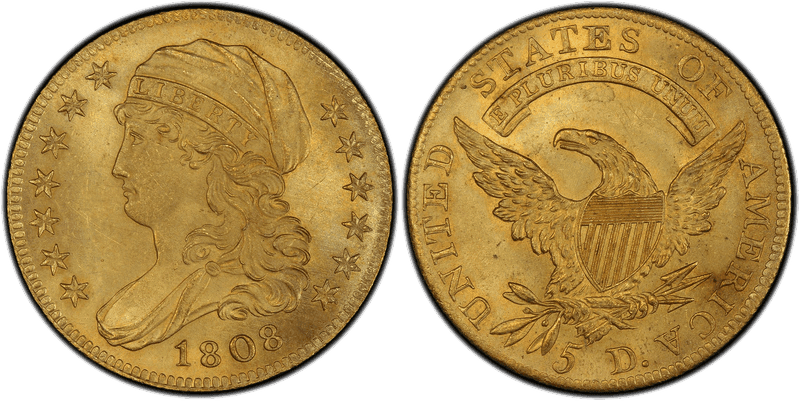
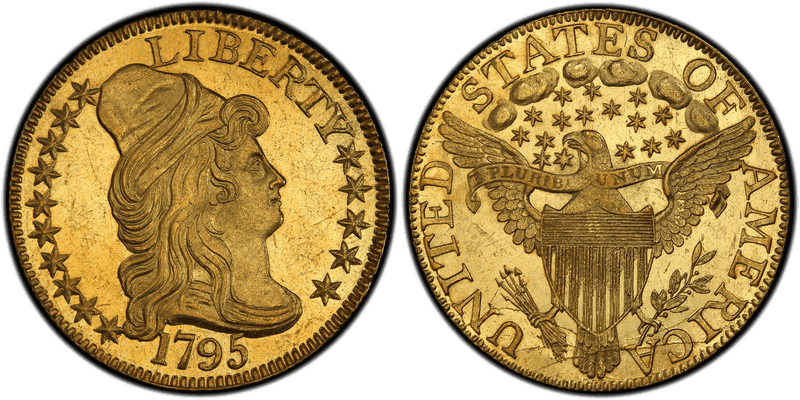
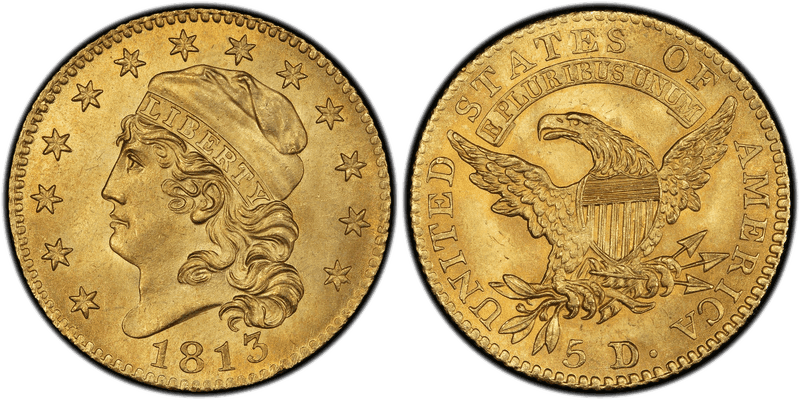
In 1807 the Mint replaced Robert Scot's Capped Bust to Right half eagle with a new design by John Reich. Reich turned Liberty to the left, put her in a soft cap bound by a band lettered LIBERTY and wrapped her shoulders in drapery. On the reverse he kept a shield-breasted eagle holding an olive branch and arrows, set the motto E PLURIBUS UNUM on a banner above it and, for the first time on a half eagle, added the value: 5 D. Half eagles dated 1807 exist in both designs.

The coin kept the weight and fineness of 1795, 8.75 grams of .9167 gold. Over six years the Mint reported from 33,875 half eagles (1809) to 100,287 (1810) a year. The eagle had not been struck since 1804, and the quarter eagle was coined only in 1808, so the half eagle carried nearly all of the country's gold coinage. Old dies were again pressed into service. The 1808/7 comes from a die first dated 1807, and the 1809 has long been catalogued as 1809/8, though current study suggests the figure beneath may be a mispunched 9.

The type ended in 1812, as war with Britain began. Walter Breen recorded a small group of Mint State 1812 half eagles that seems to come from an old hoard, and some experts think part of the 1813 deliveries came from dies dated 1812. In 1813 Reich reworked the portrait into the larger Capped Head, cutting the bust back to the neck.
How to Identify It

Obverse. Liberty faces left in a soft cap with a band lettered LIBERTY, curls showing beneath it and a drape across her bust. Thirteen stars surround her, seven on the left and six on the right, with the date below.

Reverse. An eagle with spread wings and a shield on its breast holds an olive branch and three arrows, with E PLURIBUS UNUM on a banner above, UNITED STATES OF AMERICA around and 5 D. below.

Mint mark. None. Every coin was struck at Philadelphia.

Things that cause confusion.

  • Capped Bust to Right, 1807. The 1807 Capped Bust to Right half eagle shows Liberty facing right and has no value on the reverse.
  • Capped Head, from 1813. On the Capped Head half eagles the portrait is larger and ends at the neck, without the drapery.
  • The name. The Guide Book calls this type the Capped Bust to Left; it is also called the Capped Draped Bust or Draped Bust half eagle.

Key Dates and Varieties

  • 1807: 51,605 struck with Reich's design, the first year.
  • 1808: the 1808/7 and the normal date, 55,578 for the year together. David Akers judged that at least three quarters of them were normal-date coins.
  • 1809/8: 33,875 reported, all from one pair of dies (BD-1). Dannreuther suggested that only part of that figure was dated 1809.
  • 1810: four combinations of date size and the size of the 5 in 5 D.: Small Date, Tall 5 (BD-1), Small Date, Small 5 (BD-2), Large Date, Small 5 (BD-3) and Large Date, Large 5 (BD-4). The Mint reported 100,287 for the year; Coin World puts the Small Date, Small 5 and Large Date, Small 5 at about five known each.
  • 1811: Small 5 (BD-2) and Tall 5 (BD-1), 99,581 for the year (USA Coin Book prints 99,580).
  • 1812: 58,087 reported, from two die pairings, the last year of the design.

In Our Catalog

2 errors and varieties are listed for this series. Browse them by type:

Recently added

    Mintages

    Draped Bust to Left Half Eagles 1807-1812 mintages by year and mint, taken from each coin's page in our catalog. Each figure opens that coin's page, which lists its varieties and errors. A dash means no figure was recorded. Where one issue was struck in more than one type, each type is listed.

    YearP
    1807
    1808
    1809
    1810
    1811
    1812

    Composition and Gold Content

    • Weight: 8.75 grams
    • Composition: .9167 gold, the balance silver and copper
    • Gold content: about 0.258 troy ounce
    • Diameter: about 25 mm
    • Edge: reeded
    • Designer: John Reich

    FAQ

    Why are there two kinds of 1807 half eagle?

    The design changed that year. Half eagles dated 1807 exist with Robert Scot's Capped Bust to Right design and with John Reich's new design, Liberty facing left. The Guide Book gives 32,488 for the first and 51,605 for the second.

    Is this type called Draped Bust or Capped Bust?

    Both names are used. The Guide Book calls it the Capped Bust to Left, other references the Capped Draped Bust or Draped Bust; Liberty wears a cap and a draped gown at the shoulder, which separates it from the Capped Head design that followed in 1813, where the bust is cut back to the neck.

    Is the 1809 half eagle an overdate?

    It is traditionally called the 1809/8, and every 1809 half eagle comes from the one obverse die. CoinWeek notes that more recent study suggests the digit under the 9 may be an earlier, misplaced 9 rather than an 8; John Dannreuther raised that possibility.

    What are the 1810 half eagle varieties?

    Four obverse and reverse combinations, each with its own Bass-Dannreuther number - Small Date with Tall 5 (BD-1), Small Date with Small 5 (BD-2), Large Date with Small 5 (BD-3) and Large Date with Large 5 (BD-4). The 5 is the one in 5 D. on the reverse. The Mint reported 100,287 half eagles for 1810 without dividing them.

    How much gold is in a Draped Bust to Left half eagle?

    The coin weighs 8.75 grams at .9167 fine, the rest silver and copper, so it holds about 0.258 troy ounce of pure gold. It is about 25 mm across.

    ↑ Back to the coins: every year, mint, variety and error

    Explore Other Denominations

    Collector Essentials

    Tools and references for building and protecting your coin collection.

    As an Amazon Associate, NumisDex earns from qualifying purchases.