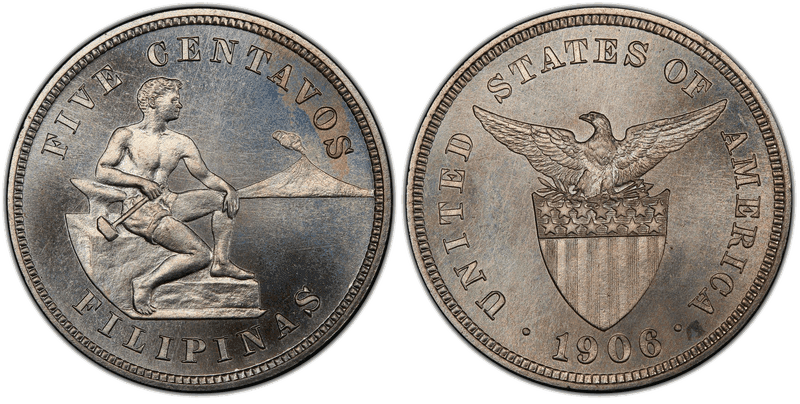
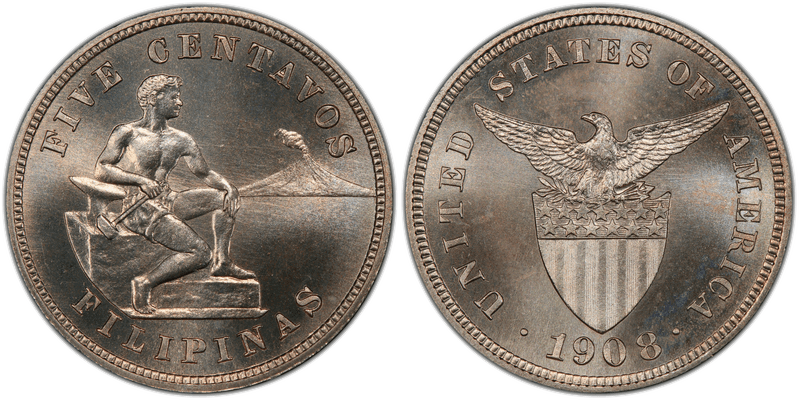
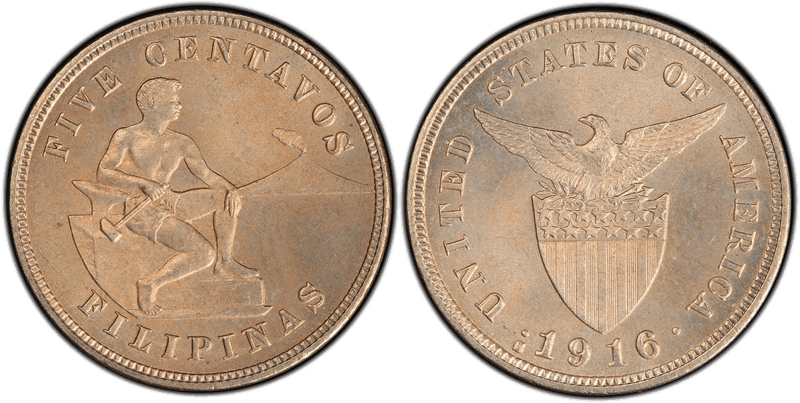
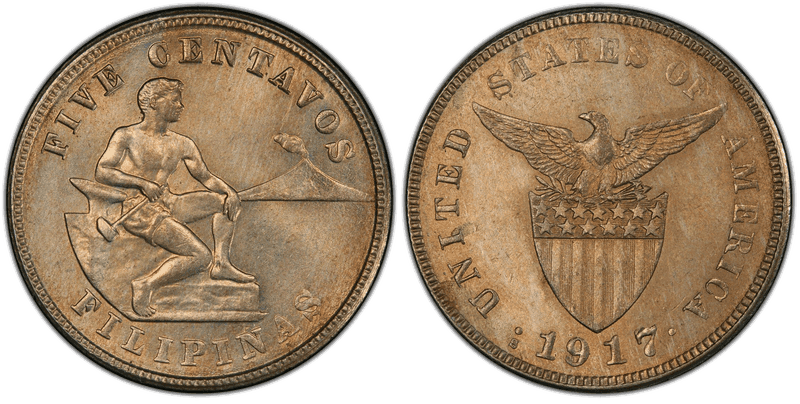
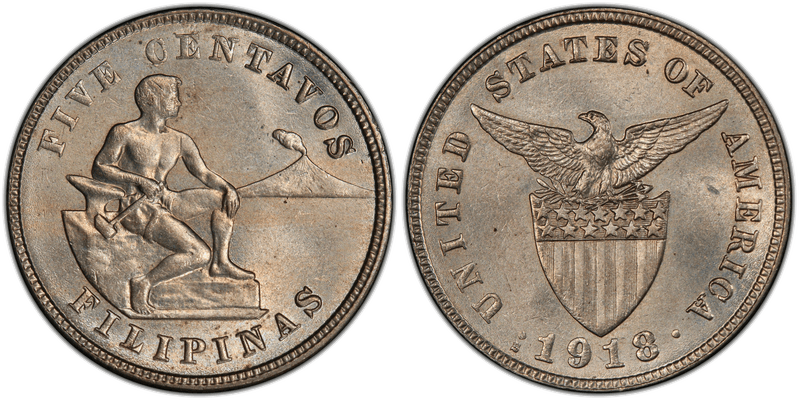
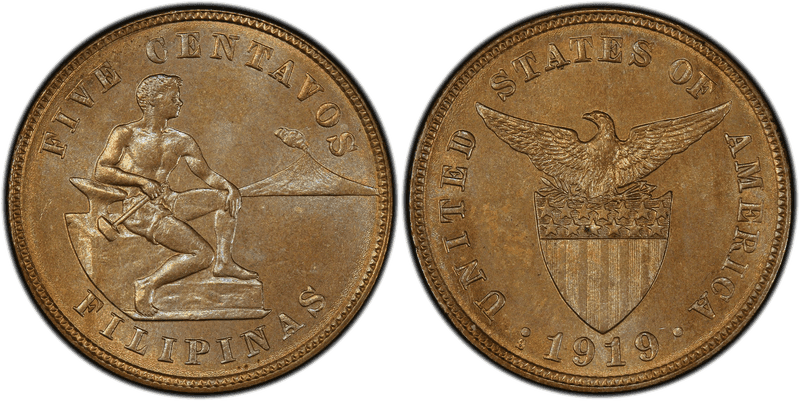
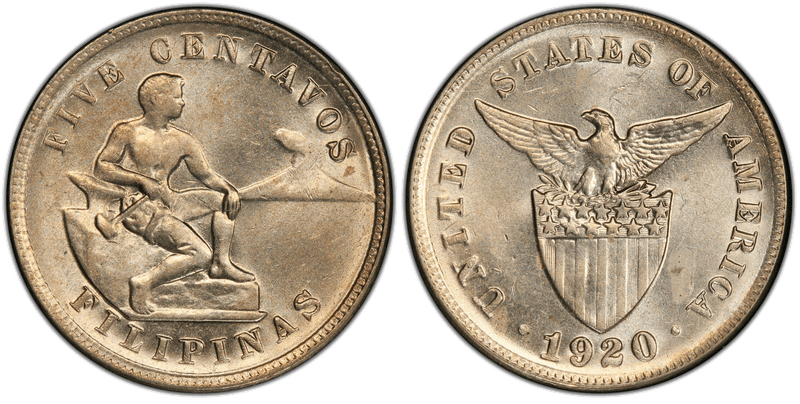
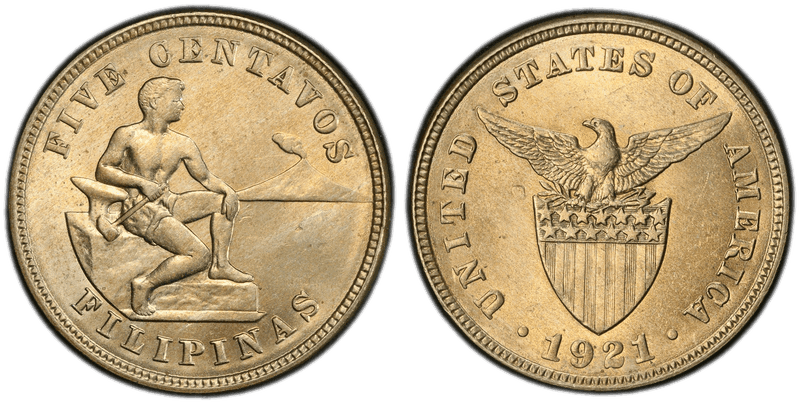
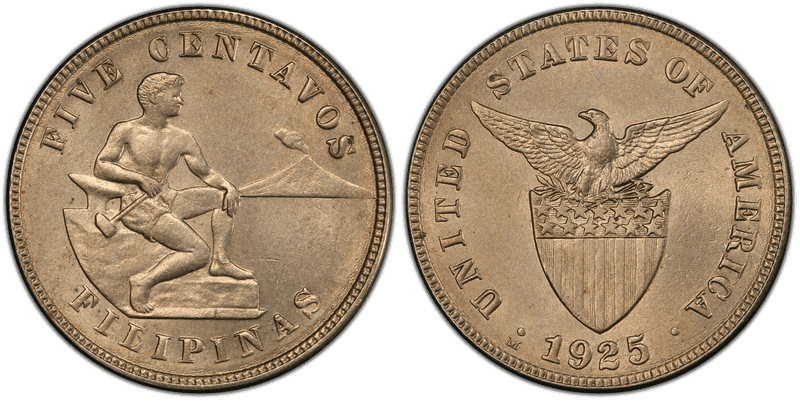
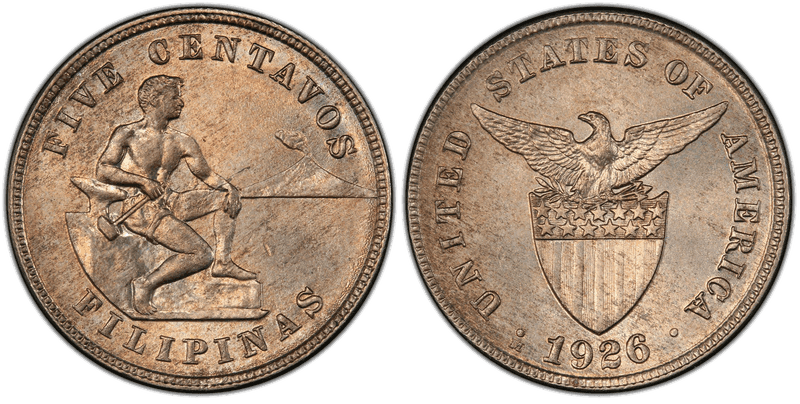
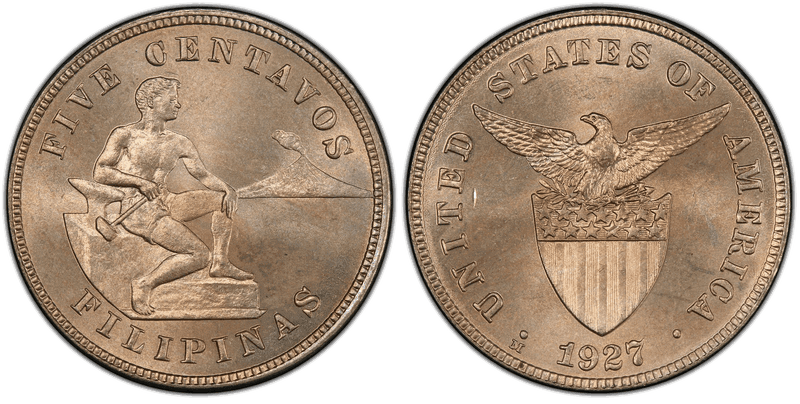
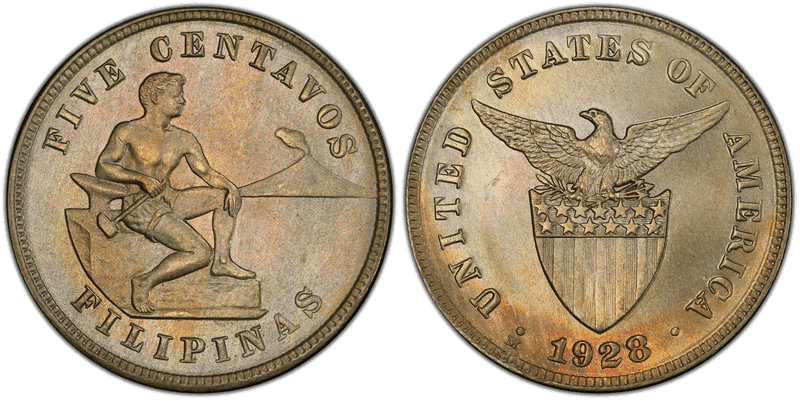
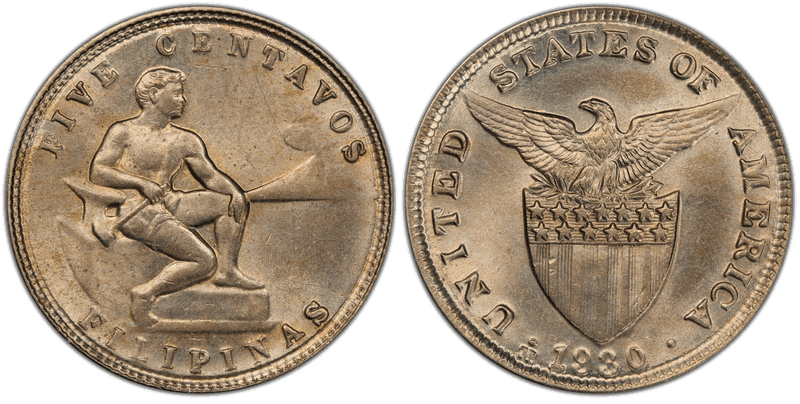
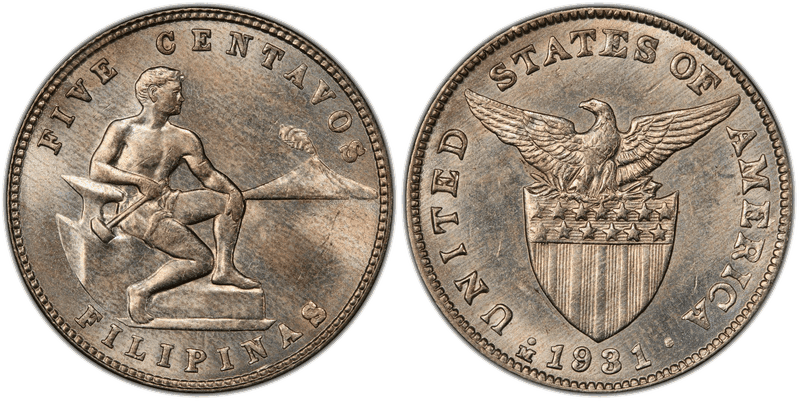
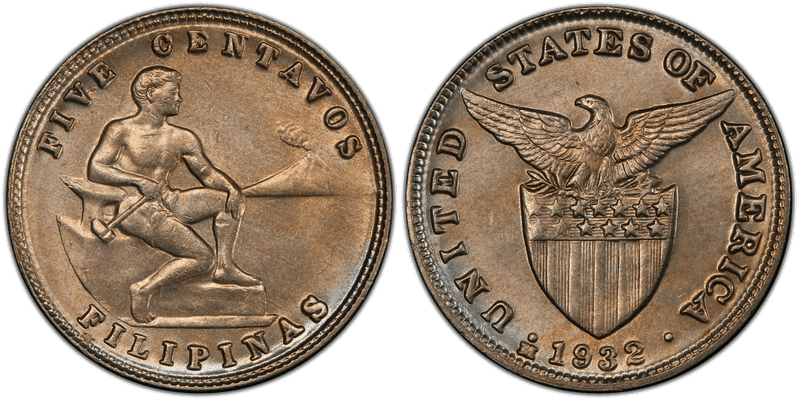
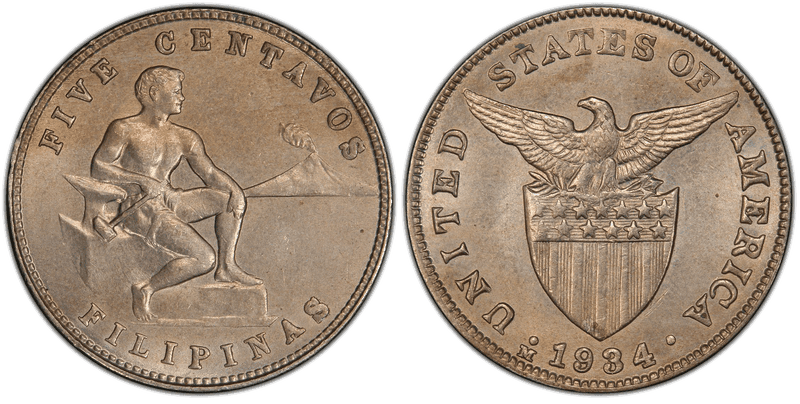
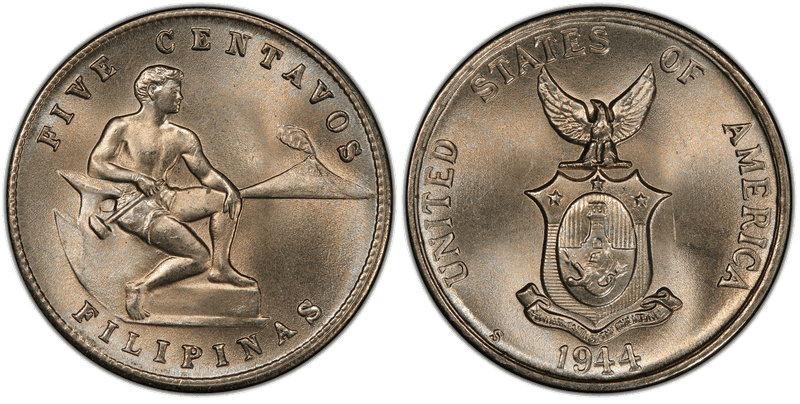
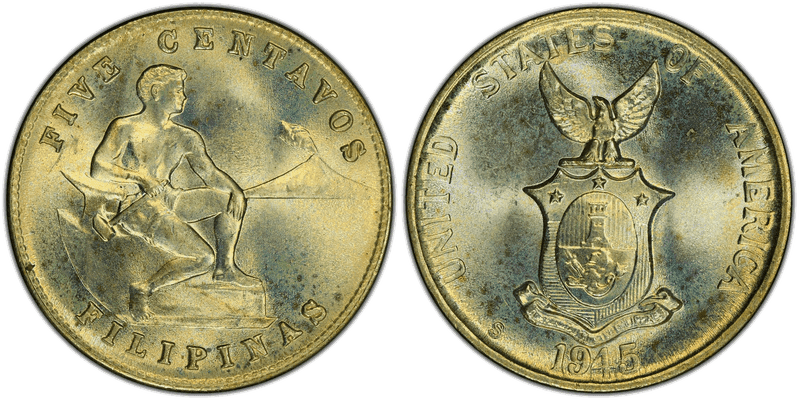
Philippines Five Centavos 1903-1945

Coin Series
Philippines Five Centavos 1903-1945 series coin

About This Series

The five centavos of the Philippines under United States administration was struck from 1903 to 1945, first in copper-nickel at about 20.5 mm, from 1930 in a smaller size, from 1937 with the Commonwealth arms on the reverse, and in 1944-1945 in a copper, zinc and nickel alloy. Philadelphia struck the coins of 1903-1904, the proofs and the 1944 coinage, San Francisco those of 1916-1919 and 1944-1945 with an S, and the Manila Mint those of 1920-1921 without a mint mark and of 1925-1941 with an M.

Browse by Base(25 bases)

Showing all 25 listings

History

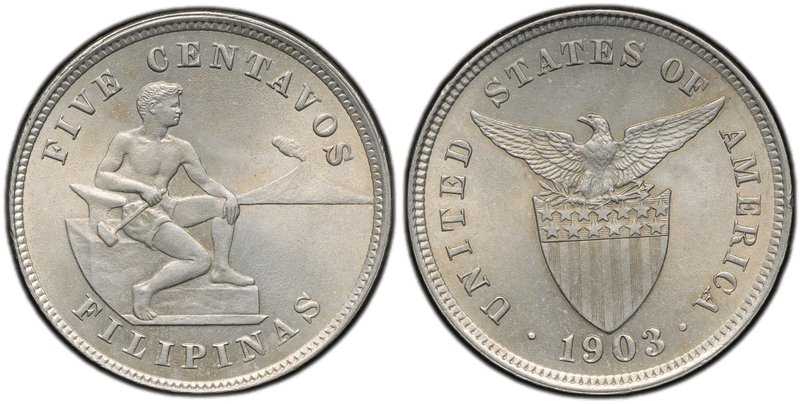
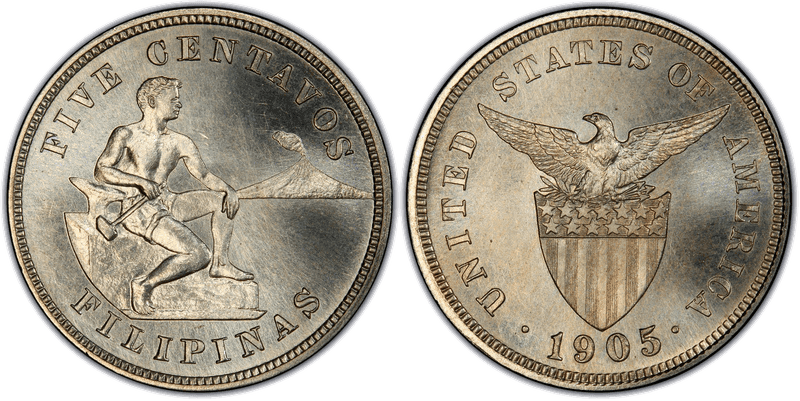
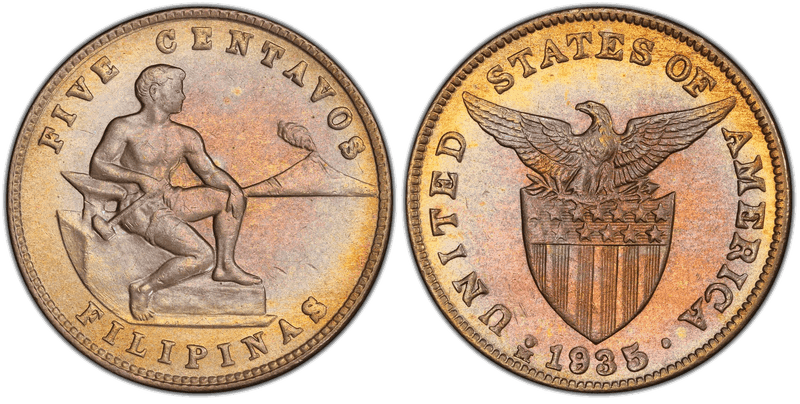
The five centavos was the copper-nickel coin of the Philippine coinage that Congress set up on March 2, 1903, and it carried the same pictures as the centavo: Melecio Figueroa's young man at the anvil with Mount Mayon behind him, and the American eagle on the United States shield. Philadelphia struck business coins dated 1903 and 1904 and the proofs for the sets of 1903 to 1908; the 1905, 1906 and 1908 dates are proofs only. No five centavos were then made for circulation until 1916.

San Francisco, which could coin the islands' base-metal pieces from 1908, made the five centavos of 1916 to 1919, each with an S. The Mint's calendar-year records give 300,000 for 1916, 2,300,000 for 1917, 2,780,000 for 1918 and 1,220,000 for 1919. Among the 1918 coins is the mule struck with a twenty-centavo reverse. The Manila Mint took over in 1920; its 1920 and 1921 coins have no mint mark, and those of 1925 to 1928 carry an M.

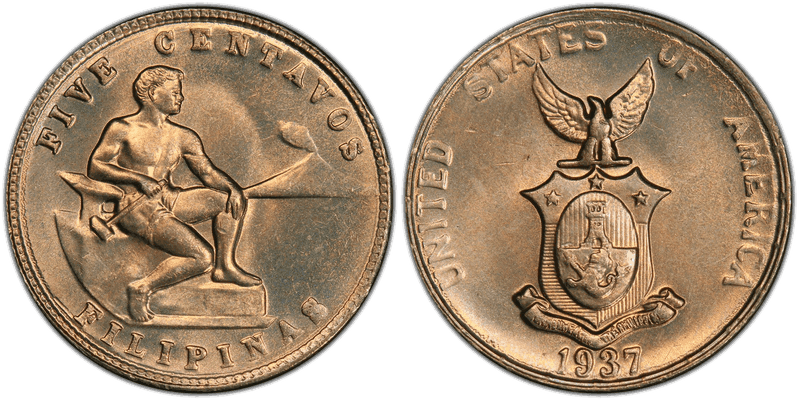
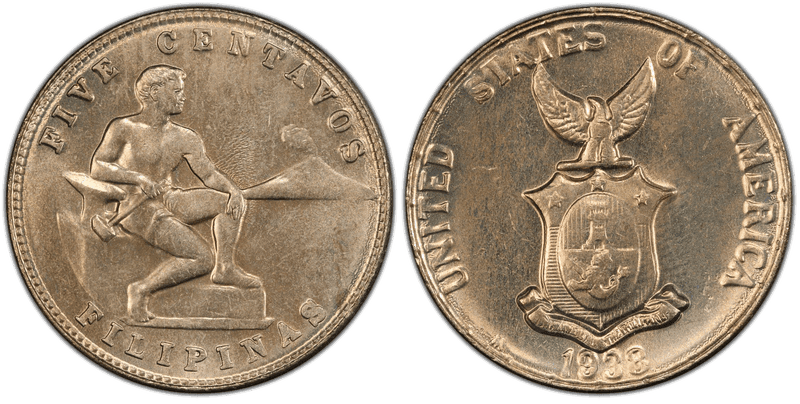
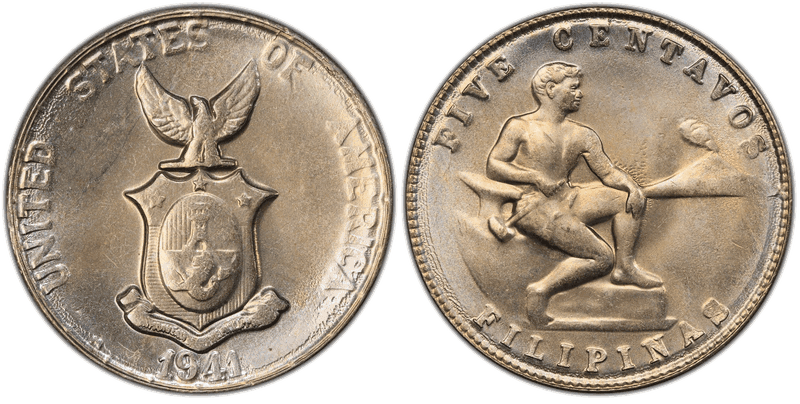
In 1930 Manila reduced the coin to about 19 mm and struck the smaller type through 1935. The Commonwealth arms replaced the eagle on the reverse in 1937, and Manila struck that type in 1937, 1938 and 1941. After Manila fell, the 1944 and 1945 five centavos were struck in the United States, at Philadelphia without a mint mark and at San Francisco with an S, in a new alloy of copper, zinc and nickel.
How to Identify It

Obverse. The same seated youth with hammer and anvil as on the centavo, the volcano behind; FIVE CENTAVOS is above and FILIPINAS beneath.

Reverse. Through 1935, an eagle on the United States shield inside UNITED STATES OF AMERICA, with the date below. From 1937, the arms of the Commonwealth of the Philippines.

Size. Coins of 1903 to 1928 are the large type, about 20.5 mm in the Red Book table (Krause gives 21.3 mm). Coins from 1930 on are about 19 mm.

Mint mark. Check the reverse beside the date, on its left: an S means San Francisco and an M means Manila. A coin without a letter is from Philadelphia if dated 1903-1908 or 1944, and from Manila if dated 1920 or 1921.

Key Dates and Varieties

  • 1903 and 1904: the only Philadelphia business strikes before 1944, with proofs for both years; the 1905, 1906 and 1908 dates exist as proofs only (500 each for 1906 and 1908; Krause gives 471 for 1905).
  • 1916-S: 300,000 struck, by the Mint's record for 1916.
  • 1918-S mule (Allen-4.08b, FS-901): the five-centavo obverse with a twenty-centavo reverse. The date on the mule is smaller than on the regular five-centavo reverse, and Heritage (search) notes a wider rim and a larger eagle. The same year has a repunched S die, FS-501, numbered Allen-4.08aa in an NGC registry list and Allen-4.08a by Greysheet.
  • Manila without a mint mark: 1920 and 1921.
  • 1930-M: the first of the reduced size.
  • 1934-M doubled die: PCGS lists this die as Allen-5.04aa ("DDO & RP1"): the doubling shows on AMERICA and the 1 of the date is repunched, both on the dated side, which PCGS calls the obverse and this guide the reverse; Greysheet gives the same PCGS number as Allen-5.04a, FS-301, repunched 1.
  • 1937-M: the first Commonwealth five centavos, 2,493,872 by the Red Book's figure.
  • 1944 (21,198,000), 1944-S (14,040,000) and 1945-S (72,796,000): the wartime coins, by the Mint's calendar-year records.

In Our Catalog

2 errors and varieties are listed for this series. Browse them by type:

Recently added

    Mintages

    Philippines Five Centavos 1903-1945 mintages by year and mint, taken from each coin's page in our catalog. Each figure opens that coin's page, which lists its varieties and errors. A dash means no figure was recorded. Where one issue was struck in more than one type, each type is listed.

    Composition

    • 1903-1941: copper-nickel, 75 percent copper and 25 percent nickel
    • 1944-1945: 65 percent copper, 23 percent zinc and 12 percent nickel, which the Mint called nickel-silver
    • Weight: sources differ. For the large type the Red Book table and CoinVarieties give 5.00 grams and the Krause catalogue 5.25 grams; for the reduced size they give 4.87 grams
    • Diameter: about 20.5 mm (1903-1928; Krause 21.3 mm) and 19 mm (1930-1945)
    • Edge: plain

    FAQ

    What is the 1918-S five centavos mule?

    A five centavos struck at San Francisco in 1918 with a reverse die made for the twenty centavos. After 1907 the twenty centavos measured about 20 mm, close to the five centavos, and the two reverse designs are much alike. NGC lists the coin as muled with a twenty-centavo reverse; PCGS catalogues it as Allen-4.08b and FS-901. The most visible sign is the date, which is smaller on the mule than on a regular 1918-S.

    How many 1918-S five centavos were struck?

    The Director of the Mint's report gives 2,780,000 five centavos struck at San Francisco in calendar year 1918. It gives no separate figure for the mules, which are part of that total.

    Why does the 1944 five centavos have no mint mark?

    It was struck at the Philadelphia Mint, which used no mint mark. The Mint's record for calendar year 1944 lists 21,198,000 five centavos from Philadelphia and 14,040,000 from San Francisco, which carry an S; the 1945 coins, 72,796,000 pieces, all came from San Francisco.

    Why are some five centavos smaller?

    In 1930 the Manila Mint began a reduced five centavos, about 19 mm across instead of roughly 20.5 mm, in the same copper-nickel alloy. The smaller size continued on the Commonwealth coins from 1937 and on the wartime issues of 1944 and 1945.

    What are the 1944 and 1945 five centavos made of?

    The Director of the Mint's reports call the alloy nickel-silver and give it as 65 percent copper, 23 percent zinc and 12 percent nickel, in place of the earlier copper-nickel of three parts copper to one of nickel.

    ↑ Back to the coins: every year, mint, variety and error

    Explore Other Denominations

    Collector Essentials

    Tools and references for building and protecting your coin collection.

    As an Amazon Associate, NumisDex earns from qualifying purchases.