Bicentennial Coins 1976

Coin Series
Bicentennial Coins 1976 series coin

About This Series

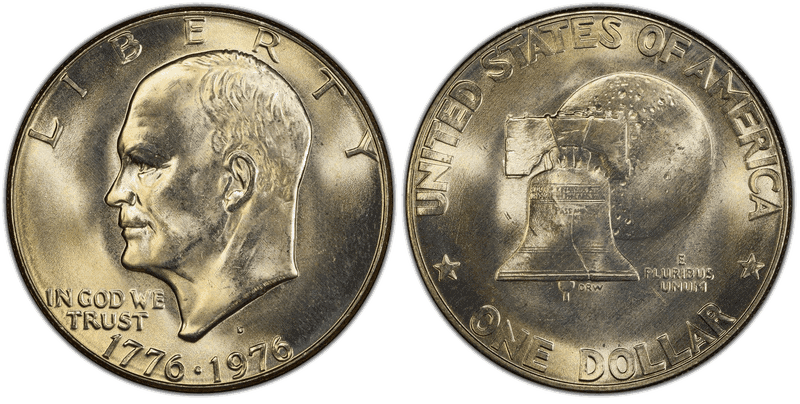
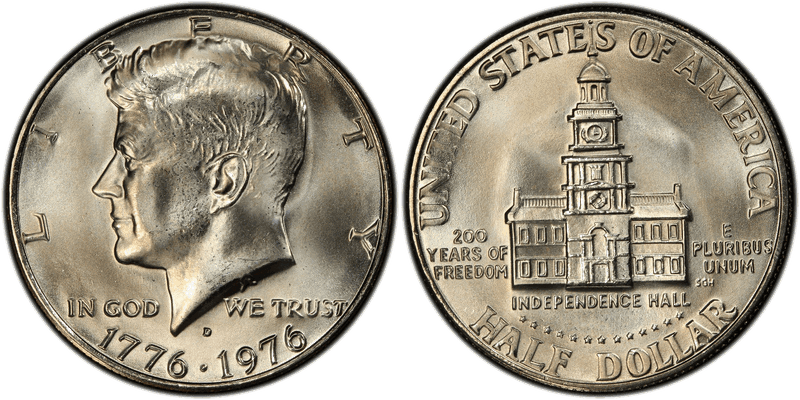
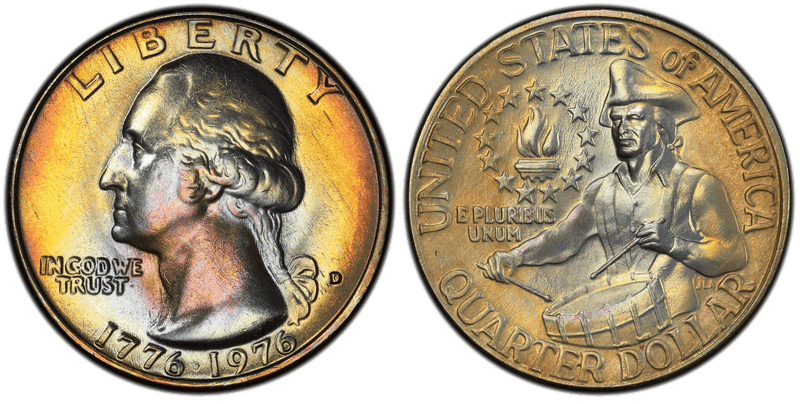
America's 200th birthday produced one of the most distinctive circulating coinage sets, with special reverse designs on the quarter, half dollar, and dollar dual-dated 1776-1976. Jack L. Ahr's Colonial drummer boy quarter was produced in quantities exceeding 1.6 billion. Seth Huntington's Independence Hall graced the half dollar, while Dennis R. Williams' Liberty Bell-and-Moon dollar symbolized space-age achievements alongside Revolutionary heritage. No 1975-dated coins were produced for these three denominations, as bicentennial production began in 1975 to build inventory. Both copper-nickel clad circulation versions and 40% silver collector versions were struck, with silver issues at San Francisco in proof and uncirculated finishes sold in three-coin sets. Die varieties include Type I and Type II Eisenhower dollar reverses distinguished by lettering width. The bicentennial silver sets remain among the most widely distributed Mint collector products ever issued, representing the most comprehensive design change to circulating coinage for a single national celebration.

Browse by Base(3 bases)

Showing all 3 listings

About the Program

Public Law 93-127, approved October 18, 1973, gave the quarter, half dollar and dollar new reverses for the Bicentennial of the American Revolution. It also replaced the year with "1776-1976" on every one of those coins made for release between July 4, 1975 and January 1, 1977. The same law ordered 45 million coins in 40% silver, to be sold only as proofs or uncirculated pieces.

The Treasury opened a design contest to the public that October. It drew 884 entries. A panel chaired by sculptor Robert Weinman started judging on January 9, 1974 and picked 12 semifinalists, who were paid $750 each for plaster models. The three winners were announced on March 6, 1974 and each received $5,000. Chief Engraver Frank Gasparro made final adjustments to all three designs.

According to NGC, Bicentennial coins came off the presses from February 1975 through the end of 1976, while the Mint kept striking 1974-dated coins well into 1975. So no quarter, half or dollar carries a 1975 date. The half reached banks first, at a July 7, 1975 ceremony in Minneapolis, followed by the quarter on August 18 and the dollar on October 13.

1976 was the Bicentennial, marking 200 years. 2026 is the Semiquincentennial, marking 250 years, with its own dual date of 1776 ~ 2026. For those coins, see the 2026 Semiquincentennial coins.
The Designs

The obverses kept their usual portraits, with the dual date beneath each one.

Washington Quarter

Jack L. Ahr, a commercial artist from Arlington Heights, Illinois, designed a colonial drummer, with a victory torch and 13 stars beside him. Philadelphia struck 809,784,016 and Denver 860,118,839. NGC adds that 376,000 were made at West Point without a mint mark, so they cannot be told from Philadelphia coins. San Francisco struck 7,059,099 clad proofs.

Kennedy Half Dollar

Seth G. Huntington of Minneapolis drew a front view of Independence Hall, with 200 YEARS OF FREEDOM and his SGH initials at the lower right. Philadelphia struck 234,308,000 and Denver 287,565,248, with 7,059,099 clad proofs from San Francisco.

Eisenhower Dollar

Dennis R. Williams was a 22-year-old student at the Columbus College of Art and Design when his Liberty Bell over the Moon won. Philadelphia struck 4,019,000 Type 1 and 113,318,000 Type 2 dollars. Denver struck 21,048,710 Type 1 and 82,179,564 Type 2. The clad proofs follow the proof sets: 2,845,450 Type 1 coins from 1975 sets and 4,149,730 Type 2 coins from 1976 sets (CoinWeek reports both as sets sold).

Mintages

Bicentennial Coins 1976 mintages by design and finish, taken from each coin's page in our catalog. Each figure opens that coin's page, which lists its varieties and errors. A dash means no figure was recorded. Where one issue was struck in more than one type, each type is listed.

How to Tell Them Apart

Mint mark. It sits on the obverse of all three coins: right of Washington's hair ribbon on the quarter; just below the truncation of Kennedy's neck, above the date, on the half; and below Eisenhower's bust, above the date, on the dollar. No mark means Philadelphia (or a West Point quarter), and D means Denver. Both are clad. S means San Francisco, which made only collector coins: clad proofs for the regular proof sets and the 40% silver pieces.

Proof set year. The 1975 and 1976 proof sets both used the Bicentennial coins, so a loose quarter or half cannot tell you which set it came from. The dollar can.

Type 1 or Type 2 dollar. In 1975 Gasparro asked Williams to revise the reverse lettering. Type 1 letters are thick and blocky with no serifs. Type 2 letters are thinner, with small serifs that match the obverse. PCGS says the gap is easiest to see in UNITED STATES OF AMERICA and ONE DOLLAR (search). CoinWeek adds that the Type 2 obverse is in slightly lower relief.

IssueReverse
Early Philadelphia and Denver strikesType 1
Later Philadelphia and Denver strikesType 2
1975 proof and mint setsType 1
1976 proof and mint setsType 2
All 40% silver dollars, proof and uncirculatedType 1

Errors and Varieties

The 1976 No S proof dollar. Only one is known: a 40% silver proof with a Type 2 reverse and no mint mark, though every regular silver dollar is Type 1. Its owner said it turned up in 1977 at a Washington, D.C. department store, and Coin World examined it in 1978 and found it genuine. No record explains how it was made. PCGS grades it PR66 Cameo. Separately, unmarked Type 1 silver prototypes were struck at Philadelphia on August 12, 1974.

In Our Catalog

50 errors and varieties are listed for this series. Browse them by type:

Recently added

Composition and Silver Content

Circulating coins and clad proofs have copper-nickel outer layers over a copper core. The silver pieces use the standard of the 1965–1970 Kennedy halves: outer layers of 80% silver, bonded to a core of about 21% silver, for 40% overall.

CoinClad weight40% silver weightSilver content
Quarter (24.3 mm)5.67 g5.75 g0.074 oz
Half dollar (30.6 mm)11.34 g11.5 g0.1479 oz
Dollar (38.1 mm)22.68 g24.59 g0.3162 oz

The edge tells you more than the scale. A clad coin shows a copper stripe. A scale settles the dollar, where the gap is almost 2 grams. For the quarter, the 0.08-gram gap falls inside the allowed tolerance. The silver coin guide covers more checks.

The last of the 45 million silver coins was struck on June 22, 1976. That works out to about 11 million uncirculated and 4 million proof coins of each denomination, sold as three-piece sets. Production and sales were different things. CoinWeek reports 4,908,319 uncirculated sets sold, and price guides list 3,998,621 proof sets (search). NGC says the program ended in 1982, while CoinWeek has the sets on offer until 1986. CoinWeek also reports that the government melted several million unsold silver coins in the 1980s.

FAQ

Are 1976 bicentennial quarters silver?

Not the ones from pocket change. Quarters with no mint mark or a D are copper-nickel clad. Only San Francisco made 40% silver Bicentennial quarters, as collector coins sold in three-piece sets, and San Francisco also made clad proofs. So an S is a reason to check the coin, not proof of silver.

Why do bicentennial coins say 1776-1976?

Public Law 93-127 required quarters, halves and dollars made for release between July 4, 1975 and January 1, 1977 to carry "1776-1976" in place of the year they were struck. The two dates mark 200 years since the Declaration of Independence. That is why no quarters, halves or dollars are dated 1975.

What is a Type 1 vs Type 2 bicentennial dollar?

The two differ in the reverse lettering. Type 1 has thick, blocky letters without serifs. Type 2, adopted during 1975, has thinner letters with small serifs that match the obverse. Look at UNITED STATES OF AMERICA and ONE DOLLAR, where the difference shows most.

How many bicentennial coins were made?

Philadelphia and Denver struck 1,669,902,855 quarters, 521,873,248 half dollars and 220,565,274 dollars. San Francisco added clad proofs and the 45 million silver coins Congress ordered, about 11 million uncirculated and 4 million proof pieces of each denomination.

Are the 1976 bicentennial coins the same as the 2026 coins?

No. The 1976 coins marked the Bicentennial, 200 years of independence. The 2026 coins mark the Semiquincentennial, 250 years, and carry the dual date 1776 ~ 2026. See the 2026 Semiquincentennial coins.
Where is the mint mark on a bicentennial coin?

The mint mark is on the obverse of all three coins. On the quarter it is right of Washington's hair ribbon, on the half it is just below the truncation of Kennedy's neck, above the date, and on the dollar it is under Eisenhower's bust, above the date. Philadelphia coins have none.

↑ Back to the coins: every year, mint, variety and error

Explore Other Denominations

Collector Essentials

Tools and references for building and protecting your coin collection.

As an Amazon Associate, NumisDex earns from qualifying purchases.