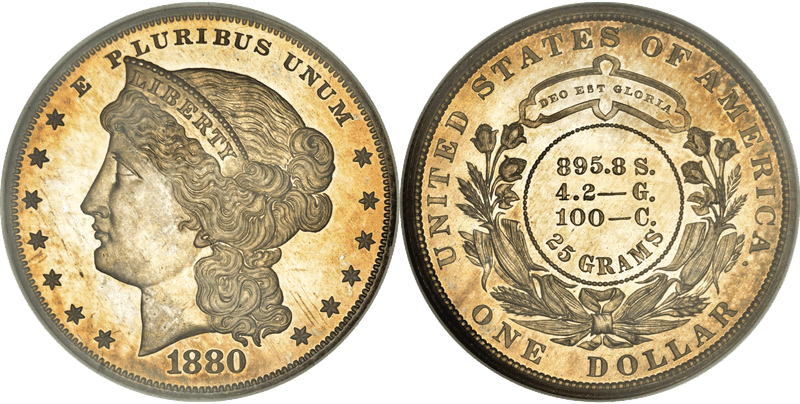
California Fractional Gold (1852-1882)

Coin Series
California Fractional Gold (1852-1882) series coin

About This Series

California fractional gold is the collectors' name for the small private gold pieces of 25 cents, 50 cents and one dollar, round or octagonal, made in California from 1852 to the early 1880s. The standard catalogue is Walter Breen and Ronald J. Gillio, California Pioneer Fractional Gold (1983; second edition revised by Robert D. Leonard Jr., 2003), whose BG numbers are arranged by denomination, shape and period. Period One pieces (1852-1857) were made by San Francisco jewelers such as Frontier & Deviercy, Antoine Louis Nouizillet and the engraver M. Deriberpie to serve as small change; Period Two pieces (1858 to 1882 in the second edition of Breen-Gillio, 1859 to 1882 in the first) were made mainly as souvenirs. An Act of June 8, 1864 made it a crime to make private coins meant to pass as money, and after a Secret Service visit in 1883 the remaining makers turned to pieces without a denomination, which are tokens rather than fractional gold. The BG-1300 numbers are later copies and restrikes, some of them made by Herman Kroll around 1906. None of these pieces was struck by the United States Mint, and no record of the numbers made survives.

Series Information

Production Years
1852-1882
Composition
Gold

Browse by Base(13 bases)

Showing all 13 listings

History

Gold was plentiful in California after 1849, but coins small enough to make change were not. The United States Assay Office in San Francisco was at first allowed to strike only octagonal fifty-dollar pieces, and shopkeepers took almost any foreign silver coin of about the right size as a quarter or half dollar. In 1852 San Francisco jewelers began striking tiny gold pieces of 25 cents, 50 cents and one dollar to fill the gap. A New Orleans paper reported receiving a California gold half dollar in June 1852, and letters from the next few years show miners spending them and tucking them into envelopes for family back East.

The makers were mostly French jewelers. Pierre Frontier and Eugene Deviercy signed some of their dies FD; Antoine Louis Nouizillet signed with N; the engraver M. Deriberpie signed DERI or DERIB; and Gaime, Guillemot & Co. used GG. The Joseph Brothers were among the earliest producers. The trade had its rough edges: Dan Owens found that Deriberpie, Nouizillet and Isadore Routhier were arrested in April 1853 on a charge of counterfeiting the ten-dollar pieces of Wass, Molitor & Co., and all three went back to making small gold afterwards. When the steamer Winfield Scott was wrecked off Anacapa Island in December 1853, divers later recovered 51 fractional pieces from the passengers' luggage, among them six octagonal dollars of 1853 signed by Deriberpie.

None of these pieces held as much gold as its face value called for. Mike Locke works out that a full-weight California gold dollar would weigh about 1.71 grams, and no Period One dollar reaches three-quarters of that. Once the San Francisco Mint was striking quarters and half dollars in quantity in 1855 and 1856, the need for private change disappeared, and the French jewelers stopped. Collectors call these early pieces Period One; the first edition of Breen-Gillio ended the period in 1856, and the second edition carries it to 1857.

From the end of the 1850s jewelers took up the little coins again, this time for visitors who wanted a piece of California gold to take home. These Period Two pieces, which Breen-Gillio's second edition dates 1858 to 1882 (1859 to 1882 in the first), carry dates into the early 1880s, are lighter still, and were not meant to circulate; Locke reports a Mint assay that found that 1859-dated pieces held gold for only about a quarter of their stated value. Frontier, Deviercy & Co. carried on into the new period; Robert B. Gray & Co., which took over Nouizillet's business around 1859-1860, marked some pieces G; Frontier & Bellemere struck quarters with a head of Washington in 1872; the Levison Brothers' pieces carry an L; and Christopher Ferdinand Mohrig made many of the Indian-head pieces. Away from San Francisco, Reuben N. Hershfield and Noah Mitchell of Leavenworth, Kansas, put an H on their pieces of 1871. Some Period Two pieces were backdated, such as the Indian-head quarters and halves dated 1852 that were made decades later.

An act of Congress approved June 8, 1864 made it a crime to make or pass any private coin intended for use as money. The souvenir trade went on anyway. According to Wikipedia the law was enforced in a Boston case in 1869 and at Fort Leavenworth in 1871; a dealer note citing Robert Leonard says federal agents stopped the Hershfield and Mitchell pieces that August. At some point a Secret Service man paid face value to a jeweler for one quarter and one half to hold as evidence, and a Secret Service visit in 1883, which brought no charges, ended the denominated pieces: from then on the makers left the value off, producing tokens rather than fractional gold. Later still came copies of the old pieces, including those of Herman Kroll in the early 1900s.

The standard catalogue is Walter Breen and Ronald J. Gillio's California Pioneer Fractional Gold (1983), revised by Robert D. Leonard Jr. in 2003. Its BG numbers are the ones used on every page of this series.

How to Identify It

Check for a denomination. A genuine piece states its value on the reverse: 1/4 DOLLAR, 25 CENTS, 1/2 DOLLAR, FIFTY CENTS, ONE DOL. or 1 DOLLAR, usually with CALIFORNIA GOLD and often a date inside a wreath or beaded circle. Pieces with no value are souvenir tokens, and so are the pieces with a small bear on the reverse, which Locke dates from about 1900 on; they belong with the California gold tokens, not here.

Note the shape and size. Each denomination was made in a round and an octagonal shape, and Breen-Gillio number them separately: Period One octagonal and round quarters, halves and dollars are the BG-100s to BG-600s (octagonal dollars BG-501 to 534, round dollars BG-601 to 607); Period Two pieces are the BG-700s to BG-1200s (octagonal dollars, round dollars).

Read the obverse. Most pieces show a small Liberty head surrounded by stars. From the late 1860s many Period Two pieces show an Indian head instead, and a few quarters of 1872 show George Washington. On Period One pieces the maker's initials are often worked into the design: FD by the bust, GG at the truncation, or N., N.R. or DERI in the reverse legend.

Look at the edge. Many Period One dollars have reeded edges, some crudely or unevenly reeded. A great many survivors were mounted in jewelry, and Locke warns that repaired solder marks and filled holes can be hard to see; a piece whose octagon has bent sides, or whose reeding is missing in one stretch, deserves a close look.

Weigh it. Genuine pieces are gold but light for their face value. Locke's full-weight figures, at 0.88 fine, are about 1.71 grams for a dollar, 0.855 grams for a half and 0.438 grams for a quarter, and nearly every genuine piece falls below them.

Key Types and Varieties

Period One dollars. The octagonal dollars open with a group whose reverse shows a small eagle with shield and branch, copied from the eagle on Augustus Humbert's fifty-dollar slugs: BG-501, which has no date, and the dated BG-502, BG-503 (legend reading COLD for GOLD), BG-504 and BG-534. Locke attributes the eagle pieces to Frontier & Deviercy; Humbert had no hand in them. The largest family is the Deriberpie dollars of 1853 and 1854, BG-514 to BG-529, with DERI or DERIB in the reverse legend, such as BG-514 and BG-525. BG-526a, a pairing of the BG-526 obverse with the BG-529 reverse, was reported as a new find with one piece known. Nouizillet's N. dollars include BG-530, and BG-533 carries N.R. The round dollars are few: BG-604 has GG on the obverse and an eagle standing on a rock on the reverse.

Period One quarters and halves. The first quarters, such as BG-101, are octagonal pieces of the Joseph Brothers, and overdates such as the 1855/4 BG-106 appear early. Locke counts eight basic Period One types: octagonal and round Liberty quarters, a round quarter with a defiant eagle and 25 CENTS, octagonal and round Liberty halves, a round half with the Arms of California, and octagonal and round Liberty dollars. The defiant eagle quarter, BG-220, is the one quarter that comes close to full weight, and the Arms of California half is BG-435. CoinWeek notes that the Arms of California half is first recorded only in 1878, so its 1853 date is questioned. Among the octagonal halves, BG-301 has an eagle reverse and BG-302 a little eagle with spread rays that collectors nickname the peacock; BG-302 pieces were found with the Winfield Scott. Deriberpie and Nouizillet each made round halves, such as BG-417 and BG-430, and Deriberpie's BG-424 and BG-425 of 1854 have fourteen stars, more than any other Period One piece.

Period Two quarters and halves. The second period opens with pieces dated 1859, such as the quarter BG-701 and the half BG-901, both by Frontier, Deviercy & Co. Makers' letters mark a few: G for Gray on BG-1017, H for Hershfield and Mitchell on BG-857 and BG-1046. The Washington-head quarter BG-722 is by Frontier & Bellemere, and Mohrig's Indian heads include BG-799. Overdates are frequent, among them 1872/1, 1873/2, 1876/5 and 1878/6, and backdated pieces include the 1852-dated quarter BG-891 and half BG-962. The 1864 dies of some halves were also struck as die trials in silver and copper, such as BG-917a.

Period Two dollars. The octagonal dollars run from BG-1101 of 1859 to 1876, with Liberty heads through the series and Indian heads from 1872; the dates include the overdates 1873/2 (BG-1121) and 1876/5 (BG-1128). The round dollars are dated 1870 to 1872; BG-1208, an Indian head of 1872, was struck by C. F. Mohrig.

Restrikes and copies. A few Period One designs were struck again around 1860, and Breen-Gillio number these pieces with Period Two: Locke identifies the 1856-dated half BG-915A as a restrike of BG-311 with a plain edge on a plated planchet, and the 1856-dated round quarter BG-818A as a restrike from the dies of the octagonal BG-111. The BG-1300 numbers, grouped on the later copies page, are copies made after the period: the Kroll copies such as BG-1301, which imitates BG-111 with a different date, their later restrikes such as BG-1301A, and copies of unknown origin, some struck in lead, white metal or brass.

Composition and Gold Content

The pieces were struck in gold of no fixed standard. Locke bases his full-weight figures on native California gold of about 0.88 fine and finds every Period One dollar well short of the weight that a full dollar in such gold would need. Wikipedia, drawing on the revised Breen-Gillio, puts the earliest pieces at roughly 80 to 90 percent of full weight and says the weights fell steadily over the years of issue. Locke observes that Frontier & Deviercy pieces appear to be plated with better gold over a lower-grade core, a plating that can peel, and that some later souvenir pieces are gold-plated silver or brass.

No piece in this series was struck by the United States Mint, so none carries a mint mark, and no record of how many were made survives. The later Kroll pieces vary as well: PCGS describes the originals as reddish, low-grade gold and the restrikes as brighter yellow gold, while some other copies in the BG-1300 range are base metal.

In Our Catalog

36 errors and varieties are listed for this series. Browse them by type:

Recently added

    FAQ

    Were California fractional gold pieces ever used as money?

    The first ones were. Small change was short in Gold Rush California, and from 1852 San Francisco jewelers struck gold quarters, halves and dollars to fill the gap. Letters of the time describe people spending them and mailing them home, but they were light for their face value and many were kept as keepsakes. After the San Francisco Mint began turning out silver coins in the mid-1850s the need passed, and the later pieces were made mainly to sell as souvenirs.

    How can I tell a genuine piece from a souvenir token?

    Look at the reverse. Genuine pieces state a value in dollars or cents, such as 1/4 DOLLAR, 50 CENTS, DOL. or 1 DOLLAR. Pieces with no denomination are souvenir tokens; those with a bear on the reverse were made from about 1900 on and are usually gold-plated brass. A genuine piece should also match a Breen-Gillio listing; anything that does not, or that the book lists as a copy, calls for caution.

    What do BG numbers mean?

    They are the numbers in Walter Breen and Ronald J. Gillio's California Pioneer Fractional Gold, first published in 1983 and revised by Robert D. Leonard Jr. in 2003. The numbers run by period, denomination and shape - for example BG-101 onward for octagonal quarters of Period One, BG-501 onward for octagonal dollars of Period One, and BG-1101 onward for octagonal dollars of Period Two. Letters after a number (BG-526a, BG-1115A) mark varieties added later.

    What are the Kroll pieces?

    They are later copies of California fractional gold, numbered in the BG-1300 range. Mike Locke dates the ones made by Herman Kroll to about 1906 and says Kroll apparently had some of the original tooling; PCGS places Kroll in New York and reports about 260 pieces found in his estate in 1923. Some Kroll dies were used again for restrikes after 1968. They are not period California pieces.

    Was it legal to make these coins?

    Not after 1864. An act of Congress approved June 8, 1864 made it a crime to make or pass private coins meant to serve as money, whatever their design. The makers kept going for years; according to Wikipedia the law was enforced in a few cases from 1869, and after a Secret Service visit in 1883, which led to no charges, the remaining makers dropped the denomination from their pieces.

    ↑ Back to the coins: every year, mint, variety and error

    Explore Other Denominations

    Collector Essentials

    Tools and references for building and protecting your coin collection.

    As an Amazon Associate, NumisDex earns from qualifying purchases.