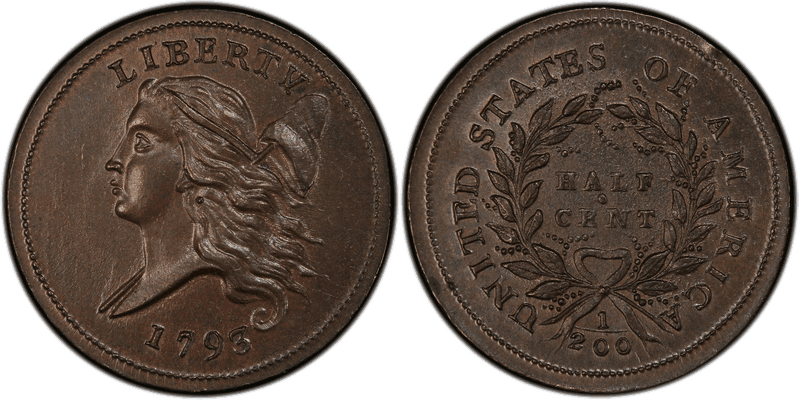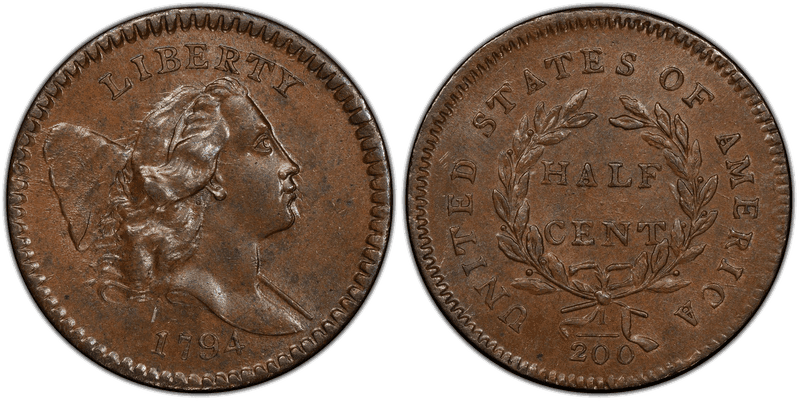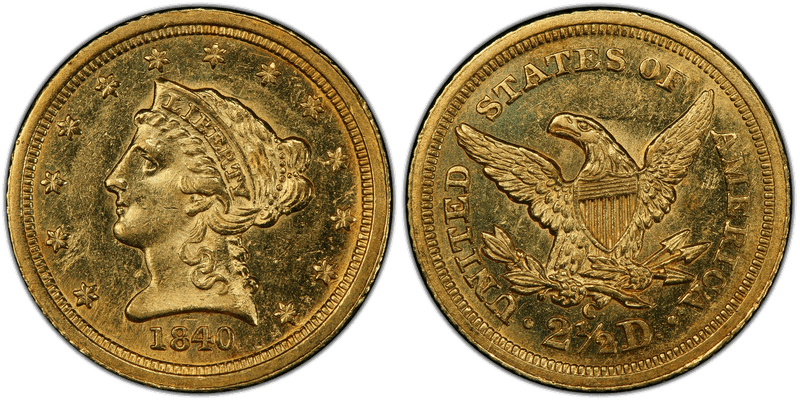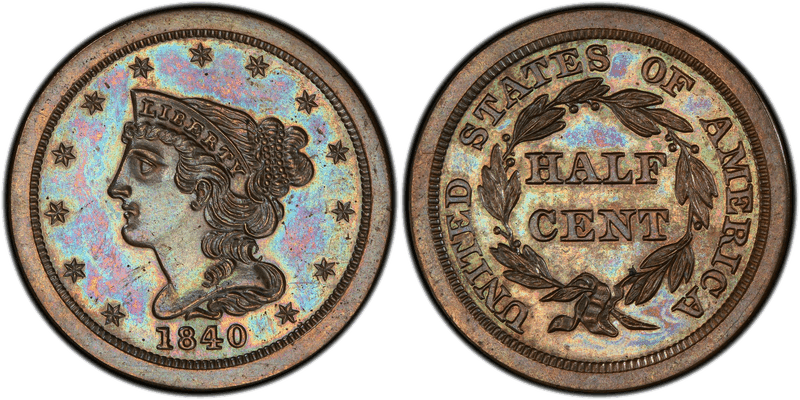
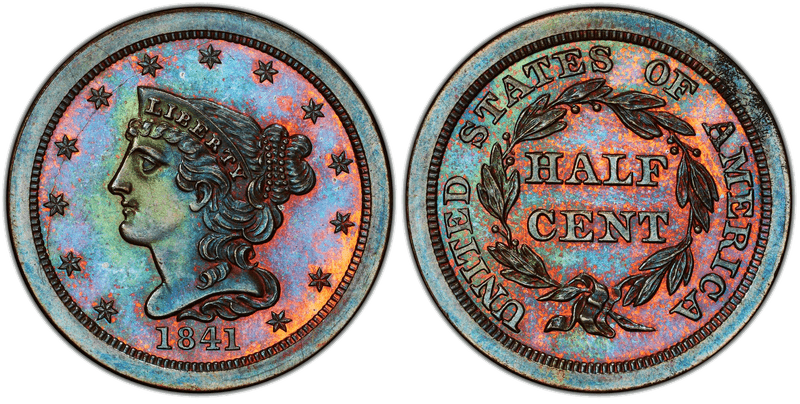
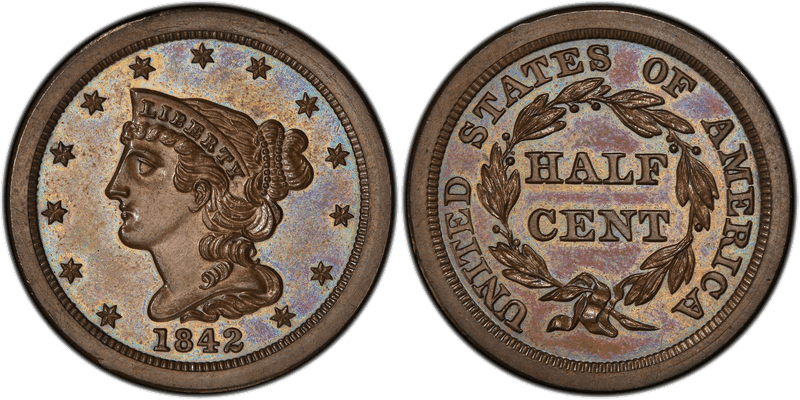
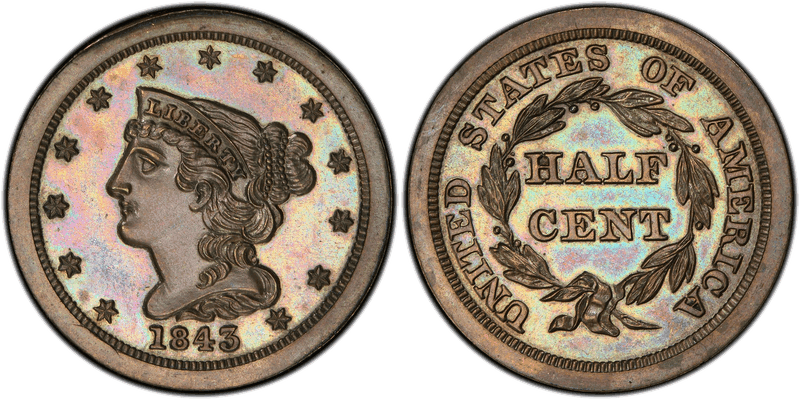
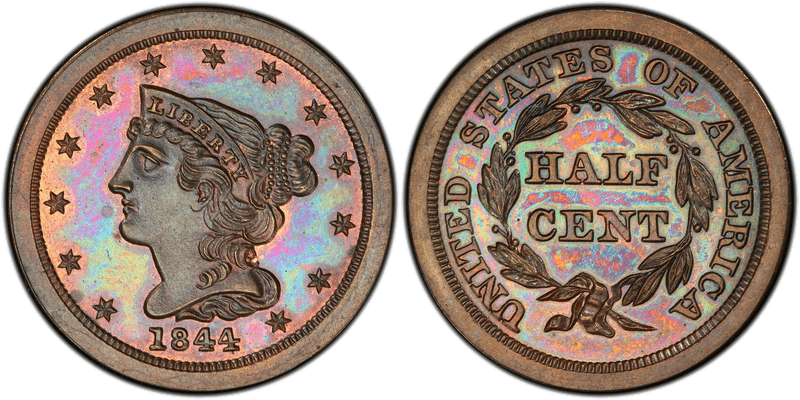
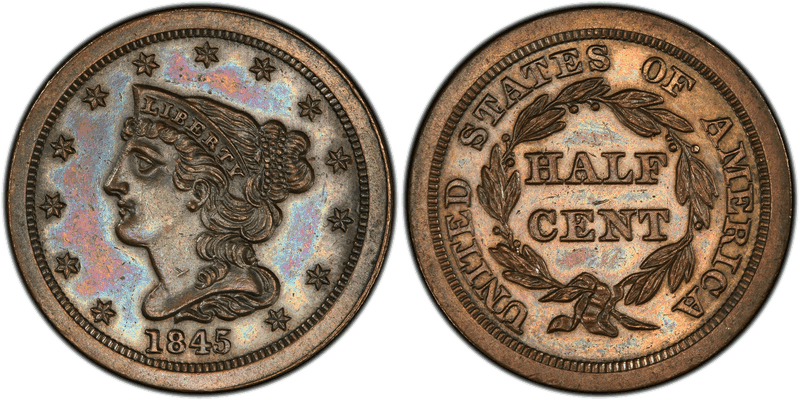
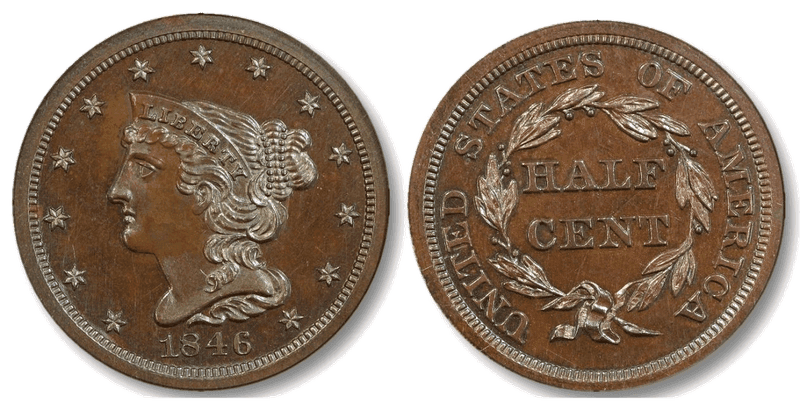
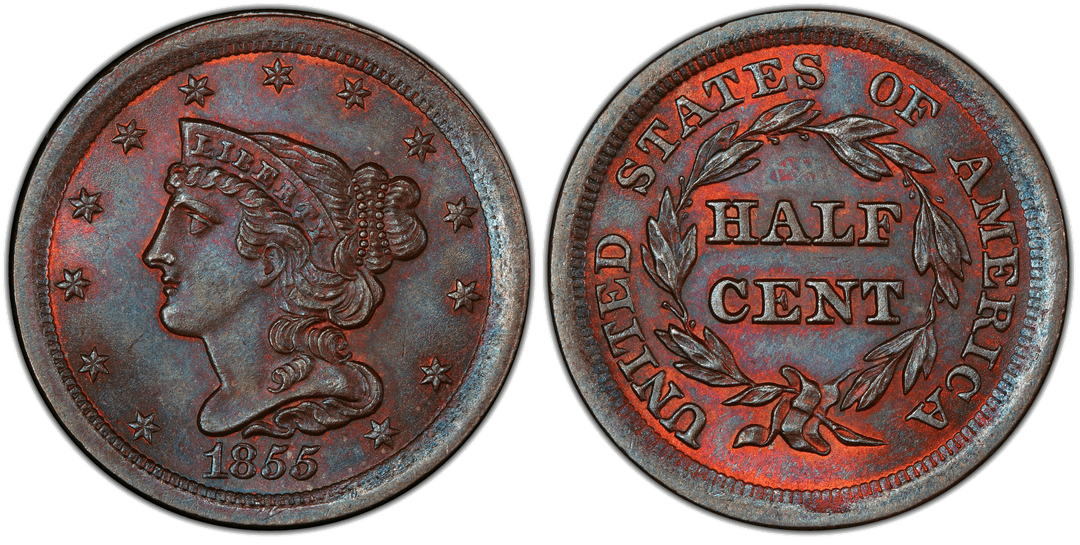
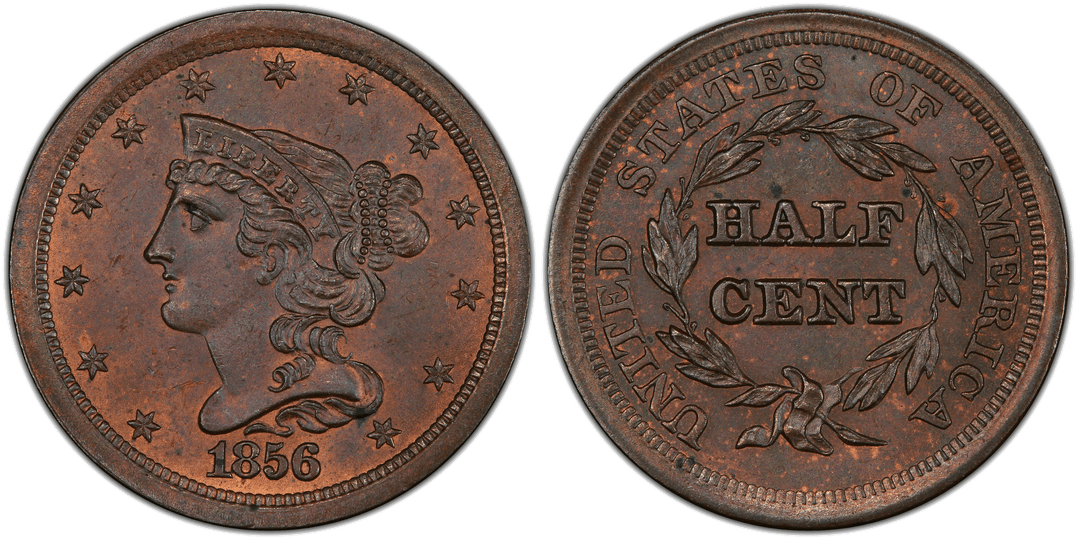
Braided Hair Half Cents 1840-1857

Coin Series
Braided Hair Half Cents 1840-1857 series coin

About This Series

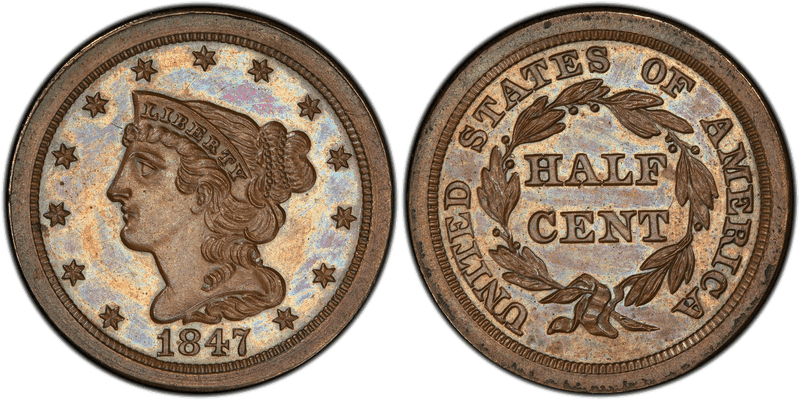
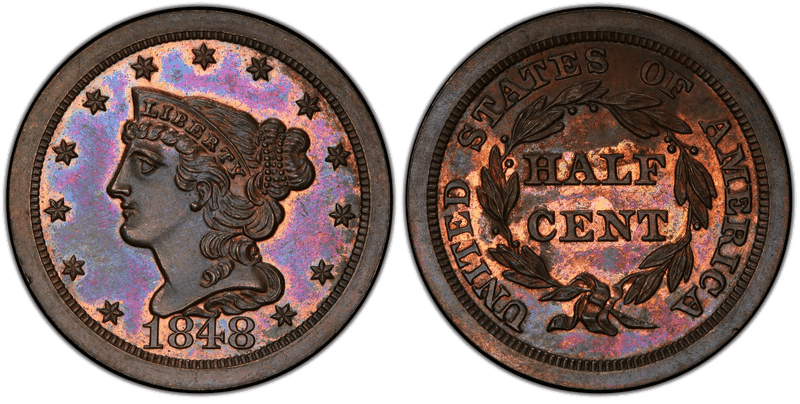
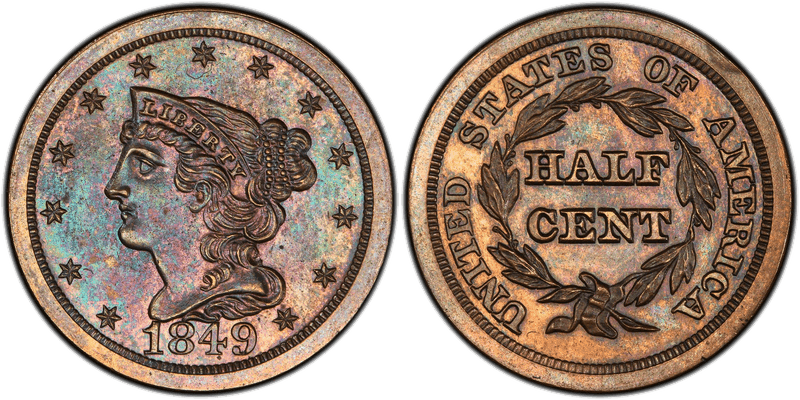
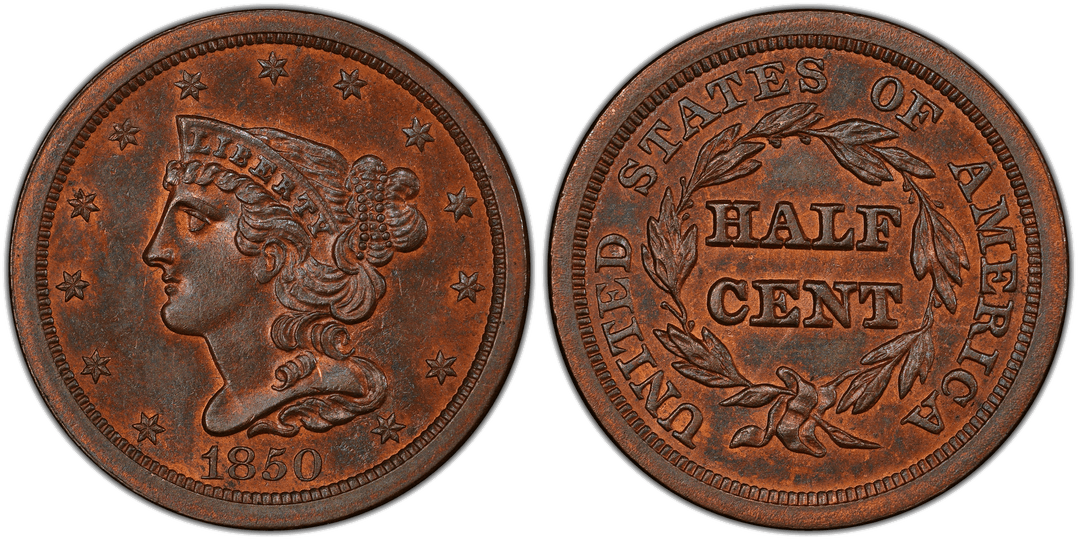
Christian Gobrecht's Braided Hair design brought the half cent denomination to its conclusion, spanning the final eighteen years of America's smallest coin. The series presents a distinctive collecting structure: dates from 1840 through 1848 were struck exclusively as proofs for collectors, with no business strike production at all, nine consecutive proof-only years. Business strikes resumed in 1849, apart from the proof-only 1852, and continued through 1857, when the Coinage Act of 1857 formally discontinued both the half cent and the large cent. The obverse features a mature, classically styled portrait of Liberty with braided hair bound by a coronet inscribed LIBERTY, while the reverse displays a wreath enclosing the denomination HALF CENT. Braided Hair half cents were struck in copper, 23 mm in diameter and 5.44 grams.

From NumisDex News

Series Information

Production Years
1840-1857
Composition
Copper

Browse by Base(18 bases)

Showing all 18 listings

History

Christian Gobrecht's Braided Hair head, used on the large cent from 1839, came to the half cent in 1840. For nine years no half cents were struck for circulation: NGC says the Mint still had enough older ones for the little demand there was. Instead it made small numbers of proofs each year for collectors and for presentation sets, and these are known as originals.

Collectors' interest in the 1840s dates led to restrikes. According to NGC they were made mostly in 1858 to 1860, from the old obverse dies paired with later reverses. Walter Breen studied them closely, sorting them into seven groups by weight and fabric, and found that many weigh far from the 84-grain standard.

Circulation strikes resumed in 1849. From then on NGC says each date was struck from a single pair of dies, and the yearly figures run from 35,180 to 147,672. No circulation coinage was made in 1852, though dies were prepared; the 1852 half cents known are proofs.

The Act of February 21, 1857, the same law that created the small Flying Eagle cent, abolished the half cent. Only 35,180 were struck that year, and NGC says most of them never left the Mint and were melted. In 1856 the half cent dies had also been used to strike copper-nickel pieces on blanks prepared for the new small cent, now catalogued as the pattern Judd 177.
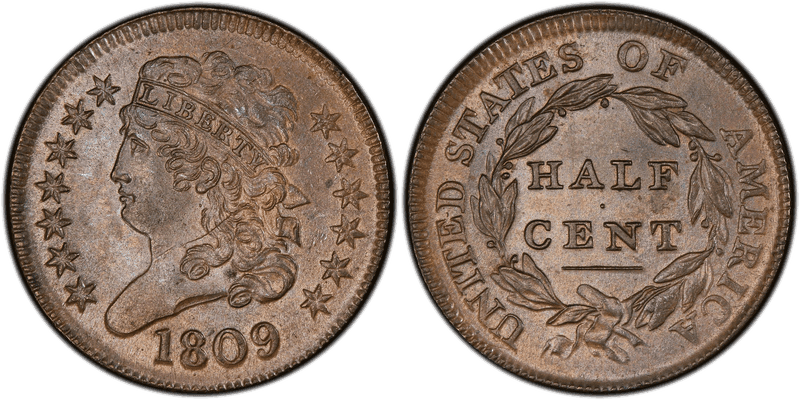
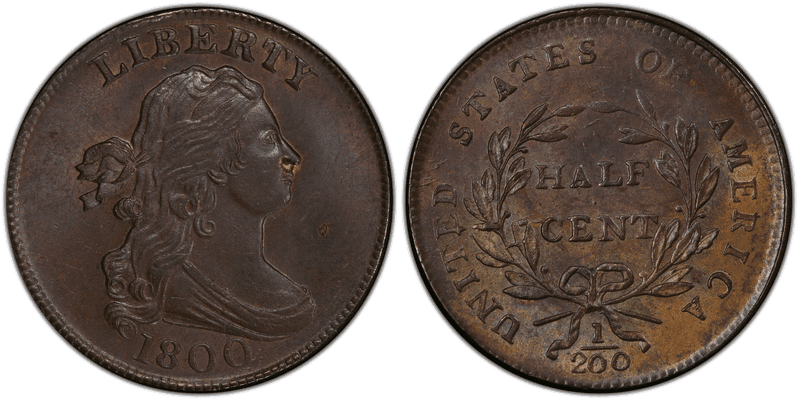
How to Identify It

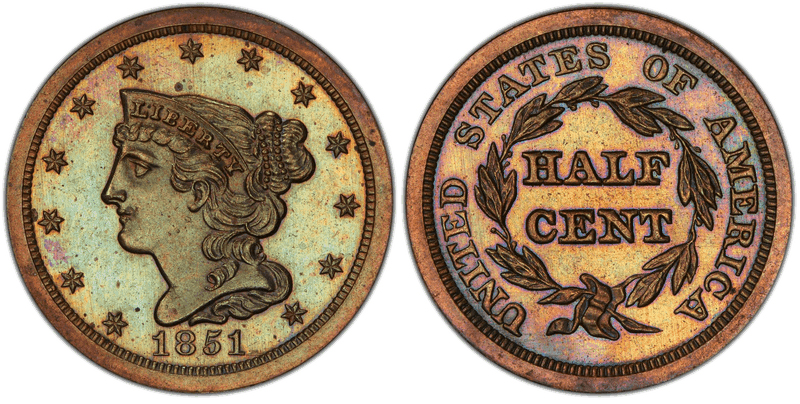
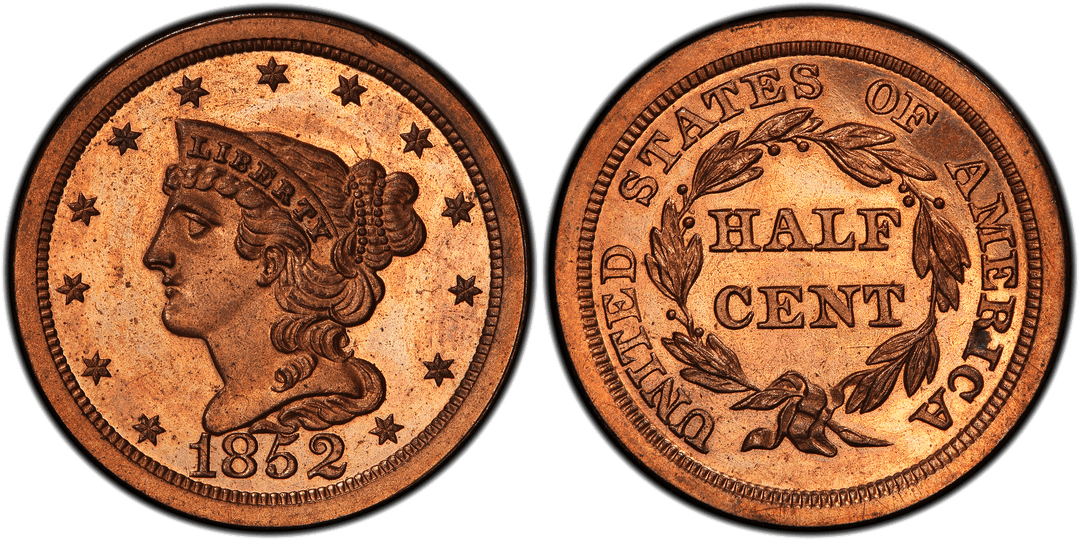
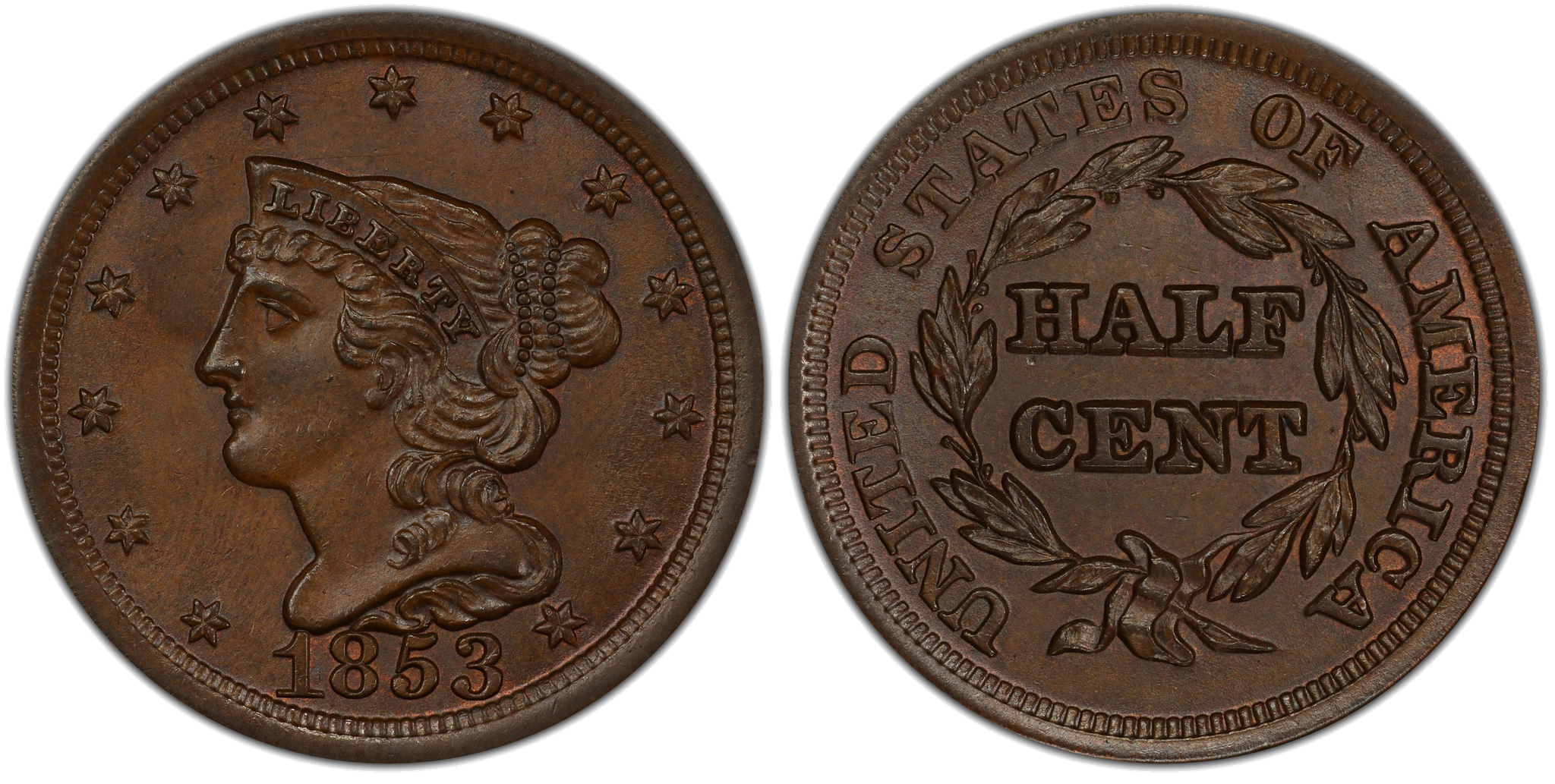
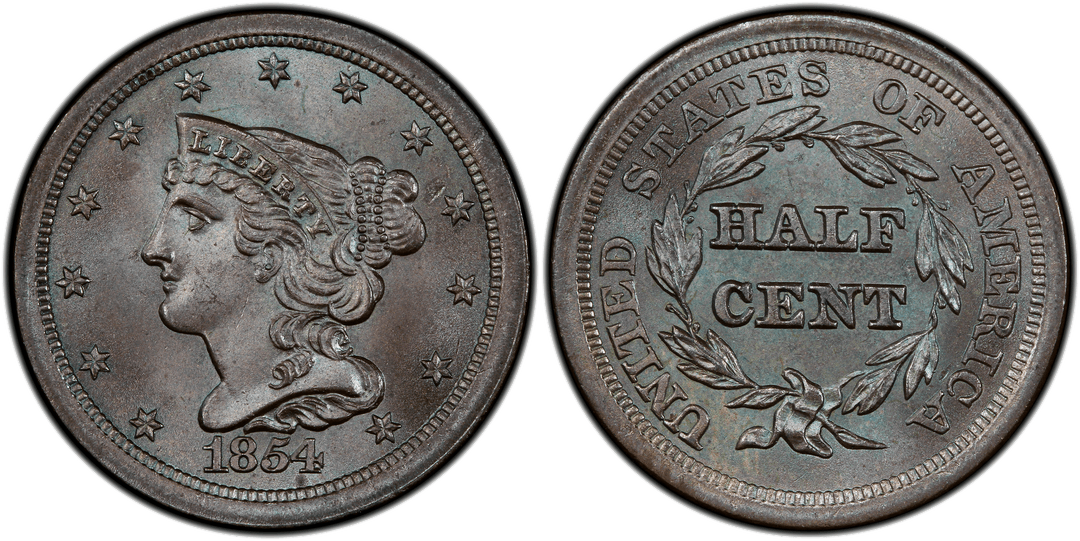
Obverse. Liberty with braided hair and a coronet inscribed LIBERTY, the date below.

Reverse. HALF CENT inside a wreath, with UNITED STATES OF AMERICA around it.

Originals and restrikes of 1840 to 1848. Look at the berries in the wreath. The originals come from a reverse die whose berries were enlarged by hand, so they are called Large Berries. Most restrikes have normal Small Berries, though Breen identified a few late restrikes made with the old large berry die. Some 1840 and 1841 originals were struck on blanks that had a reeded edge, flattened by the plain collar.

Date styles. The 1842 has a small date, the 1846 a crude date that looks engraved by hand, and the 1848 a date too large for its space. In 1849 the proofs have a small date and the circulation strikes a large one. The 1855 has slanting 5s.

Mint mark. None. All half cents were struck at Philadelphia.

Key Dates and Varieties

  • 1840 to 1848, proofs only: each year has originals and restrikes (shown here for 1840). No mintages were recorded. Breen and NGC estimate the survivors of each at a few dozen or fewer: for example about 17 or 18 originals of 1840 and about two dozen of 1841.
  • 1849: circulation strikes with a large date, 39,864 struck, and proofs with a small date (originals), small date (restrikes) or a large date.
  • 1850 and 1851: 39,812 and 147,672 struck, with a small number of proofs of each (1850, 1851).
  • 1852, proofs only: PCGS lists an original and a restrike. Breen argued that the Large Berries coins, long taken as originals, are late restrikes, and NGC says most specialists see all 1852 proofs as restrikes.
  • 1853 and 1854: 129,694 and 55,358 struck. A hoard of a thousand or more 1854s turned up around 1935. Breen counted 25 to 30 1854 proofs, and a copper-nickel 1854, Judd 155, is a pattern.
  • 1855: 56,500 struck, all with slanting 5s, plus proofs.
  • 1856: 40,430 struck. Breen put the proofs at more than 200 and also described restrikes.
  • 1857: the last half cent, 35,180 struck, most of them melted at the Mint. The number of proofs is not recorded; Breen's suggestion was 266.

In Our Catalog

No errors or varieties are listed for Braided Hair Half Cents 1840-1857 yet. Submit one

Mintages

Braided Hair Half Cents 1840-1857 mintages by year and mint, taken from each coin's page in our catalog. Each figure opens that coin's page, which lists its varieties and errors. A dash means no figure was recorded. Where one issue was struck in more than one type, each type is listed.

YearPProof
1840
1841
1842
1843
1844
1845
1846
1847
1848
1849
1850
1851
1852
1853
1854
1855
1856
1857

Composition

  • Composition: copper. Braided Hair half cents contain no silver.
  • Weight: 5.44 grams (84 grains). Restrikes often depart from it.
  • Diameter: 23 mm
  • Edge: plain

FAQ

Why were no Braided Hair half cents made for circulation from 1840 to 1848?

The Mint still had enough older half cents for the little demand there was. In those years it struck only small numbers of proofs, for collectors and for presentation sets. Circulation strikes resumed in 1849.

What is the difference between an original and a restrike?

Originals were struck in the year on the coin. Restrikes were made later, mostly around 1858 to 1860 according to NGC, from the old obverse dies. For 1840 to 1848 the reverse tells them apart: the originals' reverse die had its berries enlarged by hand, so they are called Large Berries, while most restrikes have the normal Small Berries.

Are there 1852 half cents for circulation?

No. NGC says the Mint prepared 1852 dies but struck no circulation coins with them, since the large 1851 mintage covered the need. The 1852 half cents known are proofs, and most specialists consider them restrikes; NGC has certified a single coin as an original.

How many 1857 half cents were made?

The Mint struck 35,180 for circulation. The half cent was abolished by the Act of February 21, 1857, and NGC says most of the 1857 coins never left the Mint and were melted. Walter Breen suggested that a Mint delivery of January 24, 1857 may represent 266 proofs, but the number of proofs was not recorded.

Is there a copper-nickel half cent?

Yes, as a pattern. In 1856 the half cent dies were used to strike pieces on the copper-nickel blanks made for the new small cent, Judd 177. Breen wrote that the first 50 were sent to the Secretary of the Treasury in July 1856 to show the new alloy.

Where is the mint mark on a Braided Hair half cent?

There is none. Every half cent was struck at the Philadelphia Mint.

↑ Back to the coins: every year, mint, variety and error

Explore Other Denominations

Collector Essentials

Tools and references for building and protecting your coin collection.

As an Amazon Associate, NumisDex earns from qualifying purchases.