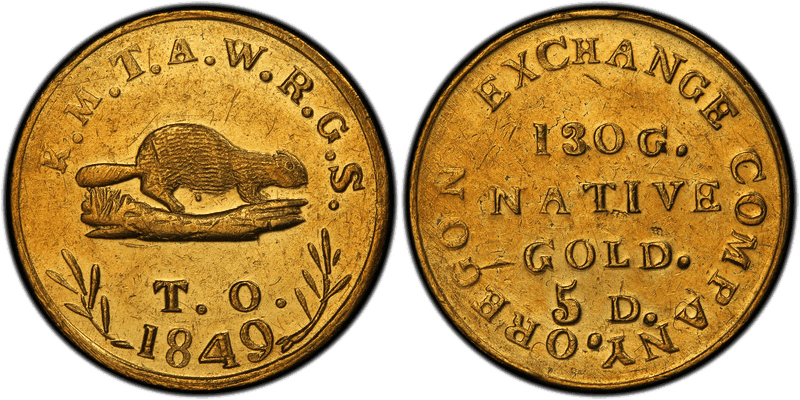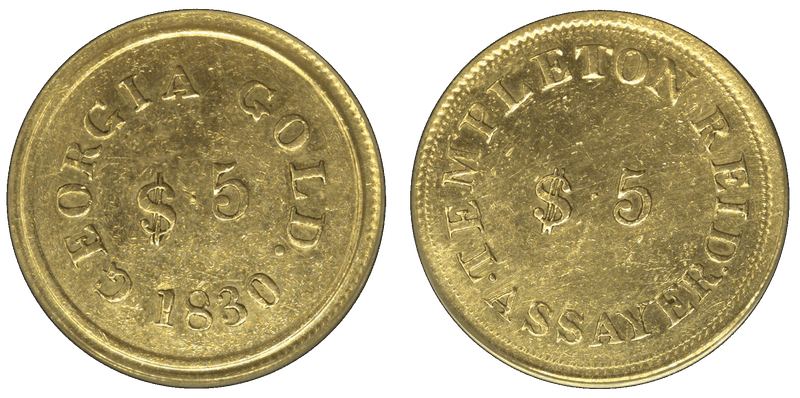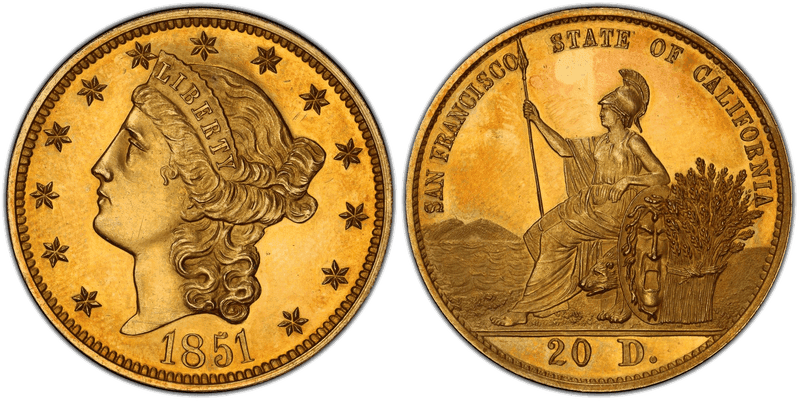
California Gold (1849-1855)

Coin Series
California Gold (1849-1855) series coin

About This Series

Private and territorial gold struck in California from 1849, when the gold rush brought large amounts of gold dust and little coin, until the San Francisco Branch Mint took over coinage in 1854 and 1855. The pages cover the private firms (Norris, Gregg & Norris, Moffat & Co., the Pacific Company, Baldwin & Co., Wass, Molitor & Co., Kellogg & Co. and others), the octagonal and round fifty-dollar pieces of the U.S. Assay Office of Gold, patterns and die trials, and later restrikes. None of these pieces was struck at a United States Mint.

Browse by Base(28 bases)

Showing all 28 listings

History

When gold was found in California in 1848 the territory had almost no coin. Miners paid in gold dust, which merchants took at a discount, while the Custom House at San Francisco insisted on gold or silver coin for duties. Edgar Adams, who searched the newspapers of the period, tells how the first private gold pieces filled that gap. The earliest he could date is a five-dollar piece of Norris, Gregg & Norris, described in the Alta California on May 31, 1849. Moffat & Co., run by the New York assayer John L. Moffat, issued stamped rectangular ingots and then five- and ten-dollar pieces closely modeled on federal coins, and these passed at par.

Several groups of 1849 brought coining equipment or at least dies with them. The Pacific Company pieces, which Adams credits to David C. Broderick and Frederick D. Kohler, were hammer-struck and assayed well below face value. J. S. Ormsby & Co. struck undated pieces in Sacramento, the Miners' Bank issued a ten-dollar piece late in the year, and the Cincinnati Mining and Trading Company and the Massachusetts and California Company left pieces that Adams took for trials of plans that were dropped. In 1850 Dubosq & Co. and Baldwin & Co. joined in, and Kohler, as State Assayer, stamped ingots for the State Assay Office.

Congress answered with an act of September 30, 1850 that allowed the Treasury to contract with a California assayer for ingots stamped by a United States Assayer. Moffat & Co. took the contract, Augustus Humbert was appointed, and from about January 31, 1851 the office issued octagonal fifty-dollar pieces. In March 1851 assays of the private coins showed Baldwin's pieces short, the public turned against them, and most private coining stopped. The bulky fifty-dollar pieces did little for small trade, so Wass, Molitor & Co. began five- and ten-dollar pieces in January 1852 and Moffat & Co. struck a ten-dollar piece the same year. Curtis, Perry & Ward succeeded Moffat & Co. at the Assay Office in 1852 and added ten- and twenty-dollar pieces before the office closed on December 14, 1853.

The San Francisco Branch Mint opened in the Assay Office building on April 15, 1854, but produced little at first. Kellogg & Co., founded by two former Assay Office employees, filled the gap with twenty-dollar pieces from February 1854, and Wass, Molitor & Co. returned in 1855 with twenty- and fifty-dollar pieces. Adams treats the twenty-dollar dies prepared by Blake & Co. of Sacramento in 1856 as the last attempt at private coinage in California.
How to Identify It

The issuer's name. Most of the later coins copy the federal Liberty head and eagle and put the firm's name where LIBERTY would be: MOFFAT & CO., BALDWIN & CO., DUBOSQ & CO., DUNBAR & CO., W.M.&CO. or KELLOGG & CO. The Shultz & Co. coronet reads SHULTS & CO., a cutting error. Many reverses read S.M.V. CALIFORNIA GOLD, for standard mint value. Earlier and smaller issuers used designs of their own, such as the Pacific Company liberty cap in rays and the J.S.O. initials of Ormsby.

Fineness labels. The Assay Office pieces state their fineness on a label above the eagle: 880 or 887 THOUS. on the fifty-dollar pieces of 1851, 887 or 900 on those of 1852, and 884 or 900 on the ten- and twenty-dollar pieces. Kellogg's fifty-dollar piece gives both weight and fineness, 1309 GRS. 887 THOUS.

Edges and reverses. The first Humbert fifty-dollar pieces carry his name and title sunk in a lettered edge, and some have 50 in a small target at the center of the engine-turned reverse. Later pieces have reeded edges with the name moved to the obverse border. The octagonal shape belongs to the Assay Office; the fifty-dollar pieces of Wass, Molitor & Co. and Kellogg & Co. of 1855 are round.

No mint mark. None of these pieces was struck at a United States Mint. The U.S. Assay Office of Gold was a contract assay office, not the San Francisco Mint, and the catalog pages carry no mint mark.

Trials, patterns and later pieces. Pieces in copper, brass, white metal, lead or silver are trials, patterns or restrikes, not issued gold. Restrikes of the Baldwin ten-dollar trial dies differ slightly from the 1850 coin; one-sided impressions from the 1852 Assay Office pattern obverse come from a die recovered long after; the 2001 Kellogg pieces name the S.S. Central America on the ribbon. Counters and markers in the shape of gold coins, which Adams describes as gambling pieces, are tokens rather than coins.

Key Types and Varieties

1849. The Norris, Gregg & Norris five-dollar piece, in plain and reeded edge versions. Moffat & Co.'s sixteen-dollar ingot, five-dollar piece and ten-dollar pieces with TEN DOL. or TEN D.. The Pacific Company dollar, five and ten. The undated Ormsby ten-dollar piece, the Miners' Bank ten-dollar piece, the Cincinnati Mining & Trading ten-dollar piece and the Massachusetts & California five-dollar piece.

1850 and 1851. Dubosq & Co. five and ten; Baldwin & Co.'s ten-dollar horseman signed by Albert Kuner and its 1851 twenty-dollar piece, which Adams calls the first of that value in California; the Shultz and Dunbar five-dollar pieces.

The Humbert fifty-dollar pieces of 1851. Lettered edge at 880 THOUS. with 50 on the reverse (K-1) and without it (K-2); 887 THOUS. with 50 (K-4); reeded edge at 880 (K-5) and 887 (K-6). The 1852 reeded-edge piece comes from new dies.

The Assay Office in 1852 and 1853. Humbert's ten-dollar and twenty-dollar pieces with 1852 cut over 1851; the United States Assay Office of Gold fifty-dollar pieces at 887 and 900 THOUS.; and the 1853 ten- and twenty-dollar pieces at 884 and 900 THOUS.

1852 to 1855. Wass, Molitor & Co.'s five-dollar pieces with small and large heads, the ten-dollar pieces of 1852 and the round fifty-dollar piece of 1855. Moffat & Co.'s 1852 ten-dollar piece with 264 GRS. on the reverse and its 1853 twenty-dollar piece. Kellogg & Co.'s twenty-dollar pieces of 1855 and the 1855 fifty-dollar piece cut by Ferdinand Gruner.

Patterns, trials and restrikes. The State of California twenty-dollar pattern of 1851, the Moran & Clark trial, the copper Bowie dollar, the Blake & Co. twenty-dollar piece of 1856, the Baldwin restrikes and the 2001 Kellogg commemorative restrike.

Composition and Gold Content

The California coiners worked with native gold, which is naturally alloyed with silver. That gives the pale yellow color newspapers of 1852 remarked on, compared with the redder federal coins alloyed with copper. Because the fineness was below the federal .900, firms such as Wass, Molitor & Co. made their pieces heavier to keep the full value: their five-dollar piece of 1852 was .880 fine at 131 1/5 grains. The Mint's assays show how widely the private issues varied, from .797 for the Pacific Company to about .870 for Baldwin & Co. and .880 to .892 for Norris, Gregg & Norris. The Massachusetts and California pieces were alloyed with copper.

The Assay Office stamped its fineness on each piece, at 880, 884, 887 or 900 thousandths. The Mint assayers Eckfeldt and Du Bois found the fifty-dollar pieces held their stated fineness, though weights varied somewhat on so large a piece; Raymond gives 1310 to 1320 grains. The 1852 and 1853 pieces at 900 THOUS. match the federal standard. Trials and restrikes are in copper, brass, white metal, lead, nickel or silver, and some are gilt; gilding is a surface coating and does not make a piece gold.

In Our Catalog

3 errors and varieties are listed for this series. Browse them by type:

Recently added

    FAQ

    Were any of these coins struck at the San Francisco Mint?

    No. Every piece in this series was made by a private firm or by the U.S. Assay Office of Gold, which was a Treasury contract office run by Moffat & Co. and later Curtis, Perry & Ward, not a branch of the Mint. The San Francisco Branch Mint only began work on April 15, 1854, in premises taken over from the Assay Office. For that reason none of these pieces carries a mint mark, and the catalog pages give none.

    What is a slug?

    In Gold Rush California the word was used for large gold pieces. Edgar Adams traced it to the rectangular ingots of Moffat & Co. and F. D. Kohler, and it came to mean the octagonal fifty-dollar pieces stamped from 1851 at the U.S. Assay Office. People at the time also called them ingots, quintuple eagles and golden adobes; the 1850 law that created the office spoke of ingots, not coins.

    Why did some private gold pieces hold less gold than their face value?

    The firms coined native California gold, which carries silver rather than the copper alloy of federal coins, and fixed their own weights. When the Mint assayers tested the pieces, some fell short. The Pacific Company ten-dollar piece of 1849 was .797 fine, with $7.86 in gold, and Baldwin & Co. pieces tested in March 1851 were about .871 fine and short of their stamped value, after which San Francisco refused them. Others, such as Moffat & Co. and Dubosq & Co., were found close to par.

    What are the Kellogg fifty-dollar restrikes?

    In August 2001 the California Gold Marketing Group and the California Historical Society struck commemorative pieces in the design of the 1855 Kellogg & Co. fifty-dollar piece, in gold recovered from the S.S. Central America. They were made from transfer dies prepared by the Gallery Mint from the original dies, with S.S. CENTRAL AMERICA GOLD / C.H.S. on the ribbon that is blank on the 1855 coin, and a striking date punched on each piece. PCGS lists a smaller group struck from the original dies separately. All of them are modern pieces, not coins of 1855.

    Why are there copper, brass and white metal pieces in a gold series?

    Some are trial strikings made to test dies, some are patterns for coins that were never issued in gold, such as the State of California set of 1851, and some are later restrikes from surviving dies, such as the Baldwin ten-dollar trial dies and the 1852 Assay Office pattern obverse. Adams believed most of the pattern dies were cut in eastern cities and brought out by the companies of 1849.

    What do the K-numbers on the pages mean?

    They are Donald Kagin's numbers from Private Gold Coins and Patterns of the United States (1981), the standard catalog of territorial gold. Each issuer is numbered separately, so K-1 for Moffat & Co. is a different piece from K-1 for Baldwin & Co. The pages give the numbers printed by Greysheet, NGC or PCGS for the piece and leave the field empty where none could be checked.

    ↑ Back to the coins: every year, mint, variety and error

    Explore Other Denominations

    Collector Essentials

    Tools and references for building and protecting your coin collection.

    As an Amazon Associate, NumisDex earns from qualifying purchases.