
1976 (D) Bicentennial Washington Quarter on Cent Planchet - WPL 002
Error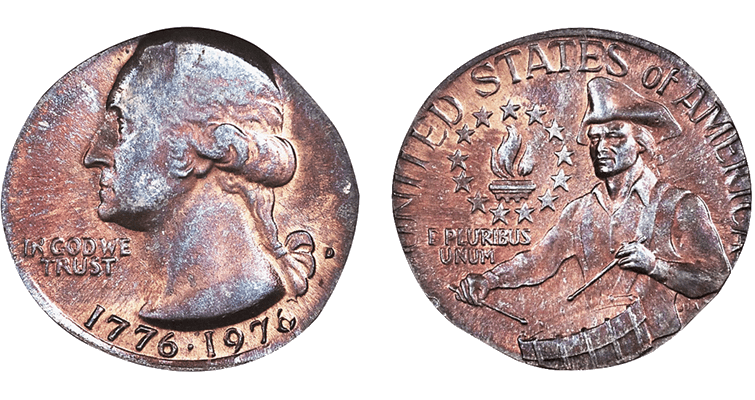
Community Voting
This listing needs 10.0 weighted votes to advance to community review.
Description
The 1976-D Bicentennial Washington Quarter struck on a Lincoln cent planchet is one of the most visually dramatic wrong planchet errors in modern U.S. numismatics. This coin was produced when a copper-zinc cent planchet — weighing approximately 3.1 grams and measuring 19mm in diameter — was accidentally fed into a coining press set up to strike Bicentennial quarters. The resulting coin carries the familiar dual-dated "1776-1976" obverse with George Washington's portrait and Jack L. Ahr's colonial drummer reverse design, but impressed onto a planchet far too small to receive the full quarter design. Wrong planchet errors occur in the minting process when planchets for one denomination become mixed with those of another, typically through the feeder system that supplies blank coins to the press. In a high-speed production environment where multiple presses run simultaneously for different denominations, a stray planchet can travel from one press's supply bin into an adjacent press's feed tube. The press does not distinguish between planchet types — it simply strikes whatever is placed between the dies with the same tonnage applied to any other coin in the run. The feeder tubes and planchet bins sit in close proximity on the production floor, and during shift changes, bin refills, or maintenance operations, cross-contamination between denominations can occur. The physical mismatch between the cent planchet and the quarter dies creates several distinctive characteristics. The quarter design is approximately 24.3mm in diameter, while the cent planchet is only 19mm, meaning approximately 39 percent of the design area extends beyond the edge of the planchet and is never struck. The resulting coin shows a partial impression of Washington's portrait and lettering on the obverse, with peripheral elements cut off by the planchet's smaller circumference. On the reverse, the colonial drummer design is similarly truncated, with much of "UNITED STATES OF AMERICA" and the denomination missing entirely. The partial impression creates a coin that is immediately identifiable as wrong — it cannot be mistaken for a normal quarter or a normal cent, because it carries quarter design elements on a cent-sized disc. The composition difference is equally telling. A standard 1976-D quarter was struck on a copper-nickel clad planchet with a distinctive silver-white appearance and a weight of 5.67 grams. This error coin, struck on a cent planchet, weighs roughly 3.1 grams and displays the reddish-brown copper color characteristic of Lincoln cent planchets. The weight difference alone — nearly 45 percent lighter than a normal quarter — makes authentication straightforward. The edge of the coin shows the solid copper-zinc composition of the cent planchet rather than the layered clad sandwich visible on a normal quarter's edge. Under magnification, the metal flow patterns at the rim also differ from a normal quarter, because the dies were designed to contain a larger planchet within the collar — and the collar never made contact with this undersized blank. The 1976 Bicentennial coinage holds special significance in American numismatics. Congress authorized the dual-dated coins in 1973, and the Denver Mint struck over 860 million Bicentennial quarters during 1975 and 1976 production. With that volume of production, the statistical probability of wrong planchet errors increases simply through the sheer number of opportunities for a stray planchet to enter the wrong press. Nevertheless, surviving examples remain rare because Mint quality control measures — including visual inspection and automated weighing stations — catch the vast majority of error coins before they leave the facility. The coins that do escape represent a tiny fraction of total production, and many are likely still sitting unrecognized in collections or change jars. Wrong planchet errors involving different base metals are among the most sought-after categories in error coin collecting. They represent a failure in multiple quality control systems simultaneously: the planchet had to enter the wrong feeder, survive the striking process without jamming the press, pass through any post-strike inspection, and exit the Mint in normal circulation channels. Each of those steps represents a checkpoint where the error could have been caught and removed. The fact that the coin exists at all means every checkpoint was missed. For collectors, wrong planchet errors on Bicentennial coinage carry added appeal because of the commemorative nature of the host design. The Bicentennial quarter is one of the most recognizable and widely collected modern U.S. coins, and an off-metal strike combines the historical significance of the design with the rarity and drama of a major minting error. The visual contrast between the undersized copper planchet and the oversized quarter design makes this type of error immediately recognizable even to non-specialists, which contributes to its desirability across the full spectrum of collectors from beginners to advanced error specialists. It is also a powerful teaching example — the size difference between the cent planchet and the quarter design illustrates exactly what "wrong planchet" means in a way that no textbook explanation can match. This variety is cataloged as WPL 002 in the NumisDex wrong planchet registry.
Community & Reference
Related Errors



More Wrong Planchet Errors
Collector Essentials
Tools for examining and preserving error coins and die varieties.
10x-20x Jeweler's Loupe
Essential for examining die varieties, doubled dies, and RPMs
Cherry Picker's Guide
The definitive reference for U.S. error coins and die varieties
2x2 Coin Flips & Holders
Protect and organize your finds with archival-quality holders
USB Digital Microscope
Capture detailed images for documentation and community submissions
As an Amazon Associate, NumisDex earns from qualifying purchases.