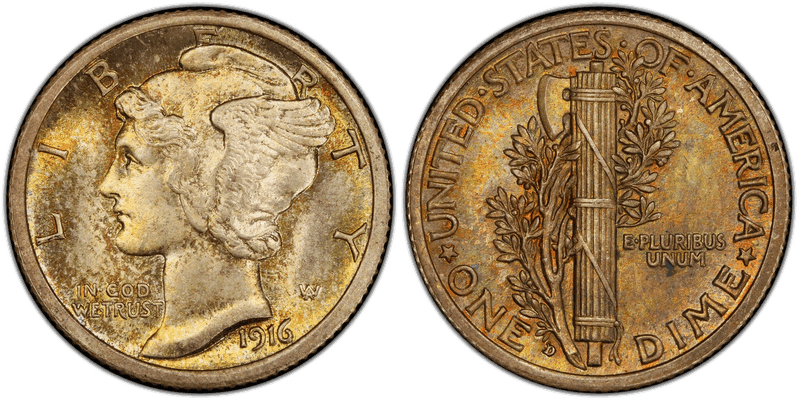
Capped Bust Dimes 1809-1837

Coin Series
Capped Bust Dimes 1809-1837 series coin

About This Series

John Reich's Capped Bust design brought artistic consistency to the dime denomination, depicting Liberty wearing a mobcap with the word LIBERTY inscribed on the band. The Large Size type (1809-1828) was struck without a close collar, producing coins with somewhat irregular edge characteristics, while the Reduced Size type (1828-1837) employed the close collar technology that yielded uniform diameter and precise reeding. The 1822 has a reported mintage of 100,000 from a single known die pair, and NGC believes much of that figure carried the date 1821. Die marriages are identified by JR numbers, from the John Reich Collectors Society's Early United States Dimes 1796-1837. Struck in .8924 fine silver at about 2.70 grams in both sizes, the Reduced Size type on a slightly smaller diameter, these small coins saw extensive circulation in an economy where the dime represented meaningful purchasing power. The transition from Large to Reduced Size around 1828 mirrors similar changes across other denominations as the Mint modernized its production technology. Varieties include the 1814 and 1820 STATESOFAMERICA (no spaces), the 1811/09 overdate, and Large Date and Small Date pairs.

From NumisDex News

Series Information

Production Years
1809-1837
Composition
89.2% Silver, 10.8% Copper

Browse by Base(20 bases)

Showing all 20 listings

History

The Capped Bust dime was the work of John Reich, a Bavarian-born engraver who had arrived in America under an indenture and joined the Mint as second engraver in 1807. His capped Liberty went onto the half dollar that year and reached the dime in 1809. Reich prepared the dime hubs as a smaller version of his half dollar, and he added the value 10 C. to the reverse, the first time a dime said what it was worth.

Dimes were struck only now and then. Spanish and Mexican reales circulated freely, and people bringing silver to the Mint rarely asked for dimes, so none were made in 1810, 1812, 1813, 1815 through 1819, or 1826. Dies were costly and were used until they wore out, which is why the reported figure for a year often includes coins with another date. The 1809 dimes were partly struck in 1810, the 1811 dimes come from an 1809 die re-dated as 1811/09, and NGC believes that much of the 100,000 reported for 1822 actually carried the date 1821.

Through 1828 the dimes were struck without a collar to contain the metal, and the edges were probably reeded beforehand on a separate machine, so the coins vary a little in size. William Kneass, chief engraver from 1823, brought in the close collar, which held the planchet and reeded the edge during striking. The first close-collar dimes appeared in 1828. Kneass also reworked Reich's design for the smaller coin, and by 1829 the change was largely complete. The weight stayed the same, so the new dimes are narrower and slightly thicker. Mint Director Robert M. Patterson ended the habit of using up old dated dies in 1835 and 1836. In late spring 1837 Christian Gobrecht's Seated Liberty dime replaced the Capped Bust design.
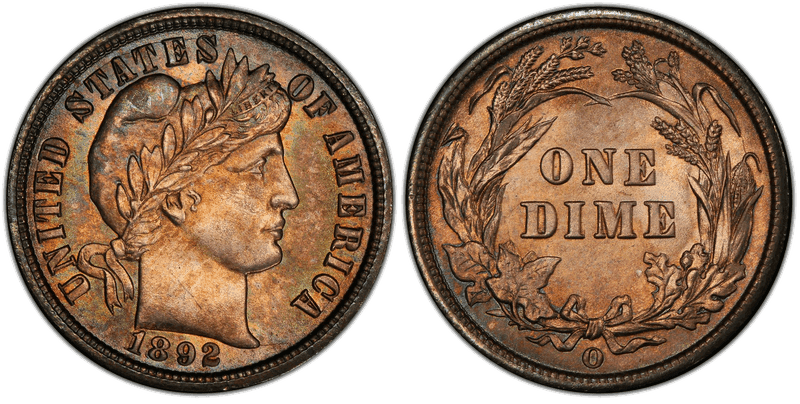
How to Identify It

Obverse. Liberty faces left, wearing a mobcap with LIBERTY on its band. Thirteen stars ring the border, seven on the left and six on the right, with the date below.

Reverse. An eagle with a shield on its breast holds an olive branch and three arrows. A curved scroll above it reads E PLURIBUS UNUM, UNITED STATES OF AMERICA runs around the top, and the value 10 C. sits at the bottom.

Edge. Reeded.

Mint mark. None. All Capped Bust dimes were struck at Philadelphia.

Telling the sizes apart.

TypeYearsHow struckDiameterBorder
Large size1809–1828no collarabout 18.8 mmwide ring of coarse denticles
Small size1828–1837close collarabout 18.5 mmraised rim with small beads inside

Size alone can mislead: CoinWeek notes that small size dimes still varied through 1834 because the collars were not all the same. The border is the surer guide.

Things that cause confusion.

  • 1828. Both types carry this date. The Small Date has a square-based 2 and the new beaded border. The Large Date has a curled 2 and the old border, and NGC says it was struck in 1829.
  • 1837. The Seated Liberty dime began the same year. It shows Liberty seated, with no stars, and the reverse reads ONE DIME inside a wreath.
  • Overdates. Many dies were re-dated, so traces of an earlier digit are common. On the 1830/29 the underlying digits are faint and are not a naked-eye variety.

Die marriages. Each pairing of an obverse die with a reverse die has a JR number within its date, from Early United States Dimes 1796-1837, published by the John Reich Collectors Society. Some years have many: NGC records 13 marriages for 1820 and 14 for 1827.

Key Dates and Varieties

  • 1809: the first year, 51,065 struck from a single pair of dies. NGC notes that 6,355 of them were coined in the second half of 1810.
  • 1811/09: every 1811 dime is this overdate, 65,180 struck from an unused 1809 obverse paired with the leftover 1809 reverse. The 0 is plain, but the 9 is hard to see.
  • STATESOFAMERICA: the 1814 (JR-5) and 1820 (JR-1) dimes have the reverse legend run together with no spaces. NGC says the 1820 coins used the reverse die left over from 1814.
  • Date sizes: 1814 Small Date and Large Date; 1820 Small 0 and Large 0; 1821 Small Date and Large Date.
  • 1822: the reported mintage is 100,000, from one known die pair. NGC thinks that much of the figure was struck with an 1821 date.
  • 1823/2: two 1822 obverses were re-dated for 1823. The reverses differ in the size of the E's in the legend: Large E's or Small E's.
  • 1824/2: no dimes were reported for 1824. NGC takes the 100,000 delivered on August 22, 1825 to be the 1824-dated coins. The two marriages differ in the 1 of the value, with a flat top on JR-1 and a curved top on JR-2.
  • 1828 Large Date and Small Date: of the 125,000 dimes coined in 1828, NGC believes 90,000 were dated 1827 and the other 35,000 were all Small Dates. The Large Date was struck in 1829 and has no separate figure.
  • 1829 value sizes: the 10 C. comes in Small, Medium, Large and Extra Large sizes. The 1829 Curl Base 2 is JR-10, the only marriage with that obverse.
  • 1830/29: an 1829 obverse that was never used in 1829 was re-dated for 1830.
  • 1833 Last 3 High: the final 3 of the date sits above the others.
  • 1834 Large 4 and Small 4: three obverses had a Large 4 and one, used late in the year, a Small 4.
  • 1837: the last year. Its dimes and the 1836 dimes have longer border beads than earlier small size dimes.
  • Proofs are listed by NGC from 1820 on. No records were kept, and NGC's notes give counts of a few to about a dozen known for each date.

In Our Catalog

8 errors and varieties are listed for this series. Browse them by type:

Recently added

Mintages

Capped Bust Dimes 1809-1837 mintages by year and mint, taken from each coin's page in our catalog. Each figure opens that coin's page, which lists its varieties and errors. A dash means no figure was recorded. Where one issue was struck in more than one type, each type is listed.

Composition and Silver Content

  • 1809–1828, large size: 2.7 g, 89.24% silver and 10.76% copper, about 18.8 mm, holding 0.0774 troy oz of silver
  • 1828–1837, small size: 2.7 g at the same fineness, about 18.5 mm, 0.0774 troy oz of silver. CoinWeek notes that some 1837 coins may be slightly lighter, following the Mint Act of January 18, 1837
  • Designer: John Reich; the small size was reworked by William Kneass

FAQ

Where is the mint mark on a Capped Bust dime?

There isn't one. Every Capped Bust dime was struck at Philadelphia, and none carries a mint mark.

What is the difference between a large size and a small size Capped Bust dime?

Dimes of 1809 to 1828 were struck without a collar to hold the metal, so they spread a little and measure about 18.8 mm, with a border of long, coarse denticles. In 1828 the Mint began striking dimes inside a close collar, which reeded the edge as the coin was struck and fixed the size at about 18.5 mm. These small size dimes have a raised rim with a row of small beads inside it. Weight and fineness did not change, so the small dime is slightly thicker.

What are the key dates for Capped Bust dimes?

Collectors usually start with the 1809 (51,065 struck, part of them in 1810), the 1811/09 (65,180) and the 1822 (100,000 reported, though NGC thinks much of that figure was dated 1821). Among the varieties, the 1828 Large Date has no separate mintage because it was struck in 1829, and the 1829 Curl Base 2 comes from a single die marriage, JR-10.

What is a JR number on a Capped Bust dime?

A JR number names one die marriage, the pairing of a particular obverse die with a particular reverse die, within a date. The numbers come from Early United States Dimes 1796-1837, the reference published by the John Reich Collectors Society. 1814 has five marriages (JR-1 to JR-5), for example, and 1820 has thirteen.

How much silver is in a Capped Bust dime?

About 0.0774 troy ounce, according to NGC. Both sizes weigh 2.7 grams and are 89.24% silver and 10.76% copper. The small size kept the same weight on a narrower planchet.

How do I tell an 1828 Large Date dime from an 1828 Small Date?

Look at the 2 and the border. The Large Date has a curled base to the 2 and the old wide border of denticles, because it came from a die made in the old style. The Small Date has a 2 with a square base and the new beaded border of the close-collar coins. NGC reports that the Small Date dimes were struck first, in 1828, and the Large Date dimes the following year.

↑ Back to the coins: every year, mint, variety and error

Explore Other Denominations

Collector Essentials

Tools and references for building and protecting your coin collection.

As an Amazon Associate, NumisDex earns from qualifying purchases.