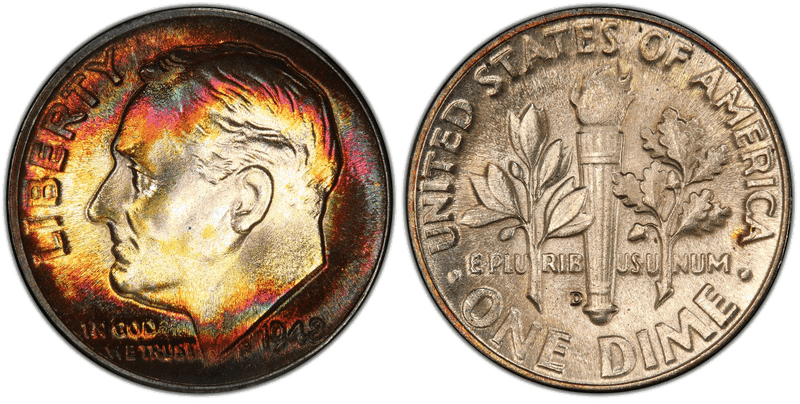
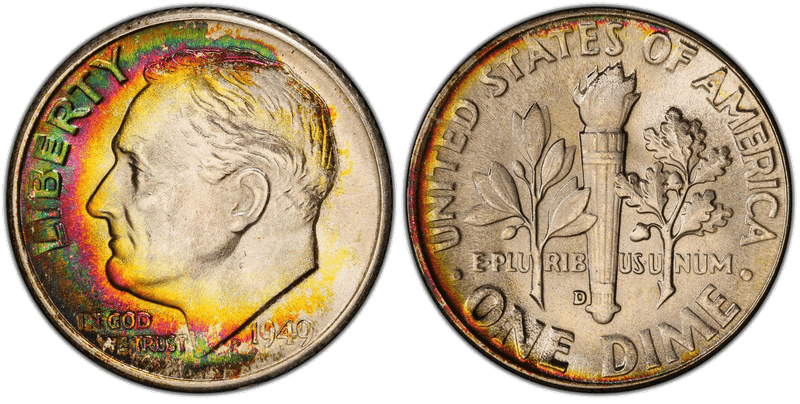
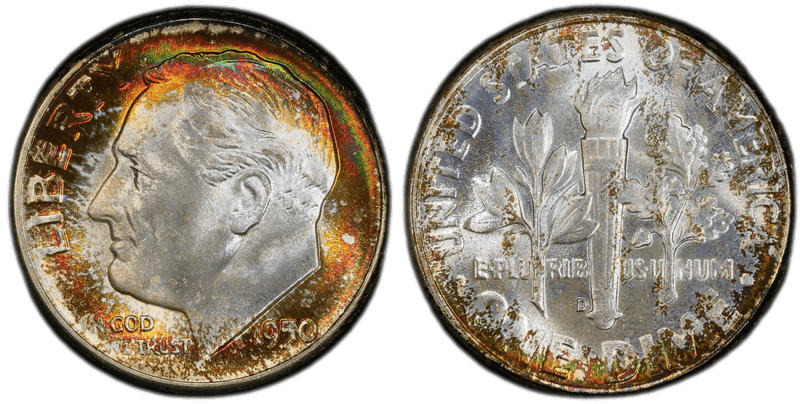
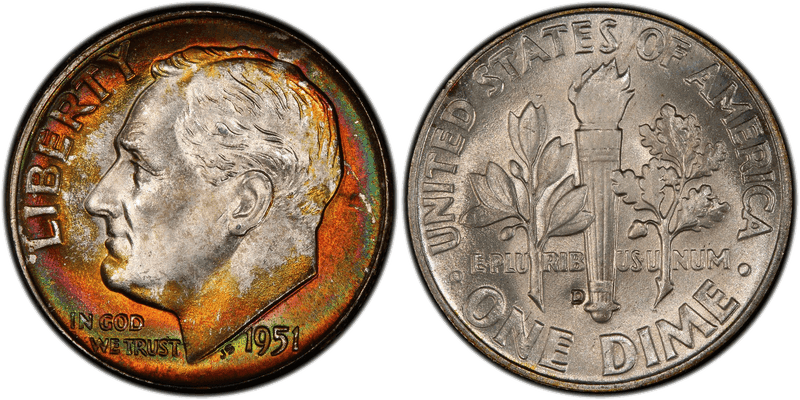
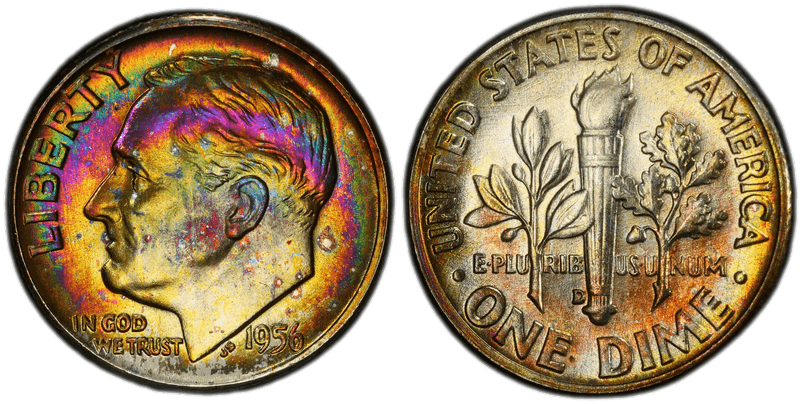
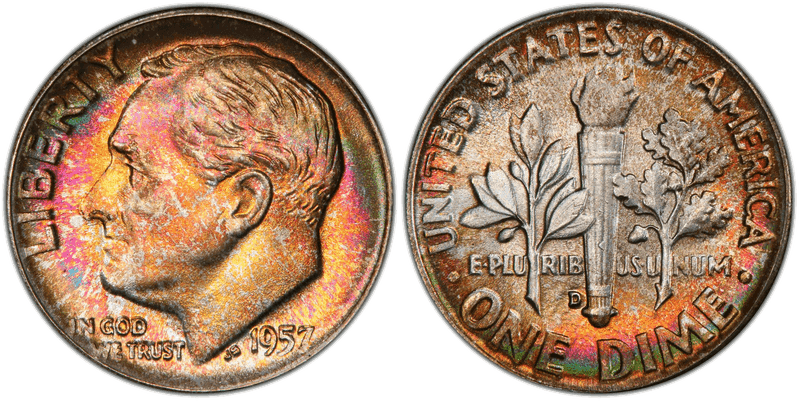
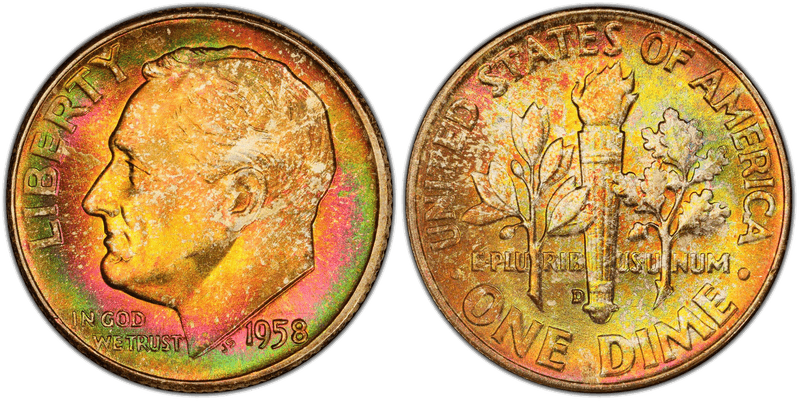
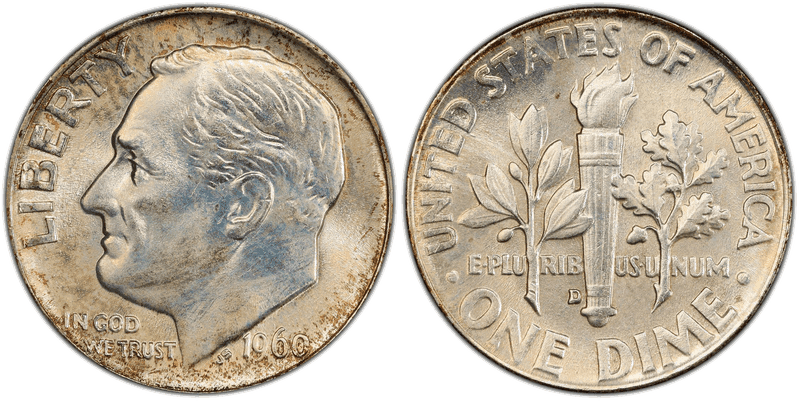
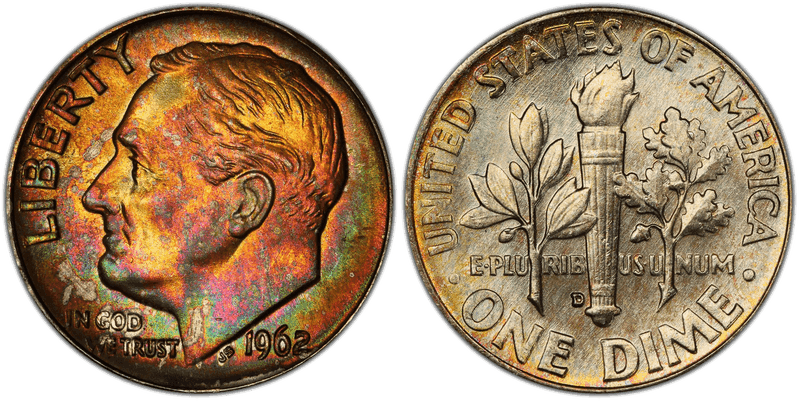
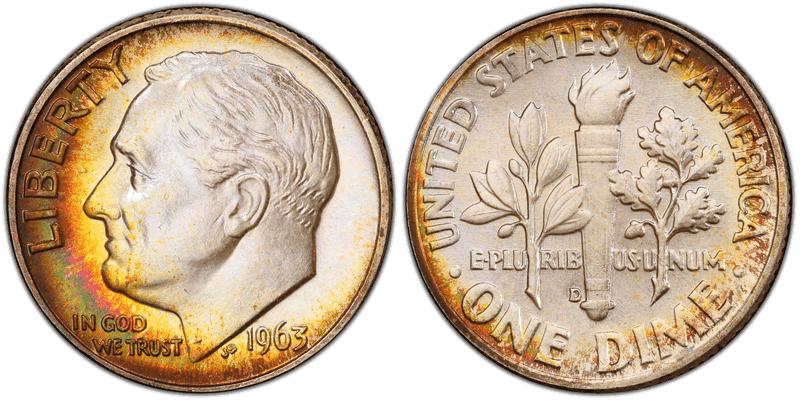
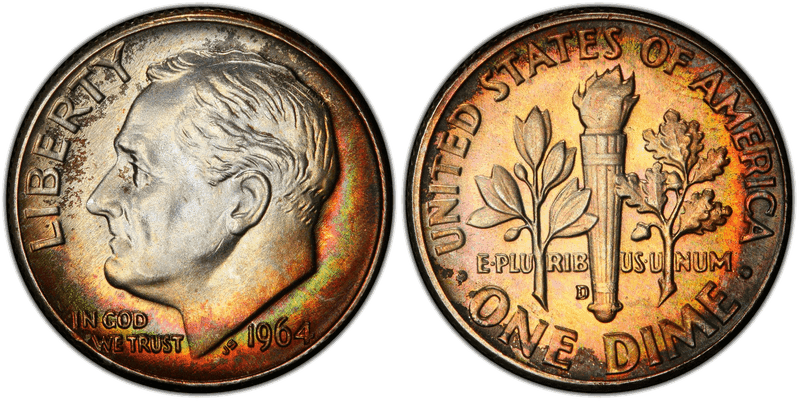
Roosevelt Silver Dimes 1946-1964

Coin Series
Roosevelt Silver Dimes 1946-1964 series coin

About This Series

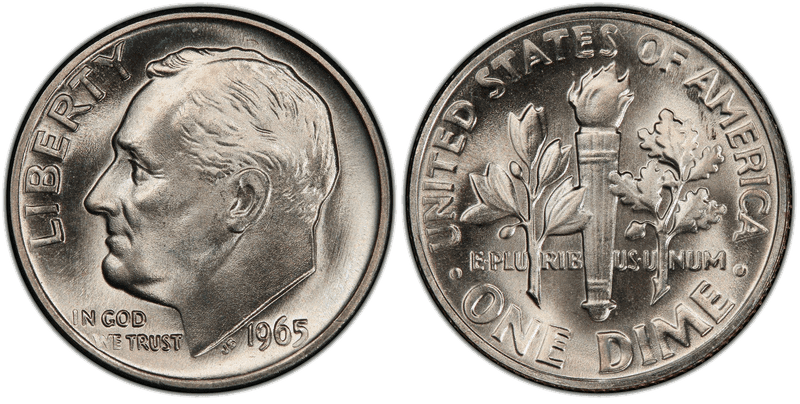
Introduced just months after President Franklin D. Roosevelt's death in April 1945, John R. Sinnock's portrait of FDR made the dime denomination a particularly fitting memorial — Roosevelt's personal connection to the March of Dimes, the charitable organization he helped establish to fight polio, linked the president indelibly to the ten-cent coin in the public imagination. It was released on January 30, 1946, which would have been Roosevelt's 64th birthday. Sinnock's design depicts Roosevelt in profile facing left, with a reverse showing a torch flanked by olive and oak branches symbolizing liberty, peace, and strength. Produced at Philadelphia and Denver throughout, and at San Francisco until early 1955, in 90% silver through 1964, the last year before the Coinage Act of 1965 removed silver from the circulating dime, these dimes represent the last generation of silver coins Americans used in everyday commerce. No individual dates are major rarities — the series is notably egalitarian in availability — but Full Torch (FT) and Full Bands (FB) strike designations create premium tiers for quality-conscious collectors. Struck at 17.9mm and 2.50 grams, billions of Roosevelt silver dimes were produced and remain widely available in circulated grades. The series' primary appeal lies in its historical connection to Roosevelt and its status as the last silver dime type for general circulation.

From NumisDex News

Series Information

Production Years
1946-1964
Designer
John R. Sinnock
Composition
90% Silver, 10% Copper
Weight
2.5g
Diameter
17.9mm
Edge
Reeded

Browse by Base(19 bases)

Showing all 19 listings

History

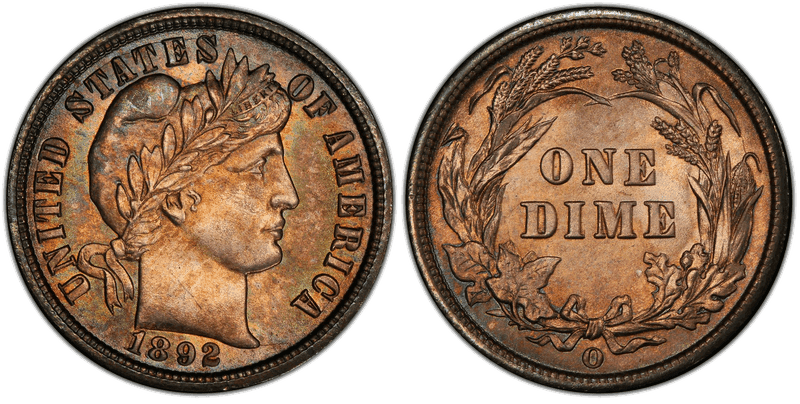
President Roosevelt died on April 12, 1945, and Treasury officials soon proposed putting his portrait on a circulating coin. The dime was the natural choice. Roosevelt was believed to have had polio (CoinWeek notes that recent research points to Guillain-Barré syndrome instead), and the March of Dimes, the fund drive he championed to fight the disease, had already tied his name to the ten-cent coin. An 1890 law also let the Treasury change a design after 25 years without asking Congress, and the Mercury dime had been in use since 1916.

The work went to John R. Sinnock, the Mint's Chief Engraver since 1925. The Commission of Fine Arts turned down his first models and asked for an open competition, but Mint Director Nellie Tayloe Ross refused, because the coin had to be ready for January 30, 1946. That was Roosevelt's birthday and the start of that year's March of Dimes campaign, and the new dime was released that day.

Controversy followed. As Cold War fears grew, a story spread that the JS under Roosevelt's neck stood for Joseph Stalin. It was false; the letters are Sinnock's initials. Others said Sinnock had borrowed his profile from a plaque by the sculptor Selma Burke. CoinWeek, comparing the two, finds them similar but not the same. Sinnock died in May 1947.

Philadelphia, Denver and San Francisco all struck dimes until early 1955, when San Francisco stopped coining after the first three months of the year. From 1956 to 1964 only Philadelphia and Denver made them. Proof dimes, offered only in complete sets from 1950, were struck every year from 1950 to 1964.

Collectors saved new rolls every year, and they hoarded the issues whose mintages were reported as low, such as the 1949-S and the three 1955 dimes. The coin shortage of the 1960s then pushed production to its peak. Congress froze the date at 1964, so about three quarters of Philadelphia's 1964 dimes were made in 1965, and Denver kept striking 1964-dated dimes into 1966. The Coinage Act of 1965 replaced silver with copper-nickel clad.
How to Identify It

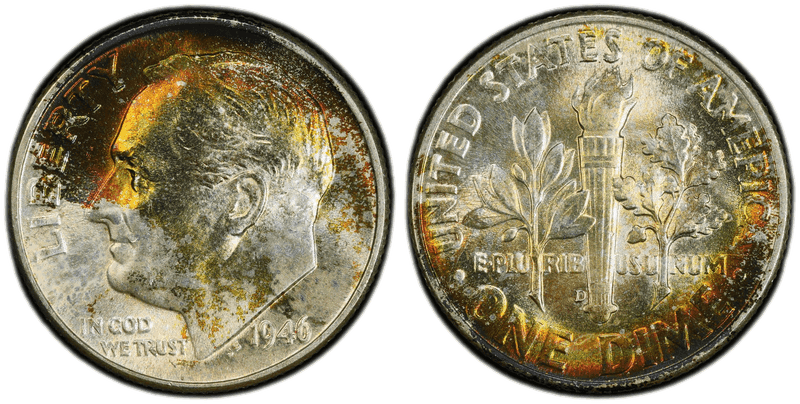
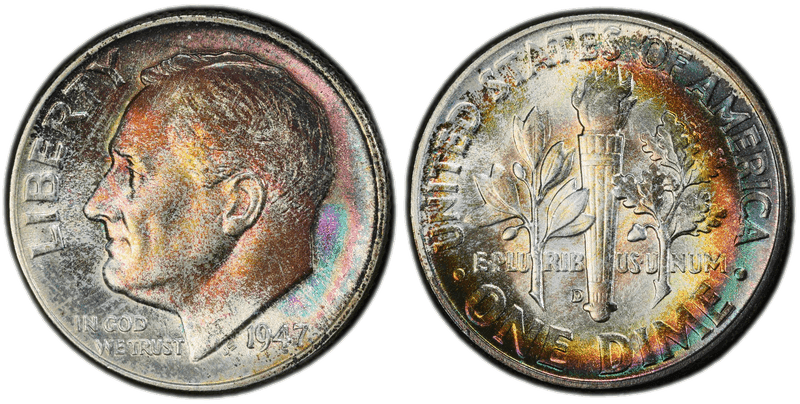
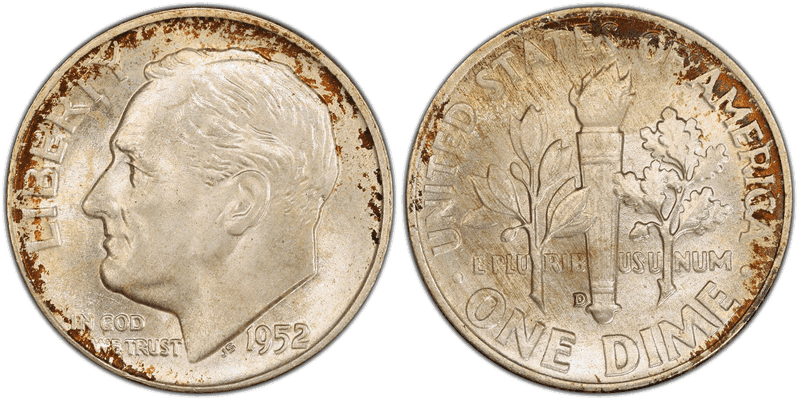
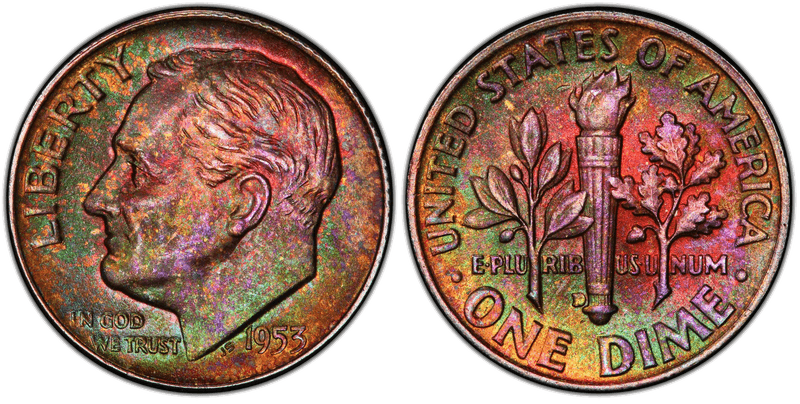
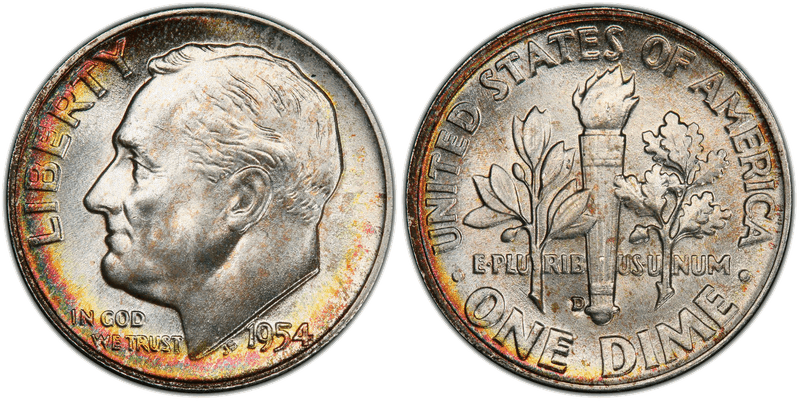
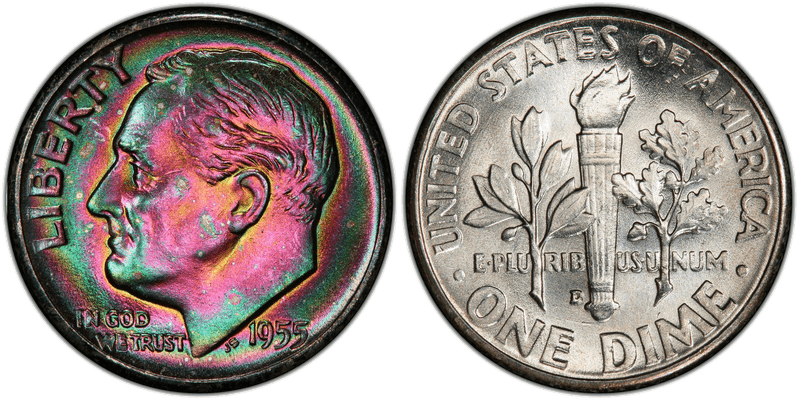
Obverse. Roosevelt faces left. LIBERTY runs along the rim in front of his face, IN GOD WE TRUST sits below his chin, and the date is at the lower right. Sinnock's initials, JS, are just under the neck truncation, left of the date.

Reverse. A flaming torch stands in the center, with an olive branch on the left and an oak branch on the right. The U.S. Mint (search) explains the torch as liberty, the olive branch as peace and the oak branch as strength and independence. E PLURIBUS UNUM is split across the base of the design, and UNITED STATES OF AMERICA and ONE DIME circle the rim.

Mint mark. On the reverse, beside the torch's base on the left, just above the E of ONE. D is Denver and S is San Francisco; Philadelphia used no letter.

Things that cause confusion.

  • Full Torch or Full Bands. Coins graded with this designation show complete separation in both pairs of horizontal bands across the torch. Many San Francisco dimes of the 1940s and 1950s came from worn dies and rarely qualify.
  • Blunt 9 and Pointed 9. Two obverse master dies were used for 1964 dimes: one gives the 9 a short, blunt tail, the other a longer tail ending in a rounded point. Both are normal, and NGC finds that most collectors are not much interested in the difference.
  • Two 1946 obverse hubs. NGC notes that the first 1946 hub left the JS initials blurry. Neither type is rare.
  • Dated 1965 and later. These look the same, but they are clad, carry no mint mark from 1965 to 1967, and show a copper stripe on the edge.

Key Dates and Varieties

  • 1949-S: 13,510,000 struck. Coin World calls it the key to the series. Speculators saved many, but NGC notes most are softly struck.
  • 1955: 12,450,181 struck at Philadelphia, which NGC gives as the smallest figure for any circulating Roosevelt dime. Collectors knew the figure at once and hoarded it. 1955-D (13,959,000) and 1955-S (18,510,000) were saved the same way.
  • 1946 doubled die obverse and 1947-S doubled die reverse: two of the early varieties CoinWeek names as selling for more than the regular coins.
  • 1964-D doubled die reverse: listed as FS-801 in the Cherrypickers' Guide (search) and priced separately by USA Coin Book. NGC calls the huge 1964-D output a cherrypicker's delight.
  • 1950 Proof: 51,386 struck in the first year proofs returned after the war. The 1960 and 1963 proofs are known for doubled dies of their own.
  • 1964 SMS: a rare 1964 dime with a finish like the Special Mint Set coins of 1965. CoinWeek says more research is needed to explain why these exist.

Mintages

Roosevelt Silver Dimes 1946-1964 mintages by year and mint, taken from each coin's page in our catalog. Each figure opens that coin's page, which lists its varieties and errors. A dash means no figure was recorded. Where one issue was struck in more than one type, each type is listed.

Composition and Silver Content

  • Composition: 90% silver, 10% copper
  • Weight: 2.5 grams
  • Silver content: 2.25 grams, or 0.0723 troy ounce
  • Diameter: 17.9 mm
  • Edge: reeded
  • Designer: John R. Sinnock

Every Roosevelt dime dated 1946 through 1964 has these specifications, whether it was struck for circulation or as a proof. Clad dimes from 1965 onward weigh 2.268 grams and contain no silver.

FAQ

Is a 1964 dime silver? Which dimes are silver?

Yes. Every Roosevelt dime dated 1946 through 1964 is 90% silver, including the 1964-dated dimes the Mint kept striking in 1965 and 1966. Dimes dated 1965 and later made for circulation are copper-nickel clad and contain no silver; the exceptions are silver proofs sold to collectors.

Where is the mint mark on a Roosevelt dime?

On silver dimes from 1946 to 1964 it is on the reverse, left of the torch's base, just above the E of ONE. D is Denver and S is San Francisco; Philadelphia dimes have no letter. Dimes of 1965 to 1967 have no mint mark, and from 1968 the letter sits on the obverse, over the date.

What does JS stand for on a dime?

The initials of John R. Sinnock, the Mint's Chief Engraver, who designed the coin. Soon after the dime came out, a rumor claimed JS meant Joseph Stalin and was a secret tribute linked to Roosevelt's meeting with him at Yalta. Coin World says the rumor had no basis in fact.

Why is the 1949-S dime worth more?

San Francisco struck 13,510,000, the second-smallest figure among silver Roosevelt dimes after the 1955 Philadelphia issue, according to NGC. Coin World calls it the key to the series. Speculators saved many, so Mint State coins exist, but NGC notes most are softly struck and Full Torch examples are very scarce.

What is the 1964-D doubled die reverse dime?

It is a 1964-D dime struck from a reverse die that received two slightly misaligned impressions from the hub, so the lettering on the reverse looks doubled. The Cherrypickers' Guide lists it as FS-801 (search), and price guides list it separately from the ordinary 1964-D.

How much silver is in a dime?

A silver Roosevelt dime weighs 2.5 grams and is 90% silver, so it holds 2.25 grams, or 0.0723 troy ounce, of pure silver. Every date from 1946 to 1964 has the same content.

↑ Back to the coins: every year, mint, variety and error

Explore Other Denominations

Collector Essentials

Tools and references for building and protecting your coin collection.

As an Amazon Associate, NumisDex earns from qualifying purchases.