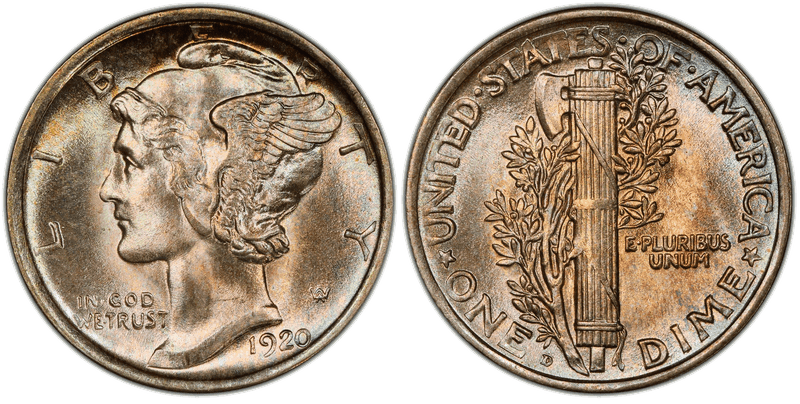
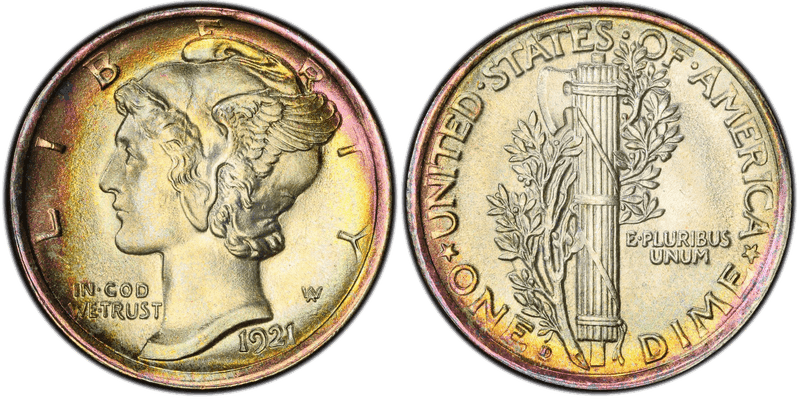
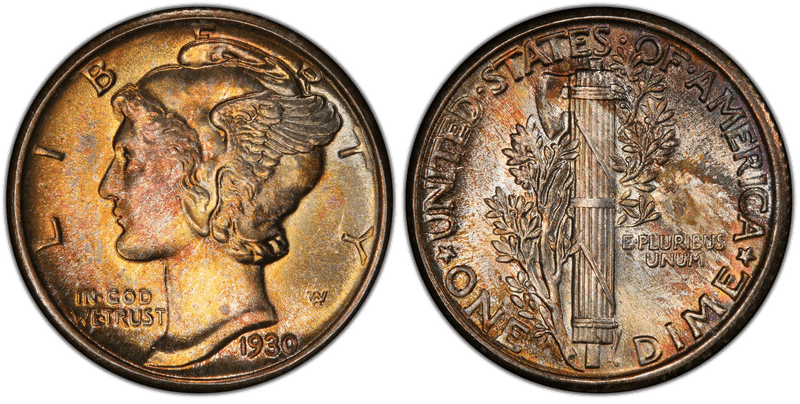
Mercury Dimes 1916-1945

Coin Series
Mercury Dimes 1916-1945 series coin

About This Series

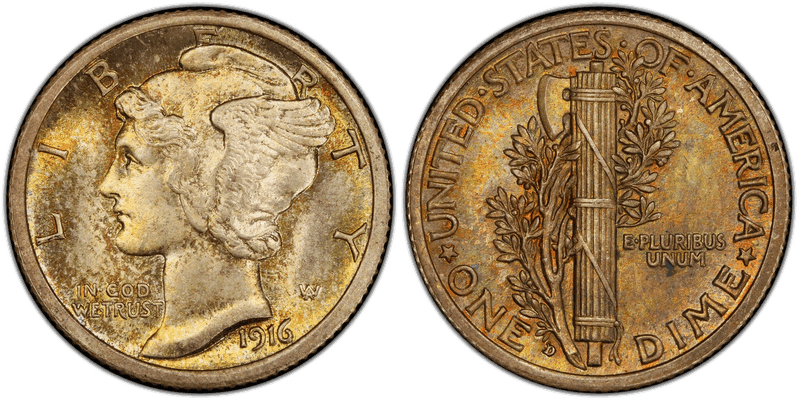
Adolph Weinman's Winged Liberty Head dime — universally known as the "Mercury" dime for Liberty's winged cap's resemblance to the Roman messenger god — ranks among the most artistically acclaimed designs in American coinage. The redesign came because the 25-year minimum term for Barber's 1892 coinage expired in 1916; Weinman's entries were chosen for both the dime and the half dollar, and he intended the wings on Liberty's cap to stand for liberty of thought. The 1916-D anchors the series as its undisputed key date, with only 264,000 struck at Denver, and it is a frequent target of counterfeiters, most often a D added to a 1916 Philadelphia dime. Full Bands (FB) coins, whose central fasces bands are struck fully separated, bring strong premiums. The series spans three decades encompassing both World Wars, the Roaring Twenties, and the Great Depression, with the 1931-D and 1931-S seeing production of just 1.26 and 1.8 million respectively. The Mint struck no quarters, half dollars or silver dollars in 1931, so that year's dimes were the only silver coins it produced, and no dimes were struck in 1932 or 1933. Struck in 90% silver at 2.50 grams, the 17.9mm Mercury dime circulated alongside Weinman's Walking Liberty half dollar, which he designed in the same 1916 competition. The fasces reverse — a bundle of rods symbolizing strength through unity — carried Roman republican imagery that complemented the classical obverse. Collectors pursue Mercury dimes from affordable circulated date sets to the challenging quest for gem-quality Full Bands examples across all dates and mints.

From NumisDex News

Series Information

Production Years
1916-1945
Designer
Adolph Alexander Weinman
Composition
90% Silver, 10% Copper
Weight
2.5g
Diameter
17.9mm
Edge
Reeded

Browse by Base(27 bases)

1916 Mercury Dime
BaseVerified

1916 Mercury Dime

3 Strike Types
3 Error Listings
1917 Mercury Dime
BaseVerified

1917 Mercury Dime

3 Strike Types
1918 Mercury Dime
BaseVerified

1918 Mercury Dime

3 Strike Types
2 Error Listings
1919 Mercury Dime
BaseVerified

1919 Mercury Dime

3 Strike Types
2 Error Listings
1920 Mercury Dime
BaseVerified

1920 Mercury Dime

3 Strike Types
4 Error Listings
1921 Mercury Dime
BaseVerified

1921 Mercury Dime

2 Strike Types
1 Error Listing
1923 Mercury Dime
BaseVerified

1923 Mercury Dime

2 Strike Types
1924 Mercury Dime
BaseVerified

1924 Mercury Dime

3 Strike Types
2 Error Listings
1925 Mercury Dime
BaseVerified

1925 Mercury Dime

3 Strike Types
1926 Mercury Dime
BaseVerified

1926 Mercury Dime

3 Strike Types
6 Error Listings
1927 Mercury Dime
BaseVerified

1927 Mercury Dime

3 Strike Types
1928 Mercury Dime
BaseVerified

1928 Mercury Dime

3 Strike Types
5 Error Listings
1929 Mercury Dime
BaseVerified

1929 Mercury Dime

3 Strike Types
4 Error Listings
1930 Mercury Dime
BaseVerified

1930 Mercury Dime

2 Strike Types
1 Error Listing
1931 Mercury Dime
BaseVerified

1931 Mercury Dime

3 Strike Types
7 Error Listings
1934 Mercury Dime
BaseVerified

1934 Mercury Dime

2 Strike Types
3 Error Listings
1935 Mercury Dime
BaseVerified

1935 Mercury Dime

3 Strike Types
9 Error Listings
1936 Mercury Dime
BaseVerified

1936 Mercury Dime

4 Strike Types
45 Error Listings
1937 Mercury Dime
BaseVerified

1937 Mercury Dime

4 Strike Types
23 Error Listings
1938 Mercury Dime
BaseVerified

1938 Mercury Dime

4 Strike Types
5 Error Listings
1939 Mercury Dime
BaseVerified

1939 Mercury Dime

4 Strike Types
22 Error Listings
1940 Mercury Dime
BaseVerified

1940 Mercury Dime

4 Strike Types
64 Error Listings
1941 Mercury Dime
BaseVerified

1941 Mercury Dime

4 Strike Types
28 Error Listings
1942 Mercury Dime
BaseVerified

1942 Mercury Dime

6 Strike Types
39 Error Listings
1943 Mercury Dime
BaseVerified

1943 Mercury Dime

3 Strike Types
24 Error Listings
1944 Mercury Dime
BaseVerified

1944 Mercury Dime

3 Strike Types
24 Error Listings
1945 Mercury Dime
BaseVerified

1945 Mercury Dime

4 Strike Types
50 Error Listings
Showing all 27 listings

History

The Mint Act of 1890 let the Treasury replace a coin design once it had been in use for 25 years, and Charles Barber's dime, quarter and half dollar reached that mark in 1916. Mint Director Robert W. Woolley went outside the Mint for new designs. Adolph A. Weinman, a former student of Augustus Saint-Gaudens, won both the dime and the half dollar, while Hermon MacNeil designed the quarter.

The new dime did not arrive smoothly. Designs from outside sculptors usually needed reworking before they would strike well, and while that work dragged on, the country still needed dimes. Philadelphia and San Francisco struck Barber dimes dated 1916 before Weinman's coins reached circulation in late October 1916. The public liked them at once and saved many of the first year's coins.

Production rose and fell with the economy. A recession that began late in 1920 cut demand so sharply that Philadelphia and Denver together struck only about 2.3 million dimes in 1921, and Denver made no more until 1924. The Depression did the same in 1930 and 1931, and many of those coins sat in Mint vaults until 1934 and 1935. No dimes at all are dated 1922, 1932 or 1933. Proof dimes returned in 1936 for the first time since 1915 and were struck each year through 1942. Wartime demand then pushed mintages past 200 million at Philadelphia alone. The Roosevelt dime replaced the design in 1946.
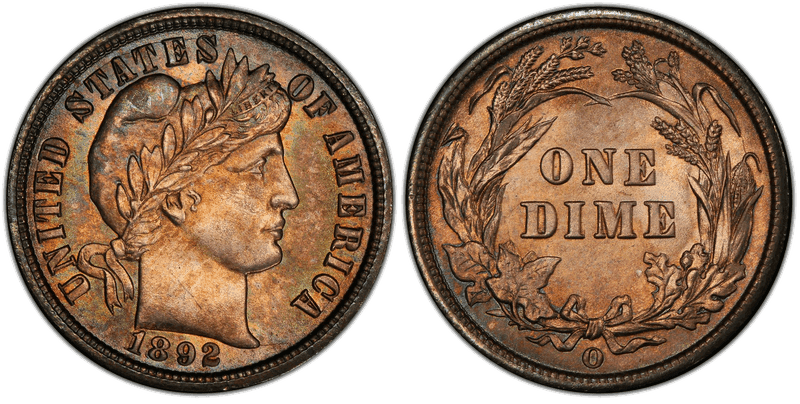
How to Identify It

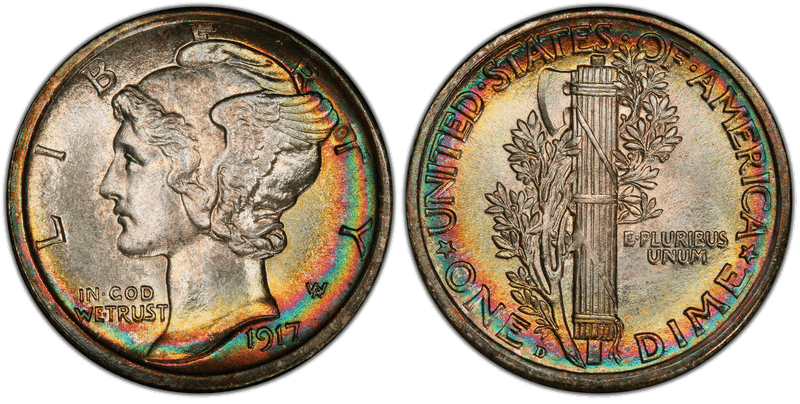
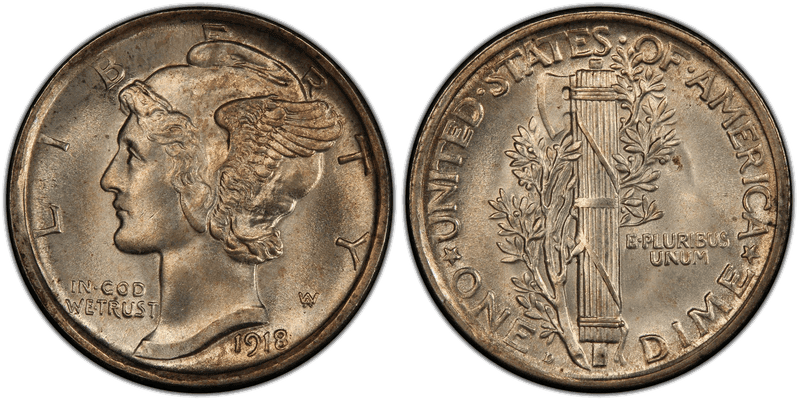
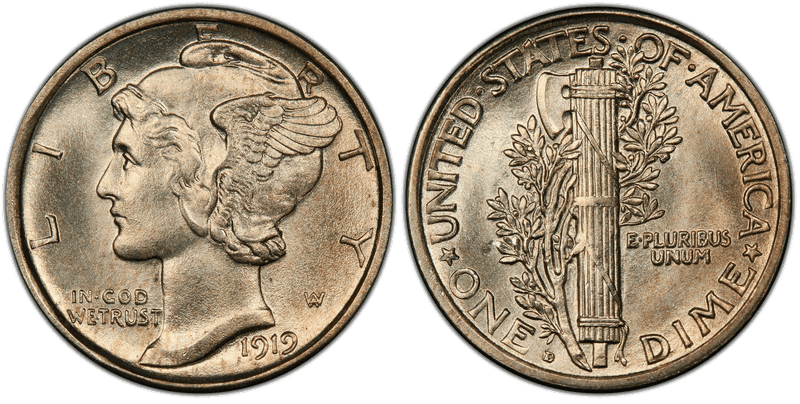
Obverse. A young Liberty faces left, wearing a Phrygian cap with a small wing at its side. LIBERTY runs around the top, IN GOD WE TRUST sits in front of her neck, and the date is at the lower right. Weinman's monogram, AW, is between the Y of LIBERTY and the date. The cap and wings were meant to stand for freedom of thought, not for Mercury, whose hat looks quite different.

Reverse. A fasces, a bundle of rods around an axe, stands upright with an olive branch wrapped around it. The rods stand for strength through unity, the axe for authority, and the olive branch for peace. UNITED STATES OF AMERICA arcs above, E PLURIBUS UNUM is to the right, and ONE DIME is at the bottom. The fasces later became the emblem of the Italian Fascist party, which Weinman's 1916 design had nothing to do with.

Mint mark. Look at the lower left of the reverse, just inside the rim, beside the bottom of the fasces where the olive branch ends. D is Denver and S is San Francisco. Philadelphia used no letter.

Full Bands. The bands tying the rods are the highest point on the reverse, so they are often flat. A coin graded with the Full Bands (FB) designation has those bands fully separated. NGC asks for a full split, with a recessed line, between the two central bands, plus separation in the upper and lower groups. PCGS (search) judges the central bands, wants no break in the split from strike or damage, and does not need them rounded; it generally gives FB only to Mint State coins, with exceptions for the 1916-D and the two 1942 overdates. FB coins sell at a premium, but NGC points out that other parts of the design can still be weak on a coin with full bands.

Key Dates and Varieties

  • 1916-D: 264,000 struck. Denver had just begun the new dimes when it was ordered to switch to quarters for the rest of the year. First-year hoarding left enough worn coins to go around, but counterfeiters target it constantly: a D added to a 1916 Philadelphia dime is the classic fake, and NGC says professional authentication is a must.
  • 1921: 1,230,000 struck. The 1921 numerals have a distinctive shape, with both 1s bowed and broad-based and an open 9, which helps expose 1941 dimes altered to read 1921.
  • 1921-D: 1,080,000 struck, all early in the year. NGC finds it noticeably scarcer than the Philadelphia coin, and gems are quite rare.
  • 1926-S: 1,520,000 struck. Very scarce from Fine upward, and few Mint State pieces have full bands.
  • 1931-D and 1931-S: 1,260,000 and 1,800,000 struck. Many did not leave the Mint until 1934 and 1935, so Mint State rolls were saved. The 1931-S is rarely found with full bands.
  • 1942/1: one Philadelphia obverse die was hubbed once from a 1941 hub and once from a 1942 hub, so a 1 shows under the 2. It was announced in 1943, but the coins had already gone into circulation, and gems are rare.
  • 1942/1-D: a second die made the same way went to Denver. It was not reported until 1960, and the 41 underneath is less distinct than on the Philadelphia coin.
  • 1945-S Micro S: several 1945-S reverse dies took a tiny S punch made in 1907 for Philippine coins struck at San Francisco. It is not rare, but it is very popular, and NGC calls Full Bands examples exceedingly rare.
  • 1936 Proof: 4,130 struck, the first proofs since 1915. Proof output grew each year to 22,329 in 1942, the last until 1950.

Mintages

Mercury Dimes 1916-1945 mintages by year and mint, taken from each coin's page in our catalog. Each figure opens that coin's page, which lists its varieties and errors. A dash means no figure was recorded. Where one issue was struck in more than one type, each type is listed.

Composition and Silver Content

  • Composition: 90% silver, 10% copper
  • Weight: 2.5 grams
  • Actual silver weight: 0.0723 troy ounce
  • Diameter: 17.9 mm (NGC lists 17.8 mm)
  • Edge: reeded

These specifications did not change from 1916 to 1945, so every Mercury dime holds the same 0.0723 ounce of silver whatever its date or mint.

FAQ

Who is on the Mercury dime?

Not Mercury. The head is Liberty wearing a Phrygian cap with small wings, which Adolph Weinman used as a symbol of freedom of thought. CoinWeek reports that his model was Elsie Stevens, wife of the poet Wallace Stevens. The wings made the public think of the Roman messenger god, and the nickname stuck; the official name is the Winged Liberty Head dime.

Where is the mint mark on a Mercury dime?

On the reverse, low on the left, near the rim beside the base of the fasces where the olive branch ends. A D means Denver and an S means San Francisco. Philadelphia dimes carry no mint mark.

What are the Mercury dime key dates?

The 1916-D (264,000 struck) is the key. The 1921 (1,230,000) and 1921-D (1,080,000) follow, then the Depression-era 1931-D and 1931-S and the 1926-S. The two overdates, 1942/1 and 1942/1-D, are the most sought-after varieties.

What does Full Bands mean on a Mercury dime?

It means the horizontal bands tying the rods of the fasces on the reverse are struck up completely. NGC requires the two central bands to be fully separated with a recessed line between them, and the upper and lower band groups to show separation too. PCGS (search) looks at the central bands, wants an unbroken split, and does not require the bands to be rounded.

How much silver is in a Mercury dime?

Every Mercury dime is 90% silver and weighs 2.5 grams, so it holds 0.0723 troy ounce of pure silver. That figure is the same for all dates and mints from 1916 to 1945.

Why is the 1916-D Mercury dime so valuable?

Denver struck only 264,000 before it was told to switch to quarter dollars for the rest of the year. Worn examples are not hard to find, but demand is huge, and NGC warns that adding a D to a 1916 Philadelphia dime has been a long-running fake, so buy only authenticated coins.

↑ Back to the coins: every year, mint, variety and error

Explore Other Denominations

Collector Essentials

Tools and references for building and protecting your coin collection.

As an Amazon Associate, NumisDex earns from qualifying purchases.